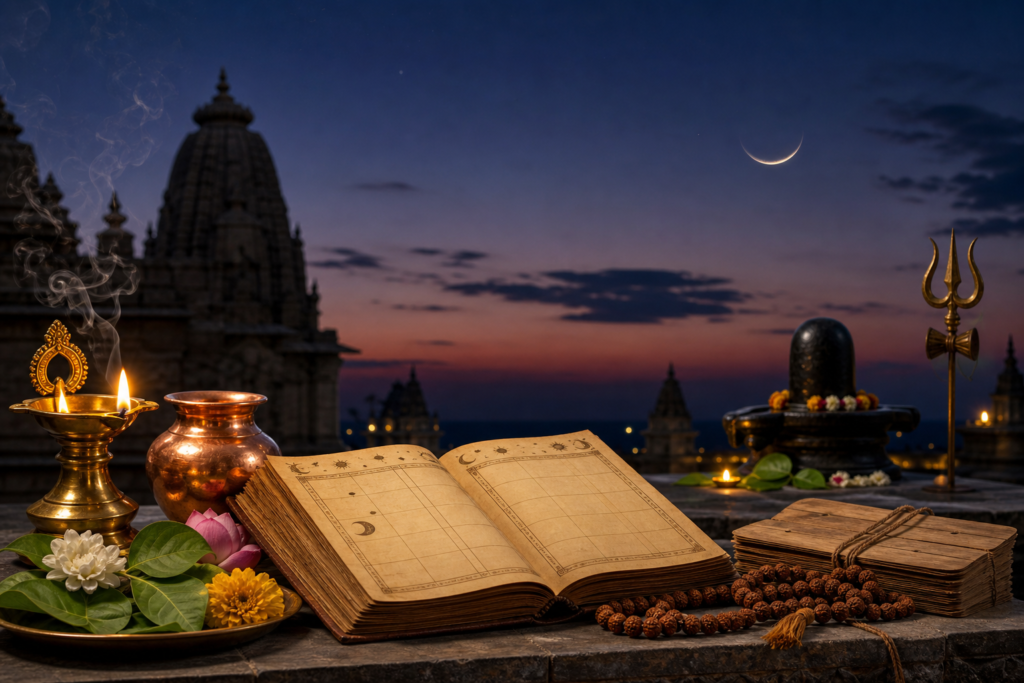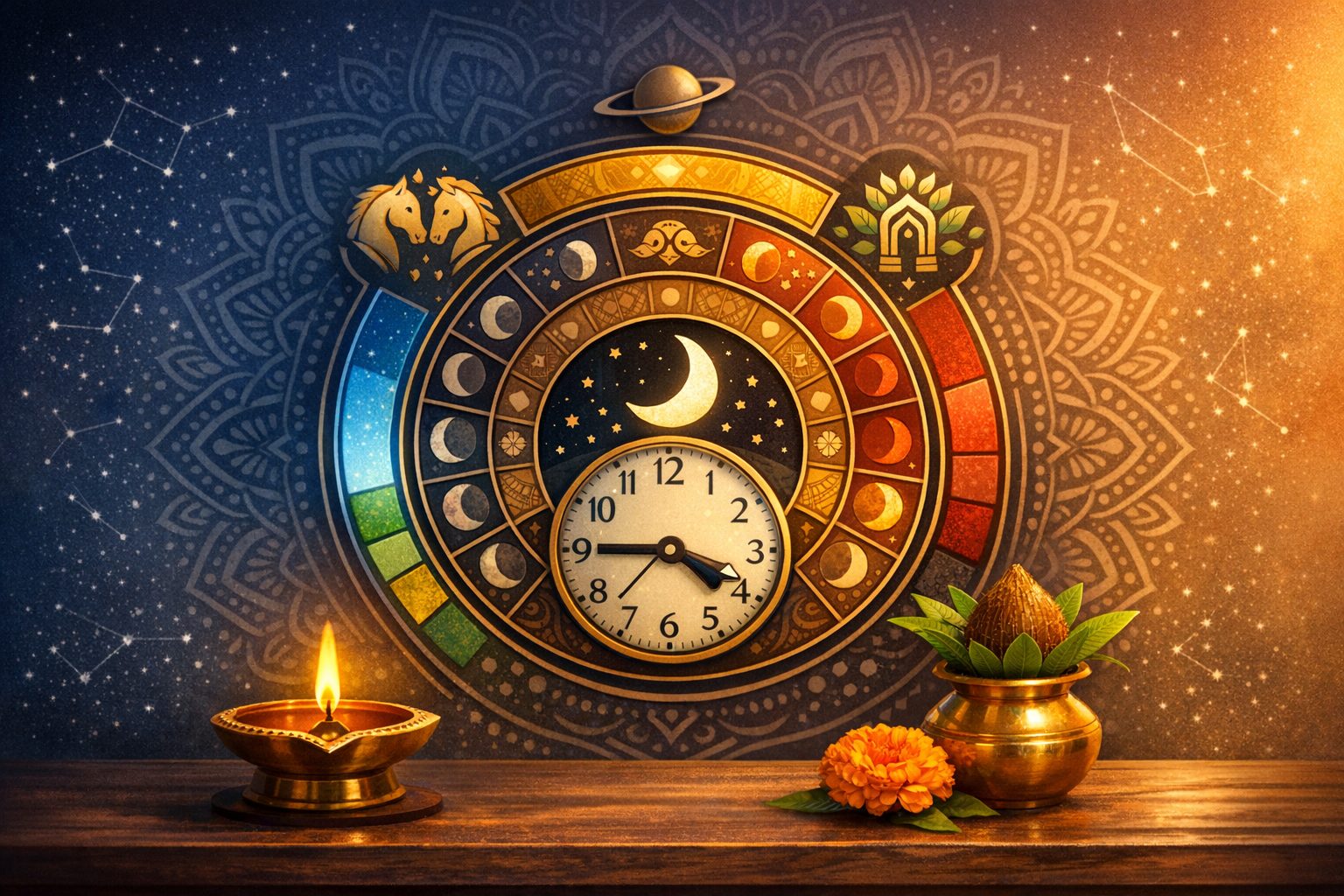
Saturday, March 21, 2026, falls in the waxing half of the lunar month as per the Hindu calendar (Panchang). In most Indian regions, it is Shukla Paksha Dwitiya until 03:47 (local almanacs typically publish times in IST); from that moment onward, the day proceeds as Shukla Paksha Tritiya. This sequence places the Gregorian date squarely within the auspicious light phase of the Moon, a period associated with commencement, growth, and steady progress in many Panchang-based traditions.
Precisely stated: Shukla Paksha Dwitiya tithi prevails until 03:47 on March 21. After 03:47, Shukla Paksha Tritiya begins and governs the day thereafter in most regions. Minor differences may appear across Panchangs due to calculation methods, local longitude and latitude, and the ayanāṁśa adopted for sidereal positions.
Technically, a tithi measures the angular elongation between the Moon and the Sun in 12-degree segments along the ecliptic. Dwitiya corresponds to the interval when the elongation is greater than 12 degrees and up to 24 degrees; Tritiya begins as soon as the elongation surpasses 24 degrees. The 03:47 transition marks the crossing of this 24-degree boundary. Because the Moon’s motion is non-uniform, an individual tithi can last anywhere between roughly 19 and 26 hours; hence the necessity of consulting a calibrated Panchang for exact start and end times.
Month naming conventions differ regionally. In the purnimanta system (common in much of North India), month names roll over at full moon, whereas in the amanta system (prevalent in many parts of South India), they roll over at new moon. As a result, the same Gregorian date may be referenced under different lunar month names across regions, even though the tithi and its qualities remain the same.
From a muhurta perspective, Shukla Paksha Tritiya is traditionally considered favorable for initiating learning, devotional practices, and household tasks that benefit from sustained momentum. When Tritiya begins before or near sunrise, many families experience the day as naturally conducive to intention-setting and calm, purposeful activity. In practice, the most effective way to leverage the day’s auspiciousness is to combine tithi with location-aware “good time” windows.
Abhijit Muhurta is widely valued as a neutral-to-auspicious midday interval. It is centered on local solar noon (the moment when the Sun culminates on the local meridian) and typically spans about 48 minutes in total. To approximate it: determine local sunrise and sunset, find the midpoint (local solar noon), and consider roughly 24 minutes before and after that midpoint as Abhijit Muhurta. This interval is frequently used when other suitable windows are not available.
Brahma Muhurtathe pre-dawn period ending just before sunriseis highly regarded for meditation (dhyāna), japa, and study. It begins approximately 1 hour 36 minutes before local sunrise and extends until about 48 minutes before sunrise. On a Tritiya day, spiritual practice during Brahma Muhurta harmonizes the mind with the waxing lunar energy that, in traditional understanding, supports clarity, receptivity, and steady growth.
Rahu Kaal, Yamaganda, and Gulikai are cautionary segments derived by dividing the daylight (sunrise to sunset) into eight equal parts. Their positions vary by weekday and by the local length of daytime. For precise use, compute the total duration from sunrise to sunset at one’s location, divide by eight, and then assign the segments according to established weekday sequences provided in regional almanacs. These periods are commonly avoided for beginning brand-new undertakings; however, routine, ongoing tasks usually proceed unaffected.
Choghadiya (more common in Western and Northern India) offers another practical day-planning lens by segmenting the day and night into time blocks labeled as auspicious or inauspicious (such as Amrit, Shubh, Laabh, Chal, Udveg, Kaal, Rog). As with Rahu Kaal, Choghadiya blocks depend on local sunrise and sunset and change daily. When Shukla Paksha Tritiya is in effect, many practitioners prefer aligning key actions with Amrit, Shubh, or Laabh blocks to complement the tithi’s inherently favorable character.
Nakshatra and Rashi for this Gregorian date depend on the Moon’s sidereal longitude at the observer’s location and the tithi transition time. With the Sun in Meena Rashi around this part of the solar year, the Moon in the early waxing phase commonly moves from late Meena through Mesha, traversing nakshatras such as Revati, Ashwini, and Bharani. Many Panchangs for March 21, 2026, will therefore show Ashwini or Bharani during the daytime hours, but exact results vary by region and calculation method. Ashwini is associated with swiftness, healing initiative, and clean beginnings; Bharani signifies disciplined transformation, responsibility, and the power to sustain commitmentsboth complement Shukla Paksha Tritiya’s constructive momentum.
Saturday (governed by Shani in classical Jyotiṣa) emphasises steadiness, accountability, and thoughtful pacing. Combining Saturday’s contemplative tone with Shukla Paksha Tritiya’s growth orientation yields a balanced environment for methodical starts, documentation, budgeting, and carefully planned learning or devotional routines. When urgency is low, many observant households favor structured, incremental progress over dramatic, high-risk undertakings on such a day.
In practical home and temple settings, Shukla Paksha Tritiya is often selected for Lakshmi–Gauri worship, simple archana, or vrata-related reading and recitation. For family activities, it is a supportive day for organizing study schedules, refreshing domestic altars, and beginning modest projects that benefit from consistency rather than haste. Where traditions encourage daana (charitable giving), small acts of service align well with the day’s sattvic inclination.
Beyond tithi and nakshatra, two additional Panchang elementsKarana and Yogarefine muhurta selection. A Karana is half a tithi (six degrees of lunar elongation), and a Yoga is computed by summing the sidereal longitudes of the Sun and the Moon and mapping the result to 27 segments. Because these values shift with time and place, authoritative Panchangs list them alongside tithi and nakshatra. When available, choosing a time where the operative Karana and Yoga are supportive adds another layer of precision to planning.
Differences across almanacs arise chiefly from computational frameworks. Traditional siddhānta-based Panchangs (e.g., Sūrya Siddhānta methods) and modern drik (observational/ephemeris-based) Panchangs can diverge by minutes in phenomena such as tithi endings, nakshatra transitions, or moonrise. Ayanāṁśa selection (for example, Lahiri/Chitra) and local coordinates further influence the displayed results. These methodological nuances explain why two reputable Panchangs may list slightly different times for the same event while remaining internally consistent.
In a broader dharmic context, lunisolar observances foster shared rhythms across Hinduism, Buddhism (especially in communities where lunar observance days are kept), Jainism, and many Sikh households that respect regional festival timings. While specific doctrines differ, the calendar’s cadencenew beginnings in Shukla Paksha, inward rest in Krishna Pakshaencourages unity in mindful living, service, and contemplative practice. The Panchang thus serves as a common civilizational thread, inviting mutual respect and harmony across dharmic traditions.
Summary for planning: On Saturday, March 21, 2026, Shukla Paksha Dwitiya continues until 03:47, after which Shukla Paksha Tritiya governs most of the day in most regions. Aligning important tasks with Abhijit Muhurta (centered on local solar noon), Brahma Muhurta (pre-dawn), and favorable Choghadiya segments provides practical, time-tested guidance. Where possible, avoid initiating brand-new undertakings during locally computed Rahu Kaal and Yamaganda, and apply Karana and Yoga filters when an authoritative Panchang provides them. With Saturday’s measured tone and Tritiya’s forward movement, the day rewards thoughtful beginnings anchored in discipline and devotion.
Inspired by this post on Hindu Blog.