Chaitra Navratri, also known as Vasant Navratri, inaugurates the Hindu lunar year in the bright fortnight of Chaitra and culminates in Sri Rama Navami. Across Indiaand especially in Maharashtra and Gujaratdevotees observe a cherished colour tradition by wearing a distinct hue each day to honor the Navadurga. This guide presents the widely followed Chaitra Navratri Colours 2026 sequence, the symbolism behind each shade, and practical dressing ideas for women and men, while acknowledging regional variations that reflect the rich diversity of dharmic practice.
Dates for Chaitra Navratri 2026 are expected around 19–27 March 2026, with Ghatasthapana (Kalash Sthapana) anticipated on Thursday, 19 March 2026, and Sri Rama Navami likely on Friday, 27 March 2026, as per most Indian Panchangs. Observance may shift by a day depending on locale, sunrise, and the calculation followed (e.g., Amanta or Purnimanta calendars). Consultation of a trusted regional Panchang, temple bulletin, or priest is always recommended for precision.
The nine colours are not merely aesthetic choices; they encode a multilayered symbolism drawing from planetary associations (saptavāra), the guṇas, and the attributes of the Navadurga. In Maharashtra and Gujarat, this palette has become a vibrant expression of collective sādhanāwomen often select sarees or salwar suits in the day’s colour, while men and children increasingly participate with kurtas, dupattas, stoles, or wrist threads. The practice supports mindful devotion, social cohesion, and a living appreciation of dharmic aesthetics.
Day 1 (Shukla Pratipada, Shailaputri) Yellow. With Ghatasthapana expected on a Thursday, the 2026 sequence begins with Yellow, a colour aligned with Guru (Jupiter) and knowledge. It signifies auspicious beginnings, clarity, and optimism. Sarees, kurtas, or scarves in mustard or sunflower tones are suitable. This day honors Shailaputri, the grounding aspect of Devi; devotees often emphasize stability and intention-setting in their prayers.
Day 2 (Brahmacharini) Green. Associated with growth, renewal, and the harmonizing influence of Shukra when observed on Friday, Green invites steady perseverancethe very discipline that defines Brahmacharini. Cotton weaves, handloom salwars, or simple linen kurtas in leaf, mehendi, or emerald hues are ideal. Those who prefer the deity-specific convention may also incorporate White accessories, a colour commonly linked with Brahmacharini’s tapas.
Day 3 (Chandraghanta) Grey. On a Saturday, Grey pays homage to Shani’s sobriety, balance, and protection, aligning with Chandraghanta’s call to cultivate courage with composure. Grey can be paired with metallic borders or subtle zari to suggest inner strength. This balanced, neutral tone is appreciated by office-goers who wish to participate within professional dress codes.
Day 4 (Kushmanda) Orange. Sunday’s Orange reflects Surya’s life-giving radiance and vitality, resonating with Kushmandathe creative, cosmic energizer. Shades from saffron to deep marigold are appropriate. Devotees often highlight seva, warm-heartedness, and generosity on this day.
Day 5 (Skandamata) White. Aligned with Chandra’s serenity on a Monday, White expresses purity, maternal grace, and peaceattributes celebrated in Skandamata. Khadi, mulmul, or chanderi in white or off-white works well; embellishment with pearl jewelry or silver accents retains the day’s sattvic mood.
Day 6 (Katyayani) Red. Mars-ruled Tuesday supports Red for courage, resolve, and righteous action, qualities that mirror Katyayani’s shakti. Crimson, sindoor, or ruby tones are favored. Many devotees choose a minimalist silhouette, letting the colour itself foreground the day’s fierce, protective energy.
Day 7 (Kalaratri) Royal Blue. On Wednesday, Royal Blue honors Budha’s discerning intelligence and, in practice, communicates steadfast protection for Kalaratri’s transformative aspect. Those adhering to deity-linked palettes may prefer very dark hues for Kalaratri; the Maharashtra–Gujarat rotation, however, commonly uses Royal Blue here. Traditional or contemporary wear with minimal prints helps the tone remain central.
Day 8 (Mahagauri, Ashtami) Pink. Often observed as Durga Ashtami, Pink signifies compassion, tenderness, and the rejuvenating blessings of Mahagauri. From baby pink to rose, softer tones are generally selected, though stronger rani shades are also seen. Families frequently plan collective pūjā or kanya-pūjā on this day, reflecting communal harmony and care.
Day 9 (Siddhidatri, Navami) Purple. Purple suggests insight, blessing, and the integrative siddhi conferred by Siddhidatri. It is a contemplative, yet celebratory close to Vasant Navratri, just ahead of Sri Rama Navami. Devotees often combine purple with gold or silver borders to symbolize completeness and gratitude.
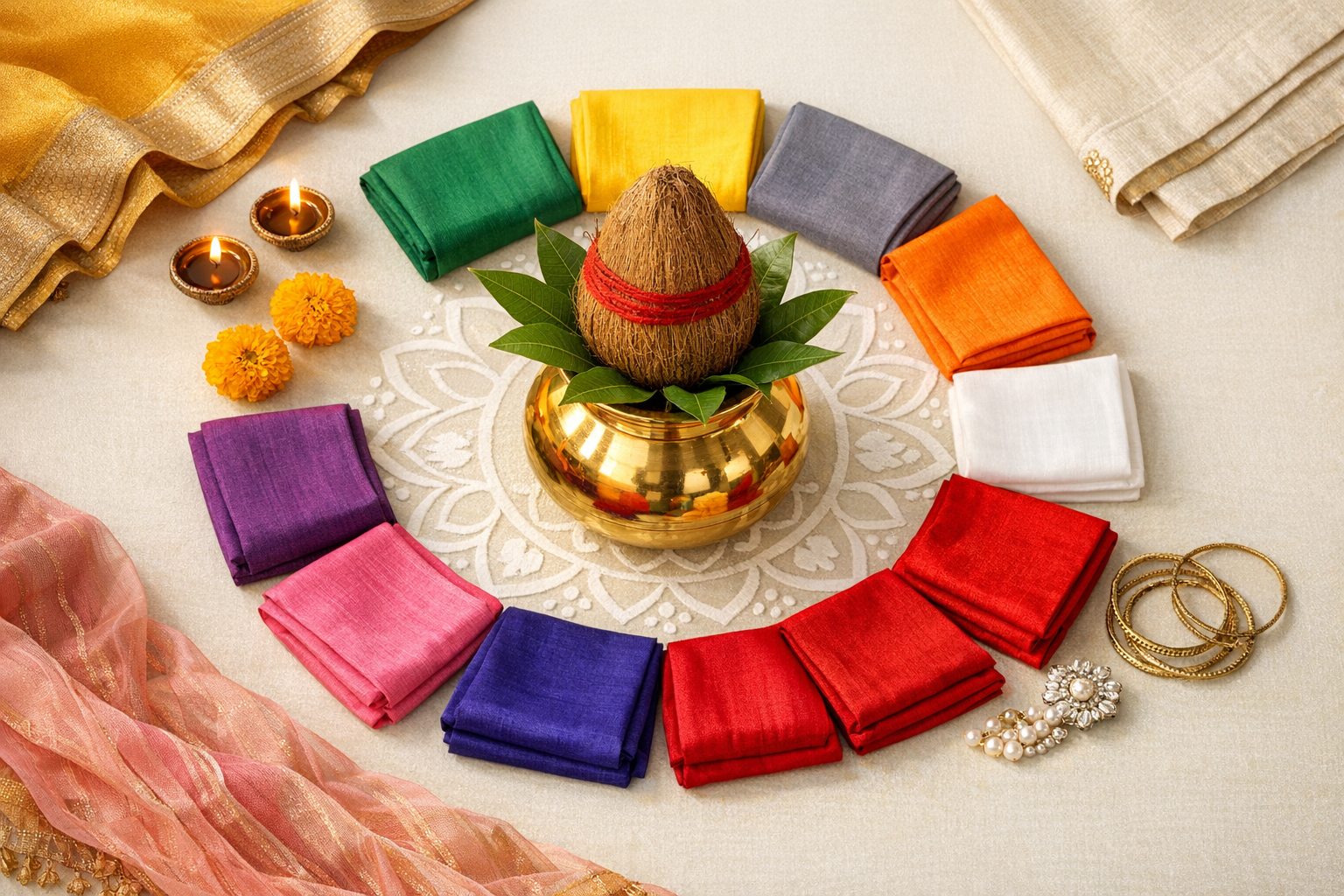
Quick reference for Chaitra Navratri Colours 2026, as commonly circulated in Maharashtra and Gujarat given a Thursday Ghatasthapana: Yellow, Green, Grey, Orange, White, Red, Royal Blue, Pink, Purple. Where local calculations shift Ghatasthapana by a day, most communities simply roll the same nine-colour sequence forward in step with the observed start date.
Regional practice varies. Some traditions tie colours directly to the Navadurga (for example, White for Brahmacharini or deep hues for Kalaratri), while Maharashtra–Gujarat communities typically anchor the nine-day sequence to the weekday of Ghatasthapana and proceed through a standard palette. Both approaches are dharmically coherent; the unifying principle is bhāvadevotional intention aligned with local sampradāya.
Ghatasthapana muhurta guidance remains consistent: it is generally performed in the first one-third of the day while Pratipada tithi prevails, avoiding Vaidhriti and Vyatipata yogas where possible, and with many seeking to avoid Chitra Nakshatra. A clean altar, sanctified kalasha with mango or betel leaves and coconut, and the invocation of Durga with simple mantras and the pañcopacāra or ṣoḍaśopacāra protocol are sufficient for home worship. Daily āratī, japa, and a short reading from texts such as the Durga Saptashati or Devī Māhātmya deepen the observance.
Attire ideas for families balance devotion with practicality. Women often prefer sarees, salwar suits, or lehengas in the day’s colour; men may opt for kurtas, Nehru jackets, or pocket squares; children can participate with hairbands, bangles, scarves, or badges. Where uniforms or professional codes apply, small accentsa dupatta, wristband, or stolecarry the observance respectfully.
A sustainable approach enhances the sanctity of practice. Re-wearing trusted garments, borrowing or swapping within family circles, favoring handloom weaves, and choosing naturally dyed textiles not only honor dharma’s ethos of restraint and gratitude but also reduce environmental footprints. Modest accessories can refresh familiar attire without encouraging unnecessary consumption.
The colour tradition also resonates with the shared civilizational vocabulary of dharmic paths. The values signifiedcompassion (Pink), knowledge (Yellow), discipline (Green), serenity (White), courage (Red), and protective wisdom (Royal Blue/Purple)speak across Hindu, Buddhist, Jain, and Sikh communities, each of which venerates ethical cultivation and inner transformation. Emphasizing these common virtues during Navratri strengthens mutual respect and unity.
In sum, Chaitra Navratri Colours 2026 present a meaningful, community-affirming practice: Yellow, Green, Grey, Orange, White, Red, Royal Blue, Pink, and Purple, proceeding from a Thursday Ghatasthapana in most Panchangs. As always, local calendars and temple advisories take precedence. The spirit of the observancedevotion, inclusivity, and careremains the guiding light, culminating in the joyous celebration of Sri Rama Navami.
Inspired by this post on Hindu Pad.