George Annesley, 2nd Earl of Mountnorrisbetter known as Viscount Valentiawas born on 4 December 1770 into an Anglo-Irish aristocratic lineage that traced back to Francis Annesley, elevated to the Barony in 1628 and later the 1st Viscount Valentia in 1642. His life and writings illuminate, with unusual candor, the intellectual and moral architecture of British Colonialism during its rapid expansion.
Educated at Brasenose College, Oxford, Valentia left without a degree in 1789. In 1796 he became enmeshed in a sensational public scandal when he charged John Bellendon Gawler with criminal conversation involving his wife, Anne. The proceedingspublished as The Genuine Trial of John B. Gawler, Esq. for Criminal Conversation with the Right Hon. Lady Valentiaexposed the period’s moral hypocrisies; legal separation followed, and later reports suggested that George himself had facilitated the liaison. The episode, and the cultural climate it revealed, formed a vivid prelude to the worldview evident in his later travels.
Valentia fashioned a public career as Fellow of the Society of Antiquaries, Fellow of the Royal Society, Privy Counsellor to Ireland, and Member of Parliament for Yarmouth from 1808 to 1810. He died on 23 July 1844, and with no male heir, the Earldom of Mountnorris became extinct.
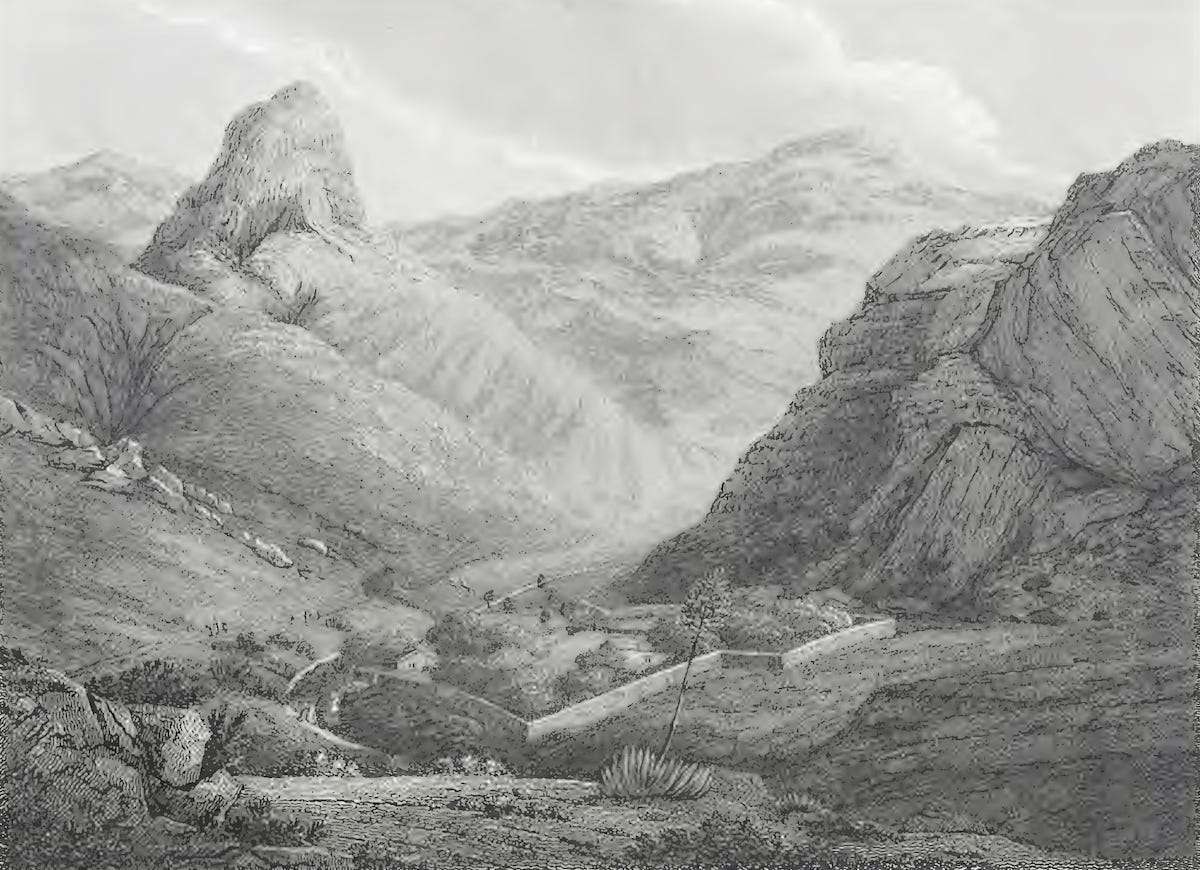
His Voyages and Travels project a portrait of relentless activityzest, learning, curiosity, and political calculation intertwining with the expanding ambitions of the British Empire. Departing from the Downs, the Minerva touched Madeira (then a Portuguese colony), moved along Cape Palmas, and halted at St. Helena before proceeding to the Cape of Good Hopethe maritime gateway that, since the time of the Portuguese navigator Vasco da Gama, linked Europe’s imperial commerce to India and beyond.
At each port, Valentia’s gaze is utilitarian and extractive: people, produce, and place are measured by their value to a burgeoning imperial system. St. Helena, in particular, drew his strategic attention. He worried about its maintenance costs to the East India Company and the inadequacy of its garrison, urging stronger fortifications to prevent a catastrophic loss. This anxious calculus exemplifies a broader imperial habit: sustained control through vigilance bordering on paranoiaa mindset that repeatedly fueled coercive responses to dissent across colonial geographies.
Valentia was also an unvarnished advocate of colonial slavery, articulating religious and administrative justifications that reflect the era’s dominant European ideologies. On St. Helena’s slave regime, he wrote: “It is with the highest degree of approbation that I must speak of the slave-laws of St. Helena. I am sorry, however, to observe that, prior to the time of Colonel Patton, many of the regulations have been evaded, and others openly violated. With an attention to their morals highly proper in a Christian country, it was positively ordered that the slaves should receive religious instruction, and that they should be obliged to marry. The former has been neglected; and of a compliance with the latter, I believe there has not been a single instance for the last fifteen years. It was also ordered, that no person should be at liberty to emancipate a slave, without giving security to the Company…Yet for some time it has been customary to emancipate slaves without this security…and these people are now, in their old age, living at the expense of the Company…These crimes can be attributed only to the want of moral instruction. I have no doubt that the slave of St. Helena, were he properly taught, would soon become a valuable member of society.”
This passage lays bare the moral grammar of imperial paternalism: enslavement reframed as tutelage, religious conversion as civilizational uplift, and human bondage rationalized as a pathway to “value” within the colonial order. Such claims aligned closely with broader British Empire narratives that conflated dominance with benevolence.
Valentia extended these arguments to the political sphere when reflecting on the Battle of Plassey and the consolidation of British rule in Bengal. He observed: “My next changing-place was at the magnificent tope of Plassey, a place celebrated in history for the victory obtained by Lord Clive…From that period we may be considered as masters of Bengal, and to that victory we in fact owe the vast empire we now possess. By what right we concluded a treaty with a traitor to depose his sovereign…is not now to be determined: and those who might have felt repugnance at executing such a business, will still rejoice at the prosperity which it acquired and secured to their country. But not only to England has it been fortunate: the original inhabitants, the Hindoos…have equal reason to rejoice…what is almost as great a blessing, the horrors of war have been far removed from their peaceable abodes.”
Here, the familiar logic surfaces again: moral ambiguities are acknowledged only to be subsumed within the narrative of imperial “prosperity,” while the lived realities of Bengal’s inhabitants are recast as beneficiaries of stability imposed by conquest. This rhetorical patternbenevolence in the guise of oppressionbecame a durable motif in British Colonialism and later echoed in “white man’s burden” discourse.
For readers of Indian history, these candid statements are analytically valuable. They reveal the ideological scaffolding that supported the British East India Company’s expansion: strategic anxiety, economic extraction, and religious rationalization. Just as crucially, they highlight how the experiences of the subcontinent’s original communitiesHindus, Buddhists, Jains, and Sikhswere reframed to validate imperial aims, often erasing plurality and local autonomy.
Engaging this record through a dharmic lens encourages a unifying response grounded in dignity, pluralism, and self-understanding. Recognizing the mechanisms of historical subjugation can strengthen solidarity among India’s dharmic traditions, foster critical literacy toward colonial sources, and affirm the shared civilizational commitment to ethical statecraft and social harmony. In this sense, Valentia’s testimony is more than a historical curiosity; it is a mirror that helps contemporary society discern, and resist, the narratives that once justified domination.
Inspired by this post on Dharma Dispatch.