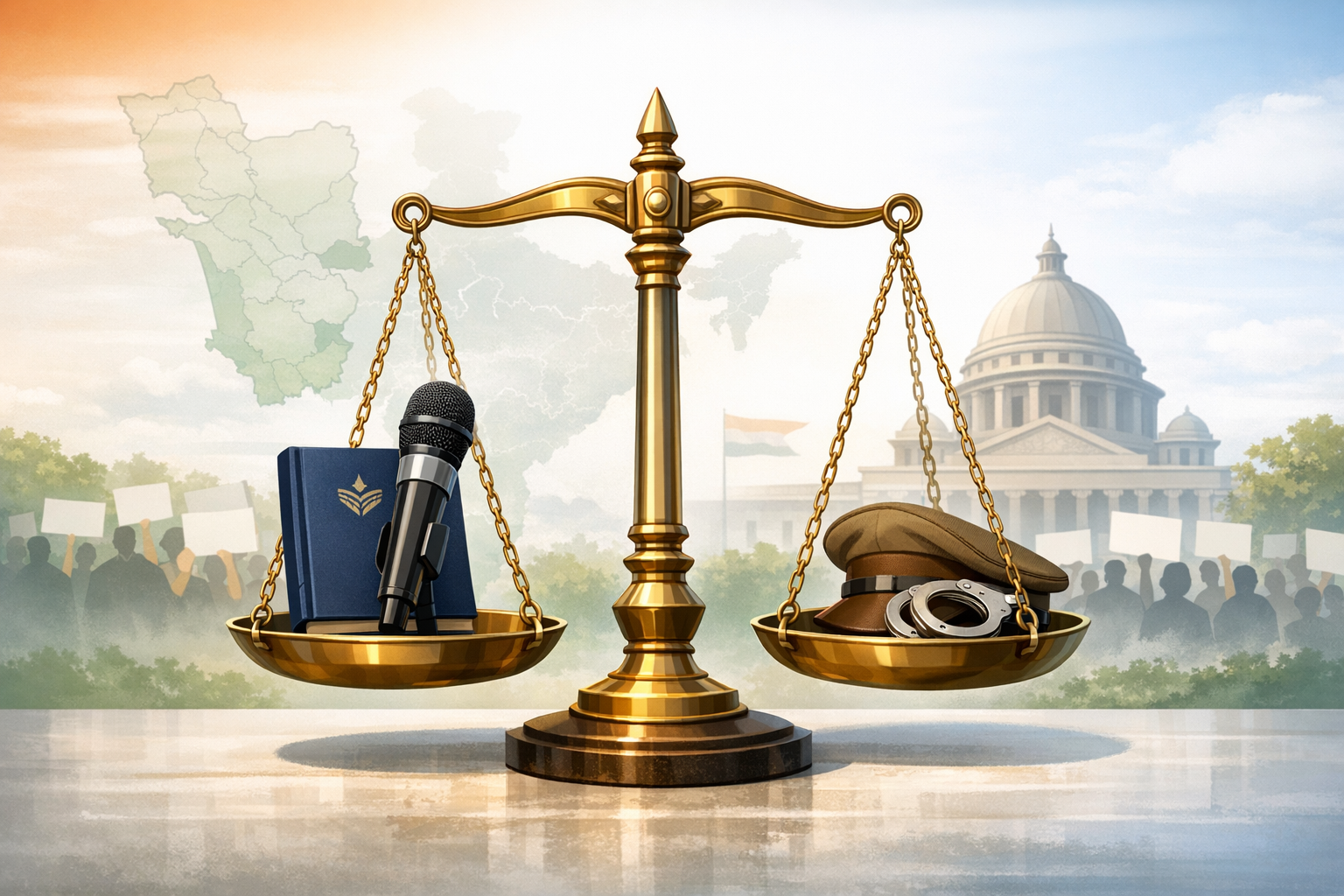
Goa Police arrested Hindu activist Gautam Khattar for alleged hate speech, prompting nationwide condemnation from civil liberties advocates, community leaders, and Dharmic associations. The episode has ignited a fresh debate on the limits of free speech, the scope of hate speech prohibitions, and the necessity of strict adherence to due process under India’s Constitution and criminal procedure framework.
Critics argue that the enforcement action reflects selective application of the law and risks chilling legitimate expression, especially on matters of faith and identity. Supporters of the action emphasise the State’s duty to preserve public order. The constitutional question therefore turns on whether the factsstill contestedcross the legal threshold from protected expression to unlawful incitement, and whether the arrest satisfied the requirements of necessity, proportionality, and procedural safeguards.
At the core lies Article 19(1)(a) of the Constitution, which guarantees freedom of speech and expression, subject to the reasonable restrictions enumerated in Article 19(2) (including public order, decency, morality, and the security of the State). Constitutional scrutiny in such cases demands more than a broad appeal to public order; it requires a close, evidence-based analysis of the actual words used, the context and audience, the likelihood of real-world harm, and the specific intent ascribed to the speaker.
In practice, speech-related prosecutions often rely on provisions such as Section 153A of the Indian Penal Code (promoting enmity between groups), Section 295A (deliberate and malicious acts intended to outrage religious feelings), and Section 505(2) (statements creating or promoting enmity, hatred, or ill-will). These offences are typically cognizable and frequently non-bailable, yet they carry exacting elements: proof of intention or knowledge, a demonstrable link to group-based enmity, and, for Section 295A, a “deliberate and malicious” design. Vague offensiveness or mere hurt sentiment does not suffice to establish criminal liability.
Supreme Court jurisprudence further sharpens these boundaries. In Shreya Singhal v. Union of India, the Court distinguished between mere advocacy and the narrower category of incitement, underscoring that restrictions must target speech that is closely linked to imminent public disorder. In later decisions, the Court has cautioned that context, target, and effect matter; general incivility or abrasive commentary is not per se criminal unless it crosses the line into unlawful incitement against protected groups.
Procedural law adds additional guardrails. Under Sections 41 and 41A of the Code of Criminal Procedure (CrPC), arrest is not an automatic consequence of registration of an FIR for offences punishable up to seven years; instead, police must assess necessitysuch as risk of absconding, tampering with evidence, or further offencesand, where appropriate, issue a notice of appearance under Section 41A. The Supreme Court’s guidance in Arnesh Kumar requires reasoned, written satisfaction of these criteria. Compliance with D.K. Basu safeguardsfurnishing an arrest memo, informing a nominated person, facilitating access to counsel, and medical examinationis also mandatory.
Another critical check lies in Section 196 CrPC, which requires prior sanction for courts to take cognizance of certain speech offences (including Sections 153A and 295A IPC). While police may investigate, the sanction requirement ensures independent, higher-level review of whether prosecution is warranted, aiming to filter out cases driven by transient outrage or political pressures rather than by evidence meeting statutory thresholds.
Bail jurisprudence anchors the presumption of liberty. Courts have repeatedly affirmed the principle of “bail, not jail,” especially where custodial interrogation adds little value relative to documentary or digital evidence already in the record. In speech cases, anticipatory bail or regular bail often turns on factors such as the specificity of the alleged remarks, the demonstrable risk to public order, the necessity of custodial interrogation, the accused’s cooperation, and the presence or absence of prior similar conduct.
Allegations of selective enforcement, frequently raised in public discourse, invoke the equality principle in Article 14. If similarly situated speakers of differing viewpoints receive dissimilar legal treatment, the appearance of viewpoint discrimination undermines public trust. Equal application of hate speech lawsirrespective of the faith or community of the speaker or the targetis essential to constitutional legitimacy and to the perception of fairness.
To that end, standardised, public-facing enforcement protocols can reduce arbitrariness. Clear, published Standard Operating Procedures (SOPs) on arrest thresholds for speech offences; independent legal vetting before registration of FIRs in borderline cases; prompt use of Section 41A notices where appropriate; and timely, reasoned communications explaining enforcement decisions all help meet constitutional scrutiny while strengthening public confidence in policing.
For many ordinary citizens across the Dharmic spectrumHindu, Buddhist, Jain, and Sikharrests over speech evoke concern about expressing faith identities in a plural society. Communities consistently report a dual aspiration: to protect each tradition from vilification and to preserve the democratic space for robust, even uncomfortable, debate. The broad goal of unity in diversity requires ensuring that the same legal standards protect every tradition and every citizen, whatever their viewpoint, so long as the expression remains within constitutional limits.
Responsible civic responses can mitigate polarisation. Counterspeech, interfaith dialogue, and community-led codes of respectful expression are often more effective than immediate criminalisation in defusing tensions. When criminal law is invoked, it should be a last resort, deployed only where statutory elements are plainly met and where alternative remediesapologies, corrections, platform moderationprove inadequate.
Digital speech adds further complexity. Viral dissemination, cross-jurisdictional reach, and the possibility of multiple FIRs across states raise issues of duplication and harassment. Courts have, in appropriate cases, directed consolidation of proceedings to prevent multiplicity and forum-shopping. Effective coordination between state police units and clear protocols for territorial jurisdiction and evidence preservation are now integral to fair and efficient enforcement.
Civic and legal literacy can help individuals navigate such episodes lawfully and confidently. If served with a notice under Section 41A CrPC, timely appearance with counsel, provision of verified contact details, and proactive cooperation reduce the risk of arrest. Where arrests occur, asserting D.K. Basu safeguards, seeking prompt legal representation, and applying for bail while demonstrating non-interference with evidence generally align with best practices.
For police agencies, constitutional compliance is not merely a legal duty but an operational advantage. Training that emphasises the precise statutory elements of Sections 153A, 295A, and 505(2); the advocacy–incitement distinction; necessity assessments under Section 41; and transparent documentation of reasons reduces error rates and strengthens cases that do proceed. Regular audits of speech-related FIRs, time-bound sanction processes, and public dashboards on outcomes further enhance accountability.
Courtroom evaluation in such matters typically focuses on four questions: whether the impugned words target a protected group with the requisite intent or knowledge; whether the likely effect transcends offence-taking to a genuine risk of disorder; whether arrest and detention were necessary and proportionate; and whether procedural safeguards were scrupulously observed. Precision on these axes frequently determines outcomes at the quashing, bail, and trial stages.
Historical context also cautions against overreach. Many of India’s speech offences arose in the late colonial period (for instance, Section 295A in 1927) to manage inter-communal tensions. In a constitutional democracy, these provisions must be read narrowly and consistently with Article 19, lest colonial-era tools be repurposed to suppress dissent rather than to protect public order in a principled, viewpoint-neutral way.
Comparative jurisprudencefrom the “clear and present danger” to the “imminent lawless action” formulationhighlights a common democratic instinct: penal law should target only speech that poses a real, immediate risk of harm, not speech that merely offends. Indian law, while tailored to public-order concerns, aligns with this instinct when courts insist on intent, imminence, and a close causal link between words and harm.
The Goa Police action in the Gautam Khattar case has therefore become a test of rule-of-law commitments on multiple fronts: substantive thresholds for hate speech, procedural rigor in arrest, and equality in enforcement. If the legal elements and necessity standards are genuinely satisfied, principled prosecution is warranted; if not, overbroad or precipitous use of arrest power risks eroding constitutional fidelity and public trust.
Across India’s Dharmic traditions, the shared aspiration remains clear: uphold dignity, prevent vilification, and preserve the democratic space for earnest debate about religion, culture, and public life. The surest path to that aspiration is viewpoint-neutral enforcement, scrupulous due process, and a civic culture of counterspeech and dialogue. In moments of national tension, unity in diversity is sustained not by silencing one another, but by reaffirming constitutional discipline that protects everyone equally.
Inspired by this post on Hindu Jagruti Samiti.