
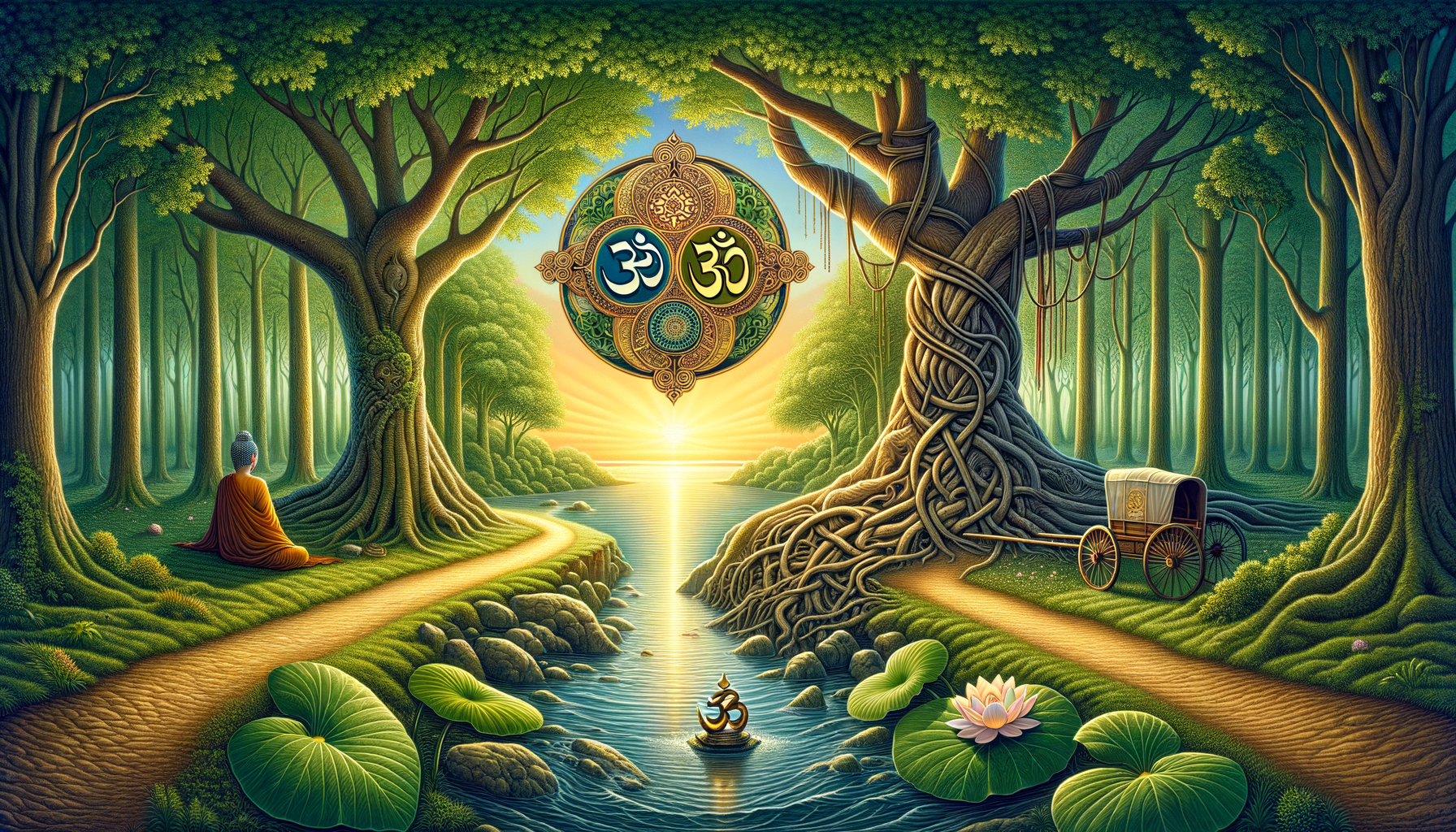
Debates about Buddhism and Hinduism often frame the Buddha as a radical social reformer who challenged Brahmin orthodoxy, much like Martin Luther’s reformation of ritualistic Catholicism or Christianity’s emergence from Judaism. This linear storyline is compelling, yet it risks oversimplifying a far older civilizational continuum shared by multiple dharmic traditions.
Ananda K. Coomaraswamy offers a decisive counterpoint. In Hinduism and Buddhism, he argues that the stark distinction between the two is largely a product of superficial study. Rather than a social protest movement, Buddhism is presented as a rediscovery of the ancient path of the awakened. The Buddha is depicted as affirming Brahmins who “remembered the old path of the contemplatives that led to Brahma,” emphasizing continuity over rupture.
Historically, both the Upanishadic and Buddhist streams emerged and matured in the forestsspaces of contemplative inquiry less susceptible to the distortions of power and prestige. Over time, courtly life drew some Brahmins toward grandeur and ritualism, encouraging identity by birth rather than realization by knowledge. Against this backdrop, the shared project of Buddhism and Hinduism appears as a re-centering of perennial truths rather than an institutional struggle.
Yet modern narratives can obscure this continuity. Buddhism is sometimes admired for what scholars think the Buddha should have said, rather than what is preserved in the traditions. This selective reading sidelines key elementssuch as reincarnation and suprasensory capacitiesthat were integral to classical frameworks while emphasizing techniques abstracted from their ethical and metaphysical contexts.
The contemporary popularity of “mindfulness” illustrates the point. In many Western settings, contemplative practice is marketed as a portable productivity tool. Within the broader dharmic understanding, however, mindfulness is inseparable from a life of ethical discipline, right view, and continuous awareness. The Buddha’s vision includes mindfulness, to be sure, but not as an intermittent “add-on.” Traditional accounts also affirm reincarnation, placing Siddhartha Gautama within a lineage of prophetic incarnations narrated across the canons.
On the question of the Self, deep study reveals fewer hard boundaries than popular summaries suggest. Consider the resonances: “For those who have attained, there is naught dearer than the self,” and “The Self is the lord of the self and its goal,” says the Buddha. Both Hindu and Buddhist traditions prioritize direct experience over mere logic; conceptual analysis is necessary but not sufficient. The goal is to transcend sensory limitation and realize ultimate truth. In this light, the attainment of an Arhat as brahma-bhutena-atmana (“with the self that is Brahma-become”) and the inquiry “By which self (kena-atmana) does one attain the Brahma world?” echo the opening quest of the Kena Upanishad. At the same time, Buddhism’s proposal of anatmya critiques the delusion behind “cogito ergo sum,” targeting the fiction of a permanent ego.
Methodologically, both traditions proceed via rigorous negation and discernment. The Upanishadic inquiry advances through neti neti“not this, not this”to approach Brahman beyond limiting concepts. The Buddhist analysis dissects physical and mental factors until the observer sees through attachment and can authentically say, “That is not my self.” Accounts such as Autobiography of a Yogi and Sri M’s spiritual autobiography document experiential milestones described across the dharmic spectrum, underscoring a shared phenomenology of transformation.
Imagery converges as well. The chariot-and-charioteer metaphorpresent in both corporateaches mastery of mind and senses. Human beings are not to drift like ships in a storm; they are capable of knowing the Self, or seeing through the illusory ego, and living from that realization with clarity and compassion.
Broadening the lens to the dharmic family strengthens this integrative picture. Jainism emphasizes Ahimsa, disciplined conduct, and kevala jnana as the culmination of self-purification. Sikhism centers Ik Onkar, Naam Simran, and ethical service (seva), cultivating God-consciousness in daily life. While their vocabularies and doctrinal emphases differ, the shared commitmentsethical living, meditation, self-mastery, and liberationreveal complementary pathways within a single civilizational ethos.
These convergences are not merely theoretical. Many practitioners find that a moment of mindful breathing before a difficult conversation, an act of seva undertaken quietly, or the deliberate choice of satya (truthfulness) in complex situations makes the ancient insights immediately tangible. Lived experience becomes the bridge between texts and transformation.
Seen in this light, the question “reformation or rediscovery” yields to a fuller recognition: Buddhism and Hinduism participate in a deep, continuous rediscovery of perennial wisdom. Rather than competing narratives, they are allied streams nurturing the same ocean of realization. Emphasizing this unity honors the integrity of each tradition while fostering harmony among Hinduism, Buddhism, Jainism, and Sikhism.
A practical takeaway follows. Approach mindfulness within an ethical frame, pursue contemplation with humility, and test doctrine against lived experience. In doing so, seekers across the dharmic traditions can discover a complete and proven pathway to inner clarity, compassion, and freedom.
Inspired by this post on Varnam.
