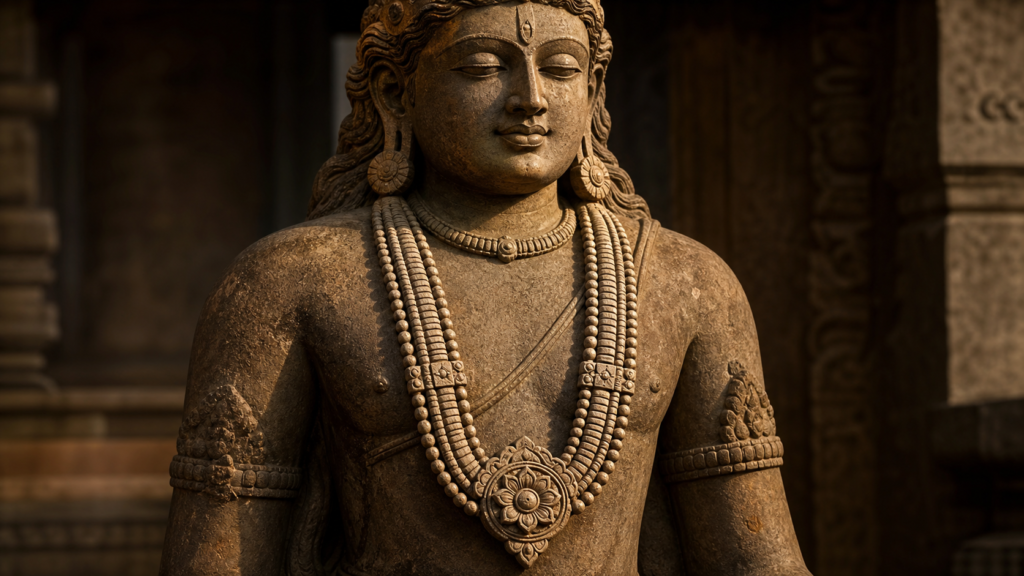
Panini’s Ashtadhyayi stands as a precise and elegant system for understanding Sanskrit grammar, foundational to the shared textual heritage of Hindu, Buddhist, Jain, and Sikh traditions. Traditional accounts place an early episode in Takshashila, where two students pursued vyākaraṇa. One was frequently underestimated, while the other was celebrated for brilliance. The firstlater known as Pāṇinipersevered despite discouragement; the second is remembered in later literature as Kātyāyana (Vararuci). These narratives underscore the intellectual humility and determination that animate India’s linguistic tradition.
According to the classical legend, Pāṇini attained a profound insight after intense tapas, associated with Śiva’s damaru. The damaru’s fourteen beats were heard as phonetic clustersMaheshwara Sutrasthat supplied the compact alphabetic framework enabling Ashtadhyayi’s generative rules. The sutras are recited as follows:
अ इ उ ण् |
ऋ ऌ क् |
ए ओ ङ् |
ऐ औ च् |
ह य व र ट् |
ल ण् |
ञ म ण ण न म् |
झ भ ञ् |
घ ढ ध ष् |
ज ब ग ड द श् |
ख फ छ ठ थ च ट त व् |
क प य् |
श ष स र् | ह ल् |
These fourteen sutras provide the phonological backbone with which the Ashtadhyayi codifies rules for both laukika and vaidika Sanskrit. Pāṇini was not the first grammarian; the Ashtadhyayi acknowledges predecessors. Yet the concision and completeness of his system eclipsed earlier schools. Kātyāyana composed Vārtikaspointed observations and refinementson Pāṇini’s sutras, and Patañjali’s Mahābhāṣya later integrated the Ashtadhyayi and Vārtikas into a monumental synthesis.
What distinguishes the Ashtadhyayi is its generative method. Rather than memorizing only finished forms, it derives infinitely many valid expressions from a finite set of definitions, operations, and conditions. The work compresses data (via technical aliases), orders steps as terminating procedures (prakriyā), and minimizes redundancy while retaining precision. Where a typical paradigm lists रामः, रामौ, रामाः as outputs, Pāṇini’s system describes how to produce these forms from a root and affixes, making the process transparent and teachable.
Because Sanskrit is the linguistic medium of vast canons across dharmic traditions, this grammar enables shared access to scriptures, philosophical treatises, and liturgy. Students, teachers, and seekers across communities often find that Pāṇini’s clarity creates a common groundconnecting logic, language, and spiritual inquiry without sectarian barriers.
प्रत्याहारः
A central compression device is the प्रत्याहारः, a concise name for a contiguous sequence of sounds in the Maheshwara Sutras. For example, अच् denotes all vowels from अ up to (but not including) च्. Tracing अ to च् across the sutras yields the full set of swaras. This mechanism allows large sound classes to be referenced with two symbols, enabling highly compact rules.
The power of प्रत्याहारः becomes clear in definitions such as अजन्तः = अच् + अन्तः, meaning “a word ending in a vowel.” Once अच् is known, अजन्तः becomes immediate and exact.
Consider the sutra इको यण् अचि. The segment इको refers to sounds from इ up to क् (i.e., इ उ ऋ ऌ). The term यण् names the corresponding semivowels (य् व् र् ल्). The environment अचि specifies that the rule applies before a vowel. This yields the following correspondences:
इ य्
उ व्
ऋ र्
ऌ ल्
Applied in sandhi, इ, उ, ऋ, ऌ transform to य, व, र, ल respectively in the specified context. For instance, in प्रति + एकः = प्रत्येकः, the इ changes to य् in the presence of a following vowel, matching the rule’s prediction.
Now consider एचोऽयवायावः:. Here, एच् designates ए ओ ऐ औ. The rule gives the following mappings in the appropriate environment:
ए अय्
ओ अव्
ऐ आय्
औ आव्
In modern terms, these operations function like algorithms; they specify input classes, transformations, and termination, long familiar to India’s grammatical sciences. Pāṇini’s methods anticipate formal, stepwise reasoning that later appears worldwide in diverse intellectual traditions.
संज्ञा
Technical namingसंज्ञाis another pillar of the system. By defining a term once, the text can reuse it precisely across rules. For example, वृद्धिरादैच्. assigns the name “वृद्धि” to the set आ ऐ औ. Once declared, वृद्धि can be referenced without expansion, sustaining brevity and clarity. Similarly, numerical and phonological संज्ञा terms are introduced systematicallymost in the first adhyāyaso that later rules remain concise yet unambiguous.
उत्सर्ग–अपवादः
Ashtadhyayi is architected around a clear pattern: a general principle (उत्सर्ग) is stated first, followed by specific exceptions (अपवाद). Learners quickly recognize the workflow: attempt the general rule; if the item falls into an exception class (such as a particular गण), apply the अपवाद instead; then terminate the procedure.
For example, with कर्तरि शप् one obtains forms like पठ + शप् + ति = पठति. An exception, दिवादिभ्यः श्यन्, yields नृत् + श्यन् + ति = नृत्यति when the root belongs to the दिवादि गण. The prakriyā proceeds by testing the general case, checking membership in an exception class, and concluding once the applicable rule has fired. This mirrors modern rule-based systems used in computation and logic.
अनुवृत्तिः
अनुवृत्तिः carries forward an essential element from a prior sutra to the immediately following sutras, eliminating repetition without loss of meaning. For instance, in the pair इको यण् अचि and एचोऽयवायावः:, the environment अचि is understood to continue, even when not restated. Pāṇini’s method avoids redundancy, preserves context, and keeps the system tightly knit.
Initial encounters with these sutras can feel terse and allusive, yet the system reveals exceptional clarity once the core devicesप्रत्याहारः, संज्ञा, उत्सर्ग–अपवादः, and अनुवृत्तिःare grasped. The result is a compact, generative, and teachable grammar that continues to illuminate Sanskrit for students, scholars, and practitioners across dharmic traditions.
Traditional accounts of Pāṇini’s life vary, yet the shared conclusion is consistent: a breakthrough in organizing Sanskrit that continues to support rigorous study and inter-traditional understanding. In this way, Ashtadhyayi strengthens a common linguistic foundation for Hinduism, Buddhism, Jainism, and Sikhism, fostering unity through precise language and shared learning.
Inspired by this post on Varnam.