
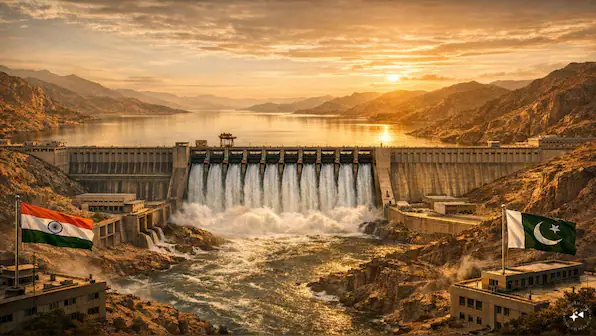
A dry canal makes compelling television. A hydrograph does not. This difference explains much of the confusion surrounding the Indus Waters Treaty. Images of depleted Pakistani reservoirs, contracting canals and distressed fields can create the impression that Bharat has already stopped the Indus system at will. Yet a photograph records a condition, not its cause. Seasonal drawdown, low rainfall, irrigation demand, sediment removal, maintenance closures and reservoir operations can all produce similar scenes. Placing a treaty in abeyance changes legal, diplomatic and administrative behaviour immediately; it does not instantly create the dams, tunnels and canals required to control a Himalayan river system. That distinction is essential to any serious assessment of the Firstpost argument that the treaty did not fail Bharat—the Nehruvian state did.
The central thesis is persuasive when stated with precision. The 1960 settlement was unusually restrictive for an upper-riparian state and rested on optimistic political assumptions. Nevertheless, the document itself also granted Bharat meaningful rights over the western rivers and unrestricted use of the eastern rivers. Successive governments failed to develop many of those rights with sufficient urgency. The resulting weakness was therefore produced by two connected decisions: accepting a rigid, open-ended bargain and then neglecting the infrastructure, institutions and technical knowledge needed to operate effectively even within that bargain. The deeper indictment concerns state capacity, strategic culture and policy continuity—not merely one signature on one September day in 1960.
A dry canal and the politics of perception
The historical anecdote involving British politician H. A. Marquand is verifiable, although its original context deserves attention. During a House of Commons debate on 11 November 1960, Marquand recalled being shown an empty section of Lahore’s Grand Canal in 1953. His guide blamed India, but subsequent inquiries established that the canal had been closed for periodic cleaning. Marquand presented the incident as evidence of the acute suspicion and tension then prevailing between India and Pakistan. The Hansard record therefore supports caution about politically framed spectacles, but it does not by itself prove that every Pakistani water complaint is fabricated or centrally orchestrated.
The enduring lesson is methodological. A credible claim that an upstream intervention caused a downstream shortage requires the location and date of the image, historical storage curves, river-discharge measurements, rainfall and snowmelt data, canal-closure schedules, gate-operation records and evidence of upstream retention or diversion. Without these, a dramatic frame can be accurate as an image and misleading as an explanation. Reservoir levels are particularly easy to misread because operators deliberately draw water down before flood periods, store it during high flows and release it according to irrigation and electricity demand. Sedimentation can also expose large dry margins without producing an equivalent decline in usable water at every point in the system.
Pakistani governments and security institutions have repeatedly internationalised the country’s downstream vulnerability, often presenting water disputes through the language of existential victimhood. That framing can rally domestic opinion, attract diplomatic attention and obscure failures of storage, canal maintenance, groundwater regulation and agricultural policy within Pakistan. Yet the existence of a strategic narrative does not erase genuine water stress. The academically defensible conclusion is narrower: claims of Indian responsibility should be tested rather than accepted from images alone, while claims that every shortage is theatrical should be subjected to the same standard.
The human stakes make such discipline indispensable. A farmer cannot irrigate a field with a press conference, and a family cannot drink strategic signalling. Water shortages affect food prices, rural debt, electricity supply, public health and migration. The Indus basin sustains communities in Ladakh, Jammu and Kashmir, Himachal Pradesh, Punjab, Sindh, Khyber Pakhtunkhwa and beyond. Those communities include Hindus, Sikhs, Buddhists, Muslims and members of other traditions whose dignity cannot be reduced to instruments in a bilateral information war.
What the Indus Waters Treaty actually established
Partition severed an integrated irrigation network rather than neatly dividing independent river systems. Headworks located in India continued to feed canals serving territory that had become Pakistan. The expiry of temporary arrangements and the interruption of some canal supplies in April 1948 demonstrated how quickly a provincial engineering dispute could become a national security crisis. The May 1948 Inter-Dominion Agreement restored supplies while negotiations continued, but the episode hardened Pakistani fears of upstream control and strengthened India’s insistence that its own underdeveloped regions could not remain permanently subordinate to colonial-era patterns of use.
After years of negotiation facilitated by the International Bank for Reconstruction and Development, the treaty was signed at Karachi on 19 September 1960 by Prime Minister Jawaharlal Nehru and Pakistani President Mohammad Ayub Khan. The World Bank signed for the limited functions assigned to it by the agreement; it did not become the sovereign owner or universal guarantor of the rivers. Under the official treaty text, the Ravi, Beas and Sutlej—the eastern rivers—became available for India’s unrestricted use after a transition period. Pakistan received unrestricted use of the waters that India was obliged to let flow in the Indus, Jhelum and Chenab—the western rivers—subject to specified Indian uses.
The familiar description that Pakistan received roughly 80 per cent of the Indus system and India about 20 per cent is a shorthand based on average river flows. Indian government assessments commonly place the eastern rivers at approximately 33 million acre-feet, or MAF, annually and the western rivers at about 135 MAF. One MAF is approximately 1.233 billion cubic metres. These figures reveal the scale of the asymmetry, but they should not be confused with a transfer of territorial sovereignty or simple ownership. The western rivers carried most of the basin’s water and historically supported much of the irrigated acreage that fell inside Pakistan. The political question was whether dependence and existing use justified imposing unusually durable restrictions on the upstream state.
India’s western-river rights were limited but not trivial. Article III and Annexures C, D and E permitted domestic use, specified non-consumptive uses, agricultural use, run-of-river hydroelectric generation and bounded storage. The aggregate storage entitlement is commonly summarised as 3.6 MAF, or roughly 4.44 billion cubic metres, across general, power and flood-storage categories. The irrigation schedule preserved an existing base and allowed approximately 701,000 acres of additional irrigated cropped area, producing a total ceiling commonly expressed as about 1.34 million acres. Hydroelectric projects remained subject to exacting rules governing intakes, spillways, pondage, operating levels and the placement of outlets.
The treaty also created an unusually elaborate administrative regime. Article VI required regular exchanges of river-flow, reservoir, canal-withdrawal and release data. Article VIII established the Permanent Indus Commission as the normal channel of communication. Article IX created a graduated process under which a technical question could move from the commissioners to a Neutral Expert and, if classified as a dispute, to a Court of Arbitration. These mechanisms helped prevent many engineering disagreements from immediately becoming military confrontations, but they also gave Pakistan repeated opportunities to challenge the design and timing of Indian projects.
Financially, the bargain extended beyond river allocation. Article V required India to contribute exactly £62.06 million in ten equal annual instalments toward replacement works in Pakistan. Those works transferred water from the western rivers to canals that had previously depended on the eastern rivers. International donors and the World Bank supplied much of the wider development fund, which financed reservoirs, barrages and link canals. This payment was not a continuing charge for water, but it understandably intensified the Indian perception that the upstream state had surrendered the larger flows and then helped finance the downstream state’s hydraulic independence.
The agreement was also designed for exceptional durability. Article XII permits modification through a duly ratified treaty concluded by both governments and states that the existing arrangement continues until terminated by another duly ratified treaty. It contains no ordinary unilateral withdrawal clause and no automatic review date. That rigidity produced stability, but it also froze assumptions made before climate change, modern environmental law, contemporary dam technology, cross-border terrorism and the present scale of electricity and water demand had transformed the strategic landscape.
Why Jawaharlal Nehru accepted the bargain
A fair assessment must reconstruct the decision environment of the 1950s. Bharat was a newly independent, food-insecure and capital-constrained state still absorbing the violence and displacement of Partition. A continuing canal conflict risked war, interfered with development planning and complicated access to international finance. Separating the rivers offered each country the ability to build an independent hydraulic system instead of negotiating every seasonal release. India also gained uncontested long-term use of the eastern rivers, enabling major irrigation and power projects in Punjab, Haryana and Rajasthan. These benefits explain why competent engineers could support the settlement without sharing every political assumption attached to it.
Nehru did not claim that the treaty was ideal. In the Lok Sabha debate of 30 November 1960, he acknowledged dissatisfaction while arguing that endless quarrelling carried its own costs. He defended the technical team, emphasised the duration and intensity of the negotiations, and described the payment as the price of a settlement and, to that extent, peace. The full parliamentary reply shows a more complicated position than either uncritical admiration or retrospective caricature suggests.
That defence contained a legitimate insight: a negotiated settlement can be preferable to indefinite coercion even when it is imperfect. The treaty reduced uncertainty, allowed both states to plan large water projects and survived the wars of 1965 and 1971, the 1999 Kargil conflict and numerous diplomatic ruptures. Engineers continued to exchange information when political leaders could barely communicate. Measured solely as a mechanism for allocating rivers and processing technical objections, the agreement demonstrated considerable resilience.
The strategic error emerged when technical predictability was treated as a down payment on political reconciliation. The treaty did not prevent Pakistan from initiating or supporting later confrontations, and it contained no security review triggered by war or sustained cross-border terrorism. Its preamble invoked goodwill and friendship, but its operative provisions imposed enduring obligations without making them conditional on a broader peaceful relationship. If the settlement was politically justified as the purchase of peace, subsequent history undermined that justification even though the hydraulic rules continued to function.
The distinction matters. The treaty did not promise to abolish ideological hostility, end the Kashmir conflict or reform Pakistan’s security establishment. It therefore cannot be said to have failed at tasks it was not legally designed to perform. The state failed when it confused the treaty’s narrow administrative success with proof that unilateral restraint would transform bilateral behaviour. A technical instrument became a symbol of moral exceptionalism, and symbolic fidelity gradually displaced periodic scrutiny of national interest.
In this sense, the term “Nehruvian state” describes more than Jawaharlal Nehru’s premiership. It denotes an institutional habit that survived him: insulating river cooperation from the security relationship, assuming that continued restraint would accumulate diplomatic credit, and postponing difficult infrastructure because the political costs were immediate while the strategic benefits were distant. Governments of several parties inherited and reproduced elements of that approach. Personalising seven decades of policy failure around one leader would allow later administrations to escape responsibility for choices they had ample time to revisit.
The more consequential failure: rights left undeveloped
The strongest evidence for institutional failure is not rhetorical; it is physical. India did not build storage on the western rivers up to the 3.6 MAF ceiling for decades, and agricultural use remained below the treaty-authorised level. A 2019 Government of India status note documented both the eastern-river allocation and long-delayed projects intended to capture water that continued to cross the border unused. A recent peer-reviewed assessment of competing Indian and Pakistani interpretations likewise records official acknowledgements that storage and irrigation entitlements on the western rivers remained underdeveloped.
Some delays resulted from genuine constraints. Himalayan construction involves unstable geology, high seismicity, glacial and monsoon hazards, exceptional sediment loads, difficult access, land acquisition, ecological damage and displacement. Insurgency and terrorism raised security costs in Jammu and Kashmir. Pakistani objections and international proceedings delayed project design and financing. Environmental appraisal and dam-safety review were necessary safeguards, not disposable inconveniences. Even after accounting for these factors, however, the persistence of large gaps across several decades points to fragmented planning and weak execution.
Jammu and Kashmir carried a disproportionate share of the opportunity cost. The western rivers pass through its territory, yet restrictive design rules and delayed projects limited irrigation, dependable electricity and the fiscal value of hydropower. Run-of-river generation can produce substantial energy, but without adequate pondage or storage it offers less control over when electricity is generated and how seasonal flows are managed. The resulting frustration cannot be reduced to abstract nationalism; it concerns farms, winter power shortages, local employment and regional development in a strategically exposed part of Bharat.
The treaty should have been treated as an outer legal boundary within which Bharat would maximise every permitted entitlement. Instead, it often became an explanation for inaction. A capable state would have maintained basin-wide surveys, project-ready designs, cumulative environmental assessments, financing pipelines, sediment-management plans and specialised negotiating teams. It would also have preserved evidence showing that each project satisfied treaty parameters. Failure to create that machinery converted negotiated rights into theoretical entries that offered little practical leverage.
This is why the title’s institutional emphasis is more useful than a simple claim that the pact “gave away” water. A treaty can restrict a state, but it cannot prevent that state from exercising rights expressly preserved in the text. Nor can it explain why projects on rivers allocated without restriction to India remained incomplete for decades. The record reveals a compound failure: an asymmetrical settlement, insufficient strategic review, underused entitlements and chronic delays in domestic water infrastructure.
Why no government can simply turn off the Indus tap
The tap metaphor obscures the basic hydrology. The Indus system is supplied by snow and glacier melt, rainfall, groundwater interactions and large tributary catchments. Its flows vary sharply by season and year. A government can control only the water that reaches a structure capable of storing, releasing or diverting it. When inflow exceeds reservoir and canal capacity, water must continue downstream. Attempting to retain extreme flows without adequate spillway capacity would threaten the dam itself and expose upstream communities to catastrophic flooding.
Three distinct capabilities are routinely confused. Storage holds water for later release. Regulation changes the timing of downstream flow. Diversion transfers water into another basin or delivery system. A run-of-river hydroelectric project primarily channels water through turbines and returns it to the river; limited pondage may shift generation and releases within a day or across short periods, but it cannot ordinarily retain an entire season’s flow. Large strategic effects require multiple reservoirs, high-capacity tunnels, canals, pumping or gravity-transfer systems and downstream distribution networks.
Existing Indian projects can nevertheless influence short-term conditions. Filling a reservoir, drawing it down, flushing sediment or altering gate schedules can change the downstream hydrograph for hours or days, especially during the lean season. The cessation of routine data sharing can magnify uncertainty because downstream operators lose advance knowledge needed to schedule canals, power plants and flood preparation. This is meaningful leverage, but it is not equivalent to permanently withholding the annual flow of the Indus, Jhelum and Chenab.
As of July 2026, the policy shift has begun to generate visible infrastructure activity. NHPC procurement records include civil works for the Chenab–Beas Link Tunnel project at Koksar, intended to connect a Chenab headwater tributary with the Beas system. The proposal is strategically significant because it represents inter-basin diversion rather than ordinary run-of-river generation. Yet a tender is not an operating tunnel. Procurement, design, clearances, tunnelling, commissioning and integration with downstream infrastructure remain separate stages, each carrying engineering and environmental risk.
Work on sediment removal at Salal and the acceleration of projects such as Pakal Dul, Kiru, Kwar, Ratle and Sawalkot may improve hydropower generation and operational flexibility. Reservoir desiltation can recover lost capacity, while new structures can increase the range of controllable flows. None of these measures should be described as a completed ability to stop all water. Their strategic value lies in cumulative capacity: each reservoir, tunnel, monitoring system and power project reduces the gap between a diplomatic declaration and a technically executable policy.
The eastern rivers expose an even clearer history of delayed execution. India already possessed unrestricted rights over the Ravi, Beas and Sutlej, yet incomplete works allowed usable water to continue into Pakistan. The long-delayed Shahpur Kandi project and the proposed Ujh multipurpose project demonstrate that the central obstacle was not always the treaty. Interstate coordination, financing, land issues, project management and political prioritisation were equally important. Capturing India’s undisputed eastern-river share is legally and technically different from diverting western-river water after abeyance, and public discussion should not merge the two.
Realistic leverage will therefore develop unevenly. The most immediate effects arise from suspended information exchange, altered maintenance and reservoir operations, faster use of existing entitlements and reduced accommodation of Pakistani objections. Medium-term effects depend on hydropower completion, restored reservoir capacity and improved canals. Large-scale diversion or seasonal retention requires many years of construction. Any claim that Pakistan has already been permanently deprived of the Indus system should be treated as political messaging unless supported by measured, sustained changes in cross-border discharge.
Narrative warfare cannot replace water accounting
A defensible assessment of any alleged cutoff should answer several questions. Which river, barrage, canal or reservoir is shown? On what date was the image recorded? How does the level compare with the same week in previous years? What were upstream precipitation, snowmelt and inflow conditions? Was maintenance, sediment flushing or irrigation drawdown under way? Do Indian and Pakistani gauges agree, and can satellite observations corroborate them? This protocol is less emotionally satisfying than declaring victory or victimhood, but it is the only reliable basis for attributing cause.
Pakistan’s water vulnerability also arises from domestic choices. Ageing canals lose water through seepage and poor maintenance; sediment reduces reservoir capacity; waterlogging and salinity damage farmland; groundwater extraction can exceed recharge; and politically influential crop patterns may consume scarce supplies inefficiently. Climate variability compounds each problem. These conditions do not disprove an Indian operational impact, but they make monocausal claims implausible. A responsible Pakistani government would address internal water governance instead of treating every shortage as evidence of foreign aggression.
Bharat faces a corresponding obligation of intellectual honesty. Triumphalist broadcasts claiming that Pakistan has already been left without water can undermine New Delhi’s credibility when the physical evidence fails to support them. They also reveal strategic plans, inflate public expectations and encourage escalation without delivering durable capacity. Credible statecraft communicates objectives, completed milestones and measurable results while distinguishing them from proposals. A strong policy does not require hydraulic mythology.
The Marquand episode is therefore best understood as a warning to both sides. His guide attributed an ordinary cleaning closure to India, but Marquand himself used the incident to describe mutual suspicion rather than to condemn an entire population. The relevant target of criticism is a political method: converting an ambiguous water condition into an emotionally certain story. That method can be employed by Pakistani officials depicting victimhood or by Indian broadcasters announcing an engineering victory that has not yet occurred.
Language also matters ethically. Pakistani state policy, military doctrine and propaganda should not be conflated with Pakistani farmers or children. Likewise, criticism of Nehruvian policy should not become hostility toward Indians who value different aspects of Nehru’s legacy. The basin’s future requires clarity about institutions and decisions rather than collective contempt. Such discipline is consistent with the plural and dharmic civilisational principle that strength, restraint and responsibility are not mutually exclusive.
What placing the treaty in abeyance changed
Following the killing of 26 people at Pahalgam on 22 April 2025, the Cabinet Committee on Security announced that the treaty would be held in abeyance until Pakistan credibly and irreversibly ended its support for cross-border terrorism. The official Indian statement framed water cooperation as inseparable from national security. Islamabad denied responsibility for the attack and rejected New Delhi’s action, maintaining that the treaty remained binding.
Administratively, India has treated treaty-based cooperation as suspended. This affects meetings of the Permanent Indus Commission, routine hydrological exchanges, advance design information and participation in contested adjudicatory processes. These steps create uncertainty even before a new dam is built. Operational data can be nearly as important as volume because downstream authorities use it to manage crops, hydropower, drought and floods. Humanitarian warnings can still be transmitted through diplomatic channels without conceding that the treaty mechanism has resumed.
Legally, the position remains contested. Pakistan relies on Article XII, the principle that treaties must be performed in good faith and the absence of a unilateral abeyance provision. India points to fundamental changes in circumstances, sustained terrorism, the preambular expectation of goodwill and Pakistan’s alleged obstruction of treaty-consistent project development. International treaty law offers arguments concerning material breach, necessity and changed circumstances, but their application is disputed. No neutral formulation should present either national position as an uncontested final judgment.
The dispute-resolution system has itself become part of the conflict. Pakistan pursued a Court of Arbitration regarding the Kishenganga and Ratle projects while India favoured a Neutral Expert, arguing that parallel proceedings were incompatible with Article IX. India has rejected the authority of the court administered through the Permanent Court of Arbitration, whereas the tribunal has continued and issued decisions, including a 2026 supplemental award concerning maximum pondage. The PCA record and India’s official objections should be read together rather than collapsed into the misleading claim that a universally accepted world court has definitively settled the matter.
Abeyance is therefore best understood as a strategic posture with immediate procedural consequences and potentially large long-term hydraulic consequences. It is not synonymous with physical termination of every downstream flow. Whether it evolves into a revised agreement, prolonged non-cooperation or a fundamentally new water regime will depend on infrastructure, legal argument, diplomatic power and the wider trajectory of India–Pakistan relations.
A treaty designed for 1960 cannot govern 2060 unchanged
The Indus Waters Treaty was advanced for its time but narrow in scope. It divided rivers and regulated specified projects; it did not create integrated basin governance. Its provisions on pollution and future cooperation are limited, while groundwater, basin-wide ecological flows, biodiversity, glacial risk, modern forecasting and climate adaptation receive no adequate operational framework. It also lacks a mandatory periodic review capable of adjusting technical assumptions to new demographic, environmental and security conditions.
Climate change increases both scarcity and volatility. Accelerated snow and glacier melt can raise flows in some periods while weakening long-term water security; changing monsoon patterns can produce drought and extreme floods within a short interval. High sediment loads reduce reservoir capacity precisely when storage becomes more valuable. Greater uncertainty makes dependable data, dam safety and coordinated flood warning more important, even when political relations deteriorate. A modern framework must therefore distinguish strategic reciprocity from the humanitarian information needed to prevent avoidable deaths.
Any future settlement should address water quantity and timing, groundwater, quality standards, environmental flows, sediment, dam safety, climate scenarios and transparent verification. It should define clear procedures for new technology and specify time limits for objections so that litigation cannot indefinitely immobilise construction. It should also contain periodic review, proportionate remedies for non-compliance and an exit or suspension framework precise enough to prevent the present legal ambiguity.
A practical roadmap for Bharat
The first requirement is a public, basin-wide audit. It should identify every entitlement created by the 1960 text, the capacity already developed, projects under construction, unutilised irrigation potential, lost reservoir volume, power potential, environmental constraints and realistic completion dates. Figures should be stated consistently in MAF and billion cubic metres. A transparent audit would replace slogans with a measurable baseline and clarify which failures arose from treaty restrictions, Pakistani objections or India’s own administrative delays.
The second requirement is disciplined project prioritisation. High-value works should be ranked by water captured, dependable power generated, irrigation delivered, construction risk, ecological impact and strategic flexibility. Recovering capacity through sediment management and modernising existing structures may sometimes yield faster benefits than announcing a new megadam. Storage, diversion and hydropower should be planned as an integrated network rather than as isolated prestige projects. Dam safety, downstream warning and cumulative environmental assessment must remain central.
The third requirement is durable federal coordination. The Union government, Jammu and Kashmir, Ladakh, Himachal Pradesh, Punjab, Haryana and Rajasthan have different interests in power, irrigation, flood control and revenue. Projects will remain vulnerable to delay unless responsibilities, financing and benefit sharing are agreed in advance. Local communities should receive credible consultation, compensation, livelihood restoration and a share in development benefits. Strategic urgency cannot become a licence to transfer all costs to mountain populations.
The fourth requirement is an independent technical evidence system. Real-time gauges, snow and glacier monitoring, reservoir telemetry, satellite analysis and audited release records would allow Bharat to rebut false accusations and correct exaggerated domestic claims. Selected non-sensitive data could be published through a national dashboard. When extraordinary floods threaten civilians downstream, warnings should be issued through a clearly labelled humanitarian channel. This would preserve moral and diplomatic credibility without automatically restoring the suspended treaty machinery.
The fifth requirement is calibrated strategic communication. Completed capacity should be distinguished from sanctioned, tendered and proposed capacity. Officials should explain whether a measure affects annual volume, seasonal timing, electricity generation or information access. Such precision may appear less dramatic than declaring that every tap has been closed, but it is more credible to citizens, investors, courts and foreign governments. Strategic patience becomes persuasive only when accompanied by visible engineering milestones.
The sixth requirement is a negotiating position that connects cooperation with reciprocity while protecting civilians. A revised arrangement could include periodic security and technical reviews, enforceable deadlines, modern climate provisions and a dispute mechanism that prevents simultaneous proceedings over the same issue. Water cooperation need not remain politically unconditional, but neither should deliberate mass deprivation become an objective. The purpose of leverage is to change hostile state behaviour and secure Bharat’s lawful development—not to turn downstream families into targets.
Finally, policy should be judged by outcomes: additional storage created, megawatts commissioned, irrigated acreage served, sediment removed, flood losses reduced, ecological conditions protected and project delays shortened. Announcements, court denunciations and televised reservoir images are inputs to politics, not measures of water security. A state capable of sustaining this programme across electoral cycles would possess leverage even without theatrical threats.
The final reckoning
The Indus Waters Treaty was neither an immaculate triumph nor an autonomous betrayal. It resolved a dangerous post-Partition canal dispute, enabled separate hydraulic development and preserved a technical channel through repeated crises. It also locked Bharat into an asymmetrical and indefinite structure, imposed exacting restrictions on western-river development and reflected an optimistic belief that exceptional restraint would support a wider peace. Both conclusions can be true.
The more damaging failure occurred after signature. Bharat did not promptly exhaust its permitted storage, irrigation and hydropower rights; it delayed projects on rivers already allocated for unrestricted use; and it allowed a technical agreement to become a substitute for strategic review. Those choices accumulated across governments until the declaration of abeyance exposed an uncomfortable reality: political freedom of action had expanded faster than physical capacity.
The path forward therefore lies beyond both Nehru worship and Nehru blame. It requires learning from the formative state’s assumptions, assigning responsibility to every successor administration and building the engineering, legal and diplomatic capacity that sovereignty demands. Bharat’s leverage will not be measured by how loudly a television anchor announces that Pakistan is dry. It will be measured by whether water can be stored safely, used productively, monitored honestly and governed in accordance with national interest, ecological prudence and human dignity.
Inspired by this post on Hindu Post.










Leave a Reply
You must be logged in to post a comment.