
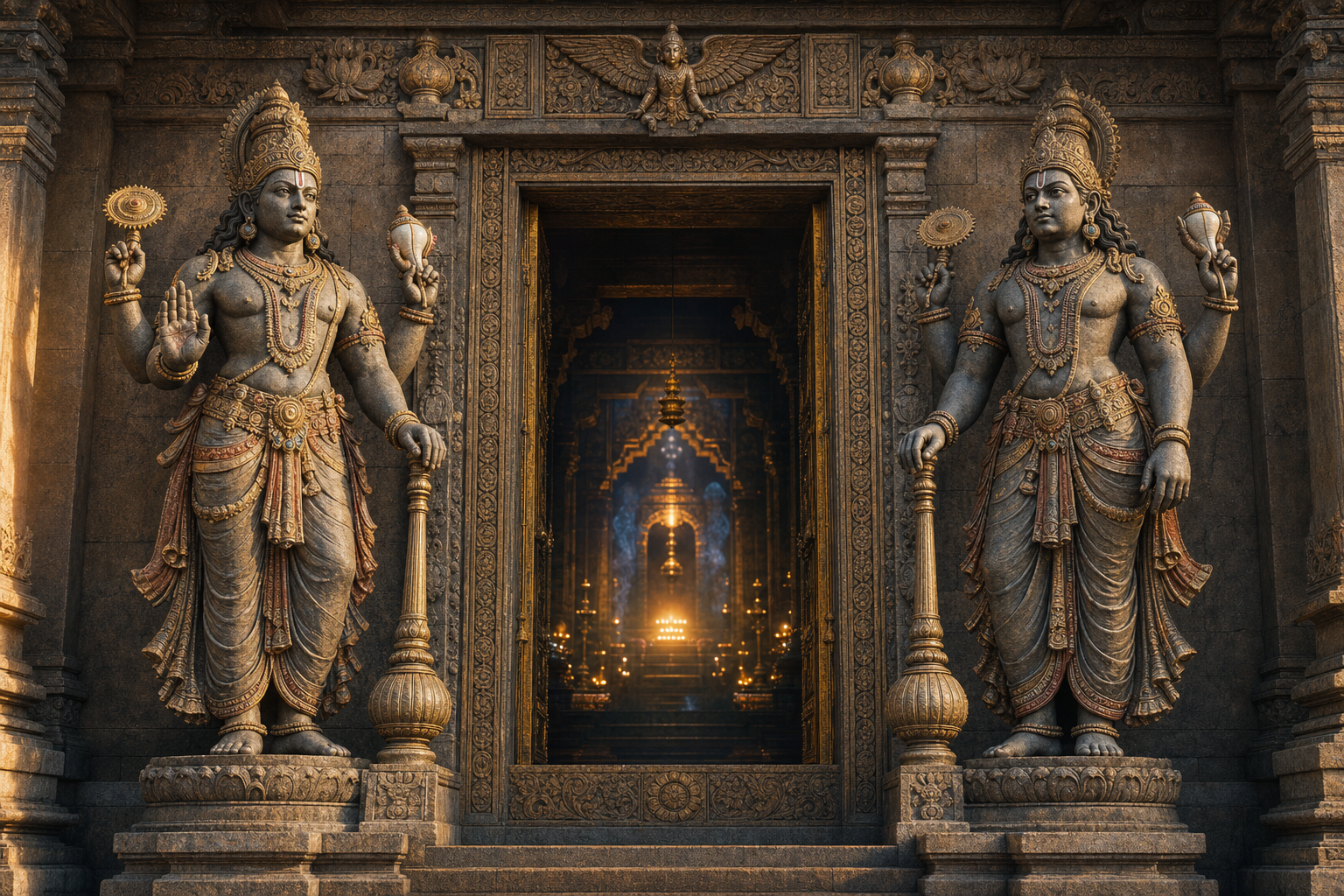
Guardians who transform a doorway into a sacred threshold
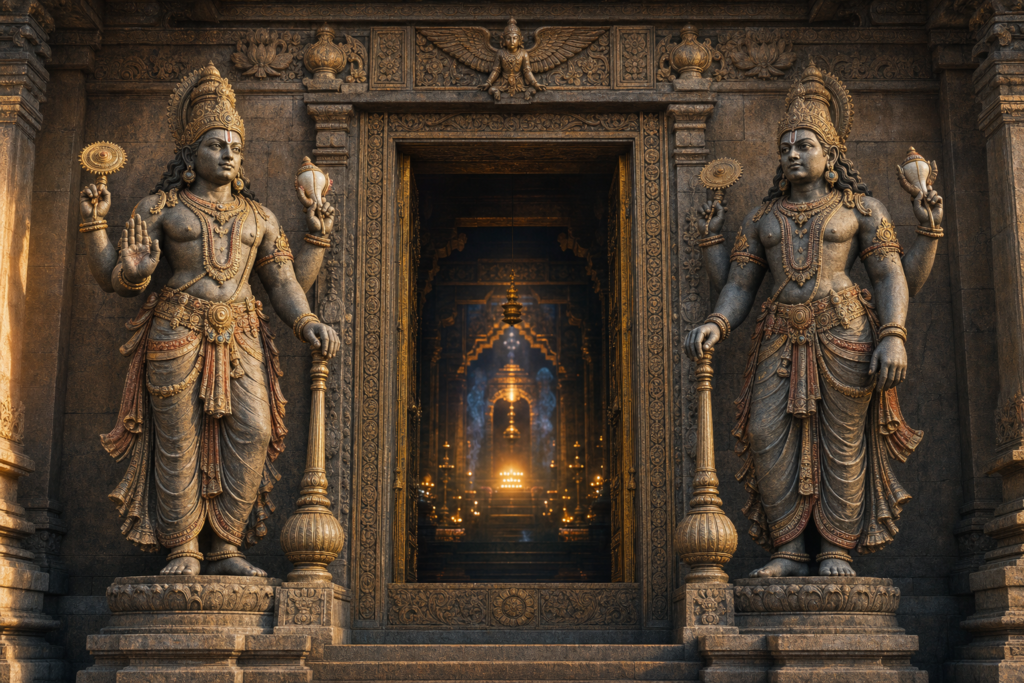
At the entrance to a Vishnu temple, a devotee may encounter two commanding figures standing on either side of a doorway. Their crowns rise above carefully arranged hair, their ornaments emphasize powerful torsos, and their multiple hands hold weapons or display meaningful gestures. These are the dvarapalas, the guardians of the threshold. In many Vaishnava temples and devotional explanations, the pair is identified as Jaya and Vijaya, the celebrated attendants of Bhagavan Vishnu. Their presence turns an architectural opening into a spiritually charged boundary between ordinary space and the concentrated sanctity of the temple interior.
Jaya and Vijaya are frequently described as guards, but that description captures only the surface of their function. Their images combine theology, narrative, ritual, architectural planning, political ideas of guardianship, and the sculptor’s understanding of the human body. They protect the deity’s domain, regulate symbolic passage, and remind visitors that entry into sacred space calls for attentiveness. Their four-armed form is especially significant because it visually associates them with Vishnu while preserving their distinct identity as divine attendants rather than independent manifestations of the Supreme Being.
What the term dvarapala means
The Sanskrit term dvārapāla, commonly written dvarapala, joins dvāra, meaning door or gateway, with pāla, meaning protector, keeper, or guardian. Its meaning is therefore both architectural and functional. A dvarapala belongs to a particular boundary and is responsible for its integrity. The plural form dvarapalas can describe guardian pairs associated with temples, shrines, palaces, monasteries, and other important structures across South and Southeast Asia.
The word does not identify a single, universally standardized iconographic type. Dvarapalas may be human, divine, semi-divine, royal, martial, serene, or fearsome. They may have two arms, four arms, or more, depending on the period, region, sectarian context, ritual text, and status of the doorway they guard. Some hold clubs, staffs, swords, serpents, conches, or discs. Others rely on commanding posture and gesture. The category is therefore broader than the names Jaya and Vijaya, even though those names have become strongly associated with Vishnu temple guardians in popular and liturgical memory.
Why not every Vaishnava guardian pair can automatically be named Jaya and Vijaya
It is tempting to identify every pair beside a Vishnu shrine as Jaya and Vijaya, but responsible iconographic study requires greater care. Vaishnava ritual and architectural traditions preserve several sets of guardian names. Their placement can vary according to the gateway, cardinal direction, enclosure, or level of the sacred complex. Local temple histories may also use names different from those found in another region or textual system. A pair may function as Vishnu’s dvarapalas without possessing inscriptions or attributes that prove an individual identification as Jaya and Vijaya.
A reliable identification draws upon several forms of evidence: the deity enshrined within, the precise location of the sculptures, the number of arms, the objects held, sectarian marks, inscriptions, ritual manuals, regional conventions, and the temple’s living oral tradition. Placement alone is rarely decisive. Even the figure standing to the viewer’s right cannot automatically be called Jaya or Vijaya without supporting evidence, because conventions of naming and orientation are not uniform. Where certainty is unavailable, the academically sound description is a pair of Vaishnava dvarapalas traditionally associated with Jaya and Vijaya.
The meanings carried by the names Jaya and Vijaya
Both names are formed around the idea of victory. Jaya means victory, triumph, or success, while Vijaya carries a closely related sense of decisive or distinguished victory. As a paired formula, the names intensify one another. They do not merely suggest military conquest. Within the sacred setting, victory may signify the establishment of dharma, the overcoming of disorder, the protection of divine sovereignty, and the devotee’s struggle against distraction, arrogance, fear, and confusion.
Their names also establish an important relationship between protection and rightful order. The guardians do not stand at an arbitrary fortress. They keep the threshold of Vishnu, whose sustaining role in Hindu thought is associated with cosmic stability and the restoration of dharma. Jaya and Vijaya consequently embody strength disciplined by service. Their authority is substantial, but it is delegated authority. Every weapon, gesture, ornament, and imposing feature ultimately points beyond the guardians to the deity whose presence they serve.
The foundational Vaishnava narrative
The best-known account of Jaya and Vijaya appears in the Vaishnava Puranic tradition, with an influential narration in the Śrīmad Bhāgavata Purāṇa. Jaya and Vijaya guard the entrance to Vaikuntha, the divine realm of Vishnu. The sages Sanaka, Sanandana, Sanatana, and Sanatkumara approach in a state of spiritual purity. Although ancient in wisdom, they possess the appearance of children. The guardians prevent them from advancing, judging by outward appearance rather than recognizing their spiritual attainment.
The sages respond by pronouncing that the guardians must leave Vaikuntha and take birth in the mortal world. Vishnu then appears, honors the sages, and addresses the failure at the gate. The precise theological emphasis varies in retelling, but the central lesson remains clear: proximity to divine authority does not eliminate the need for humility and discernment. A guardian may correctly value a boundary yet still misuse judgment in deciding who is worthy to cross it.
In the widely transmitted version, Jaya and Vijaya are offered a choice between seven births as devotees and three births as powerful opponents of Vishnu. They select the shorter separation, accepting three births in hostile roles so that they may return more quickly. They are consequently associated with the pairs Hiranyaksha and Hiranyakashipu, Ravana and Kumbhakarna, and Shishupala and Dantavakra. These adversaries are overcome through manifestations of Vishnu, including Varaha, Narasimha, Rama, and Krishna. Individual mappings and details can vary among textual and regional traditions, but the cycle consistently ends in restoration and return.
This narrative is not a simple endorsement of hostility as a spiritual path. Vaishnava interpreters sometimes discuss the intense, adversarial absorption of these figures in relation to Vishnu, but their violence and arrogance remain destructive within the stories. The deeper theological paradox is that divine grace can operate even through separation, conflict, and apparent catastrophe. The former guardians do not cease to belong to Vishnu’s larger order, although their worldly identities temporarily obscure that relationship.
A profound lesson about authority and discernment
The episode gives the sculpted guardians an ethical complexity that a purely decorative interpretation would miss. Jaya and Vijaya represent vigilance, but their story warns against confusing vigilance with suspicion. They represent loyalty, but their fall shows that loyalty without discernment can become exclusion. They represent authority, but the sages’ curse reveals that authority remains accountable to dharma. For a visitor approaching the shrine, the guardians therefore embody both protection and self-examination.
Their mythology also complicates the modern assumption that a guardian should be morally flawless. Hindu narratives often preserve sacred figures through transformation rather than reducing them to static examples of perfection. Jaya and Vijaya make an error, endure its consequences, participate in vast cosmic dramas, and finally return. Their journey conveys that failure need not be final, yet restoration does not erase responsibility. This balance between consequence and grace gives the pair an enduring emotional power.
The temple as a carefully ordered sacred landscape
Hindu temple architecture is organized through a sequence of spaces rather than a single undifferentiated interior. Depending on the temple’s scale and regional form, a visitor may move through an outer gateway, enclosure, courtyard, pillared mandapa, transitional vestibule or antarala, and finally toward the garbhagriha, the inner sanctum. Each stage concentrates attention. Light may diminish, sound may change, and the visual field may narrow as the sanctum approaches.
Dvarapalas can appear at more than one point in this progression. Monumental guardians may flank an outer gateway, while smaller and more explicitly divine figures stand beside the sanctum door. Their scale, attributes, and expression correspond to the status of the boundary. The pair closest to Vishnu’s image carries particular theological force because it marks the transition from congregational or processional space into the deity’s most concentrated ritual domain.
The threshold is neither fully outside nor fully inside. It is a liminal zone in which movement pauses and identity is symbolically adjusted. A visitor may remove footwear before entering the temple, quiet the voice, arrange the body respectfully, or join the hands in reverence. The guardians give sculptural form to that change in conduct. Their presence communicates that sacred approach is not merely physical movement; it is a reorientation of attention.
Why the four-armed form matters
Multiple arms in Hindu sculpture are a visual language of expanded capacity. They should not be read as an attempt to portray ordinary anatomy. Additional arms allow an image to display several attributes and actions simultaneously, revealing powers that cannot be adequately represented by a conventional human body. Four arms can indicate divine or superhuman status, mastery of several functions, and participation in the iconographic world of the presiding deity.
For Jaya and Vijaya, four arms establish a deliberate resemblance to Vishnu, who is commonly represented with four arms bearing the conch, discus, mace, and lotus. The resemblance announces intimacy with the deity and authority derived from him. At the same time, the guardians remain distinguishable through their position at the doorway, their martial posture, their subordinate scale or framing, and the particular combination of objects in their hands.
The four arms can also organize two complementary modes of guardianship. One pair of hands may hold weapons or insignia, while another offers a gesture of reassurance, warning, readiness, or reverence. Protection is thereby represented as more than physical force. It includes alertness, communication, ritual authorization, and the maintenance of order. The exact arrangement varies, so an isolated modern diagram should never be treated as a universal rule for every historical sculpture.
The mace as an emblem of disciplined power
The mace or gadā is among the most characteristic attributes of a temple guardian. It has an immediate martial meaning, yet its symbolism extends beyond combat. A mace is a concentrated instrument of authority. When held upright, planted against the ground, or supported beside the body, it gives the figure visual stability. Its vertical line can echo the doorjamb, linking the guardian’s body to the architecture itself.
In Vaishnava iconography, the mace also recalls Kaumodaki, the mace of Vishnu. A guardian carrying a related weapon visually participates in Vishnu’s protective sovereignty without becoming identical to him. The handling of the mace is important: a relaxed grip may suggest controlled readiness, while a raised weapon creates a more immediate sense of threat. Many accomplished sculptures favor contained power. The guardian does not need to strike because divine order is already present.
Conch, discus, lotus, and other attributes
Some four-armed Vaishnava dvarapalas carry the conch and discus, the most recognizable emblems of Vishnu. The śaṅkha or conch is associated with sacred sound, proclamation, auspiciousness, and the ordering call that precedes ritual or battle. The chakra or discus signifies dynamic power, protection, cosmic order, and the decisive removal of obstruction. When these appear with the guardians, they declare sectarian affiliation and reinforce the authority of the threshold.
The lotus or padma, where present, introduces a different quality. It can communicate purity, beauty, auspicious unfolding, and spiritual emergence. Its inclusion prevents the guardian’s identity from being reduced to aggression. Swords, shields, staffs, serpents, or other objects may occur in particular regional and textual traditions. Broken hands and weathered attributes can make identification difficult, which is why researchers consider sockets, surviving contours, old photographs, and comparable sculptures from the same monument.
Attributes must always be read as a coordinated ensemble. A disc-like object may be a chakra, but its identification depends on shape, handling, placement, and context. A rounded damaged form should not automatically be called a conch. Similarly, an object reconstructed during a modern restoration may reflect recent assumptions rather than the original program. Iconographic study is strongest when visual observation, textual comparison, and conservation history are considered together.
Mudras and the communication of sacred authority
An open palm can be as meaningful as a weapon. A hand resembling abhaya mudra communicates reassurance or freedom from fear, although the formal identification of a mudra depends on the exact arrangement of fingers and palm. Another hand may point, rest on a weapon, touch the hip, or indicate the direction of entry. Such gestures give the guardian a communicative role. The figure does not simply block passage; it instructs the approaching body in how to cross the threshold.
The combination of reassurance and force is central to dvarapala symbolism. To those who approach respectfully, the guardian can appear protective. To forces of disorder, the same figure appears formidable. The sculpture therefore does not express indiscriminate hostility. It presents power governed by relationship and purpose, a principle closely aligned with the protection of dharma.
Posture, balance, and controlled movement
The body of a dvarapala is usually composed to command attention without obscuring the doorway. Sculptors may employ a stable frontal stance, a subtle shift of weight, or a more pronounced bend through the hips and knees. One leg may bear the body while the other relaxes or extends toward the side. These adjustments create latent movement: the guardian appears capable of acting while remaining permanently stationed at the threshold.
Indian sculptural traditions use several systems for describing bodily balance, including straight, slightly flexed, and multiply bent postures. Their application varies, and surviving figures do not always fit a single label. What matters visually is the relationship among vertical stability, turning shoulders, flexed limbs, and the diagonals created by weapons. A successful composition feels both anchored and alive.
Paired guardians may mirror one another, face slightly inward, or turn outward toward approaching visitors. Mirroring creates architectural symmetry, while subtle differences prevent mechanical repetition. One guardian may bend a knee more deeply, hold a mace on the opposite side, or incline the head at a different angle. Such variation gives each figure individuality while maintaining the unity of the pair.
Face, gaze, and the spectrum between serenity and fierceness
The expression of a Vaishnava guardian can range from composed majesty to overt ferocity. Wide eyes, arched brows, flared nostrils, prominent teeth, or a heavy moustache may heighten protective force. Other examples possess calm faces that resemble royal attendants. These differences reflect period style, regional taste, the rank of the doorway, and the theological mood intended by the temple’s designers.
A fierce face should not automatically be interpreted as evil or demonic. In sacred art, controlled fierceness can be apotropaic, meaning that it turns away harmful influences. Conversely, a serene expression does not indicate passivity. Stillness may communicate confidence so complete that visible anger is unnecessary. The guardian’s outward gaze makes the visitor aware of being seen, while the guardian’s proximity to the sanctum confirms continuous attention to the divine presence within.
Crowns, ornaments, and the visual language of rank
Jaya and Vijaya are commonly shown as exalted attendants rather than ordinary soldiers. Crowns, earrings, necklaces, armlets, bracelets, sacred threads, belts, and elaborate textiles establish their elevated status. A tall crown extends the body upward and makes the figure appear monumental even within a narrow doorway. Broad jewelry catches light and articulates anatomical transitions at the neck, shoulders, arms, waist, and ankles.
Ornament is not merely decorative excess. In temple sculpture it can signify auspiciousness, divine proximity, abundance, royal service, and a body perfected for sacred representation. The contrast between refined jewelry and powerful weapons is deliberate. These guardians combine courtly dignity with martial readiness. Their beauty belongs to the order they protect, while their strength ensures that the order is not violated.
Sectarian marks may provide further evidence. A Vaishnava forehead mark, emblems related to Vishnu, or motifs such as Garuda can clarify the identity of the pair. Such details are sometimes eroded, covered by repeated ritual applications, or altered by later repainting. Their study therefore requires close observation and sensitivity to the fact that many sculptures remain active objects of worship rather than detached museum specimens.
How the guardians relate to the doorframe
A dvarapala should be studied together with the doorway it guards. Doorjambs may contain floral bands, divine figures, celestial beings, river goddesses, auspicious vessels, scrollwork, or narrative scenes. The lintel may identify the presiding deity or present a condensed statement of the temple’s theology. Jaya and Vijaya form one component of this coordinated visual program.
Their bodies often repeat or counter the geometry of the portal. A planted mace parallels a vertical jamb; a bent arm draws the eye toward the opening; a crown mediates between the human scale of the visitor and the height of the architecture. The pair may project into the visitor’s path without physically closing it. Sculpture and architecture thus work together to create a controlled invitation: entry is possible, but it is never casual.
Their location also shapes how they are seen. A figure observed from below may possess enlarged upper features or a forceful silhouette. Deep carving produces shadows that strengthen the eyes, ornaments, and weaponry. During lamp-lit worship, changing illumination can make the guardians appear especially animated. The temple image is therefore not designed only for evenly lit, frontal photography; it belongs to a moving and sensorial ritual environment.
Prescriptive texts and the diversity of actual monuments
Temple construction and image making draw upon extensive bodies of architectural, sculptural, Agamic, Pancharatra, and Vaikhanasa knowledge. Such traditions discuss measurements, attributes, placement, ritual suitability, and the relationships among images. They are indispensable for interpreting Vaishnava iconography, but they do not constitute a single manual followed identically across all centuries and regions.
A surviving sculpture may reflect one textual lineage, a local workshop convention, the instructions of a patron or ritual specialist, or a creative synthesis of several sources. Texts themselves exist in different recensions and sometimes prescribe alternative forms. Historical monuments can also depart from surviving prescriptions. The responsible method is therefore comparative: texts illuminate images, images test assumptions about texts, and living temple traditions preserve knowledge that neither category contains by itself.
Rigid checklists can obscure this complexity. Four arms do not by themselves prove that a figure is Jaya or Vijaya, just as a mace does not identify every guardian as Vaishnava. The entire iconographic system must be evaluated. Academic caution does not weaken sacred interpretation; it prevents regional diversity from being erased by a single generalized formula.
Materials and the craft of making a guardian
Dvarapalas have been fashioned in granite, sandstone, schist, chloritic stone, stucco, wood, metal, and other locally available materials. The stone chosen affects both appearance and technique. Hard granite favors strong masses, durable silhouettes, and carefully controlled detail, while finer-grained stones can support intricate jewelry, delicate facial features, and deep ornamental undercutting. Stucco and wood permit different kinds of modeling but require protection from climate and fire.
A stone figure begins as an architectural and volumetric problem. The sculptor must accommodate the available block, establish the principal axes, distribute four arms without visual confusion, preserve structurally vulnerable wrists and attributes, and ensure that the composition remains legible from the visitor’s route. The mace may serve both iconographic and compositional purposes by forming a strong supporting line. Rear arms are arranged above or beside the shoulders so that their attributes remain visible.
Many temple sculptures may originally have carried pigment, coatings, textiles, metal ornaments, or ritual substances that changed their visual effect. The unpainted stone admired today is not always the complete historical appearance. At living temples, recurring anointing, cleaning, garlanding, and repainting continue to shape the surface. These practices form part of the image’s ritual biography, although conservation specialists must also monitor abrasion, salt formation, trapped moisture, and incompatible modern coatings.
Regional variation across India
The history of Hindu temple sculpture demonstrates continuity without uniformity. Early and medieval door guardians helped establish a visual vocabulary that later workshops expanded in different ways. In many northern traditions, guardians are integrated with densely organized doorframes and auspicious threshold imagery. In southern temple architecture, dvarapalas often acquire exceptional scale and bodily force, especially near major gateways and sanctum entrances. Deccan workshops may combine muscular mass with elaborate ornament and sharply articulated movement.
Pallava, Chola, Hoysala, Vijayanagara, Nayaka, Odisha, Rajasthan, central Indian, and other regional traditions each developed recognizable approaches to anatomy, ornament, posture, and architectural framing. These labels are useful historical guides, but they should not become stereotypes. A temple could be renovated under several dynasties, and a doorway might contain guardians created centuries later than the sanctum it serves. Dating must therefore consider construction history, inscriptions, material, style, and archaeological context.
South Indian dvarapalas are often remembered for dramatic posture, powerful torsion, emphatic eyes, and monumental clubs. Hoysala and related sculptural environments may surround guardians with exceptionally detailed ornament. Later gateways can amplify scale until the guardian becomes an overwhelming architectural presence. Elsewhere, a smaller and calmer pair may achieve the same ritual function through balanced symmetry and refined symbolism. Monumentality is only one means of communicating sacred authority.
Beyond India: a shared and adaptable guardian tradition
Dvarapala imagery traveled and developed across South and Southeast Asia through networks of pilgrimage, trade, scholarship, artisanship, diplomacy, and royal patronage. Guardian figures became prominent in Khmer, Javanese, Balinese, and other architectural traditions, where artists adapted Indic concepts to local materials, cosmologies, clothing, and concepts of power. Some are associated with Hindu temples, others with Buddhist monuments, and many belong to complex religious landscapes that changed over time.
These international examples should not automatically be called Jaya and Vijaya. The broader dvarapala concept is demonstrably mobile, but a personal name requires local evidence. Careful comparison reveals something more valuable than a claim of exact sameness: communities adopted a shared language of sacred guardianship while producing distinct forms appropriate to their own histories.
Dharmic parallels without erasing difference
Guardian figures and protected thresholds also appear in Buddhist and Jain visual cultures. Yakshas, directional protectors, martial attendants, and other sacred beings may defend monuments, teachings, or ritual space. These traditions developed through long periods of artistic exchange with Hindu communities. Shared workshops, regional aesthetics, and inherited symbols created genuine points of connection.
Comparison must nevertheless preserve theological difference. A Buddhist guardian, a Jain protective deity, and a Vaishnava dvarapala are not interchangeable simply because they occupy similar architectural positions. Their narratives, ritual roles, and doctrinal meanings may differ substantially. Respectful study recognizes both relationship and distinction. This approach strengthens unity among dharmic traditions because it builds understanding without flattening each tradition’s integrity.
The ethical principle embodied by a sacred threshold also has wider relevance. Hinduism, Buddhism, Jainism, and Sikhism each possess distinctive teachings, yet all have developed disciplined ways of relating conduct, community, service, and spiritual aspiration. Jaya and Vijaya contribute a specifically Vaishnava reflection on how strength should serve the sacred. Their story adds the warning that guardianship must never lose humility, wisdom, or accountability.
Darshana and the visitor’s encounter
Temple sculpture is encountered through movement. A visitor does not usually study Jaya and Vijaya from a neutral distance before proceeding. The figures emerge during an approach shaped by bells, lamps, fragrance, chanting, footsteps, and the anticipation of darshana. Their scale and gaze may produce a momentary feeling of being halted, even when the doorway remains fully open.
That pause can be interpreted as part of the temple’s spiritual discipline. Before seeking the sight of Vishnu, the visitor is invited to become conscious of intention. Anger, haste, vanity, and distraction do not vanish at the door, but they can be recognized. The guardians make this interior work visible. Their weapons confront disorder, while their service to Vishnu demonstrates where power must be directed.
For many viewers, the most moving aspect of the pair is not their ferocity but their unwavering presence. Generations pass, dynasties disappear, buildings are repaired, and patterns of worship change, yet the guardians remain at their assigned boundary. Their endurance can evoke trust, continuity, and the sense that sacred responsibility is sustained through service repeated over time.
Victory as an inward and outward principle
The names Jaya and Vijaya allow the doorway to be read as a site of victory. At the cosmic level, Vishnu’s order prevails over forces that threaten creation. At the ethical level, disciplined judgment must prevail over arrogance. At the personal level, attention can prevail over distraction. These meanings coexist without requiring the sculpture to function as a simplistic allegory.
The guardians’ own fall makes their victorious names deliberately paradoxical. They stand for triumph, yet their mythology begins with a serious failure at the gate. Their eventual restoration shows that the deepest victory is not immunity from error but return to right relationship after consequences have been faced. This interpretation gives their forms an unusual depth: the protectors of order have personally experienced the cost of misjudgment.
Distinguishing the guardians from Vishnu
Because four-armed Jaya and Vijaya may carry Vishnu’s attributes, an isolated photograph can be mistaken for an image of Vishnu. Context resolves much of the uncertainty. Vishnu normally occupies the central position of worship and possesses an iconographic arrangement appropriate to a particular form. The guardians stand laterally, relate dynamically to a doorway, and frequently emphasize martial readiness. Their attributes may resemble Vishnu’s but are arranged to express attendance and protection.
Scale is helpful but not infallible. A monumental dvarapala can be larger than an image visible deep inside the sanctum, while a small guardian may be carved within a doorjamb. Pedestal motifs, accompanying figures, inscriptions, crown type, posture, and architectural placement must all be considered. Iconographic identity emerges from relationships, not from a single object held in one hand.
A practical method for reading a four-armed guardian sculpture
A careful examination begins with location. The viewer should determine whether the figure belongs to an outer gate, a mandapa entrance, an antarala, or the sanctum doorway. The presiding deity and the orientation of the entrance should be recorded. The sculpture must then be studied as one half of a pair, because mirrored attributes and complementary postures may clarify details that are damaged on one side.
The next stage is visual documentation. The number of arms, position of each hand, surviving attributes, crown, jewelry, sacred thread, facial expression, stance, pedestal, attendant figures, and sectarian marks should be described before an identification is proposed. Damage must be distinguished from intentional form. A missing hand should be recorded as missing rather than imaginatively supplied with the object expected by a modern viewer.
Contextual evidence follows. Inscriptions, temple chronicles, ritual manuals, archival photographs, conservation reports, and information maintained by priests or hereditary service communities may preserve the names of the figures. Comparisons should prioritize sculptures from the same monument and region before turning to distant examples. Only then should wider textual prescriptions be used to refine the interpretation.
The final description should indicate the degree of certainty. Phrases such as identified by inscription, locally worshipped as, conventionally associated with, or probably representing communicate different levels of evidence. This vocabulary protects both academic accuracy and the authority of living tradition. It also leaves room for future discoveries rather than presenting every interpretation as final.
Common interpretive mistakes
One common mistake is to treat the figures as decorative soldiers added to fill empty wall space. This ignores their ritual location and theological narrative. Another is to assume that fierce appearance indicates moral evil. A third is to identify each hand-held object from expectation rather than observation. A fourth is to impose one regional convention on every Vishnu temple in India.
Modern images can create additional confusion. Newly produced sculptures often synthesize features from several historical styles, while online captions may repeat unverified names. Digital mirroring can reverse the apparent positions of the pair. Cropped photographs remove the doorway that explains their function. Reliable interpretation therefore depends on provenance, an uncropped architectural view, and evidence from the temple itself.
It is equally misleading to force every feature into a single secret meaning. Sculptors work through theology, but they also solve problems of material, visibility, balance, patronage, and style. A hand may be positioned partly to display an attribute clearly or to protect a narrow stone projection. Symbolic and technical explanations often operate together.
Conservation of guardians at living temples
Dvarapalas stand in exposed and heavily used locations. They may be affected by rain, wind, temperature change, salts, biological growth, smoke, dust, repeated touching, oil, pigment, and accidental impact. Doorways are also vulnerable during structural repairs because loads shift and visitors pass close to the sculpture. Lost hands and attributes are especially common where stone projections extend into the circulation route.
Conservation must respect both material evidence and continuing worship. Aggressive cleaning can remove historical coatings, tool marks, pigments, or ritual layers. Incompatible cement repairs can trap moisture or place stress on older stone. An undocumented replacement may make a figure look complete while introducing an iconographically inaccurate attribute. The strongest projects involve conservation professionals, temple authorities, ritual communities, historians, and craftspeople in shared decision-making.
High-resolution photography, measured drawings, three-dimensional scanning, and condition mapping can preserve valuable information without replacing direct care. Documentation should include the whole doorway, not only dramatic close-ups of faces and weapons. The relationship between guardian and architecture is part of the monument’s meaning and must be conserved as a unit.
Contemporary relevance of Jaya and Vijaya
The guardians remain relevant because every community must decide how to protect what it values without becoming unjustly exclusionary. Their mythology refuses an easy answer. Boundaries can be necessary, and careless access can damage sacred spaces. Yet a boundary administered without wisdom may reject the very holiness it was created to protect. Jaya and Vijaya thus offer a sophisticated reflection on security, hospitality, accountability, and the limitations of outward judgment.
Their four arms reinforce this message through visual abundance. Effective guardianship requires more than force: it demands attention, restraint, discernment, and service. Weapons alone do not make a guardian sacred. The sacred quality comes from alignment with dharma and devotion to a purpose beyond personal power.
For temple visitors, the pair can encourage a simple but demanding question: what must be left at the threshold before entering? The answer need not involve rejection of the world. It may involve leaving behind haste, contempt, careless speech, or the assumption that sacred experience is automatically owed. The doorway becomes a place where approach is transformed into preparation.
The enduring power of the four-armed form
Jaya and Vijaya occupy a distinctive place in Hindu sculptures because they unite imposing form with moral vulnerability. They are powerful enough to guard Vaikuntha, yet capable of misjudgment. They fall into worlds of conflict, yet remain connected to Vishnu. They carry the symbols of divine authority, yet stand to the side in service. Their identity is created through these tensions rather than through physical strength alone.
Their four-armed images also demonstrate the precision of Vaishnava iconography. Every arm expands the range of action; every attribute establishes affiliation; every posture negotiates between stillness and readiness; every ornament expresses rank; and every placement beside the doorway defines a boundary. Read together, these features transform stone into a complex statement about sacred order.
At the threshold of a Vishnu temple, Jaya and Vijaya do more than prevent intrusion. They prepare the way for darshana. Their strength protects, their story cautions, and their unwavering service directs attention toward Bhagavan Vishnu. The visitor who pauses before them encounters one of Hindu temple architecture’s most powerful insights: entry into sacred space begins not when the feet cross a doorway, but when awareness, humility, and purpose are brought into alignment.
Inspired by this post on Hindu Blog.






Leave a Reply
You must be logged in to post a comment.