
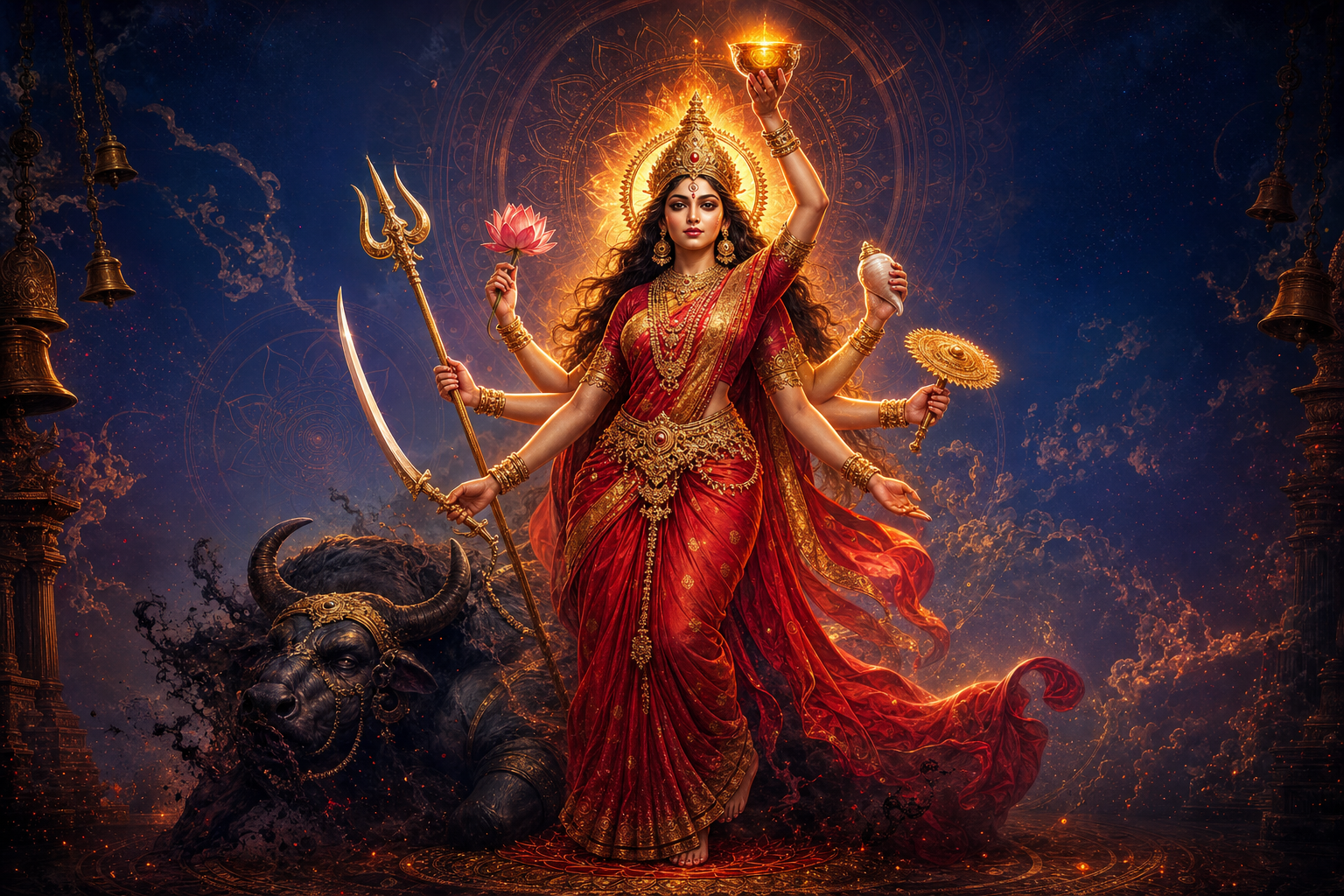
Ugra Chandika’s act of drinking alcohol in the Devi Mahatmya is one of the most striking images in Hindu sacred literature. It is not presented as ordinary indulgence, social excess, or moral weakness. It appears in the battlefield context of the Goddess confronting adharma, where every gesture, weapon, sound, and mood carries symbolic force. The moment is therefore best understood through the language of Shakti, dharma, ritual symbolism, and inner transformation rather than through a narrow moral reading of alcohol as a social substance.
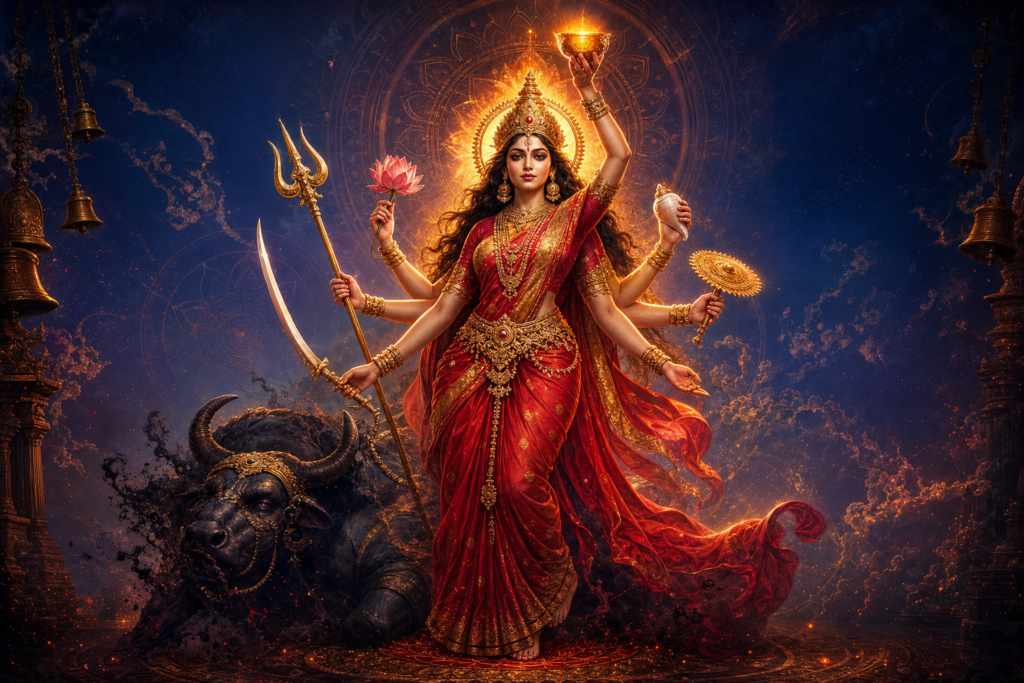
The key line often associated with this image occurs in the third chapter of the Devi Mahatmya, during the confrontation with Mahishasura. Chandika addresses the demon with the fierce declaration: “Garj garj kshanam mudha madhu yavat pibamyaham.” Roar, O fool, for a moment while I drink. The statement is brief, but its theological power is immense. It reverses the expected logic of fear. The demon roars to intimidate, but the Goddess allows him only a temporary sound before his defeat. Her drinking becomes an announcement of sovereignty: time, terror, intoxication, battle, and death are all under her command.
In Shakta traditions, Chandika is not merely a fierce warrior goddess. She is the concentrated power of Devi, the radiant and terrible form of the divine feminine who arises when cosmic balance is threatened. The word Ugra means fierce, intense, formidable, or terrible in the sacred sense. It does not imply cruelty for its own sake. It indicates a form of compassion that has become uncompromising because the situation demands it. Ugra Chandika is the force that appears when persuasion, patience, and gentle correction can no longer restrain destructive arrogance.
The drinking of madhu in this setting must be read within the symbolic universe of the Devi Mahatmya. The Sanskrit word madhu can carry associations of sweetness, honey, wine, and intoxicating drink, depending on context. In the battlefield scene, the imagery evokes a sacred intoxication, a state beyond ordinary hesitation and social restraint. Chandika does not drink because she is controlled by desire. She drinks because she is beyond being controlled by anything. The intoxicant that overwhelms ordinary beings becomes powerless before the Goddess. What binds the limited mind becomes an ornament of the unlimited Shakti.
This distinction is essential. Hindu scriptures often teach that substances, emotions, and powers are not spiritually neutral in every context; their meaning depends on intention, discipline, adhikara, and sacred setting. Fire can cook food, illuminate a shrine, or destroy a forest. Speech can bless, teach, deceive, or wound. In the same way, madhu in the hand of Ugra Chandika is not a license for disorder. It is a symbol of divine mastery over the forces that usually disturb human judgment. The Goddess consumes what would consume others.
The scene also challenges superficial ideas of purity. Chandika’s purity is not fragile. It is not dependent on avoidance, delicacy, or social approval. Her purity is ontological; it belongs to her very nature as Devi Shakti. She can enter the battlefield, stand among blood and weapons, laugh at demonic arrogance, drink madhu, and still remain the source of cosmic order. This is why the image has such enduring force in Hindu iconography and spiritual reflection. It shows a sacred power that is not diminished by contact with the terrifying aspects of existence.
Mahishasura represents more than a mythic enemy. In the Devi Mahatmya, he is the shape-shifting force of arrogance, violence, domination, and spiritual blindness. His buffalo form is often interpreted as a symbol of tamas: heaviness, inertia, ignorance, and brute instinct. His shifting forms suggest the unstable nature of ego, which changes its appearance whenever it is challenged. Sometimes it appears as pride, sometimes as anger, sometimes as clever justification, and sometimes as wounded self-importance. Chandika’s calm fierceness exposes all these disguises.
Her command to the demon to roar for a moment is psychologically profound. The ego often roars loudest when it is closest to defeat. It creates noise to avoid recognition. It performs strength when it senses the arrival of truth. Chandika does not panic before that roar. She gives it a limit. The phrase “Garj garj kshanam mudha madhu yavat pibamyaham.” becomes a sacred lesson in inner discipline: let the forces of confusion make their noise, but do not mistake noise for power. Dharma does not need to shout in order to prevail.
The drinking image also belongs to the wider Shakta understanding of divine rasa. Rasa means essence, flavor, mood, or aesthetic-spiritual experience. The Goddess is not an abstract principle detached from life. She is power, rhythm, intensity, beauty, terror, nourishment, and dissolution. In some forms she is motherly and gentle; in others she is blazing, martial, and unyielding. Ugra Chandika embodies the rasa of righteous ferocity. Her sacred intoxication is the ecstasy of divine purpose, not the confusion of human escapism.
This is why the image should not be reduced to a debate about alcohol alone. The deeper question is mastery. Who is the subject, and what is the object? In ordinary addiction or indulgence, the person becomes the object, controlled by craving. In the Devi Mahatmya, Chandika remains the sovereign subject. She acts, chooses, speaks, drinks, fights, and destroys from complete self-possession. The madhu does not cloud her perception; it dramatizes her transcendence over all limiting forces.
There is also a ritual dimension. In several Tantric and Shakta contexts, substances that are socially restricted or symbolically dangerous are ritually transformed under strict conditions. Such practices are not casual permissions for excess. They are surrounded by discipline, mantra, lineage, and sacred intention. The point is not indulgence but transmutation. What is feared, rejected, or misunderstood is brought into the field of consciousness and offered to the Divine. Ugra Chandika’s madhu can therefore be read as a cosmic version of this transformation: the raw force of intoxication becomes absorbed into Shakti and redirected toward the restoration of dharma.
At an ethical level, the scene teaches that dharma is not always soft in appearance. Many spiritual seekers are comfortable with compassion, patience, and forgiveness, but become uneasy before divine wrath. Yet Hindu scriptures repeatedly show that protection sometimes requires force. Durga, Kali, Narasimha, Bhairava, and other fierce forms do not contradict compassion; they protect its possibility. Without the destruction of predatory adharma, gentleness becomes vulnerable to exploitation. Ugra Chandika’s fierceness is therefore not the opposite of love. It is love armed with clarity.
The emotional power of this image lies in its refusal to flatter weakness. Many people encounter moments when inner Mahishasura appears as fear, shame, rage, compulsion, or despair. These forces often seem enormous because they roar within the mind. The Goddess offers a different response. She does not negotiate endlessly with the destructive impulse. She sees it, names its foolishness, allows its final roar, and destroys it. For practitioners, this becomes a meditative image of courage: the deepest spiritual strength is not the absence of darkness, but the capacity to face it without surrender.
Ugra Chandika also expands the understanding of the Sacred Feminine in Hindu tradition. The feminine divine is not confined to softness, fertility, beauty, or maternal tenderness, though it includes all of these. Devi is also strategy, force, sovereignty, speech, judgment, and cosmic anger. This matters because a culture that worships Devi must be able to honor feminine power in its full range. Chandika drinking on the battlefield is a radical theological statement: the Goddess does not exist to satisfy human expectations of politeness. She exists as reality itself, and reality includes the power to end what violates cosmic order.
The episode also has a philosophical connection with the three gunas: sattva, rajas, and tamas. Mahishasura’s buffalo nature suggests tamasic dullness and brute resistance. The battle itself is rajasic, full of movement, passion, and force. Chandika, however, stands beyond both. She uses rajasic energy to destroy tamasic oppression, while remaining rooted in a higher divine clarity. Her drinking does not pull her downward into tamas. Instead, it reveals that the gunas operate within Prakriti, while the supreme Devi is their source and ruler.
In devotional reading, this moment becomes an assurance that the Divine is not intimidated by chaos. Human beings often feel overwhelmed by the disorder of the world: injustice, violence, arrogance, and the repetitive return of harmful patterns. The Devi Mahatmya does not deny that such forces exist. It gives them a form, a voice, and a roar. Then it places them before Chandika. The result is not sentimental optimism but sacred confidence. Adharma may roar, but its time is limited.
The unity of Dharmic traditions can also be appreciated through this symbolism. Hinduism, Buddhism, Jainism, and Sikhism each emphasize, in distinct ways, the conquest of inner enemies such as ignorance, ego, anger, attachment, and delusion. The imagery of Ugra Chandika belongs specifically to the Shakta Hindu scriptural world, but its deeper lesson is widely resonant across Dharmic thought. True strength is disciplined. True victory is inward as well as outward. True spiritual power does not glorify violence; it ends the tyranny of forces that prevent awakening, compassion, and righteous living.
For this reason, Ugra Chandika’s drinking should be approached with reverence and interpretive care. A literalist reading risks missing the theological depth, while a dismissive modern reading may mistake sacred symbolism for scandal. The Devi Mahatmya speaks in the language of myth, poetry, mantra, and metaphysical drama. Its images are meant to disturb complacency. They are meant to awaken attention. Chandika drinking madhu while the demon roars is not an incidental detail; it is a carefully charged image of divine fearlessness.
The phrase “Roar while I drink” therefore carries several layers of meaning. It is a battlefield taunt, a declaration of divine sovereignty, a psychological teaching, and a metaphysical symbol. The demon is permitted a final display, but the outcome is already sealed. The Goddess drinks not to escape reality but to reveal her command over it. She is unshaken by sound, form, intoxication, violence, or death. This is the unflinching Shakti at the heart of the episode.
In the end, the symbolism of Ugra Chandika drinking alcohol is not about celebrating intoxication. It is about the sacred power that cannot be intoxicated, corrupted, frightened, or controlled. It is about the Goddess who transforms the dangerous into the divine, the chaotic into the purposeful, and the terrifying into the protective. Her cup is not a sign of weakness; it is a sign that nothing in creation stands outside her sovereignty. Her destruction is not nihilism; it is the clearing of space for dharma to breathe again.
Ugra Chandika remains one of the most compelling forms of Devi because she speaks to a truth that is both cosmic and intimate. There are moments when the inner and outer worlds require tenderness, and there are moments when they require decisive strength. The Devi Mahatmya preserves both truths. In Chandika’s fierce laughter, in her fearless drinking, and in her command to the roaring demon, the tradition offers an enduring vision of Shakti: compassionate enough to protect, fierce enough to destroy, and sovereign enough to remain untouched by everything she transforms.
Inspired by this post on Hindu Blog.


Leave a Reply
You must be logged in to post a comment.