
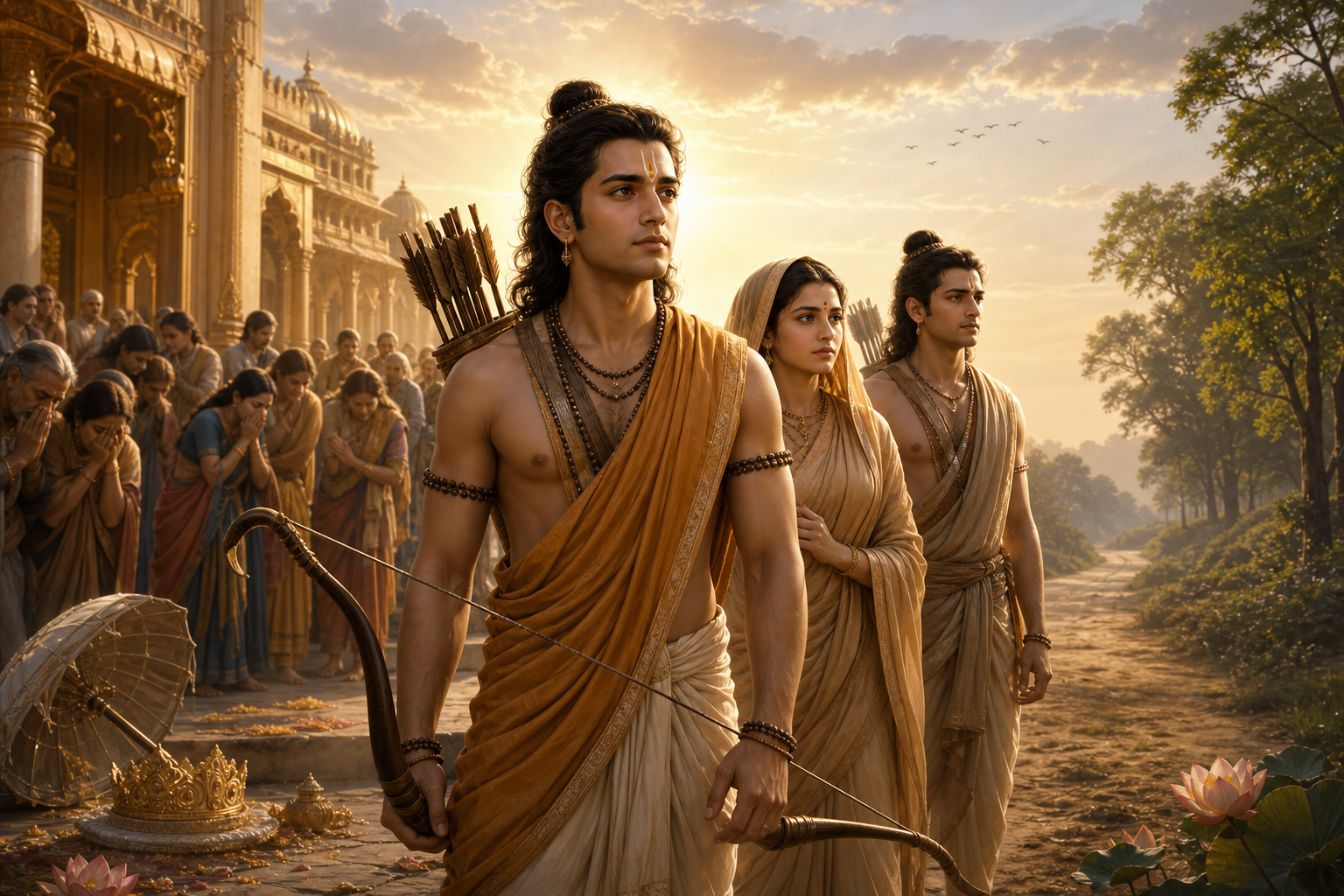
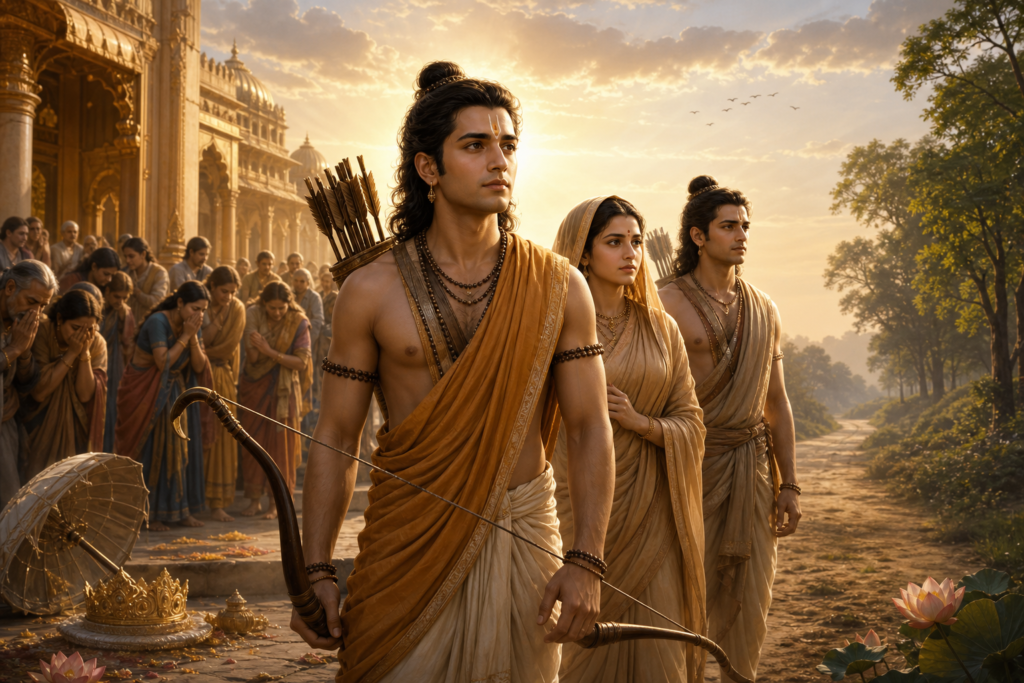
The departure of Rama from Ayodhya for fourteen years of exile remains one of the most psychologically powerful moments in the Ramayana. It is not merely a royal crisis, a family tragedy, or a turning point in an epic narrative. It is a concentrated study of dharma under pressure, self-control under provocation, and emotional discipline when every visible circumstance seems unjust. The scene endures because Rama does not respond to exile as a detached supernatural figure untouched by pain. In the Valmiki Ramayana, he is presented with striking human immediacy: a prince, a son, a husband, and an heir whose life is suddenly overturned by palace intrigue and the binding force of a promise.
Rama’s calm is often described as stoic, but it is important to understand that this calm is not coldness. It is not indifference, emotional numbness, or passive resignation. His composure is disciplined moral clarity. He sees the crisis before him, understands its personal cost, recognizes the grief it will cause to those who love him, and still chooses a course rooted in dharma rather than impulse. This is why the episode has remained central to Hindu thought, Indian literature, and broader dharmic reflection: it shows that true strength is not the absence of suffering, but the ability to act rightly while suffering is fully present.
The political background is familiar. King Dasharatha, bound by earlier boons granted to Queen Kaikeyi, must send Rama into exile and install Bharata as heir. The demand is devastating because Rama has just been prepared for coronation. Ayodhya expects celebration, not bereavement. The kingdom has already emotionally accepted Rama as its future ruler. Yet in a single turn, royal joy becomes moral testing. This reversal is not accidental to the Ramayana’s structure. It reveals whether Rama’s virtue depends on favorable circumstances or whether it remains steady when power, honor, and comfort are stripped away.
Rama’s response is extraordinary because he does not treat the throne as an entitlement. He does not argue that public support overrides Dasharatha’s word. He does not mobilize popular affection against Kaikeyi. He does not present himself as the wronged prince whose personal claim must be defended at any cost. Instead, he places the integrity of the father’s promise above his own immediate gain. In this sense, the exile becomes a test of satya, filial duty, rajadharma, and restraint. Rama’s greatness lies in the fact that he can distinguish between what is legally available, emotionally tempting, politically possible, and morally necessary.
The Valmiki Ramayana’s treatment of Rama is especially significant here. Later devotional traditions rightly honor him as Bhagavan Vishnu’s avatar, yet the epic frequently allows him to move within the limits of human experience. He grieves, deliberates, questions, loves, suffers, and acts. His divinity does not erase his humanity; rather, his humanity becomes the field through which dharma is made visible. The exile is therefore not best understood as a god pretending to be calm. It is the portrait of an ideal human being showing what disciplined consciousness looks like when confronted with loss.
This distinction matters because it makes Rama’s conduct ethically meaningful. If he were portrayed only as omniscient and unaffected, his calm would be impressive but inaccessible. The Ramayana instead gives readers a model that can be contemplated, debated, and imitated in proportion to one’s own capacity. Rama does not deny the pain of separation from Ayodhya. He does not trivialize the sorrow of Kausalya, Sita, Lakshmana, or the citizens. Yet he refuses to let pain become a justification for adharma. His mastery is not over events; it is over the inner turbulence that events awaken.
In this way, Rama’s departure becomes a technical lesson in self-governance. The first discipline is cognitive clarity: he identifies the central moral fact, namely that Dasharatha’s promise must be upheld. The second is emotional regulation: he does not allow anger toward Kaikeyi to dominate his speech or conduct. The third is social responsibility: he prevents the crisis from becoming a civil rupture in Ayodhya. The fourth is spiritual steadiness: he accepts exile not as meaningless humiliation, but as a field for dharma. These layers together create the distinctive calm associated with Rama.
His silence in this episode is not weakness. It is chosen restraint. In many political worlds, silence is interpreted as defeat, and visible outrage is mistaken for courage. Rama reverses that assumption. He shows that speech has moral weight, and that words spoken in anger can deepen disorder. His refusal to condemn Kaikeyi publicly does not mean he approves of her demand. It means he will not allow personal hurt to become a weapon against family, kingdom, and truth. This is a profound form of kshatra dharma: the warrior’s strength begins with conquest of the self.
Rama’s calm also protects others. Dasharatha is already shattered by the consequences of his own promise. Kausalya is overcome with grief. Lakshmana burns with righteous anger. Sita faces the terrifying prospect of forest life after palace life. The citizens of Ayodhya are emotionally destabilized. In such a moment, Rama becomes the still center of a collapsing world. His steadiness does not remove everyone’s sorrow, but it prevents sorrow from turning into chaos. This is why his conduct is not merely private spirituality; it is public ethics.
The episode also reveals the Ramayana’s understanding of leadership. A ruler is not tested only by how he exercises power, but also by how he relinquishes it. Rama’s willingness to leave Ayodhya demonstrates that legitimate authority is not possession. It is service governed by dharma. A person attached to power at all costs would interpret exile as annihilation. Rama interprets it as obligation. That difference is the mark of inner sovereignty. He loses the throne outwardly, but he does not lose command over himself.
This is why the phrase Maryada Purushottama remains so important in understanding Rama. Maryada refers to boundary, discipline, propriety, and ethical order. Rama’s greatness is not lawless charisma, emotional exhibition, or conquest for its own sake. His excellence is measured through adherence to rightful limits. When he leaves Ayodhya, he accepts a boundary he did not create and did not desire. Yet by honoring it, he transforms an imposed exile into a voluntary act of dharma. The event becomes spiritually luminous because the inner decision changes the meaning of the outer circumstance.
There is also a subtle distinction between obedience and moral intelligence. Rama is not portrayed as thoughtless. He understands the implications of the exile. He knows that the people want him to stay. He knows that Kaikeyi’s demand is harsh. He knows that Dasharatha is acting under unbearable compulsion. Still, he judges that preserving the sanctity of a promise is essential to the moral fabric of the royal house. In dharmic reasoning, truth is not a private preference; it sustains trust across family, society, and state.
Rama’s conduct toward Kaikeyi is particularly revealing. He does not demonize her in the moment of departure. He addresses the situation through duty rather than resentment. This does not erase the moral seriousness of her demand, but it prevents the narrative from becoming a simple exercise in hatred. The Ramayana’s ethical sophistication lies in this restraint. It recognizes wrongdoing, grief, and error, yet keeps the larger horizon of dharma visible. For a blog committed to unity among dharmic traditions, this is a crucial point: moral clarity need not require bitterness, and justice need not be pursued through dehumanization.
Sita’s decision to accompany Rama deepens the emotional and philosophical force of the exile. Rama initially seeks to protect her from the dangers of the forest, but Sita insists on sharing his fate. Her choice is not decorative loyalty; it is agency grounded in dharmic partnership. The exile therefore becomes a household test as much as a royal one. Rama’s calm must now include responsibility for Sita’s safety, Lakshmana’s devotion, and the uncertain conditions of forest life. The burden increases, yet his composure remains ordered by duty.
Lakshmana’s response forms a meaningful contrast. He is intense, protective, and indignant. His anger is not selfish; it arises from love and a sharp sense of injustice. Yet Rama guides him toward restraint. This exchange is psychologically important because the Ramayana does not deny the appeal of anger when wrongdoing occurs. It shows, however, that even justified anger requires governance. Lakshmana represents the fire of loyalty; Rama represents the discipline that gives that fire direction. Together, they show that dharma needs both courage and control.
The citizens of Ayodhya add another layer to the episode. Their grief demonstrates that Rama’s relationship with the kingdom is not merely institutional. He is loved because he embodies trust. When such a figure leaves, the city feels morally orphaned. Yet Rama does not exploit this affection. A lesser leader might have used public emotion to reverse the decision, provoke rebellion, or humiliate the royal household. Rama refuses. His departure therefore protects Ayodhya from the danger of factional breakdown. This is political restraint of the highest order.
From a comparative dharmic perspective, Rama’s calm resonates with several traditions without needing to collapse their differences. In Hindu thought, it reflects dharma, self-control, and the discipline of the senses. In Buddhist reflection, one may see a parallel concern with equanimity amid impermanence and suffering. In Jain ethics, there is resonance with restraint, non-possessiveness, and careful governance of passion. In Sikh tradition, the dignity of accepting hukam while acting with courage offers another meaningful point of reflection. These traditions are distinct, yet they share a deep respect for inner discipline joined to ethical action.
The language of stoicism can be useful if applied carefully. Classical Stoic philosophy emphasizes distinguishing between what is within one’s control and what is not. Rama’s exile illustrates a comparable insight in a dharmic framework. He cannot control Kaikeyi’s demand, Dasharatha’s earlier promise, or the immediate grief of Ayodhya. He can control his response, his speech, his loyalty to truth, and his willingness to walk the path of duty. His calm is therefore not fatalism. It is active moral agency within unavoidable limitation.
Modern readers often encounter this episode through the lens of personal crisis. A career collapses unexpectedly. A family decision feels unfair. A promise made by someone else alters one’s life. Public recognition disappears just when it seemed certain. In such moments, Rama’s exile continues to speak because it does not offer shallow consolation. It does not say that pain is unreal. It says that pain need not be sovereign. The human being may not command events, but can still choose dignity, truth, and disciplined action.
This is one of the reasons Rama’s silence has such emotional force. People often remember moments when they could have spoken harshly and did not, or when restraint preserved a relationship that anger might have destroyed. Rama’s example does not demand passivity in the face of injustice. Rather, it asks whether the response to injustice is governed by dharma or by wounded ego. That question is difficult because anger often disguises itself as principle. Rama’s departure teaches that principle becomes luminous only when ego has been disciplined.
The technical structure of the episode also deserves attention. The exile is a narrative device that removes Rama from royal privilege and places him into direct contact with sages, forests, rakshasas, allies, grief, separation, and war. In literary terms, the forest is not an empty wilderness. It is a moral laboratory. Ayodhya tests Rama as son and prince; the forest tests him as protector, husband, brother, warrior, and seeker of justice. The calm with which he leaves Ayodhya prepares the reader for the larger trials that follow.
Rama’s departure also marks a movement from inherited order to lived dharma. In Ayodhya, dharma is supported by palace, lineage, education, and social expectation. In the forest, those supports become thinner. One must carry dharma inwardly. This is why the exile is spiritually significant. It asks whether righteousness survives when ceremonies, titles, and comforts are removed. Rama’s answer is embodied, not theoretical. He walks away from the throne with the same moral seriousness with which he would have ruled it.
The emotional intelligence of Rama is equally important. He does not demand that others become calm immediately. He allows grief to exist. He consoles, explains, and steadies. This is different from suppressing emotion. In many families and institutions, crises worsen because one person’s panic provokes another’s anger, which then provokes another’s despair. Rama interrupts that chain. His self-mastery creates space for others to process pain without being pulled into destructive action. This remains one of the most practical teachings of the episode.
Rama’s calm should not be confused with lack of agency. The later Ramayana will show him acting decisively, forming alliances, confronting evil, and waging war when dharma requires it. The exile scene therefore cannot be used to glorify helplessness. It shows discrimination: when the duty is to honor a promise, he accepts exile; when the duty is to rescue Sita and confront Ravana, he acts with force. The same person can be gentle in one circumstance and fierce in another because both responses are governed by dharma rather than mood.
This balance is central to the Ramayana’s enduring appeal. Rama is not an abstract moral rule. He is a living synthesis of tenderness and firmness, obedience and judgment, sorrow and discipline, renunciation and action. His departure from Ayodhya condenses these qualities into a single public act. The prince who could have claimed the throne chooses the forest. The son who could have blamed his father honors him. The wronged heir who could have condemned Kaikeyi restrains himself. The beloved leader who could have stirred the masses protects the kingdom from disorder.
There is a deep psychological realism in this portrayal. Human beings often imagine that peace will come when circumstances become favorable. Rama’s exile suggests the opposite: inner peace is proven when circumstances are unfavorable. This does not mean that injustice should be romanticized. It means that the soul’s discipline cannot depend entirely on comfort. The highest calm is not produced by isolation from difficulty, but by alignment with truth in the middle of difficulty. That is why Rama’s departure still feels alive rather than merely ancient.
The Ramayana also invites reflection on the difference between reputation and character. On the eve of exile, Rama’s public reputation is at its peak. He is admired, loved, and expected to rule. Yet reputation can be taken away by circumstance. Character is what remains when applause disappears. Rama’s character becomes clearer precisely because the coronation is denied. In losing the visible sign of sovereignty, he reveals the invisible sovereignty of self-command.
For contemporary society, this episode has civic relevance. Public life often rewards outrage, spectacle, and the constant assertion of personal grievance. The Ramayana offers a different model of leadership: one in which restraint is not weakness, promises matter, family conflict is not exploited for public advantage, and power is subordinate to ethical order. Rama’s exile does not remove the need for justice; it refines the manner in which justice is pursued. It suggests that societies are sustained not only by laws, but by people who can bear personal cost for truth.
The scene also has spiritual relevance for individual practice. Whether one approaches the Ramayana through devotion, philosophy, literature, or cultural memory, Rama’s departure can be read as a meditation on attachment. He does not despise Ayodhya. He loves it deeply. He does not reject kingship as meaningless. He recognizes its importance. Yet he is not possessed by either city or throne. This is a refined form of aparigraha in spirit: the capacity to hold responsibility without clinging to possession.
Rama’s example therefore does not ask readers to abandon emotion, ambition, family, or public duty. It asks them to order these realities through dharma. Ambition without dharma becomes entitlement. Emotion without dharma becomes instability. Power without dharma becomes domination. Loyalty without dharma becomes blindness. Rama’s calm integrates these forces. He feels, loves, leads, obeys, and suffers, but he does not become fragmented by them.
The exile from Ayodhya is thus one of the great teachings on inner strength in Indian epic literature. Its beauty lies in its restraint. No dramatic speech is needed to prove Rama’s greatness. No public denunciation is required. His act is enough. He accepts the burden, comforts those around him, honors the word that binds the royal house, and walks into uncertainty without surrendering his center. In that walk, the Ramayana gives a lasting image of dharma as lived courage.
Rama’s stoic calm remains powerful because it is not merely ancient memory. It is a discipline relevant to homes, institutions, communities, and nations. It teaches that silence can be strength when rooted in truth, that restraint can be heroic when chosen consciously, and that exile itself can become sacred when walked in fidelity to dharma. The prince leaves Ayodhya without the throne, but not diminished. He carries with him the authority that no palace can grant and no forest can take away: mastery of the self.
Inspired by this post on Hindu Blog.






Leave a Reply
You must be logged in to post a comment.