
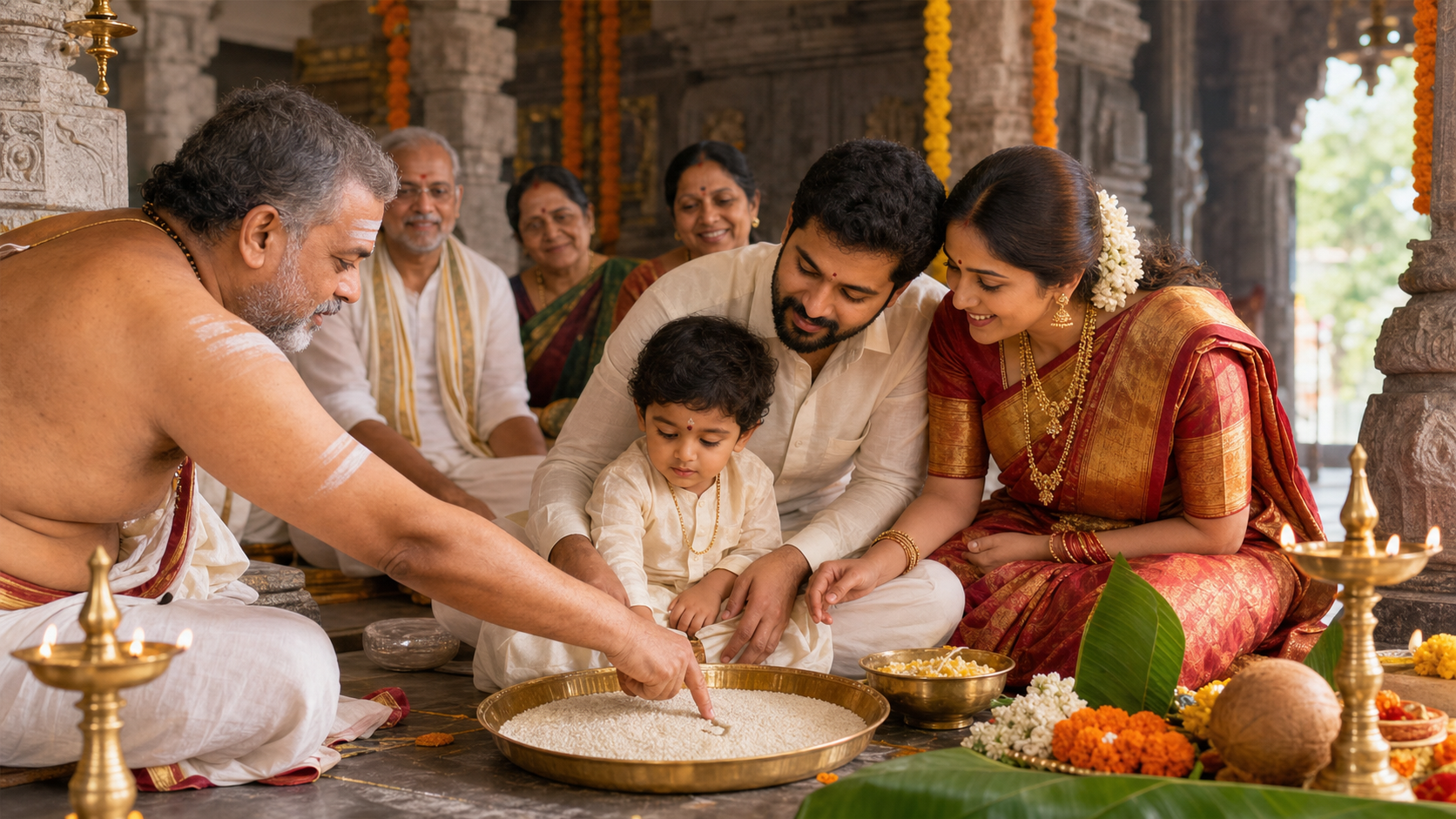
From 3 July 2026, Tirumala Tirupati Devasthanam (TTD) is scheduled to introduce “Akshara Govindam” and Annaprasana services at Sri Vakulamata Temple in Tirupati, creating a dedicated sacred setting for two deeply meaningful childhood rites: the beginning of learning and the first ceremonial feeding. The initiative brings together devotion, family memory, temple tradition, and early-life samskara practice under the blessings of Sri Venkateswara Swamy and Sri Vakulamata.
Akshara Govindam is intended for children aged 3 to 5 years, the age at which many Hindu families traditionally introduce a child to letters, sound, memory, and disciplined learning. In the ritual imagination of Hindu society, education is not treated merely as a technical skill or a path to employment. It is also understood as a sacred responsibility, a movement from unformed curiosity toward knowledge, refinement, self-control, and dharmic awareness.
The choice of Sri Vakulamata Temple is culturally significant. Sri Vakulamata is revered in the Tirupati tradition as the maternal figure associated with Sri Venkateswara Swamy. By placing a child’s first formal step into learning in her presence, the ceremony gains a tender familial dimension. It evokes the idea that education begins not in isolation, but within a network of blessings: parents, elders, guru, deity, community, and tradition.
In many homes, a child’s first writing ceremony becomes one of the earliest spiritual memories preserved by the family. Parents remember the small hand guided over rice, slate, or a writing surface; grandparents recall the sound of mantras; siblings often watch with curiosity; and the child, though too young to fully understand the meaning, becomes part of a lineage of learning. Akshara Govindam at Vakula Mata Temple gives this intimate domestic emotion a formal temple setting in Tirupati.
The word “Akshara” carries layered meaning in Indian knowledge traditions. At one level, it means a letter or syllable, the basic unit through which language and study unfold. At a deeper level, akshara can also suggest that which does not perish, pointing toward the enduring value of knowledge. In this context, the child’s first encounter with letters becomes more than literacy; it becomes a symbolic entry into culture, memory, and sacred learning.
Aksharabhyasam, the ritual beginning of education, has long been associated with reverence for Saraswati, Ganesha, Vishnu, and other forms of the divine depending on regional and family tradition. The Tirupati initiative situates this rite within the devotional world of Sri Venkateswara Swamy, while also honoring the maternal presence of Sri Vakulamata. This makes the service especially meaningful for families who connect their spiritual life with Tirumala and Tirupati.
The inclusion of Annaprasana services further expands the temple’s role in early childhood samskaras. Annaprasana, commonly understood as the first feeding ceremony, marks the child’s transition into receiving solid food in a ritual manner. Food in Hindu thought is not merely nutrition; it is associated with prana, purity, gratitude, and divine offering. When the first feeding is performed in a temple, the family expresses that nourishment itself is sacred.
Together, Akshara Govindam and Annaprasana represent two foundational dimensions of human development: food and knowledge. One sustains the body; the other shapes the mind and character. Their introduction at Sri Vakulamata Temple reflects a broader dharmic understanding that childhood should be protected, blessed, educated, and emotionally anchored within a meaningful cultural environment.
For devotees, the announcement is also important because TTD-administered or TTD-supported temple services often shape the ritual calendar of families across Andhra Pradesh, Telangana, Tamil Nadu, Karnataka, and the wider Hindu diaspora. Tirupati is not only a pilgrimage center; it is a living religious institution where domestic rites and public worship frequently meet. A service such as Akshara Govindam can therefore become a major reference point for families planning a child’s first educational ceremony.
The age range of 3 to 5 years is practical and culturally appropriate. At this stage, children begin to recognize symbols, imitate sounds, hold writing tools, and respond to guided instruction. The ritual does not replace formal schooling; rather, it sanctifies the beginning of that journey. It reminds families that learning is most fruitful when it is supported by humility, attention, discipline, and gratitude.
The launch date, 3 July 2026, gives devotees a clear point from which these services are expected to become available at Sri Vakulamata Temple. Families planning to participate should follow official TTD communication for practical details such as registration procedure, timings, required documents, offerings, age eligibility, queue arrangements, and any service guidelines that may apply at the temple.
In technical terms, a well-organized temple service for children requires more than ritual correctness. It needs crowd management, age-sensitive scheduling, hygienic arrangements, trained priests, clear instructions for parents, and a calm environment. Since young children may be anxious or restless in crowded sacred spaces, the success of Akshara Govindam will depend on how gently the ritual process is administered.
The Vakula Mata Temple setting also gives the initiative a distinct emotional tone. Sri Vakulamata’s association with motherly care makes the temple a fitting place for rites connected to a child’s early life. In Hindu family culture, the mother is often the child’s first teacher, first source of nourishment, and first experience of security. The temple’s theological symbolism therefore aligns closely with both education and feeding.
Akshara Govindam may also be understood as part of a larger revival of samskara consciousness among contemporary Hindu families. In modern life, many rites are compressed, postponed, or forgotten because of migration, work schedules, urban living, and lack of access to knowledgeable elders. Temple-based services can help families reconnect with tradition in a structured and accessible way without reducing the ritual to mere formality.
At the same time, the value of such initiatives lies in their ability to remain inclusive within the dharmic fold. Hinduism, Buddhism, Jainism, and Sikhism all carry deep respect for learning, disciplined conduct, sacred sound, and ethical living. While the ritual form of Akshara Govindam belongs specifically to the Hindu temple tradition of Tirupati, its broader message is shared across dharmic civilizations: knowledge must be approached with reverence and used for the welfare of life.
For parents, the ceremony can become a moment of reflection. A child’s education should not be measured only by competition, grades, and institutional success. The dharmic view asks whether education cultivates truthfulness, compassion, steadiness, respect for elders, service to society, and inner clarity. When a child begins learning in a temple, the family symbolically places these values at the foundation of the educational path.
For the child, the ritual may later become part of family storytelling. Many adults remember being told where their first letters were written, which deity was invoked, which elder held their hand, and what blessings were received. These stories matter because they create continuity. They allow the child to grow with the awareness that learning is not an isolated individual achievement, but a gift received through family, society, and divine grace.
The Annaprasana component carries a similarly deep message. In a world where food is often treated as consumption, convenience, or preference, the first feeding ceremony restores a sense of sanctity to nourishment. It reminds families that food is received through the labor of many beings: earth, water, farmers, animals, cooks, parents, and divine order. Gratitude becomes the first lesson of eating.
Sri Vakulamata Temple’s association with these services may also strengthen its role in the devotional geography of Tirupati. While Tirumala remains the central pilgrimage destination for millions of devotees of Sri Venkateswara Swamy, temples connected with the wider sacred narrative of the region help pilgrims understand Tirupati as a network of living traditions. Vakula Mata Temple, in that sense, is not merely an additional stop; it carries a distinct theological and emotional identity.
The announcement also reflects the evolving role of temple institutions in contemporary society. Temples are not only places for darshan and festivals; historically, they have also supported education, food distribution, arts, social cohesion, and the preservation of memory. By facilitating Aksharabhyasam and Annaprasana, TTD is linking modern administrative capacity with traditional religious functions.
From an educational perspective, Akshara Govindam highlights the civilizational importance of letters and language. Indian traditions have preserved knowledge through oral recitation, scriptural study, poetry, commentary, music, mathematics, astronomy, philosophy, grammar, and ritual manuals. The first letter written by a child stands at the threshold of that vast inheritance, even when the ceremony itself is simple and brief.
From a devotional perspective, the rite affirms that learning should begin with humility. The child does not enter education as a consumer of information, but as a receiver of blessing. The family does not treat knowledge as private possession, but as sacred trust. The temple does not merely perform a service, but frames learning as a responsibility guided by dharma.
Families interested in Akshara Govindam at Vakula Mata Temple should keep the date, location, and age eligibility clearly in mind: the service is scheduled from 3 July 2026 at Sri Vakulamata Temple, Tirupati, and children aged 3 to 5 years are eligible for the Aksharabhyasam component as announced in the source report. For Annaprasana, families should verify the practical requirements directly through TTD’s official channels before planning travel.
Ultimately, Akshara Govindam is significant because it places the child at the center of sacred continuity. It honors the parents’ hope, the community’s responsibility, the temple’s role, and the child’s future. In the presence of Sri Venkateswara Swamy and Sri Vakulamata, the beginning of education becomes more than a milestone; it becomes a prayer that knowledge may be guided by wisdom, nourishment by gratitude, and childhood by blessing.
Inspired by this post on Hindu Pad.







Leave a Reply
You must be logged in to post a comment.