
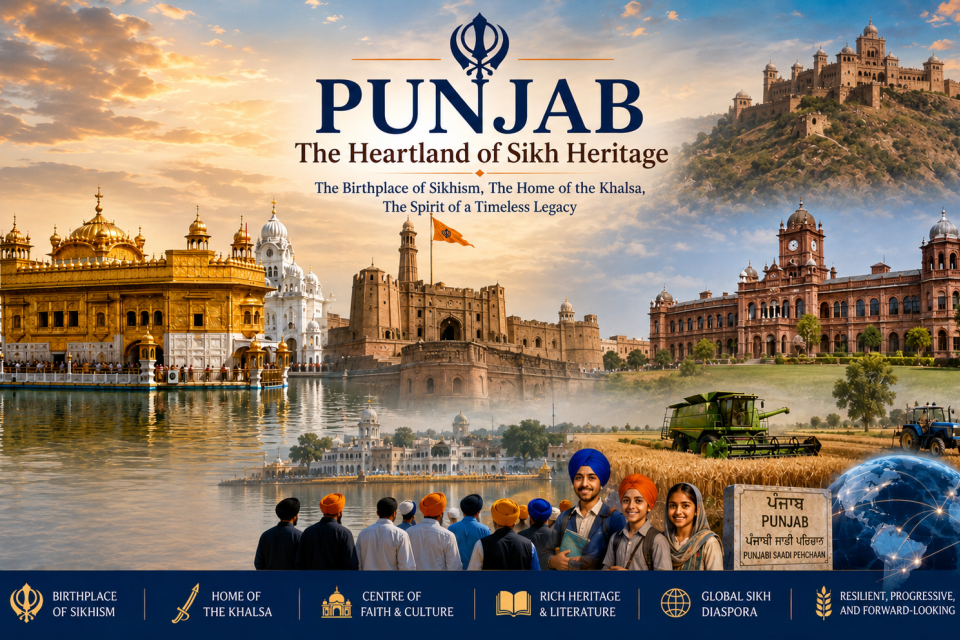
Punjab stands as one of South Asia’s most historically charged cultural landscapes, and its identity as the heartland of the Sikhs is rooted in geography, memory, devotion, agriculture, language, and community institutions. The word Punjab is commonly understood as the “land of five rivers,” a phrase that evokes the Indus river system and the fertile plains that shaped settlement, trade, agrarian life, and political power across centuries. In the modern Indian context, Punjab is a state with a distinctive linguistic and religious profile, but its civilisational significance cannot be reduced to administrative borders. It is a homeland of Sikh sacred history, a cradle of Punjabi culture, and a region where Dharmic traditions have interacted through shared practices of pilgrimage, music, ethics, service, and reverence for the Divine.
To understand Punjab as the heartland of the Sikhs, it is necessary to begin with the land itself. The plains of Punjab have long supported dense agriculture because of riverine soils, seasonal rhythms, and irrigation traditions. This agrarian foundation shaped the social imagination of the region: the farmer, the village, the harvest, the well, the field, and the communal meal became more than economic realities. They became cultural symbols of resilience and interdependence. Sikh history emerged within this world, not as an abstract doctrine detached from life, but as a deeply embodied path shaped by work, remembrance, justice, and shared responsibility.
Punjab’s significance in Sikhism begins most prominently with Guru Nanak, whose life and teachings gave spiritual form to a new religious community while remaining intelligible within the broader Dharmic and Indic vocabulary of devotion, discipline, karma, liberation, and ethical conduct. Guru Nanak’s message emphasized devotion to the One, truthful living, humility, honest labor, and service to humanity. These principles did not merely produce a theology; they produced a social order. The Sikh path placed spiritual realization in the midst of household life, community obligation, and moral courage. Punjab became the soil in which this vision grew into institutions, songs, practices, and collective memory.
The development of Sikhism through the ten Gurus gave Punjab a sacred geography. Places associated with the Gurus became centers of worship, teaching, and collective identity. Kartarpur, Goindwal, Amritsar, Tarn Taran, Anandpur Sahib, and many other locations came to carry layered meanings: they were historical sites, devotional centers, and anchors of community life. The gurdwara, as an institution, gave architectural and social shape to Sikh values. It became a place of prayer, kirtan, langar, memory, learning, and equality. In Punjab, the gurdwara is not only a religious building; it is a civic and ethical institution embedded in everyday life.
Amritsar occupies a central place in this sacred landscape. The Harmandir Sahib, often known globally as the Golden Temple, is among the most revered sites in Sikhism. Its placement within the sarovar conveys a disciplined spiritual symbolism: the devotee approaches through humility, purification, listening, and remembrance. The complex is also one of the most powerful public demonstrations of seva. The langar at Harmandir Sahib is not an ornamental custom but a living theological statement: food is prepared and shared across social boundaries, and service becomes a path of devotion. In this sense, Punjab’s spiritual identity is visible not only in scripture and ritual but in organized compassion.
The Guru Granth Sahib gives Sikh tradition its scriptural center, and Punjab’s linguistic world is inseparable from that sacred inheritance. Gurmukhi, standardized and promoted in the Sikh tradition, became a vehicle of scripture, poetry, pedagogy, and identity. Punjabi language and Sikh devotional expression developed in mutual relationship. Kirtan, shabad, and recitation created a culture in which sound, meaning, and memory became intertwined. The result is a distinctive spiritual literacy: faith is heard, sung, remembered, and practiced. This oral and musical dimension of Sikhism remains one of Punjab’s most enduring contributions to Indian spirituality and world religious heritage.

Punjab’s Sikh identity also developed through the principle of the saint-soldier, especially in the historical context of social conflict, political instability, and the defense of religious freedom. Guru Gobind Singh and the formation of the Khalsa at Anandpur Sahib in 1699 marked a decisive moment in Sikh history. The Khalsa gave institutional form to courage, discipline, equality, and collective responsibility. Its symbols and practices were not simply markers of identity; they were ethical commitments. The Sikh ideal joined devotion with readiness to defend justice, making spirituality active in the public world rather than confined to private contemplation.
Vaisakhi carries special importance in Punjab because it unites seasonal, agrarian, and religious meanings. As a harvest festival, it expresses gratitude for agricultural abundance. As a Sikh commemoration, it recalls the birth of the Khalsa and the transformation of the community’s moral and institutional life. This combination is characteristic of Punjab: the sacred and the everyday are not separate realms. The farmer’s harvest, the congregation’s gathering, the memory of Guru Gobind Singh, the rhythm of kirtan, and the discipline of seva converge in a single cultural experience. For many families, Vaisakhi is not merely observed; it is inherited as memory, gratitude, and identity.
The history of Punjab cannot be narrated without acknowledging its plural cultural setting. Sikhism emerged in a region that had long known Hindu, Buddhist, Jain, Islamic, and later colonial influences. The region’s spiritual vocabulary reflects this complexity. Sikh tradition has its own theology, scripture, discipline, and institutional structure, yet it also belongs to the broader Dharmic civilisational space in which questions of dharma, liberation, devotion, karma, ethical life, and spiritual realization have been explored in multiple forms. A responsible understanding of Punjab therefore avoids both reduction and separation: Sikhism should neither be collapsed into another tradition nor detached from the Indic environment that shaped its historical language and social world.
This broader Dharmic context is important for the objective of cultural unity. Hinduism, Buddhism, Jainism, and Sikhism each maintain distinct philosophical and ritual identities, but they also share civilisational patterns of inquiry, discipline, sacred geography, ethical self-cultivation, reverence for teachers, and concern with liberation from ignorance and ego. Punjab’s Sikh heritage demonstrates how a tradition can be distinct without being isolated. Its institutions have often expressed universal hospitality through langar, music, and service. This creates a model of religious confidence that does not require hostility to neighboring paths. It supports a healthier understanding of unity: unity does not erase difference; it dignifies difference within a shared moral horizon.
The agrarian economy of Punjab played a major role in shaping Sikh social organization. Landholding patterns, village networks, seasonal labor, and military recruitment all influenced the region’s historical development. The Sikh community became associated with discipline, physical labor, collective organization, and martial readiness in part because the land demanded endurance and cooperation. The village gurdwara often functioned as a social nucleus, while festivals and life-cycle ceremonies reinforced kinship networks. Even when Punjab modernized through canals, railways, migration, education, and industrial development, the moral vocabulary of land, work, and community remained deeply influential.
Punjab’s modern history is marked by both achievement and trauma. The partition of India in 1947 violently divided the historical Punjab between India and Pakistan, displacing millions and reshaping religious demography on both sides of the border. For Sikh families, Partition was not an abstract geopolitical event; it was a rupture of ancestral homes, shrines, fields, and memories. Many sacred Sikh sites remained in Pakistan, including Nankana Sahib, associated with Guru Nanak’s birth. This history continues to shape Punjabi consciousness. It explains why homeland, memory, pilgrimage, and border politics remain emotionally charged themes in Sikh and Punjabi life.
Yet Punjab’s story is not only a story of rupture. It is also a story of reconstruction. After Partition, Indian Punjab rebuilt institutions, towns, farms, industries, and educational networks. The Green Revolution transformed agricultural productivity, making Punjab central to India’s food security. This transformation brought prosperity and national significance, but it also introduced long-term challenges involving water use, soil health, crop diversity, debt, and ecological sustainability. A technical reading of Punjab must therefore consider the relationship between cultural heritage and environmental responsibility. The same land that nourished memory and identity now requires careful stewardship for future generations.
Punjab’s Sikh heritage also has a global dimension. Migration carried Punjabi language, gurdwaras, kirtan, food, festivals, and community structures to the United Kingdom, Canada, the United States, Australia, East Africa, Southeast Asia, and beyond. The Sikh diaspora preserved a strong connection to Punjab while adapting to new societies. Diasporic gurdwaras often became centers of worship, language education, social service, political discussion, and cultural continuity. This global spread has made Sikhism one of the most visible Dharmic traditions outside India. The turban, langar, Nagar Kirtan, and public seva have become recognizable expressions of Sikh identity in many parts of the world.
At the same time, the global visibility of Sikh identity has sometimes brought misunderstanding. In several countries, Sikhs have had to explain their symbols, defend their right to religious expression, and confront stereotypes. Punjab’s heritage therefore carries a contemporary ethical lesson: cultural literacy matters. A society that understands the meaning of the turban, the discipline of the Khalsa, the role of the gurdwara, and the theology of service is better equipped for respectful coexistence. This lesson is relevant not only for Sikhs but for all Dharmic communities whose symbols and practices are often misread outside their original context.
Punjabi culture also extends beyond formal religion. Bhangra, Giddha, folk poetry, food traditions, oral narratives, wedding customs, and seasonal festivals form a vibrant cultural fabric. These practices should not be treated as superficial entertainment. They preserve social memory, gendered expression, humor, resilience, and collective celebration. The dhol, the boliyan, the harvest song, and the communal feast all express a society that learned to transform labor into rhythm and hardship into shared energy. Punjab’s cultural vitality is one reason Sikh identity has remained publicly confident and emotionally resonant across generations.
Educationally, Punjab’s Sikh heritage offers a strong case study in how religious communities build institutions. From scriptural education and traditional learning to modern schools, colleges, and charitable organizations, Sikh communities have repeatedly invested in knowledge and service. The relationship between spiritual discipline and public welfare is especially important. Sikhism does not treat service as secondary to devotion; it treats service as devotion made visible. This has implications for modern civil society, where religious institutions can contribute to food distribution, disaster relief, healthcare, education, and social cohesion without abandoning their spiritual foundations.
The political history of Punjab must be handled with care because it contains sensitive questions of sovereignty, identity, federalism, violence, and memory. A balanced academic approach recognizes that Sikh history includes experiences of persecution, resistance, sovereignty under Maharaja Ranjit Singh, colonial transformation, anti-colonial participation, Partition, post-independence reorganization, and later periods of conflict. These histories should be studied without sensationalism. Punjab’s deeper lesson is that communities require dignity, justice, and truthful remembrance, but also reconciliation, institutional trust, and a commitment to the common good. Responsible historical writing should illuminate complexity rather than inflame division.
Maharaja Ranjit Singh’s Sikh Empire remains one of the most important political chapters in Punjab’s history. His rule from Lahore created a powerful state that combined military capability with administrative pragmatism. The empire included Sikhs, Hindus, Muslims, and others in positions of responsibility, reflecting the political complexity of the region. While no historical state should be romanticized beyond scrutiny, the Sikh Empire remains significant because it demonstrated Punjab’s capacity for statecraft, diplomacy, plural administration, and cultural patronage. It also occupies a central place in Sikh memory as a period of sovereignty before British annexation.
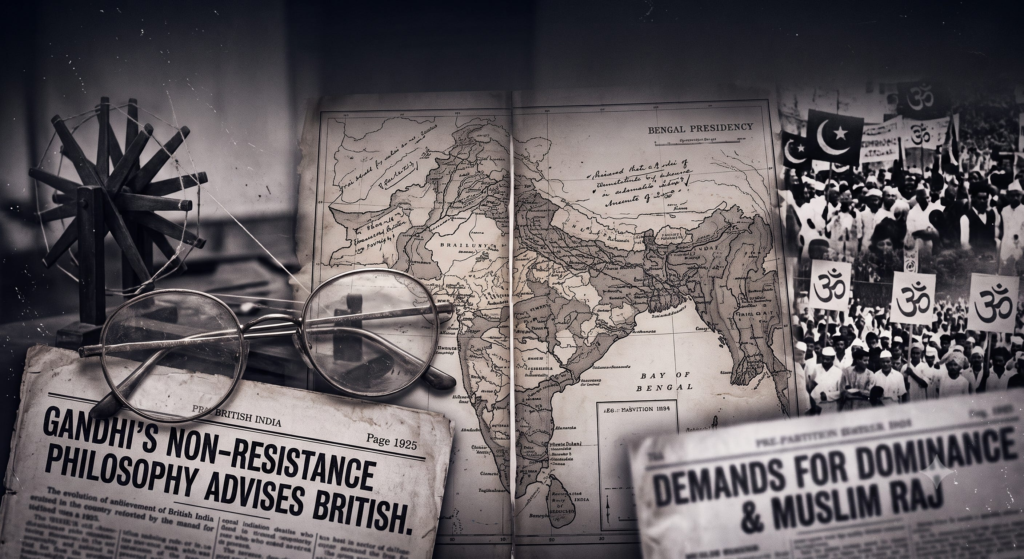
Colonial rule reshaped Punjab through military recruitment, land settlements, canal colonies, censuses, education policies, and new forms of identity classification. The British viewed Punjab as strategically important, especially after the annexation of the Sikh kingdom and the revolt of 1857. Colonial institutions created both opportunities and distortions. They expanded certain forms of infrastructure and education while also hardening categories and redirecting local economies toward imperial priorities. Sikh, Hindu, and Muslim identities in Punjab were increasingly organized through modern institutions, print culture, reform movements, and political representation. This period is essential for understanding modern Punjabi consciousness.
The reform movements of the nineteenth and early twentieth centuries also influenced Punjab’s religious landscape. Sikh reform efforts sought to strengthen community institutions, clarify identity, and recover control of gurdwaras. Hindu reform movements, Arya Samaj influence, Christian missionary activity, Islamic reform currents, and colonial legal frameworks all interacted in the region. This produced debate, contestation, and renewal. From the perspective of Dharmic unity, this history should be approached with maturity: reform can strengthen tradition, but polemics can also create hardened boundaries. The most constructive inheritance is the commitment to learning, ethical renewal, and institutional responsibility.
Punjab’s connection to India’s freedom struggle is substantial. Sikh participation in anti-colonial movements, revolutionary networks, military service, and public protest formed an important part of the broader Indian independence movement. Figures such as Lala Lajpat Rai, Bhagat Singh, Udham Singh, and many lesser-known contributors emerged from the Punjabi historical world. Their legacies show that Punjab’s identity cannot be reduced to one dimension. It is at once religious, linguistic, agrarian, martial, revolutionary, devotional, and intellectual. The region repeatedly produced individuals and institutions willing to confront injustice through sacrifice and public courage.
The moral architecture of Sikh life is especially visible in the concepts of naam, kirat, and vand chhakna: remembrance of the Divine, honest work, and sharing with others. These principles have technical social consequences. They produce a disciplined model of ethical economy in which labor is dignified, wealth is morally accountable, and community welfare is institutionalized. In an age of individualism and social fragmentation, Punjab’s Sikh inheritance offers a practical framework for public ethics. It does not separate spirituality from economics; it asks whether work, consumption, and distribution serve justice and human dignity.
For visitors, Punjab’s Sikh heartland can be experienced through more than monuments. It is encountered in the sound of kirtan at dawn, the sight of volunteers preparing langar, the discipline of covering one’s head before entering a gurdwara, the humility of sitting in a pangat, and the memory of families who preserve stories of migration, harvest, service, and sacrifice. Such experiences can be emotionally powerful even when approached academically, because living heritage is not merely information. It is a form of presence. Punjab teaches through space, sound, food, gesture, and collective memory.
The relationship between Sikhism and other Dharmic traditions should be discussed with precision and respect. Sikhism is a distinct religious tradition with its own scripture, Gurus, institutions, and discipline. At the same time, its historical emergence in the Indic world means it shares civilisational conversations with Hinduism, Buddhism, and Jainism regarding ethical action, spiritual practice, liberation from ego, reverence for wisdom, and the moral limits of power. A unity-oriented approach does not blur boundaries. It recognizes that traditions can stand beside one another with clarity, mutual respect, and shared responsibility for preserving civilisational memory.
Punjab’s sacred and cultural heritage also faces modern pressures. Urbanization, language shift, ecological stress, substance abuse concerns, migration, political polarization, and the commercialization of culture all affect the region. Punjabi language preservation is particularly important because language carries memory. When younger generations lose access to Punjabi and Gurmukhi, they risk losing direct contact with scripture, oral history, folk literature, and family narratives. Cultural preservation must therefore include language education, archival work, music, local history, and intergenerational storytelling. Heritage survives when it is practiced, not merely displayed.
Technically, Punjab’s future requires balancing agricultural productivity with ecological repair. The region’s dependence on wheat and rice cycles, groundwater extraction, chemical inputs, and market pressures has created sustainability concerns. A culturally rooted response would not treat ecology as separate from dharma. The land that nourished Punjab’s religious and cultural history deserves responsible care. Crop diversification, water conservation, soil restoration, rural education, and farmer dignity are not only policy issues; they are civilisational duties. In Punjab, environmental stewardship is also heritage preservation.
Punjab’s role in Indian civilization is therefore both specific and expansive. It is specifically the heartland of the Sikhs because Sikh sacred history, institutional life, language, and collective memory are deeply rooted there. It is expansive because Punjab also speaks to larger questions of civilisational continuity, religious plurality, agrarian ethics, public courage, and community service. Its lessons are relevant to Hindus, Buddhists, Jains, Sikhs, and all who study South Asian history with seriousness. Punjab shows how a region can become a homeland not only through territory, but through sacrifice, scripture, song, and service.
In the final analysis, Punjab remains powerful because it holds together contrasts that modern discourse often separates: devotion and courage, agriculture and spirituality, local memory and global diaspora, distinct identity and Dharmic kinship, trauma and reconstruction. Its Sikh heartland is not a museum of the past. It is a living field of practice where the ideals of seva, sangat, equality, remembrance, and justice continue to shape community life. To study Punjab is to encounter a civilization in motion, rooted in sacred memory yet still responsible for the future it will cultivate.
Inspired by this post on SikhNet – News.








Leave a Reply
You must be logged in to post a comment.