
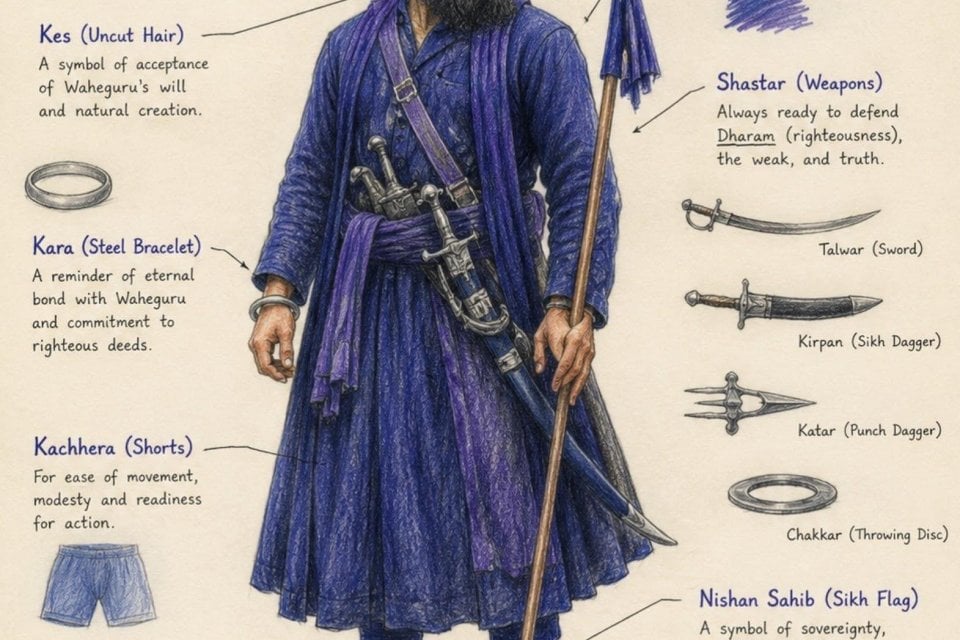
An Anatomy of a Nihang Singh is more than a study of distinctive clothing, weapons, and battlefield memory. It is an examination of how Sikh spiritual discipline, Khalsa identity, and martial responsibility are embodied in visible form. The Nihang Singh, often associated with the Akali tradition, stands as one of the most recognizable figures in Sikh history: blue robes, towering dumalla, iron weaponry, disciplined bearing, and a public identity shaped by devotion, courage, and service.
The word Nihang is commonly explained through multiple traditions. Some connect it with fearlessness and independence; others associate it with older Persian usage referring to a crocodile, suggesting a being formidable in its own domain. Within Sikh memory, however, the term has acquired a clearer ethical meaning: a Nihang is expected to be one who lives without worldly fear, remains prepared for righteous defense, and keeps spiritual sovereignty above comfort, fashion, or social approval.
The Nihang identity cannot be understood apart from the Khalsa, inaugurated by Guru Gobind Singh in 1699. The Khalsa was not merely a military formation; it was a disciplined spiritual commonwealth formed around devotion to the Divine, moral equality, collective responsibility, and readiness to resist oppression. The Nihang tradition preserved a particularly martial expression of this Khalsa ideal, emphasizing shastar, bana, simran, seva, mobility, and public courage.
The most immediate visual feature of a Nihang Singh is the blue bana. Blue is not incidental decoration. It evokes martial readiness, austerity, depth, and the horizon of the sky. In Sikh tradition, the blue garment is often associated with the warrior-saint ideal: inwardly anchored in remembrance of Akal Purakh, outwardly prepared to stand firm in the world. The color communicates that the body itself has become a moving banner of discipline.
The dumalla, the high turban worn by many Nihangs, is both practical and symbolic. Practically, it protects the head and can hold small weapons or iron rings. Symbolically, it marks dignity, sovereignty, and responsibility. A Sikh turban is never merely fabric; in the Nihang context, it becomes a crown of service. Its height and structure remind the community that spiritual authority does not depend on royal courts, imperial favor, or modern applause.
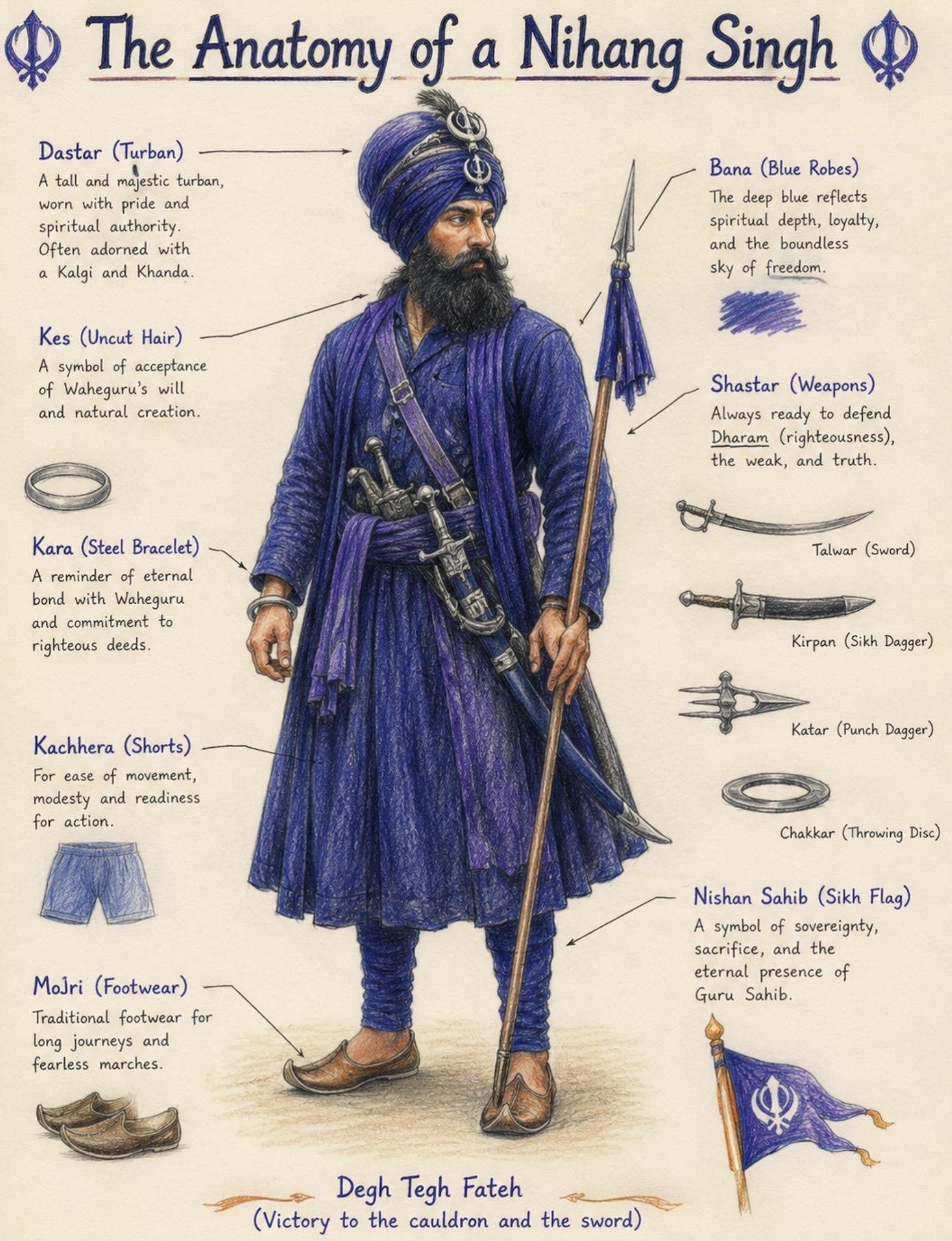
The iron rings often fixed around the dumalla, known as chakram or quoits in older military descriptions, reveal the technical ingenuity of Sikh martial culture. They could function historically as weapons, but they also operate as signs of readiness. Iron, in Sikh symbolic vocabulary, frequently represents firmness, restraint, and moral steadiness. The Nihang body is therefore not ornamented for vanity; it is equipped as a disciplined instrument of dharma, defense, and duty.
The farla, a loose cloth plume sometimes attached to the turban, carries special prestige in Nihang tradition. It is often associated with distinction, command, and recognition within particular groups. Its presence transforms the headgear into a visible marker of lineage and authority. Like many traditional signs, it is meaningful because it belongs to a community of practice, not because it can be reduced to costume.
The kachera, kara, kanga, kirpan, and kes, the Five Ks of Khalsa discipline, remain central to this anatomy. In a Nihang Singh, these are not isolated religious symbols but integrated practices. Kes preserves the sanctity of the natural body. Kanga represents order and care. Kara recalls restraint and divine accountability. Kachera signifies moral discipline. Kirpan represents the duty to protect, not the license to dominate.
The kirpan is frequently misunderstood when viewed through purely modern categories of weaponry. In Sikh thought, it is bound to ethics. Its ideal purpose is protective, not aggressive; restrained, not impulsive. The Nihang tradition intensifies this meaning by surrounding the kirpan with a larger discipline of prayer, service, training, and self-control. A weapon without moral discipline becomes violence; a weapon governed by dharma becomes responsibility.
The shastar, or weapons, carried by Nihangs form a technical vocabulary of martial history. Swords, spears, daggers, shields, bows, matchlocks in older contexts, and later firearms all appear in the wider martial record of Sikh communities. These weapons are not merely relics. They represent the historical reality that Sikh institutions developed under conditions of persecution, political turbulence, and repeated conflict. The material culture of Nihangs preserves that memory in visible and disciplined form.
Shastar vidya and gatka are often associated with Sikh martial training, though the two are not identical in every context. Gatka is widely known today as a demonstrative martial art performed in public festivals and religious gatherings. Shastar vidya refers more broadly to weapon knowledge, combat principles, and inherited systems of martial practice. In both cases, the body is trained to coordinate attention, balance, timing, courage, and restraint.
The Nihang body can therefore be read as a map of integrated disciplines. The head bears the dumalla and memory of sovereignty. The hair preserves obedience to the Khalsa form. The torso carries the blue bana as a uniform of sacred identity. The waist may hold weapons and practical equipment. The hands serve, pray, train, cook, defend, and distribute. The feet remain mobile, historically suited to camps, processions, pilgrimages, and rapid movement.
The kamarkassa, the cloth belt or waist binding, adds another layer of meaning. It is practical because it secures clothing and equipment. It is symbolic because it suggests readiness. Across many Indian martial and ascetic traditions, binding the waist indicates preparation for disciplined action. In the Nihang context, the kamarkassa quietly announces that spirituality is not passivity. Devotion must be capable of movement.
Horses have held an important place in Nihang memory and practice. Mounted mobility was crucial in the military history of the Sikh misls and later Sikh power. The horse became more than transport; it represented speed, independence, dignity, and tactical adaptability. Even when modern life has transformed warfare and travel, equestrian imagery remains part of the traditional imagination surrounding Nihang identity.
The nagara, or war drum, also belongs to the public soundscape of Sikh sovereignty. Historically, drums announced presence, assembly, movement, and authority. In religious and martial settings, sound can organize bodies and emotions. The nagara does not simply make noise; it gathers attention. It reminds the sangat that the community has a collective rhythm, a shared pulse, and a responsibility to act as more than scattered individuals.
The Nishan Sahib, the Sikh flag, completes the public anatomy of the tradition. Where the Nihang body carries visible signs of discipline, the Nishan Sahib marks the collective space of Sikh presence. Together, body and banner communicate a theology of public courage: faith is not hidden, and service is not private sentiment alone. It enters streets, camps, gurdwaras, processions, and moments of crisis.
The Nihang tradition is often described through the phrase sant-sipahi, the saint-soldier. This phrase must be understood carefully. The saint-soldier is not half saint and half soldier, as though spirituality and defense were separate compartments. The ideal is an integrated human being whose martial strength is governed by humility, whose devotion is tested by courage, and whose public action is restrained by moral law.

This ideal has deep resonance across dharmic traditions. Hindu kshatra dharma, Buddhist reflections on disciplined courage, Jain emphasis on self-mastery, and Sikh teachings on righteous defense all address the problem of power. Power without restraint becomes destructive; restraint without courage can become helplessness before injustice. The Nihang Singh represents one Sikh answer to this universal civilizational question: how can strength be spiritualized without being weakened?
The emotional force of the Nihang image lies in its refusal to separate memory from embodiment. Many communities preserve history in books, archives, and monuments. Nihangs preserve it through posture, fabric, iron, sound, food, movement, and daily discipline. For observers, this can be striking because the past does not appear as a museum object. It walks, prays, rides, serves, and trains in the present tense.
Langar and seva are essential to this understanding. A superficial account might focus only on weapons and spectacle, but Sikh martial tradition is inseparable from service. The same hands that hold the kirpan are expected to prepare food, protect the vulnerable, assist pilgrims, and serve the sangat. This balance prevents martial identity from hardening into mere aggression. It restores the ethical center of the Khalsa vision.
Nihang groups, including historically significant dals, have preserved distinctive practices, oral histories, and internal structures. These institutions developed in changing political environments, from Mughal conflict and Afghan invasions to the rise of Sikh power and the transformations of colonial and postcolonial India. Their continuity demonstrates that religious traditions survive not only through doctrine but through disciplined communities capable of adapting without dissolving their core identity.
It is also necessary to distinguish reverent study from romantic exaggeration. Nihang history includes courage, sacrifice, and cultural preservation, but it also belongs to real human institutions shaped by debate, variation, and changing social conditions. Academic honesty requires avoiding both dismissal and uncritical glorification. The tradition deserves careful attention precisely because it is complex: spiritual, martial, aesthetic, political, communal, and historical at once.
The anatomy of a Nihang Singh is therefore not reducible to external appearance. Every visible sign points toward an internal demand. The bana asks for discipline. The dumalla asks for dignity. The shastar asks for restraint. The kirpan asks for protection of the vulnerable. The kara asks for accountability. The horse asks for mobility. The nagara asks for collective readiness. The Nishan Sahib asks for public fidelity to truth and service.
In contemporary society, where identity is often treated as branding, the Nihang form offers a more demanding model. It suggests that identity must be practiced before it is displayed. Clothing, symbols, and weapons become meaningful only when supported by character. Without discipline, they become performance. With discipline, they become pedagogy: a visible teaching about courage, memory, humility, and moral responsibility.
The continued presence of Nihang Singhs at festivals, gurdwaras, processions, and public gatherings keeps Sikh martial heritage within community memory. For younger generations, this visibility can provoke curiosity: Why blue? Why iron? Why the tall turban? Why weapons in a place of prayer? These questions open a path into Sikh history, Khalsa theology, and the broader dharmic understanding that spirituality must shape the whole person, not merely private belief.
A mature reading of the Nihang Singh also supports unity among dharmic traditions. The tradition belongs specifically to Sikhism and should be respected on its own terms. At the same time, its deeper values resonate across the Indian civilizational landscape: reverence for discipline, defense of dignity, sacred responsibility, community service, courage before tyranny, and the integration of spiritual practice with public life.
The Nihang Singh remains one of the most powerful embodiments of Sikh identity because the form is not decorative; it is instructive. It teaches that sovereignty begins with self-mastery, that courage must answer to dharma, and that inherited symbols survive only when lived with seriousness. To study this anatomy is to encounter a tradition in which the body becomes scripture in motion, and history becomes a discipline worn with humility and strength.
Inspired by this post on SikhNet – News.







Leave a Reply
You must be logged in to post a comment.