
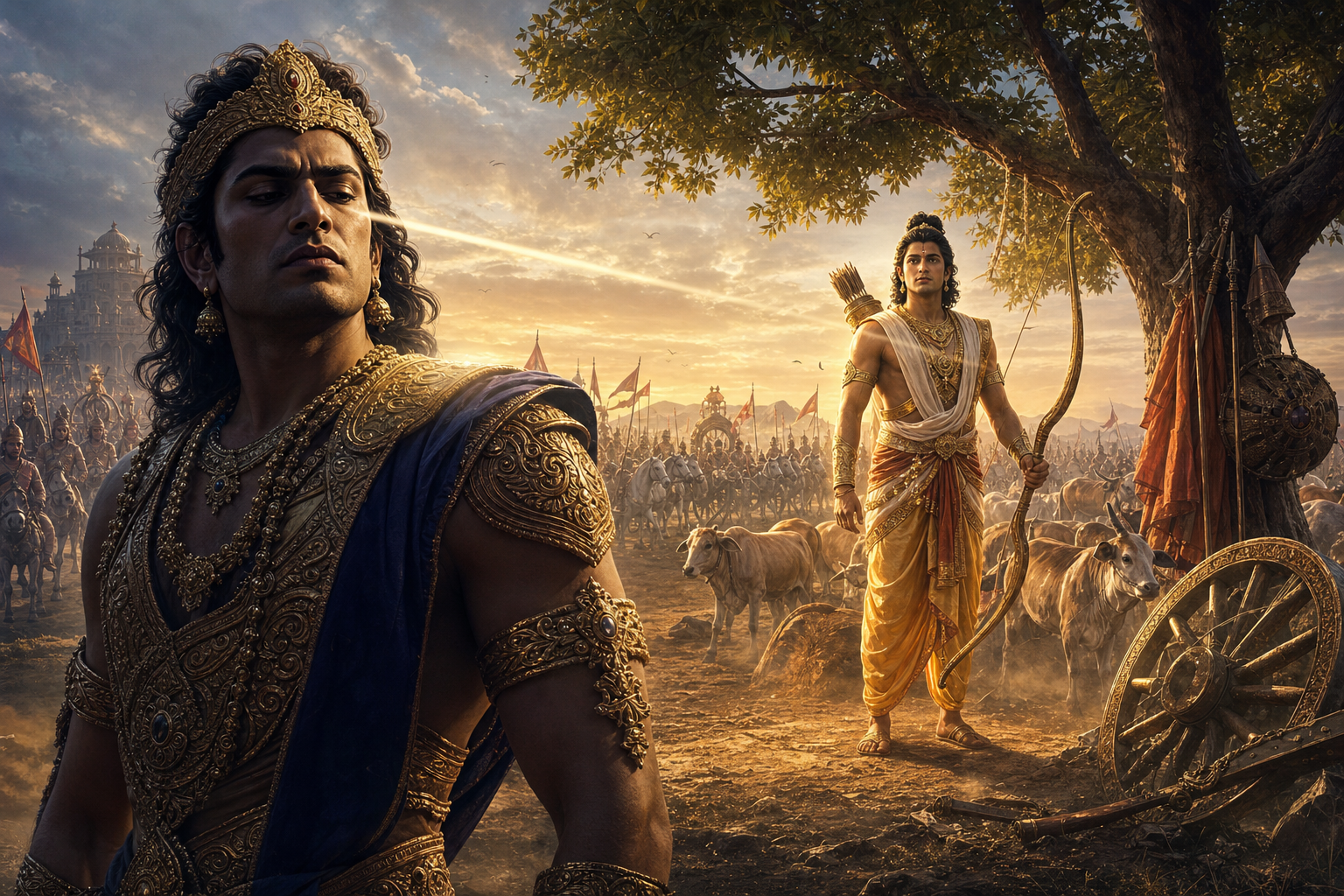
The Virata War in the Mahabharata is often remembered as a dramatic prelude to Kurukshetra, but its deeper significance lies in what Duryodhana failed to learn from it. The episode took place at the end of the Pandavas’ thirteenth year of exile, when they were living incognito in the kingdom of Matsya under King Virata. The Kauravas, suspecting that the Pandavas might be hidden there, joined a cattle raid designed not merely to seize wealth but to expose their rivals before the agreed period of disguise had ended.
On the surface, the plan appeared strategically clever. Cattle wealth was central to ancient polity, economy, and royal prestige. By attacking Virata’s herds, the Kauravas expected the hidden defenders of Matsya to reveal themselves under pressure. Yet the raid produced the opposite result. It revealed not the weakness of the Pandavas but the continuing brilliance of Arjuna, the limitations of Kaurava confidence, and the tragic inability of Duryodhana to read defeat as instruction.
Arjuna, concealed under the identity of Brihannala, emerged with Prince Uttara after retrieving his weapons from the shami tree. Once he resumed his true martial role, he faced a formidable assembly of Kuru warriors: Bhishma, Drona, Kripa, Karna, Ashwatthama, Duryodhana, and others. This was not a minor skirmish against an unprepared force. It was a concentrated confrontation with many of the greatest fighters of the age, men who would later shape the terrible battlefield of Kurukshetra.
The outcome should have been impossible to ignore. Arjuna defeated the Kuru host, protected Virata’s cattle, and demonstrated that the long exile had not diminished the Pandavas’ martial strength. In several traditional retellings, he used celestial weapons with restraint and subdued the army without turning the encounter into a slaughter. This restraint is crucial. The victory was not merely a display of power; it was a disciplined exercise of kshatra dharma, where force was governed by purpose and proportion.
For Duryodhana, the Virata War should have functioned as a final political warning. The Pandavas were not broken by exile. Arjuna was not weakened by concealment. Bhima, Yudhishtira, Nakula, Sahadeva, and Draupadi had endured humiliation without losing their inner cohesion. The alliance networks around them could still be rebuilt. Above all, their claim to justice had not disappeared simply because Duryodhana had successfully delayed it.
Yet Duryodhana did not learn from the event because his central problem was not lack of information. The Mahabharata repeatedly shows that he had access to good counsel. Bhishma warned him. Drona understood the danger. Vidura spoke with moral clarity. Even Dhritarashtra, despite his weakness, often recognized the destructive direction of his son’s choices. Duryodhana’s failure was not intellectual ignorance in the ordinary sense; it was a refusal to allow knowledge to transform desire.
This distinction is essential for understanding his character. Duryodhana was not portrayed as an incapable prince. He had courage, political ambition, administrative confidence, and loyalty to those who stood with him, especially Karna. His tragedy was that these strengths were placed in the service of envy and entitlement. In the Mahabharata, a person may possess talent and still be ruined if the inner orientation is governed by adharma.
The Virata War exposed this moral blindness. A reflective ruler would have asked why a single warrior could repel a grand Kuru formation. A prudent strategist would have reconsidered the feasibility of war against the Pandavas. A dharmic statesman would have recognized that the return of the Pandavas was no longer avoidable and that reconciliation, however difficult, was preferable to civilizational disaster. Duryodhana, however, processed the defeat as an insult rather than a lesson.
Ego played a decisive role. In the Mahabharata, ego is not merely self-confidence; it is the hardening of the self against truth. Duryodhana could see events, but he could not interpret them without defending his pride. Arjuna’s victory at Virata threatened the story Duryodhana had told himself: that the Pandavas could be dispossessed, humiliated, and politically erased. When reality contradicted that story, he chose to attack reality rather than revise the story.
This pattern remains psychologically recognizable. Human beings often learn less from defeat than they claim, especially when defeat wounds identity. A person who has invested years in a harmful rivalry may treat every warning as provocation. A leader surrounded by flatterers may mistake persistence for strength. A community may continue down a destructive path because admitting error feels more painful than continuing the error. Duryodhana’s conduct is ancient, but the psychology is not remote.
The role of Shakuni also matters, though it should not be used to absolve Duryodhana. Shakuni sharpened grievance into strategy and converted resentment into schemes. Still, the Mahabharata does not present Duryodhana as a helpless instrument. He repeatedly chose the counsel that confirmed his desires and rejected the counsel that challenged them. The Virata War became another moment where he could have stepped back, but instead moved deeper into confrontation.
Karna’s presence made the problem more complex. Karna’s loyalty to Duryodhana was emotionally powerful and politically important, but it also reinforced Duryodhana’s confidence that the Pandavas could be defeated. After Virata, Karna’s humiliation at Arjuna’s hands should have introduced caution. Instead, the rivalry between Karna and Arjuna intensified the determination for a decisive war. Personal rivalry replaced strategic realism.
Bhishma and Drona represented another kind of lesson. They were bound to the Kuru throne, but their hearts and moral judgment were not blind. Their presence in the Virata War showed Duryodhana the uncomfortable truth that institutional power does not automatically equal moral legitimacy. He had the army, the throne, and the machinery of state; the Pandavas carried the stronger claim of dharma. The Mahabharata repeatedly asks readers to distinguish power from righteousness.
The dispute over whether the Pandavas’ incognito year had been completed also reveals Duryodhana’s mindset. Rather than respond to the ethical substance of the situation, he focused on technical advantage. The question was not simply whether a calculation could be manipulated; it was whether justice could be indefinitely postponed through procedural argument. Bhishma’s understanding of time and duty pointed toward completion of the exile, but Duryodhana’s desire was to invalidate the Pandavas’ return.
In this sense, the Virata War is a study in failed discernment. The Sanskritic ethical world of the Mahabharata places great value on viveka, the capacity to discriminate between what is merely pleasing and what is truly right. Duryodhana repeatedly chose the pleasing interpretation: the Pandavas could be trapped, their claim could be denied, their allies could be intimidated, and their power could be overcome. Virata proved otherwise, yet he remained attached to the illusion.
Arjuna’s conduct offers the contrast. During the incognito year, he accepted the role of Brihannala, living in restraint rather than vanity. When the moment of duty arrived, he did not cling to disguise out of fear or abandon discipline out of anger. He acted with timing, clarity, and proportion. This movement from concealment to rightful action gives the Virata episode its ethical force: strength is highest when governed by dharma.
Duryodhana’s inability to learn also came from envy of the Pandavas’ legitimacy. Their survival itself was unbearable to him. Yudhishtira’s moral stature, Bhima’s physical strength, Arjuna’s martial excellence, the twins’ loyalty, Draupadi’s dignity after suffering, and Krishna’s eventual support together formed a political and ethical challenge that Duryodhana could not tolerate. He did not merely want territory; he wanted the Pandavas’ claim to honor erased.
This is why the Virata War did not soften him. A lesson can be received only when the learner values truth more than self-justification. Duryodhana valued victory, possession, and prestige above correction. Even when evidence accumulated against him, he interpreted it through the emotional grammar of rivalry. The defeat at Virata did not become wisdom because he had already decided what reality was allowed to mean.
The Mahabharata’s brilliance lies in presenting this failure without reducing it to caricature. Duryodhana is not a simple villain who lacks ability. He is a warning about ability without humility, courage without moral restraint, and loyalty without justice. Such a figure is more disturbing precisely because he is not empty. He has force, charisma, and conviction, but they are organized around an unjust center.
For dharmic traditions broadly, including Hindu, Buddhist, Jain, and Sikh reflections on conduct, the episode resonates as a study of inner discipline. Pride, attachment, delusion, and anger are not treated as small private defects; they shape public action and collective destiny. A ruler’s unresolved inner disorder can become a kingdom’s catastrophe. The Virata War warns that self-mastery is not separate from ethical leadership.
The emotional weight of the episode comes from its preventability. Kurukshetra was not inevitable in a mechanical sense. The epic gives Duryodhana many opportunities to turn back: after the dice game, during exile, after Virata, during Krishna’s peace mission, and even in the tense final negotiations. Each opportunity narrowed as pride hardened. The Virata War was one of the last clear mirrors held before him.
From a political perspective, Duryodhana misread deterrence. Arjuna’s victory should have signaled that war would be devastating even if the Kauravas possessed numerical strength. Armies do not win by numbers alone; morale, legitimacy, leadership, alliances, and divine or moral confidence matter. The Pandavas had endured hardship together, while the Kaurava coalition contained divided loyalties and uneasy consciences.
From an ethical perspective, Duryodhana misread patience as weakness. The Pandavas’ willingness to honor exile did not indicate helplessness. Their restraint was a form of strength. This is one of the Mahabharata’s enduring lessons: dharma may appear slow, but it is not passive. When the proper time arrives, disciplined restraint can become decisive action.
From a psychological perspective, Duryodhana misread humiliation as motivation for revenge rather than correction. Arjuna’s triumph embarrassed the Kauravas, but embarrassment can lead either to maturity or aggression. Duryodhana chose aggression. The same pattern appears throughout the epic: where others see warning, he sees challenge; where others see moral consequence, he sees personal insult.
The Virata War therefore stands as a compact preview of the entire Mahabharata conflict. It contains disguise, revelation, cattle wealth, royal duty, martial excellence, wounded pride, contested time, and the inability of adharma to recognize its own approaching ruin. It is not merely a battlefield episode; it is a diagnostic scene in which the future of the Kuru dynasty becomes visible to anyone willing to see.
Duryodhana did not learn because learning would have required surrendering the inner claim that had defined him: that the kingdom belonged to him regardless of dharma, kinship, or justice. To learn from Virata would have meant admitting that the Pandavas were not defeated, that his strategy had failed, and that reconciliation was necessary. For a mind governed by pride, such admission felt like death before death.
The lasting value of this episode is not limited to epic history or literary analysis. It speaks to families, institutions, and societies whenever rivalry becomes identity. It asks whether defeat is being used as a teacher or as fuel for further resentment. It asks whether counsel is being heard or merely filtered for convenience. It asks whether power is being guided by dharma or defended by ego.
In the end, the Virata War teaches that evidence alone does not transform a person. Transformation requires humility, moral courage, and the willingness to let truth disturb ambition. Arjuna emerged from concealment and revealed strength disciplined by dharma. Duryodhana emerged from defeat more committed to denial. That contrast explains why one side moved toward rightful restoration while the other moved toward ruin.
Inspired by this post on Hindu Blog.






Leave a Reply
You must be logged in to post a comment.