
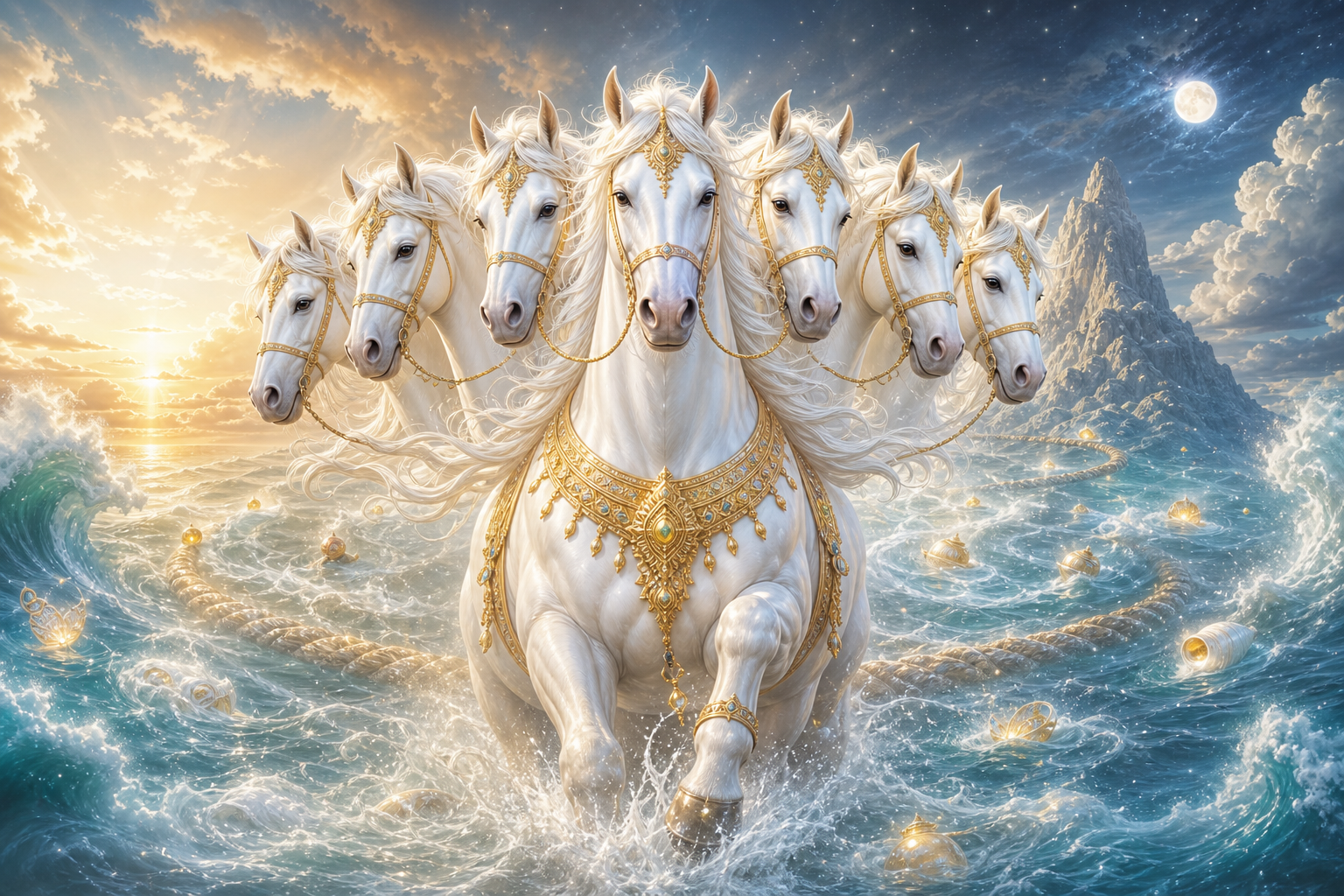
Uchchaihshravas, the radiant divine white stallion of Hindu sacred literature, stands among the most evocative beings to emerge from the Samudra Manthan, the churning of the cosmic ocean. In Puranic imagination, this celestial horse is not merely an ornament of mythic storytelling; it is a compact symbol of sovereignty, purity, speed, cosmic order, and spiritual aspiration. The figure appears in textual traditions such as the Bhagavata Purana and the Vishnu Purana, and its later iconographic forms, especially the seven-headed representation, invite a deeper reading of how Hindu art transforms scriptural memory into visible theology.
The Samudra Manthan narrative is one of the most philosophically rich episodes in Hindu scriptures. Devas and asuras, normally positioned as rival powers, cooperate to churn the Kshira Sagara, the ocean of milk, in search of amrita, the nectar of immortality. Mount Mandara becomes the churning rod, Vasuki becomes the rope, and Vishnu sustains the cosmic process through divine intervention. From this oceanic act arise treasures, beings, medicines, goddesses, and powers that reshape the moral and metaphysical landscape of the universe. Uchchaihshravas belongs to this class of luminous emergences.
The name Uchchaihshravas is commonly interpreted as “high-eared,” “loud-neighing,” or “of exalted fame,” depending on the philological emphasis placed on the Sanskrit components. Each meaning is suggestive. The high ear implies alertness and receptivity; the powerful neigh suggests vitality and cosmic announcement; exalted fame points to a being whose presence transcends ordinary animal symbolism. In sacred language, such names rarely function as labels alone. They encode temperament, metaphysical quality, and devotional memory.
In many scriptural accounts, Uchchaihshravas is described as dazzlingly white, an image that immediately connects the horse with sattva, purity, luminosity, and divine auspiciousness. White in Hindu iconography often evokes clarity, truth, peace, and the unclouded radiance of spiritual knowledge. The white horse therefore becomes an image of disciplined force purified of selfish aggression. It is not brute speed alone, but speed aligned with dharma.
The association of Uchchaihshravas with Indra, king of the devas, adds another layer of meaning. In Vedic and Puranic thought, kingship is never only a political condition; it is a responsibility to uphold order, protect life, and maintain the balance between heaven, earth, and human society. When Uchchaihshravas is connected with Indra’s sovereignty, the horse becomes a symbol of royal energy under divine obligation. Power, in this reading, is legitimate only when governed by cosmic responsibility.
The seven-headed idol form of Uchchaihshravas is especially striking. While scriptural references do not always describe the horse in the same visual detail, temple art and devotional imagination often expand textual images into symbolic forms. Seven heads may be read through the wider sacred vocabulary of Hindu thought: the seven worlds, seven meters of Vedic recitation, seven flames, seven rivers, seven horses of Surya’s chariot, or seven channels of awakened awareness. The number seven repeatedly marks completeness, ordered multiplicity, and the movement from earthly experience toward higher planes.
In iconographic terms, seven heads can also suggest multidirectional consciousness. A single-headed horse may represent momentum; a seven-headed divine horse represents momentum guided by expanded perception. This is an important distinction. The sacred image teaches that spiritual strength is not merely the ability to move quickly, conquer, or dominate. True divine force sees in many directions, responds to subtle realities, and carries awareness beyond the narrowness of ego.
The horse has long held a significant place in Indian sacred and royal culture. Vedic ritual literature, epic narratives, and Puranic symbolism frequently use the horse to represent vitality, prana, nobility, sacrifice, and movement. In the Ashvamedha context, the horse becomes a sign of sovereignty and ritual authority. In solar symbolism, horses draw the chariot of Surya, linking equine imagery with light, time, and cosmic rhythm. Uchchaihshravas gathers these associations into one celestial form.
The divine stallion’s emergence from the ocean is also psychologically meaningful. The ocean in Hindu symbolism often represents the undifferentiated depth of existence, the hidden reservoir from which both poison and nectar may arise. The churning process brings forth not only treasures but also danger, including halahala, the terrible poison consumed by Shiva for the welfare of all beings. Uchchaihshravas appears within this larger pattern: spiritual treasures emerge only through effort, friction, cooperation, restraint, and divine grace.
This makes Uchchaihshravas more than a mythological marvel. The divine white stallion becomes a teaching image for inner life. Human consciousness, when churned by discipline, devotion, study, and ethical struggle, can bring forth luminous capacities. Speed becomes focus. Strength becomes service. Beauty becomes refinement. Nobility becomes responsibility. The mythic horse is therefore also a map of inner transformation.
From the standpoint of Hindu philosophy, Uchchaihshravas may be understood as a symbol of pranic elevation. Horses move with breath, muscle, rhythm, and alertness; they are creatures of kinetic intelligence. When this natural symbolism is lifted into the celestial realm, it suggests the disciplined movement of life-force toward higher awareness. The seven heads can be contemplated as seven refined channels of perception, all directed by one divine body of purpose.
The idol form also communicates the relationship between beauty and metaphysics. Hindu iconography does not present sacred forms merely for aesthetic admiration. Form is a vehicle of tattva, or principle. Color, number, posture, ornament, gaze, weapon, vehicle, and gesture all carry layered meaning. A seven-headed white horse emerging from cosmic mythology is therefore a visual scripture: it invites the devotee to read divine order through proportion, multiplicity, purity, and motion.
In devotional settings, Uchchaihshravas can evoke reverence for the mysterious abundance of creation. The Samudra Manthan does not produce a single treasure but many, including Lakshmi, Kaustubha, Airavata, Kalpavriksha, Varuni, the moon, and amrita. This abundance reflects a worldview in which the sacred manifests in many forms. Such plurality is central to dharmic traditions. Hinduism, Buddhism, Jainism, and Sikhism all preserve, in different idioms, a respect for disciplined transformation, ethical living, and the possibility of inner awakening.
For this reason, Uchchaihshravas may be approached in a way that strengthens unity among dharmic traditions rather than sectarian separation. The image of the divine horse can be appreciated as a Hindu sacred symbol while also resonating with broader Indic concerns: mastery of the senses, nobility of conduct, purification of intention, reverence for life, and the journey from ignorance toward wisdom. These themes are not confined to one community’s ritual vocabulary; they are part of a larger civilizational conversation.
The whiteness of Uchchaihshravas also deserves careful attention. In ordinary life, white is easily reduced to purity in a simplistic moral sense. In sacred symbolism, however, purity is more demanding. It implies transparency of purpose, freedom from distortion, and alignment with truth. The white horse therefore asks whether energy has been cleansed of vanity. It asks whether ambition has become service, whether strength has become protection, and whether brilliance has become wisdom.
The seven-headed form intensifies this ethical reflection. Seven heads without unity would be fragmentation. Seven heads governed by one body become integrated awareness. This is a subtle but important teaching. A person may possess knowledge in many fields, power in many domains, or attention in many directions, yet remain divided inwardly. Uchchaihshravas represents multiplicity gathered into harmony. It is a sacred image of integration.
In art-historical interpretation, such composite and multi-headed forms are common in Hindu iconography because they express capacities beyond ordinary human perception. Multi-faced and multi-headed deities or beings do not imply biological exaggeration in a literalistic sense. They indicate expanded power, omnidirectional knowledge, cosmic function, and symbolic fullness. The seven-headed Uchchaihshravas belongs to this visual grammar of sacred abundance.
The idol form can also be read through the lens of movement between realms. Uchchaihshravas is a horse of the celestial realms, but its story begins in the oceanic depth. It rises from below and belongs above. This vertical movement mirrors a central spiritual pattern: consciousness must descend into difficulty, churn through confusion, and rise into clarity. The sacred horse’s upward destiny is therefore inseparable from the struggle of its origin.
The Samudra Manthan itself is not a tale of effortless divine reward. It is a narrative of tension. Devas and asuras both participate. Desire, ambition, fear, strategy, patience, and divine intervention all operate together. This complexity makes the episode enduringly relevant. It acknowledges that spiritual life is rarely simple. Even the search for nectar may produce poison first. Uchchaihshravas, emerging from this process, represents the noble outcome of a difficult cosmic labor.
Modern readers often encounter Uchchaihshravas as a mythic figure and may initially admire the image for its visual grandeur. Yet the deeper value lies in contemplating what the image asks of human life. It asks for alertness like the raised ear, disciplined energy like the trained horse, purity like the white radiance, and expanded awareness like the seven heads. Such symbolism remains relevant because it speaks to perennial human problems: distraction, pride, misuse of power, and loss of inner direction.
The divine horse also clarifies the Hindu understanding of animals in sacred imagination. Animals are not merely decorative companions to deities. They embody energies, virtues, instincts, and cosmic functions. Garuda represents divine speed and Vedic power; Nandi represents devotion and patient strength; Airavata represents royal rain-bearing abundance; the lion and tiger represent fierce shakti; the horse represents vitality, sovereignty, and forward movement. Uchchaihshravas is the celestial perfection of equine symbolism.
Because Uchchaihshravas is born from the cosmic ocean, its symbolism is not limited to royal grandeur. It is also connected to the hidden richness of existence. The ocean contains what is not yet manifest. Churning represents sadhana, the deliberate effort that brings the hidden into form. In this sense, the idol reminds devotees that spiritual excellence is not manufactured from nothing; it is uncovered from the depths through discipline and grace.
The story also contains a warning. The treasures of the ocean can become objects of attachment if they are pursued without wisdom. Uchchaihshravas is beautiful, powerful, and prestigious, yet its sacred value is diminished if viewed only as a symbol of possession. The higher reading sees the horse as a sign of divine order, not personal acquisition. Sacred symbols elevate the mind when they are contemplated, but they can bind the mind when reduced to status.
This distinction is central to dharmic spirituality. Power is not rejected, but it must be purified. Beauty is not rejected, but it must be sanctified. Wealth is not rejected, but it must be governed by dharma. Uchchaihshravas therefore stands beside other treasures of the Samudra Manthan as a reminder that the universe offers abundance, but abundance requires ethical maturity.
In temple sculpture, paintings, ritual storytelling, and contemporary devotional art, Uchchaihshravas continues to hold symbolic force because the image is both majestic and contemplative. The seven heads create wonder; the white body creates serenity; the celestial origin creates reverence. Together they produce a form that is visually memorable and philosophically dense. This is the strength of Hindu iconography: it allows theology to be seen, remembered, and meditated upon.
Uchchaihshravas also helps readers appreciate the sophistication of Puranic symbolism. Puranic literature is sometimes misread as simple mythology, but its narratives often operate simultaneously at ritual, cosmic, ethical, psychological, and devotional levels. The same story can instruct a child, inspire an artist, guide a devotee, and challenge a philosopher. The divine white stallion is one such layered figure.
At the ritual and devotional level, the image inspires reverence for divine manifestation. At the ethical level, it teaches disciplined power. At the psychological level, it represents elevated life-force. At the metaphysical level, it points to the emergence of order from cosmic depth. At the cultural level, it demonstrates how Hindu civilization preserves knowledge through symbol, story, sculpture, and sacred memory.
The spiritual significance of Uchchaihshravas is therefore not exhausted by identifying it as Indra’s horse or a treasure of the Samudra Manthan. Those are essential starting points, but the fuller meaning lies in what the image does to consciousness. It trains perception to see beyond surface form. It teaches that divine symbols are not arbitrary; they are carefully arranged fields of meaning.
For seekers, the most practical lesson may be this: energy must be refined before it can become sacred power. The horse is a creature of momentum, yet unchecked momentum can become restlessness. Uchchaihshravas is not restless; it is radiant. Its movement is celestial because it is ordered. Its strength is beautiful because it is purified. Its multiplicity is meaningful because it is integrated.
In a world marked by haste, noise, and scattered attention, the seven-headed divine horse remains an unexpectedly relevant symbol. It suggests that speed without wisdom is incomplete, ambition without dharma is dangerous, and perception without unity becomes confusion. Uchchaihshravas points toward a nobler ideal: swift action joined with clarity, strength joined with humility, and aspiration joined with spiritual discipline.
The sacred iconography of Uchchaihshravas ultimately reveals a profound Hindu insight: the divine is not limited to human-like forms. The sacred may appear as a river, mountain, tree, mantra, weapon, animal, sound, light, or cosmic event. Each form becomes a doorway into tattva when approached with reverence and understanding. The divine white stallion is one such doorway, carrying the mind from mythology into meditation.
Uchchaihshravas remains powerful because it unites grandeur with discipline. It is born from cosmic churning, shines with sattvic brilliance, bears the dignity of celestial sovereignty, and expands into sevenfold symbolic awareness. As an idol form, it invites contemplation of purity, movement, kingship, spiritual ascent, and the disciplined transformation of inner energy. As a cultural symbol, it preserves the genius of Hindu sacred art, where every form can become philosophy in visible form.
Inspired by this post on Hindu Blog.


Leave a Reply
You must be logged in to post a comment.