
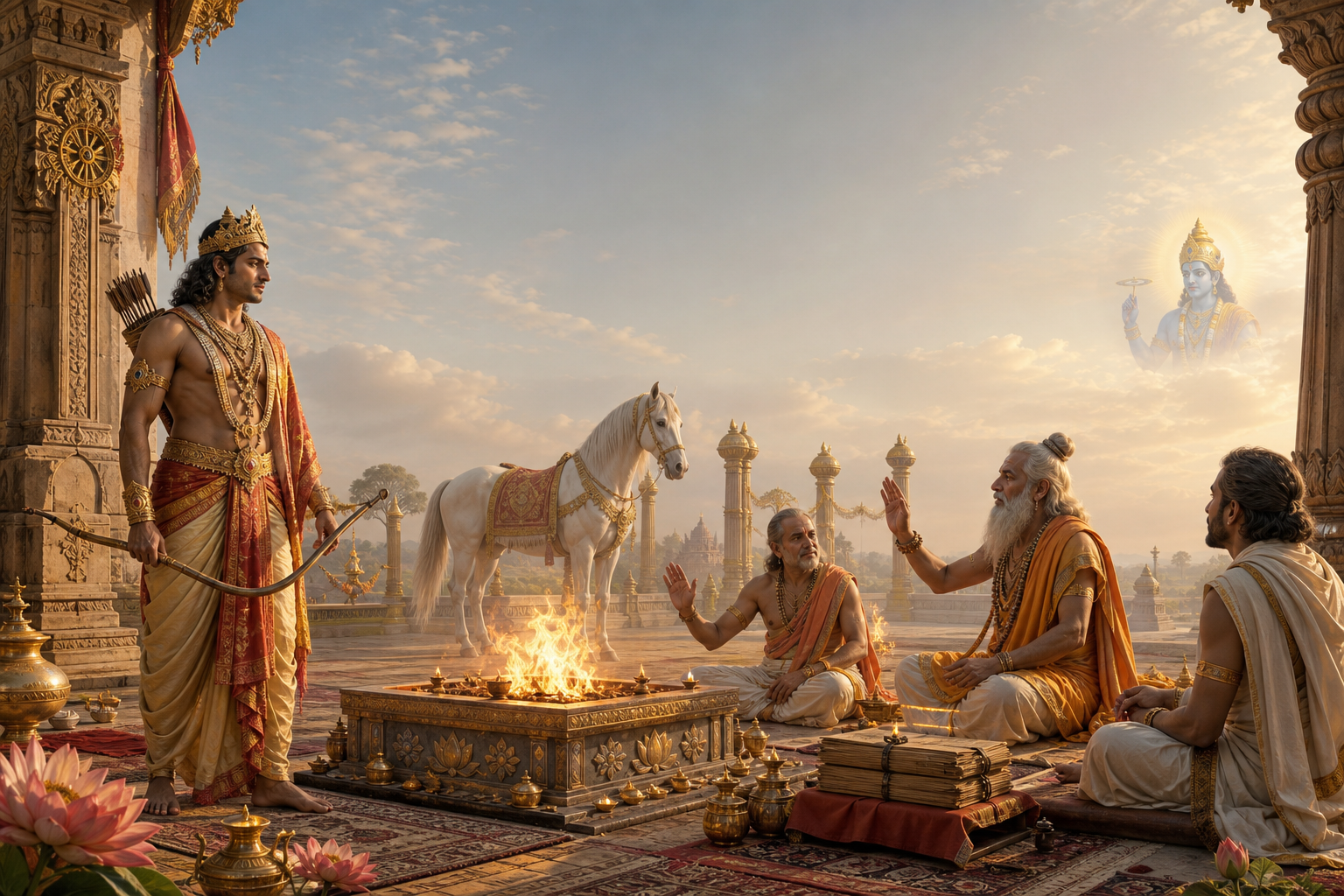
Śrīmad-Bhāgavatam 4.19.27 stands at a dramatic moral threshold in the narrative of King Pṛthu and Indra. The verse appears in Canto 4, Chapter 19, a section traditionally known for the account of King Pṛthu’s one hundred horse sacrifices and the crisis created when Indra repeatedly obstructs the final rite. On the surface, the episode is a royal and ritual conflict: a righteous king is provoked, a celestial ruler acts from envy, and learned priests intervene at the moment when anger is about to become irreversible action. At a deeper level, the verse becomes a study in dharma, restraint, scriptural authority, ritual discipline, and the ethical limits of power.
The Sanskrit verse reads: तमृत्विज: शक्रवधाभिसन्धितंविचक्ष्य दुष्प्रेक्ष्यमसह्यरंहसम् । निवारयामासुरहो महामतेन युज्यतेऽत्रान्यवध: प्रचोदितात् ॥ २७ ॥
The scene is tense because Mahārāja Pṛthu, celebrated in the Bhāgavata tradition as an exemplary ruler and a divinely empowered guardian of social order, has reached the point of fury. Indra has stolen the sacrificial horse and adopted deceptive external signs of renunciation, thereby disturbing the yajña and introducing confusion into religious life. The priests, seeing Pṛthu prepared to kill Indra, stop him and remind him that the sacrificial arena is governed by śāstra, not by personal anger, even when that anger appears justified.
For textual reference, the verse is available in the Bhaktivedanta VedaBase at Śrīmad-Bhāgavatam 4.19.27, within the chapter titled King Pṛthu’s One Hundred Horse Sacrifices. The surrounding verses clarify the narrative movement: Indra becomes disturbed by Pṛthu’s sacrificial success, repeatedly steals the horse, uses misleading religious appearances, and provokes both royal anger and priestly counteraction. This context is essential because the verse is not an isolated moral slogan; it is a carefully placed intervention in a larger discussion about dharma and adharma.
The key phrase in the verse is na yujyate, meaning that a proposed action is not fitting, not proper, or not aligned with the situation. This is a powerful ethical category. The priests do not deny that Indra has acted wrongly. They do not trivialize Pṛthu’s anger, nor do they present passivity as superior to justice. Instead, they distinguish between legitimate grievance and legitimate response. In dharmic reasoning, the existence of wrongdoing does not automatically sanctify every act committed in reaction to it.
This distinction is one of the most enduring teachings of the episode. Dharma is not merely the possession of righteous emotion. Dharma is the disciplined ordering of emotion through wisdom, proportion, duty, and śāstra. Pṛthu’s anger is intelligible because Indra has interfered with sacred work and damaged public religious trust. Yet the priests identify a boundary: a yajña cannot become the stage for uncontrolled vengeance. The sacred fire must not be used as a cover for personal retaliation.
The word ṛtvijaḥ refers to the officiating priests, those who know the proper time, procedure, and liturgical responsibilities of sacrifice. Their role in this verse is not decorative. They represent learned institutional memory, ritual precision, and the courage to restrain power when power is moving too fast. In the political theology of the Bhāgavata Purāṇa, even a great king benefits from counsel. Kingship without learned restraint risks becoming force; priestly learning without moral courage risks becoming ritual formalism. Here, the two are brought into corrective relationship.
King Pṛthu’s portrayal is especially important. He is not condemned as an adharmic ruler for feeling anger. The verse addresses him as mahā-mate, a great-minded person. This respectful address reveals the refinement of the intervention. A person may be great and still require correction. A ruler may be righteous and still need to pause. A devotee may have sincere zeal and still need guidance. The Bhāgavata does not flatten moral life into simplistic categories of good person and bad person; it shows that even elevated figures must remain answerable to dharma.
Indra’s role is equally instructive. In this chapter, he is not presented merely as a villain but as a powerful being overcome by envy and insecurity. His anxiety arises when Pṛthu’s sacrifices threaten to exceed his prestige. This is a subtle psychological observation. Even those with status may fear the excellence of others. Even those associated with cosmic administration may act from possessiveness. The text therefore warns that position alone does not guarantee purity of motive.
The episode also examines the danger of false religious signs. Indra’s deceptive use of renunciant appearances becomes a major concern in the chapter because external symbols can mislead when disconnected from inner discipline. This teaching has continuing relevance in all religious communities. Robes, titles, rituals, vocabulary, and institutional identity can support genuine spiritual life, but they can also become masks if separated from humility, truthfulness, and service. The Bhāgavata’s critique is not a rejection of renunciation; it is a defense of authentic renunciation from imitation.
In a technical sense, Śrīmad-Bhāgavatam 4.19.27 functions as a ritual-ethical boundary marker. The sacrificial arena is not an ordinary battlefield. It has a defined purpose, a defined procedure, and a defined theological orientation toward Lord Viṣṇu. When the priests tell Pṛthu that another killing is not prescribed there, they are emphasizing that sacred practice cannot be modified by anger. The ritual form has integrity. Its purpose cannot be rewritten in the heat of provocation.
This does not mean that the text endorses violence as a casual religious act. Traditional discussions of Vedic sacrifice are highly technical and are framed by scriptural conditions, mantra, ritual qualification, and theological intention. The Bhāgavata tradition, especially in Vaiṣṇava interpretation, repeatedly directs attention toward devotion, purification, and the satisfaction of Lord Viṣṇu rather than toward violence. In this verse, the point is not to expand the domain of ritual killing but to restrict action within scripturally defined limits and to prevent the sacrificial act from becoming a vehicle for revenge.
The deeper dharmic principle is ahiṁsā guided by wisdom, not sentiment detached from duty. Hindu, Buddhist, Jain, and Sikh traditions each approach non-harm, restraint, justice, and discipline through distinctive vocabularies and practices, yet they share a civilizational concern for transforming destructive impulse into ethical conduct. This verse contributes to that larger dharmic conversation. It teaches that spiritual maturity is not measured by the intensity of outrage but by the capacity to prevent outrage from violating truth.
For communities committed to Sanatana Dharma and to unity among dharmic traditions, the passage offers a valuable model. It does not ask people to ignore adharma. It does not romanticize weakness or counsel surrender to deception. Instead, it shows that the defense of dharma must itself remain dharmic. A response to wrongdoing that abandons restraint may reproduce the very disorder it seeks to correct. This is why the priests’ intervention is not a delay in justice; it is the preservation of justice from becoming corrupted.
The emotional force of the verse is easy to recognize in ordinary life. Individuals and communities often encounter moments when anger feels morally clear. A betrayal, insult, public distortion, or institutional failure can create a desire to act immediately and decisively. The Bhāgavata does not dismiss that pain. It places a wise voice at the critical moment and asks whether the intended action truly belongs to the sacred purpose at hand. That pause is not weakness. It is a form of inner sovereignty.
King Pṛthu embodies kṣatra, the protective and governing principle. Kṣatra without self-command becomes domination, but kṣatra without courage becomes negligence. Śrīmad-Bhāgavatam 4.19.27 shows the proper tension between the two. The king must protect dharma, yet he must also accept correction from those trained in śāstra. This makes the verse useful for modern discussions of leadership, governance, institutional ethics, and religious authority. Real authority is not the absence of limits; it is the ability to submit to rightful limits.
The priests’ counsel also illustrates a dharmic version of checks and balances. The king has executive power, the priests have scriptural expertise, and the sacrificial arena has its own sacred law. None of these elements is allowed to swallow the others. This layered structure prevents the collapse of dharma into personality. In contemporary terms, it suggests that healthy institutions require both conviction and accountability, both courage and procedure, both moral seriousness and restraint.
The chapter later shows that Lord Brahmā also intervenes and advises that the sacrifices should stop rather than allow Indra’s deception to multiply irreligious practices. This continuation reinforces the teaching of verse 27. Sometimes the most dharmic act is not to finish a prestigious project at any cost. Sometimes the protection of spiritual integrity requires renouncing even a respected goal when its pursuit begins to generate disorder. Pṛthu’s greatness is shown not only in his power to perform sacrifice but in his willingness to accept higher counsel.
This is a striking lesson for religious and cultural life. Communities can become attached to visible success: numbers, ceremonies, institutions, recognition, and public triumphs. Such achievements may be valuable when they serve spiritual growth, but they become dangerous when they feed rivalry or ego. Indra’s envy and Pṛthu’s anger are both tied to the pressure of prestige. The Bhāgavata therefore redirects attention from external completion to inner alignment with dharma.
In the teaching tradition associated with speakers such as HG Rama Raya Das, verses like this are often approached not merely as ancient narrative but as living guidance for sādhana, community conduct, and spiritual discernment. The value of such study lies in slowing down the narrative enough to see the ethical architecture inside it. A single verse can hold political theory, ritual theology, psychology, and devotional instruction together. Śrīmad-Bhāgavatam 4.19.27 is precisely such a verse.
The word śāstra is central to the verse’s meaning. Śāstra is not treated as ornamental authority invoked after decisions have already been made. It is the governing framework that determines what is fitting. In a dharmic worldview, freedom is not the rejection of all limits; freedom is disciplined alignment with truth. The priests remind Pṛthu that even when one has power, emotion, and cause, action must still be measured by revealed wisdom.
From a philosophical perspective, the verse challenges purely consequentialist thinking. One might argue that killing Indra would punish wrongdoing and deter future disruption. Yet the priests refuse to judge only by desired outcome. Means matter. Context matters. Scriptural authorization matters. The sanctity of the yajña matters. Dharma is therefore not reducible to utility, anger, or public symbolism. It is an integrated order in which act, agent, intention, means, place, and purpose must be examined together.
The passage also offers a warning against religious instrumentalization. When sacred forms are used to settle personal scores, they lose their elevating power. A mantra, robe, ritual, temple, or scripture can become misused when detached from humility and truth. Indra misuses religious appearance, and Pṛthu is briefly in danger of misusing the sacrificial setting for punitive force. The priests stand between these two distortions and reassert the integrity of sacred practice.
For modern readers, the lesson is not confined to royal sacrifice. It applies wherever noble causes are vulnerable to anger, ego, and performative righteousness. A movement for cultural preservation can become harsh if it forgets compassion. A defense of Hindu scriptures can become shallow if it abandons careful study. A call for justice can lose credibility if it refuses self-discipline. Śrīmad-Bhāgavatam 4.19.27 insists that dharma must be defended in a dharmic manner.
This is especially important for inter-dharmic unity. Hinduism, Buddhism, Jainism, and Sikhism have diverse metaphysical vocabularies and historical developments, yet all affirm the need to discipline the mind, purify conduct, and resist ego-centered action. The verse can therefore be read as a shared ethical reminder: anger may alert the conscience, but it cannot be allowed to govern the hand. The highest traditions do not merely produce strong reactions; they cultivate purified responses.
Śrīmad-Bhāgavatam 4.19.27 finally presents restraint as a form of power. The priests do not weaken Pṛthu by stopping him. They protect his greatness. They preserve the dignity of the sacrifice, the authority of śāstra, and the possibility of reconciliation. The verse teaches that the truly great person is not the one who can destroy an opponent at the height of anger, but the one who can hear dharma at that very moment and allow wisdom to interrupt force.
Seen in this light, the episode is not only about King Pṛthu, Indra, or an ancient yajña. It is about the recurring human struggle between justified anger and righteous restraint. It is about the need for spiritual communities to honor both courage and humility. It is about the enduring relevance of Hindu scriptures in shaping ethical life. Above all, it is about the principle that dharma is protected not merely by strength, but by strength disciplined through truth.
Inspired by this post on Dandavats.






Leave a Reply
You must be logged in to post a comment.