
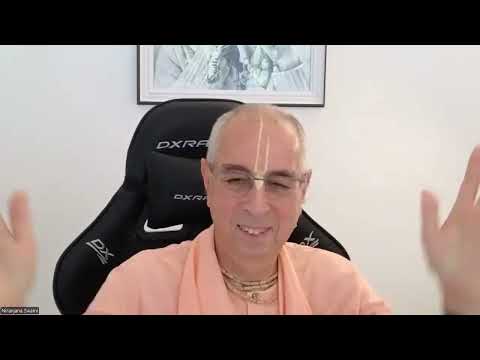
June 28, 2026 – Hungary – My Recent Experiences with Dhirasanta Goswami + Br. Bhag. 3.7.8 – English presents a focused devotional setting in which personal remembrance, scriptural study, and the discipline of inquiry meet within the wider landscape of Krishna consciousness. The available source material identifies the recording as an English presentation from Hungary and notes that translation has been removed, which makes the teaching stand primarily as a direct English reflection rather than a multilingual transcript. Its thematic center is Śrīmad-Bhāgavatam 3.7.8, a verse that draws attention to Vidura’s earnest questioning and Maitreya Muni’s composed, God-conscious reply.
The significance of this setting lies not merely in the location or the personality being remembered, but in the classical structure of dharmic learning itself. A sincere question is raised, a realized teacher responds, and the exchange becomes a vehicle for philosophical clarification. In the Bhāgavata tradition, knowledge is rarely treated as abstract information alone. It is embodied in dialogue, refined through humility, and transmitted through a relationship of trust between seeker and guide. This gives the video enduring relevance for students of Hindu scriptures, bhakti, guru-shishya tradition, and the larger family of dharmic spirituality.
Śrīmad-Bhāgavatam 3.7.8 occurs in the section known as “Further Inquiries by Vidura,” where Vidura continues his search for truth under the guidance of Maitreya. The verse describes how Maitreya, addressed by Vidura as a seeker of reality, initially appears astonished yet responds without hesitation because his consciousness is fixed on Bhagavān. This is a technically rich moment. It presents the teacher not as a performer of certainty, but as one whose inner orientation is stable enough to meet complex questions without defensiveness, agitation, or intellectual vanity.
The Sanskrit term tattva-jijñāsunā is especially important. It refers to one who is eager to inquire into tattva, the nature of reality. This is not casual curiosity, nor is it argument for the sake of argument. It is the disciplined hunger to understand what is ultimately true. In Hindu philosophy, this impulse appears across Vedānta, Sāṅkhya, Yoga, Nyāya, and other darśanas. It is also recognizable in Buddhist inquiry into suffering and impermanence, Jain attention to many-sided truth through Anekantavada, and Sikh emphasis on divine remembrance, humility, and lived wisdom.
The verse also uses the expression bhagavac-cittaḥ, indicating consciousness absorbed in the Supreme. In a technical devotional sense, this is not only emotional piety; it is a trained state of awareness shaped by śravaṇa, kīrtana, smaraṇa, seva, and disciplined association. A mind centered on Bhagavān becomes less reactive because it is not dependent on social approval, intellectual display, or victory in debate. Such a mind can receive difficult questions without turning them into personal threats. That quality is central to any serious spiritual teacher.
This is where the reference to recent experiences with Dhirasanta Goswami becomes meaningful. The title suggests a recollective frame: lived contact with a senior spiritual personality is being placed beside a scriptural verse on inquiry and response. In the dharmic world, experience with a guru, sādhu, monk, or advanced practitioner is not treated as a substitute for śāstra. Rather, it becomes a lens through which śāstra becomes intelligible. The living example helps reveal how composure, humility, steadiness, and devotion operate in ordinary circumstances.
A careful reading of Śrīmad-Bhāgavatam 3.7.8 shows that spiritual authority is not authoritarian. Maitreya does not silence Vidura’s inquiry. Vidura’s questioning is honored because it arises from a desire to know truth. This distinction matters deeply in modern religious life. A healthy tradition does not fear sincere questioning; it welcomes it when the question is rooted in humility, discipline, and commitment to reality. The strongest dharmic communities are not those that suppress inquiry, but those that refine it into wisdom.
The emotional power of such a verse lies in its realism. Many seekers have experienced moments when spiritual questions appear contradictory, unsettling, or even disruptive. A question about suffering, divine will, karma, duty, or the presence of evil can disturb simplistic belief. The Bhāgavatam does not dismiss this disturbance. Instead, it models a response: the teacher may appear surprised, but remains inwardly steady. The mature guide neither panics nor pretends that the question is trivial. He answers from a consciousness disciplined by devotion.
This model is especially useful for contemporary students of Hinduism and Sanatana Dharma. In a time of fragmented attention and rapid commentary, many people encounter scripture through short clips, isolated quotations, or social debate. Śrīmad-Bhāgavatam 3.7.8 invites a slower method. It suggests that truth is approached through attentive listening, careful questioning, philosophical patience, and the humility to learn from those whose lives have been shaped by practice. The result is not mere information but transformation of perception.
The Hungary setting adds another layer of meaning. Devotional culture traveling across regions shows how Hindu spiritual traditions have become part of a global religious conversation. Krishna consciousness, ISKCON communities, and broader bhakti movements have carried Sanskrit texts, kirtan, prasadam, temple worship, and guru-disciple learning into many cultural contexts. Yet the essential grammar remains ancient: a seeker asks, a teacher responds, and both stand within a lineage that regards divine consciousness as the foundation of knowledge.
The removal of translation also raises a practical point about accessibility. Translation can help multilingual audiences, but its absence places greater responsibility on clear English teaching and careful contextual explanation. A viewer approaching the video should therefore listen for how scriptural terms are explained, how personal experience is connected to śāstra, and how the mood of the presentation supports spiritual reflection. In serious study, one does not merely consume a lecture; one traces the relationship between text, teacher, tradition, and lived application.
From an academic perspective, the verse demonstrates a refined theory of knowledge. Vidura represents the qualified questioner, Maitreya represents the qualified respondent, and Śukadeva Gosvāmī frames the exchange for King Parīkṣit. This layered narration is common in Purāṇic literature. It creates a chain of transmission in which knowledge is preserved through dialogue rather than impersonal assertion. The structure itself teaches that truth is relationally transmitted, ethically held, and spiritually realized.
The phrase smayann iva gata-smayaḥ is also philosophically suggestive. It conveys the appearance of wonder while indicating the absence of hesitation or pride. A teacher may outwardly respond with surprise, but inwardly remain free from confusion born of ego. This is not theatrical modesty. It is the paradox of spiritual maturity: the realized person may appear simple, ordinary, or even momentarily astonished, yet remains grounded in a deeper certainty arising from God consciousness.
For modern practitioners, this offers a practical standard. Spiritual growth is not measured only by the number of texts read, rituals performed, or public identities claimed. It is visible in the ability to remain steady when challenged, compassionate when questioned, and truthful without becoming harsh. In this sense, the Bhāgavatam’s teaching is deeply relevant to family life, community leadership, interfaith dialogue, and the daily discipline of speech. A God-centered consciousness should make one more patient, not more brittle.
The video title’s reference to Dhirasanta Goswami therefore invites reflection on the role of saints and spiritual mentors in preserving continuity. The guru is not merely a lecturer. In dharmic traditions, a genuine guide helps students see how doctrine becomes conduct, how devotion becomes service, and how scriptural principles survive contact with human complexity. This is why personal remembrance can be spiritually valuable. It translates philosophical ideals into observable qualities: steadiness, compassion, humility, discipline, and devotion.
Such reflection also supports unity among dharmic traditions. Hinduism, Buddhism, Jainism, and Sikhism differ in metaphysics, theology, ritual forms, and historical development, yet they share a serious concern for disciplined inquiry, ethical transformation, humility, and liberation from ego-centered life. A verse about Vidura’s sincere questioning and Maitreya’s composed answer can therefore be appreciated not only within Vaishnava theology, but also within a wider dharmic culture that honors seekers, teachers, self-control, and truth-oriented dialogue.
At the same time, the specifically Vaishnava meaning should not be diluted. Śrīmad-Bhāgavatam is a central text of Krishna bhakti, and its language of bhagavac-cittaḥ points toward consciousness absorbed in the Supreme Person. The unity of dharmic traditions does not require flattening every tradition into sameness. A more respectful unity allows each sampradāya to speak in its own vocabulary while recognizing shared commitments to sincerity, discipline, compassion, and transcendence. This is a more durable model of harmony than vague universalism.
In personal terms, teachings of this kind often matter most when life becomes intellectually or emotionally unsettled. Many sincere people reach a point where inherited formulas no longer answer the full weight of their questions. The Bhāgavatam does not shame that moment. It shows Vidura asking, Maitreya responding, and Śukadeva preserving the exchange for future generations. The implied lesson is gentle but demanding: questions should become a doorway to deeper surrender, not an excuse for cynicism or spiritual laziness.
For readers and viewers, the practical application is clear. When approaching a scripture class, especially one connected with Śrīmad-Bhāgavatam 3.7.8, the first discipline is attentive listening. The second is honest inquiry. The third is reflection on conduct. A question becomes spiritually powerful only when it is joined with the willingness to be changed by the answer. Vidura is exemplary because he does not ask from arrogance. Maitreya is exemplary because he does not answer from ego. Their exchange becomes a model for all serious learning.
The enduring value of this featured video is therefore its convergence of place, memory, and scripture. Hungary becomes the contemporary setting; Dhirasanta Goswami becomes the personal reference point; Śrīmad-Bhāgavatam 3.7.8 becomes the philosophical anchor. Together they point toward a central truth of bhakti spirituality: knowledge matures when inquiry is sincere, guidance is rooted in realization, and consciousness is oriented toward Bhagavān. That lesson remains as relevant in modern Europe as it was in the ancient narrative world of Vidura, Maitreya, Śukadeva Gosvāmī, and King Parīkṣit.
Ultimately, the teaching encourages a culture of serious, respectful, and transformative dialogue. In an age where disagreement often becomes hostility, the Bhāgavatam offers a different pattern: inquire deeply, answer responsibly, and remain anchored in the divine. This is not only a religious ideal; it is a civilizational discipline. It strengthens Hindu spiritual education, supports dharmic unity, and reminds seekers that the highest knowledge is inseparable from humility, devotion, and a purified heart.
Inspired by this post on Dandavats.







Leave a Reply
You must be logged in to post a comment.