
Introduction. Rajadharma remains one of the most demanding concepts in Indic political thought because it refuses to reduce government to mere power, procedure, or ideology. It asks a harder question: what makes authority legitimate, restrained, beneficial, and answerable to Dharma? The study of government types in ancient Bharatavarsha therefore cannot be limited to modern labels such as monarchy, republic, democracy, oligarchy, or federation. These terms are useful, but they become clearer only when placed beside the Indic vocabulary of Prabhuthvam/Adhikarana, Raashtra, Raajya Vyavastha, Ganaraajya Vyavastha, Jaanaraajya Vyavastha, Sangharaajya, and the layered institutions of sabha, samithi, gana, kula, and panchayat.
The central insight is that Dharmic governance was not one single mechanical form. It included monarchies, republics, confederations, local assemblies, guild-linked civic bodies, village councils, and advisory institutions. Some were hereditary, some were elective, some were aristocratic, and some had democratic features at the local level. What joined the better forms together was not identical institutional design, but a shared ethical expectation: power was meant to serve order, justice, welfare, and the protection of society rather than the private appetite of rulers, priests, corporations, factions, or mobs.
Why typology matters. Government typology is not an abstract classification game. It shapes how a civilization understands legitimacy, citizenship, accountability, and public duty. In contemporary India, where constitutional democracy is often debated in emotional, ideological, or partisan terms, older Indic models provide a valuable comparative lens. They reveal that Bharatavarsha had experience with monarchy, aristocratic republics, confederate formations, assemblies, ballots, advisory councils, bureaucratic offices, and autonomous local institutions long before modern political vocabulary entered public life.
At the same time, the evidence should be handled carefully. Ancient Indian republics were not identical to modern liberal democracies. Many were aristocratic or clan-based. Franchise was often limited to householders, family heads, ruling lineages, or consecrated political classes. This fact should neither be romanticised nor dismissed. It shows that Indic political history was complex: it contained self-government, deliberation, and civic responsibility, but also hierarchy, qualification, and limits on participation. A mature reading accepts both sides.
Foundational vocabulary. Several terms are essential. Prabhuthvam/Adhikarana refers to government or authority. Raashtra refers to the polity or state, while Raajya Vyavastha refers to monarchical order. Ganaraajya Vyavastha refers to republicanism, and Jaanaraajya Vyavastha refers to democracy or public rule. Sacheeva varga/Adhikaari vyavastha refers to bureaucracy. Manthri Parishad denotes the king’s council of ministers, and Raaja Sabha denotes the royal court. Raashtra Vidhatha may be understood as a national conclave involving governors, commanders, or major provincial actors. Jaana Samithi refers to a popular assembly. These terms show that governance was imagined as a structured field with offices, councils, ranks, duties, and procedures.
Other administrative terms indicate a refined public vocabulary: Nirvaachaka for elections, Janagananaa for census, Janasankhya for population, Upeksha for impartiality, Saasana sanchaarin for bailiff, Salaaka-prathigraahin for ballot counter, and Salaaka for ballot or vote tally. Such language matters because political institutions require more than ideals. They require repeatable procedures, named offices, and public norms that make accountability possible.
Classical government types. A useful comparison comes from the familiar Greek typology associated with Plato and Aristotle: monarchy can decline into tyranny, aristocracy into oligarchy, and democracy into ochlocracy or mob rule. The moral point behind this typology is still relevant. Every form of government has a healthy and diseased version. A monarchy can protect law or become despotic. An aristocracy can cultivate excellence or become closed oligarchy. A democracy can honour public consent or descend into emotional crowd rule. The same concern appears in Rajadharma: institutions are necessary, but they are insufficient without character, restraint, and a concept of justice higher than convenience.
Modern categories add further distinctions. A republic is broadly a non-monarchical state. It may be military, aristocratic, democratic, constitutional, or parliamentary. A democratic republic is not the same as every ancient republic, because modern democratic republics usually assume broader citizenship and universal suffrage. Ancient republics, including many in India, often vested sovereignty in selected classes, lineages, or corporate bodies. This does not make them irrelevant; it makes them historically specific.
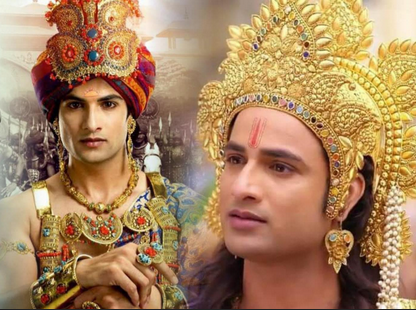
Rajadharma and monarchy. The most visible political form in Indian history was monarchy, but Dharmic monarchy should not be confused with unrestricted divine-right kingship. The Raaja was not meant to be a private owner of the state. He was the bearer of a trust. Dharma stood above the ruler, and the ruler’s task was to protect social order, uphold justice, defend the realm, and maintain welfare. The old explanation that Raajaa is connected with the duty to please or benefit the people captures this ideal: kingship was legitimate only when it served the people and the moral order.
Indic monarchy also included elective elements in certain periods and circumstances. When dynastic succession failed, sources describe the selection of rulers on merit. The people assembled in the Samitee could participate in the appointment or recognition of a king. This does not mean monarchy became modern democracy, but it shows that kingship was not always imagined as automatic blood entitlement. Consecration, public acceptance, counsel, oath, competence, and protection of the realm all mattered.
The king was expected to command the executive, judicial, and military branches, but he was also surrounded by councils, ministers, advisers, provincial authorities, and local bodies. The Manthri Parishad advised, the Raaja Sabha gave courtly and political structure, and officials executed policy. The king could overrule advice, yet a wise ruler ignored counsel at his peril. In this sense, Dharmic monarchy was strong government restrained by Dharma, public expectation, institutional advice, and the possibility of decline if arrogance replaced duty.
Gana and Sangha. The Indic republic requires careful terminology. Gana generally refers to a corporate political body, group, or assembly; Sangha often refers to a confederation or association of such bodies. Ancient Indian political literature, Buddhist sources, Jain traditions, and the Mahabharata preserve evidence of gana and samgha formations. The Licchavis, Sakyas, Mallas, Yaudheyas, Malavas, Koliyas, Moriyas, Bhulis, Bhargas, Kshudrakas, Arjunaayas, Surashtras, and Kambhojas appear in discussions of non-monarchical or republican forms. These were not always democratic in the modern sense. Many were aristocratic republics, clan republics, warrior confederacies, or corporate polities.
The famous Vajji or Vrijji confederation illustrates the strength of disciplined republican culture. The advice attributed to The Buddha regarding the Vajjians emphasises frequent assemblies, concord in deliberation, respect for established institutions, honour toward elders, protection of women, reverence for sacred sites, and support for the spiritually worthy. The political lesson is striking. A confederation prospers when its members assemble regularly, preserve lawful continuity, prevent social abuse, respect institutions, and resist internal disunion. The threat to such a polity is not only external invasion; it is factional breakdown.
This insight is valuable for all Dharmic traditions. Bauddha Sangha, Jain Gana, Hindu sabha and samithi traditions, and later Sikh institutions of collective discipline all point toward a civilizational memory in which community, counsel, duty, and shared norms matter. These traditions need not be collapsed into one another, and their historical differences should be respected. Yet they reveal a common Dharmic concern: authority must be disciplined by ethical purpose and collective responsibility.
Ganaraajya and aristocratic republics. Many ancient Indian republics were aristocratic. Political authority was commonly held by ruling Kshatriya families, with heads of families representing their kula in assembly. This structure differed from both absolute monarchy and modern mass democracy. It was republican because sovereignty did not rest in one monarch; it was aristocratic because political power was not universally distributed. Such systems could produce disciplined deliberation, but they could also become narrow, proud, and exclusionary if Dharma gave way to lineage vanity.
The history of the Sakyas and Koliyas provides a sober warning. Aristocratic self-confidence can become destructive when it turns into contempt for others. A polity built on birth status alone eventually weakens its own legitimacy. Rajadharma, properly understood, therefore cannot be reduced to caste arrogance, hereditary entitlement, or factional superiority. It must be rooted in conduct, qualification, character, and the willingness to protect the common good.
Jaanaraajya and democracy. Jaanaraajya is best understood as public rule, though its historical expressions varied. The evidence for full state-level democracy in ancient India is debated, but the evidence for democratic or semi-democratic local government is much stronger. Village assemblies, town bodies, and civic corporations managed irrigation, roads, tanks, gardens, charities, dispute resolution, temple affairs, revenue collection, and local records. In some places, assemblies included all adult male householders; in others, they were select bodies governed by qualification, rotation, and custom.
Uttaramerur is often cited in this context because Chola-period inscriptions describe ward representation, annual selection, committees, age qualifications, property requirements, disqualification for misconduct, and restrictions on immediate reappointment. The details should be studied without exaggeration. Uttaramerur was not universal democracy. It was a highly regulated local council within a specific social and religious setting. Still, it remains important because it records formal procedures for public office, anti-corruption safeguards, rotation, committee responsibility, and local accountability.
The local committees themselves show administrative sophistication. There were committees for annual affairs, charities, tanks, gardens, justice, gold supervision, wards, fields, temples, and ascetics. These categories reveal that local self-government was not symbolic. It handled water, land, law, endowments, religious institutions, and public works. For readers accustomed to modern bureaucratic distance, this older model offers a relatable lesson: governance is most meaningful when people can see its effects in roads, water, fairness, records, and the protection of shared institutions.
Ballots and parliamentary procedure. Ancient Indian assemblies also had procedures for voting. Chhanda, meaning wish or desire, could refer to the expression of a member’s will. When unanimity failed, speeches could be made and majority procedure followed. Salaakaas or voting tickets were used, and a Salaakaagraahaka could serve as teller or collector of votes. Voting might be open or secret depending on the procedure. Such details are historically significant because they show that deliberation required institutional method, not merely moral aspiration.
The presence of ballots, tellers, majority procedure, assemblies, councils, and committee rotation complicates simplistic claims that political sophistication belonged only to the modern West. At the same time, it also challenges careless claims that ancient India had every modern institution in identical form. The better conclusion is more balanced: Bharatavarsha developed its own political grammar, including monarchy, republic, confederation, local democracy, and administrative decentralisation, but these forms must be understood on their own terms.
Subsidiarity and decentralisation. One of the strongest themes in Indic governance is subsidiarity, meaning that matters should be handled at the lowest competent level wherever possible. Villages often exercised extensive authority over local disputes, water management, charities, roads, gardens, revenue arrangements, and temples. Central power existed, but local bodies were not always passive subjects. They could hold funds, receive endowments, manage common resources, and face penalties for dereliction of duty.
This decentralised pattern does not mean the state was absent. Royal officers supervised accounts. Serious crimes and capital punishment belonged to higher authority. Temple administration could involve both local management and royal oversight. Public institutions were therefore neither purely private nor merely state-owned. They existed in a layered order of trusteeship, local responsibility, and sovereign supervision. This offers an important corrective to modern debates that treat state and community as mutually exclusive.
Temple governance and public trust. Temple management in historical India was closely tied to public ethics, local administration, and royal oversight. Village bodies could manage temple affairs, but they could also be corrected if misappropriation occurred. Conversely, local bodies could report wrongdoing by temple servants. This indicates that sacred institutions were not meant to be beyond accountability. Their sanctity demanded better stewardship, not immunity from scrutiny.
For contemporary readers, this is one of the most practical lessons of Rajadharma. A temple, monastery, matha, gurdwara, Jain institution, or Buddhist vihara carries moral authority only when it is administered with transparency, service, and restraint. Dharmic unity is strengthened when institutions protect their sacred purpose while honouring public trust. Misuse of funds, factional capture, or sectarian rivalry weakens the very Dharma such institutions exist to uphold.
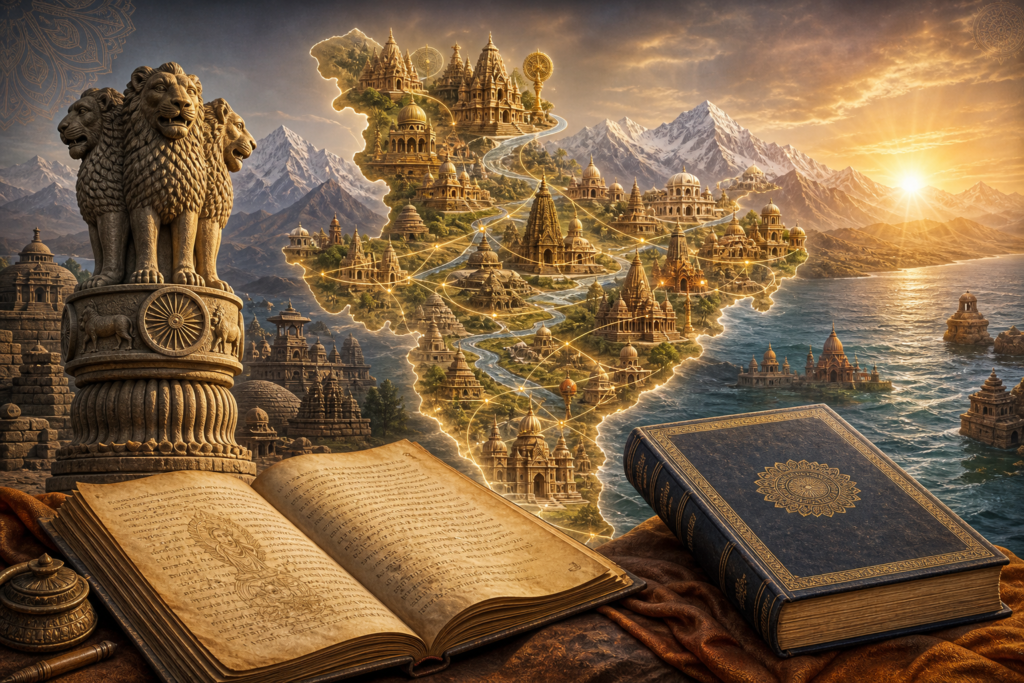
Confederation, federation, and union. Indic political vocabulary also recognises gradations of collective political order. Sammucchaya means collection, Sammaithree means alliance, Sangharaajya means confederation, Sandhaana means federation, and Samyuktha refers to union or unitary state. These distinctions matter because India historically contained many layers: civilization, nation, state, republic, province, tribe, city, village, guild, and sacred institution. Political unity did not always require institutional uniformity.
The confederate model was especially important for ganas that required mutual defence. The safety of smaller republics often depended on larger sanghas. The Kshudrakas and Mallas, for example, are remembered in relation to united military organisation. The lesson is practical: local autonomy without strategic coordination can become vulnerable, while central power without local legitimacy can become oppressive. Dharmic governance seeks balance between both dangers.
Political decline and corrupted forms. Every government type has a corrupted counterpart. Monarchy can become tyranny. Aristocracy can become oligarchy. Democracy can become mob rule. Bureaucracy can become self-serving officialdom. Religious guidance can decay into priestly domination. Corporate consultation can become corporatocracy. National attachment can become unjust nationalism, and public welfare politics can become irresponsible populism. Rajadharma is therefore not nostalgia for any single form; it is a discipline that asks whether power is being used for justice, welfare, order, and restraint.
This is where the distinction between rule of law and rule of Dharma becomes important. Rule of law requires predictable statutes, procedures, and consent. Rule of justice or virtue asks whether law itself serves a higher moral order. Dharmic political thought values both. Law without justice becomes mechanical coercion. Moral rhetoric without law becomes arbitrary power. Rajadharma requires the two to be joined.
Bureaucracy as service. The older Indic administrative vocabulary suggests that officials were meant to serve functions, not create a permanent class of untouchable administrators. Adhikaari, Adhyaksha, Sanchaalaka, Nirdhesaka, Aayogin, Pramaathri, Rahasyadhikrtha, Thantrapaala, and other offices existed for defined purposes. The ideal was not bureaucratic distance but competent execution. A public servant who removes obstacles, reports neglect, and carries out duty reflects Rajadharma better than one who hides behind procedure.
Modern governance can learn from this without pretending that ancient systems can be copied directly. Today’s India is vastly larger, more diverse, constitutionally structured, and socially transformed. Universal citizenship, fundamental rights, electoral democracy, judicial review, and modern administration are realities. Yet the older insistence on duty, accountability, decentralisation, civic training, and character remains highly relevant.
The question of civic qualification. The conclusion of this inquiry should not be a call to revive exclusionary aristocracy. It should be a call to revive civic responsibility. Ancient systems often linked office to qualification, age, property, lineage, conduct, ritual status, or household responsibility. Modern society rightly rejects many hereditary barriers, but it still needs standards of competence and integrity. A republic cannot function if public office becomes a prize for noise, money, manipulation, inherited entitlement, or factional loyalty.
A Dharmic republic in the ethical sense would therefore evaluate leadership by qualification, conduct, character, and public service. It would honour learning without becoming technocratic, respect tradition without becoming casteist, protect faith without becoming sectarian, and value democracy without surrendering to mob pressure. This balance is difficult, but it is precisely the kind of difficulty Rajadharma was designed to address.
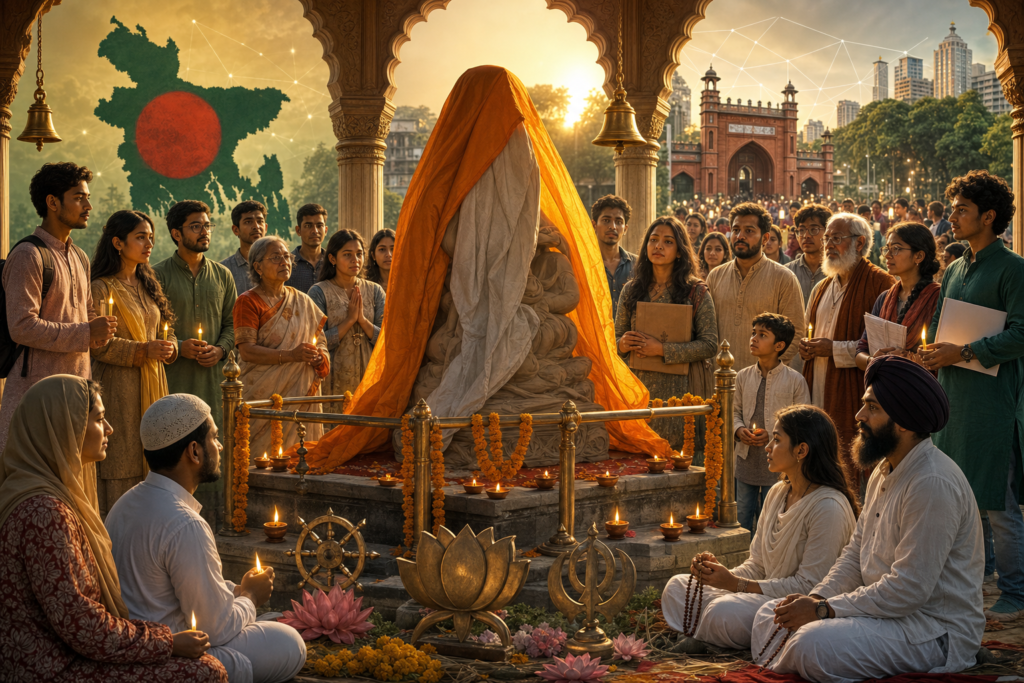
Dharmic unity and institutional memory. Hindu, Buddhist, Jain, and Sikh traditions each preserve distinctive approaches to authority, community, discipline, and service. The Bauddha Sangha emphasises concord and discipline. Jain Gana traditions preserve corporate religious organisation and rigorous ethical life. Hindu Rajadharma links sovereignty with cosmic and social order. Sikh institutions later demonstrate the power of collective commitment, seva, and community accountability. Their histories are not identical, but they can be read together as part of a broader Dharmic civilizational conversation on how power should be restrained and service should be organised.
This shared civilizational lens is especially important today. Dharmic unity does not require flattening difference. It requires mutual respect, accurate history, and the recognition that institutions survive only when communities practice responsibility. A village assembly, a gana, a sangha, a temple board, a panchayat, a republic, or a constitutional state all fail when duty is replaced by entitlement. They prosper when service, restraint, and truth remain public virtues.
Modern relevance. The study of Rajadharma and government types offers several practical lessons for contemporary governance. First, decentralisation matters because people understand local problems most directly. Second, central authority remains necessary for defence, justice, coordination, and standards. Third, public institutions require oversight because sacred or civic status alone does not prevent misuse. Fourth, democracy requires civic training, not only periodic voting. Fifth, historical memory must be accurate enough to inspire without becoming fantasy.
The deepest lesson is that no structure automatically guarantees justice. Monarchy, republic, federation, confederation, democracy, and bureaucracy can all serve Dharma or violate it. The decisive question is whether the form is animated by public duty, moral restraint, administrative competence, and a sincere commitment to welfare. In that sense, Rajadharma is not merely an ancient doctrine. It is a continuing standard by which political power may be judged.
Conclusion. Government typology in the Indic tradition is richer than a simple contrast between monarchy and democracy. It includes Raajya Vyavastha, Ganaraajya Vyavastha, Jaanaraajya Vyavastha, Sangharaajya, village assemblies, councils, ballots, committees, royal oversight, civic corporations, and sacred trusts. Its history contains admirable experiments as well as limitations that modern society must not repeat. The enduring value lies in its insistence that power is a trust, society is a moral organism, and public office is a duty.
Rajadharma finally points beyond institutional pride. It reminds every generation that the state exists for culture, welfare, prosperity, development, justice, and protection. It rejects tyranny, factional arrogance, mob rule, priestly domination, bureaucratic vanity, and corporate capture alike. Its finest political teaching can be stated simply: a government is legitimate only when it serves Dharma, protects people, and disciplines power through responsibility.
Inspired by this post on Indic Portal.



Leave a Reply
You must be logged in to post a comment.