
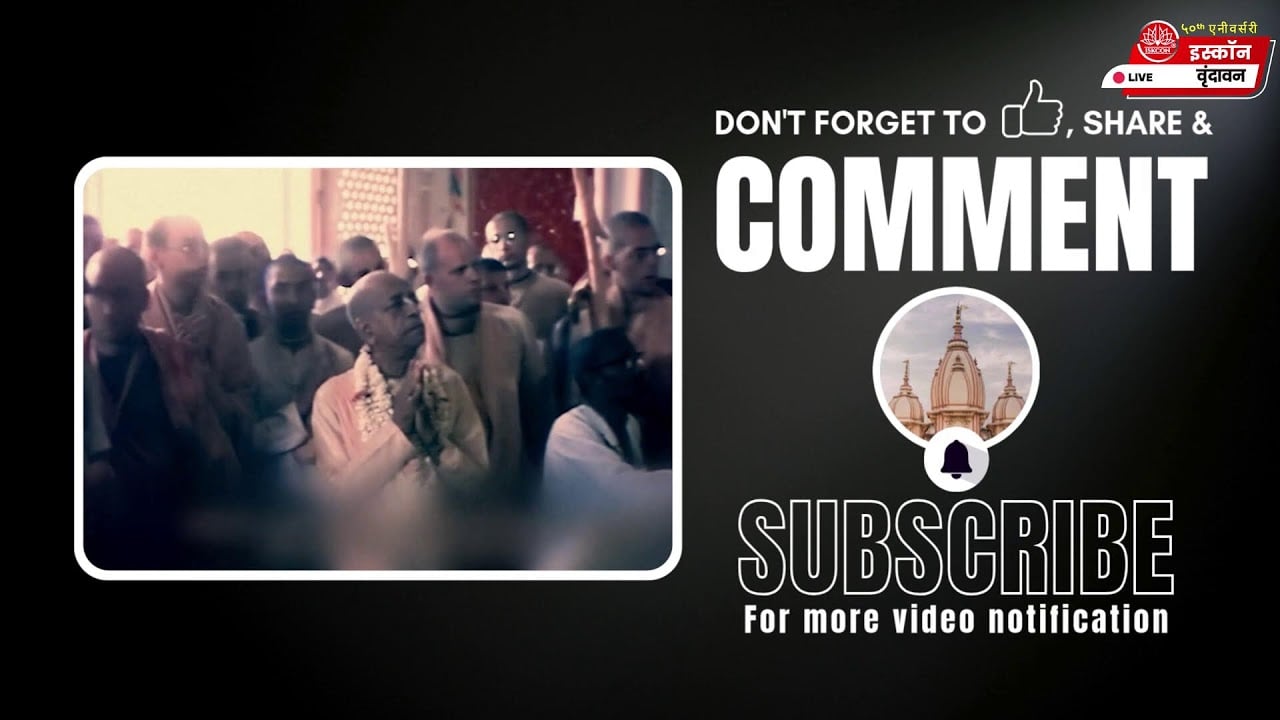
The 14.06.2026 discourse by HG Daivi Shakti Mataji at ISKCON Vrindavan offered a rigorous, contemplative reading of Srila Prabhupada-lilamrita, illuminating how biography, place, and practice converge to guide contemporary spiritual life. Framed within the living memory of Vrindavan, the session highlighted how a historically grounded narrative can also function as a manual for Bhakti-yoga, ethical leadership, and inter-dharmic harmony.
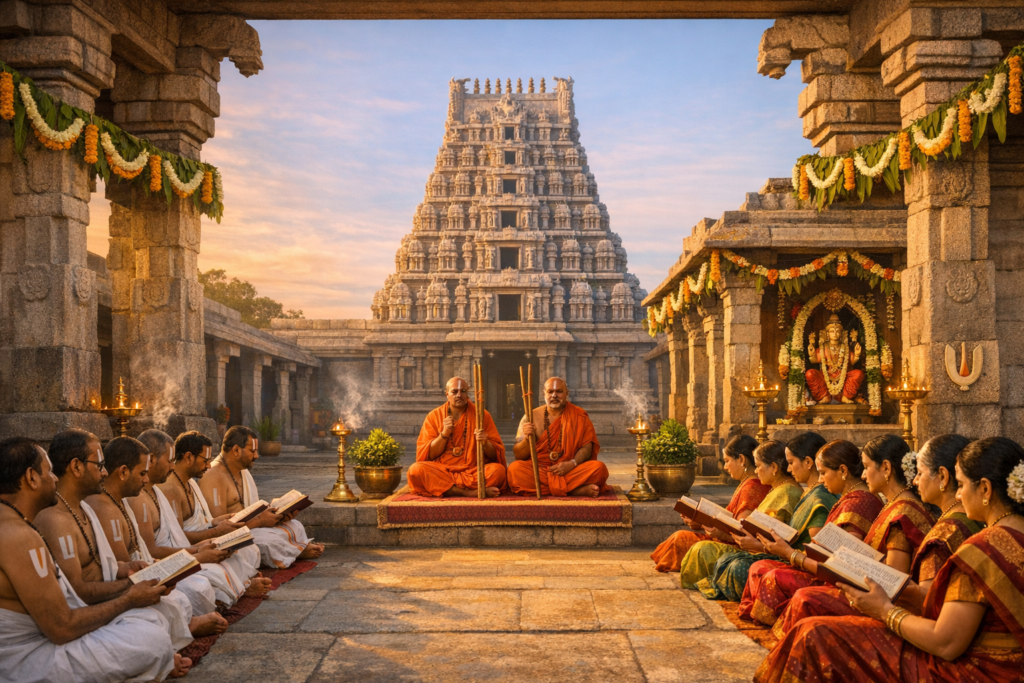
HG Daivi Shakti Mataji—revered within the Vrindavan community for decades of seva and for carefully preserving first-hand recollections—structured the presentation as a methodical study circle. This format supported both accuracy and affect: verified facts anchored the discussion, while recollected experiences conveyed the emotive force of Srila Prabhupada’s mission and its enduring relevance across generations.
Srila Prabhupada-lilamrita, composed by Satsvarupa dasa Goswami, is a multi-volume biography built from interviews, personal letters, journals, and institutional records. The text’s historiographical strength lies in triangulation—cross-checking oral testimony with archival material—while its devotional strength lies in presenting personality and purpose without sacrificing factual clarity. The session explained how to read the work critically yet devotionally, seeing it as both history and sadhana.
Born Abhay Charan De in 1896 in Calcutta, Srila Prabhupada was nurtured in a devotional household. A decisive intellectual and spiritual turn occurred in 1922 with the meeting of Bhaktisiddhanta Sarasvati Thakura, whose instruction to “preach in English” set a lifelong trajectory. This directive situated Prabhupada within a Gaudiya Vaishnava modernity that sought faithful transmission through contemporary media and languages.
After formal initiation in 1933, he launched the magazine Back to Godhead in 1944, demonstrating an early synthesis of scholarship, publishing logistics, and outreach. By the 1950s he had relocated to Vrindavan, accepted sannyasa (1959), and begun translating Srimad-Bhagavatam. These years reveal a pattern of disciplined labor: organizing printing, distributing books, and refining pedagogical clarity to serve a global readership.
In 1965, Srila Prabhupada undertook a transoceanic journey aboard the cargo ship Jaladuta, braving illness while composing the reflective poem “Markine Bhagavata-dharma,” which captured the theology, humility, and determination of his mission. Arrival in Boston signaled not an end but the inaugural threshold of a pedagogical experiment that would soon become a worldwide movement.
New York’s 26 Second Avenue storefront became a laboratory of bhakti pedagogy: kirtan at Tompkins Square Park; instruction in mantra meditation; and in 1966, the legal incorporation of the International Society for Krishna Consciousness (ISKCON). A clear behavioral framework—four regulative principles coupled with a daily quota of japa—established a replicable practice culture adaptable to diverse urban contexts.
Globalization followed rapidly. London (1969) amplified visibility through cultural interfaces, and in 1972 the Bhaktivedanta Book Trust (BBT) scaled scholarly publication. The Krishna Balaram Mandir in Vrindavan (1975) embodied an integrated model of worship, education, and prasadam culture. By 1977, Srila Prabhupada had offered final instructions in Vrindavan, leaving a network of more than one hundred centers and a comprehensive literary corpus.
The theological architecture of Gaudiya Vaishnavism—achintya-bhedābheda, the simultaneous oneness and difference between the divine and the soul—was presented as a sophisticated synthesis. It affirms personal theism while engaging nondual insights, offering a dialogic bridge to wider Indian philosophies and supporting respectful exchange with other dharmic traditions.
Practice was analyzed through the nine processes of bhakti (including śravaṇa and kīrtana), the primacy of nāma-saṅkīrtana, and the stabilizing force of daily japa. Attention to brahma-muhūrta discipline, study of Bhagavad-gita As It Is and Srimad-Bhagavatam, and consistent seva formed a tripod of applied spirituality. HG Daivi Shakti Mataji emphasized how small, cumulative commitments shape lasting transformation.
Literary method received careful treatment. Srila Prabhupada’s purports synthesize the works of earlier ācāryas such as Baladeva Vidyābhūṣaṇa and Viśvanātha Cakravartī, balancing fidelity to paramparā with readability for modern audiences. BBT editorial protocols—from translation consistency to glossary usage—were presented as technical scaffolding that preserves nuance while inviting broad participation.
The moral center of the narrative is compassion anchored in tapasya. Daily schedules, robust correspondence, and tireless travel translated inner conviction into accessible pedagogy, especially for youth dislocated by the cultural tumult of the 1960s. Community norms were framed not as restriction but as architecture for freedom—the space where higher aspirations can reliably mature.
Institutionally, the formation of the Governing Body Commission (GBC) distributed responsibility, reduced concentration risk, and encouraged local innovation within global standards. Book distribution served as portable education; temples matured as cultural commons offering kirtan, classes, and prasadam—public goods with measurable social benefit.
Inter-dharmic resonance emerged naturally. The sevā and karuṇā underlying bhakti dialogue with Buddhist compassion and mindfulness; Jain ahiṃsā and aparigraha harmonize with vegetarian ethics and simplicity; Sikh kīrtan and seva mirror the sonic and service dimensions of Hare Krishna practice. All four traditions affirm inner transformation, ethical conduct, communal harmony, and remembrance of the sacred.
The role of women in bhakti received respectful attention. Vaishnavis have long contributed to kirtan leadership, education, and community organization; HG Daivi Shakti Mataji’s own service exemplifies this continuity. The guru–śiṣya paramparā, understood correctly, affirms universal access to devotion while upholding standards of integrity and learning.
Pedagogically, biography functions as sādhanā. Internalizing narrative—its trials, decisions, and graces—recalibrates conduct. Techniques such as guided reading, reflective journaling, and structured discussion create a feedback loop between śāstra (texts), sādhu-saṅga (sacred association), and sādhanā (daily practice), aligning aspiration with method.
Vrindavan’s sacred geography—anchored by the Krishna Balaram Mandir and Srila Prabhupada’s samādhi—makes devotion tangible. Darśana, kirtan, and study form a seamless circuit: sight refines memory, sound purifies intention, and learning informs service. The discourse showed how place-based practice catalyzes personal and communal resilience.
Measurable outcomes reinforce these claims: global adoption of vegetarian and sattvic diets, the diffusion of mantra meditation into wellness and academic settings, and sustained interest evidenced by BBT holdings in libraries worldwide. Such data points, while only partial indicators, corroborate the transformative scope of a text-centered, practice-forward movement.
Actionable takeaways were distilled clearly: maintain a steady japa practice; read foundational bhakti texts daily; engage in local seva initiatives; cultivate humility and gratitude; and prioritize community. Consistency over intensity was recommended as the surest path to durable change.
Emotionally, the narrative cadence mattered. Accounts of the Jaladuta voyage, early hardships, and persistent hope generated empathy that strengthens resolve. Remembering these episodes invites a shared ethic of care that naturally extends across communities and traditions.
In sum, the 14.06.2026 session positioned Srila Prabhupada-lilamrita as living guidance: historically responsible, spiritually potent, and socially constructive. It offered a disciplined template for Bhakti-yoga, fostered unity among Hindu, Buddhist, Jain, and Sikh traditions, and invited ongoing study within ISKCON Vrindavan and beyond—so that knowledge, devotion, and service continue to move together as one.
Inspired by this post on Dandavats.




Leave a Reply
You must be logged in to post a comment.