Lakshmi Ganapati occupies a luminous place among the thirty-two celebrated forms of Ganesha attested in the Hindu and Tantric traditions, where auspiciousness, wisdom, and prosperity converge into a single, integrative vision of spiritual life. In this form, Ganapati is enshrined with the goddesses of prosperity, signifying that material well-being and spiritual accomplishment can be harmonized within dharmic bounds. The designation “Lakshmi” here indicates the presence and power of prosperity-shakti rather than a substitution of Ganesha with Goddess Lakshmi; it clarifies that this is a distinct iconographic and theological expression of Ganesha aligned with the Lakshmi-tattva.
Across textual and regional traditions, Lakshmi Ganapati is consistently presented as spiritually potent and benevolent. Sources such as the Ganesha Purana and the Mudgala Purana provide the theological horizon for the thirty-two forms, while later compendia like the Śrītattvanidhi (Mysore, 19th century) transmit detailed iconography. Together, these materials show a living lineage of practice spanning temple art, household worship, and Tantric sādhanā, ensuring continuity between classical descriptions and contemporary devotion.
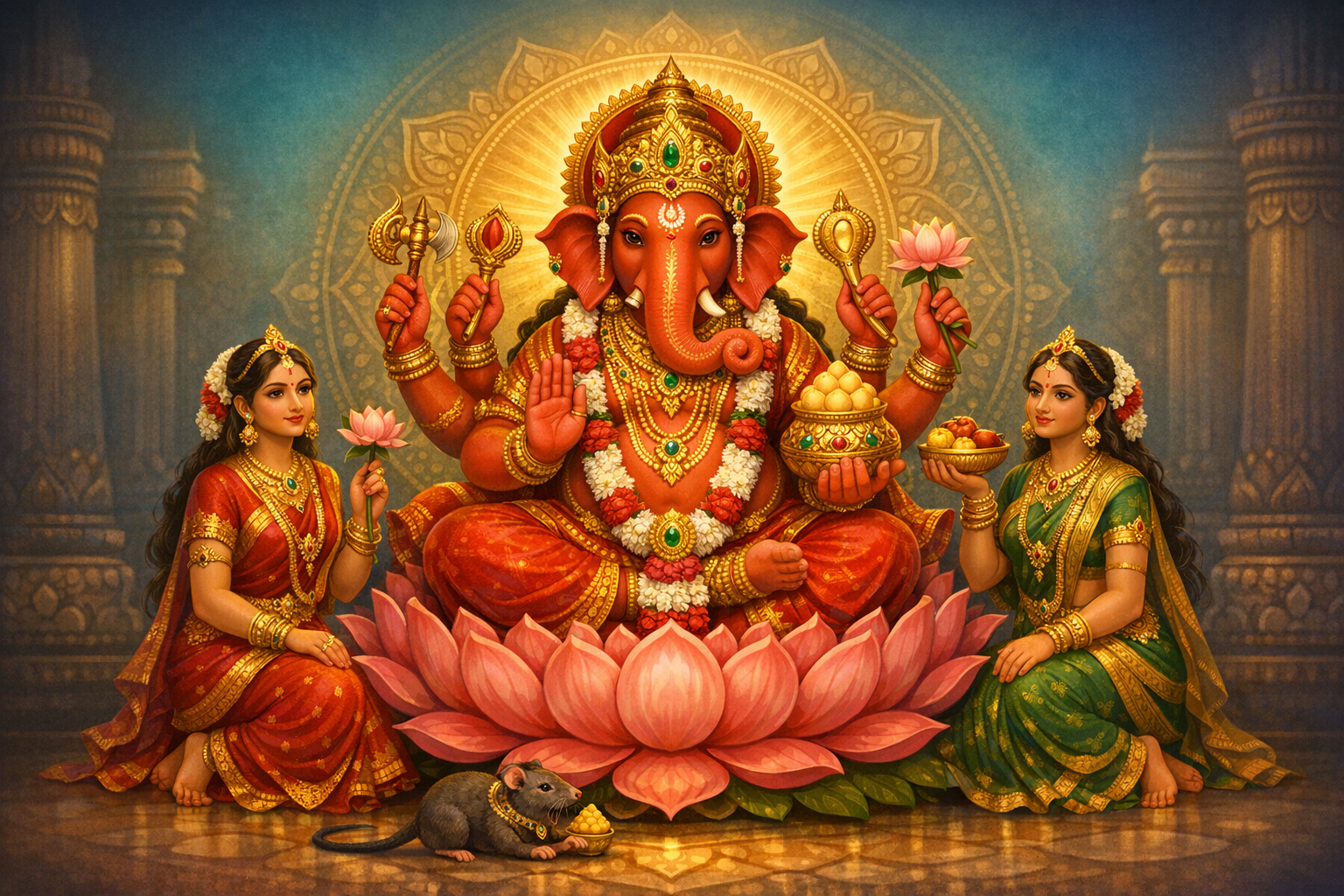
Iconographically, Lakshmi Ganapati is typically golden or red-golden in complexion, a chromatic cue to abundance, vitality, and auspicious radiance. He is most often seated, with the mouse (mūṣika) as vahana, and attended by two consorts commonly identified as Siddhi and Riddhipersonifications of spiritual accomplishment and prosperitywho are closely aligned with the Lakshmi principle. His hands (frequently eight, though four-armed depictions occur) display a constellation of attributes: pasha (noose), ankusha (goad), modaka (sweet), a ratna-kumbha (pot of jewels or nectar), lotus, and sometimes an axe or fruit. Regional ateliers may vary one or more emblems without compromising the recognizable profile of the form.
Each attribute bears layered symbolism essential to understanding Lakshmi Ganapati’s meaning. The pasha does not merely bind; it also gathers the errant mind back to the center of discernment. The ankusha redirects inner momentum, turning habit into aspiration and distraction into one-pointed focus. The ratna-kumbha expresses overflowing abundance earned through dharmic means, while the modaka, etymologically linked to bliss (moda), signifies the sweet fruit of disciplined practice and ethical action. The lotus, rising unsullied from mud, symbolizes purity of motive in both spiritual and worldly pursuits.
The presence of the two Shaktis as Siddhi and Riddhi communicates a pedagogical and devotional synthesis. Siddhi conveys spiritual attainmentsclarity, steadiness, and realized wisdomwhile Riddhi represents growth in rightful prosperity and well-being. Together they assure the householder and the renunciate alike that dharma is not a zero-sum choice between inner realization and outer flourishing. In Lakshmi Ganapati, dharma (moral order), artha (prosperity), and kāma (rightful desire) are disciplined and illumined to serve moksha (liberation), not to eclipse it.
In Tantric frameworks, Lakshmi Ganapati embodies the union of wisdom and prosperity as a sacred polarity, approached through mantra, mudra, and visualization grounded in guru-śishya paramparā. While mantras differ across lineages, the practice typically combines Ganesha’s seed-syllabic force with Lakshmi-related bija-sounds, reflecting the union of remover-of-obstacles with bestower-of-aishvarya (noble abundance). The intent is neither acquisitive nor ascetic in isolation; rather, it is integrative, aligning livelihood, learning, and liberation in a single contemplative arc.
Ritual observance centers on purity of intent and ethical action. Offerings may include modaka, coconut, and seasonal fruits; durvā grass (a classic Ganesha offering) appears in many regional puja paddhatis; and flower selections in red or golden hues are common to Lakshmi-oriented worship. Shukla Paksha Chaturthi remains especially auspicious, as do venerations during Ganesh Chaturthi. Temple festivals and home pujas alike emphasize abhaya (fearlessness) and varada (boon-bestowing) mudras, inviting participants to cultivate responsibility in success and steadiness in challenge.
Art-historically, Lakshmi Ganapati can be traced across the subcontinent’s styles. South Indian bronzes and stone sculpture from Chola and Hoysala ateliers often accentuate balanced proportions and ornamental serenity. In Odisha’s pattachitra and Bengal’s painting traditions, the icon’s golden aura and consorts receive narrative elaboration, while the Mysore school, closely linked to the Śrītattvanidhi, preserves detailed codifications of color, posture, and attributes. Nepalese paubha and Newar craftsmanship frequently highlight jewel-toned abundance and precise hand-gestures, emphasizing the icon’s meditative geometry.
The inter-dharmic resonance of Lakshmi Ganapati is instructive for a unified understanding of Indic spirituality. In several Vajrayana Buddhist contexts, forms of Ganapati (Vināyaka or Mahā-Rakta Gaṇapati) appear as wealth-bestowing or obstacle-clearing deities within a mandalic whole, signifying auspicious support to practice. In Jain contexts, Ganesha is represented in some temple ecosystems as an attendant or as an auspicious figure near goddesses like Ambikā, underscoring how prosperity and obstacle-removal function as ethically positive, pan-Indic ideals. Within Sikh tradition, which centers on the formless One and rejects image-worship, the shared civilizational emphasis on truthful living, honest livelihood (kirat karni), and seva aligns with the ethical heart of Lakshmi Ganapati’s prosperity-through-dharma message. Such convergences show complementary pathways rather than competition, affirming unity in diversity across Hindu, Buddhist, Jain, and Sikh heritage.
Philosophically, Lakshmi Ganapati may be read as a hermeneutic guide to livelihood: prosperity is not an end-state but a responsibility. The icon asks for alignmentearning without exploitation, giving without condescension, consuming without waste, and leading without arrogance. Many devotees and scholars alike note how this form steadies the mind in times of growth and challenge, encouraging gratitude in gain and equanimity in uncertainty. The emotional connection is immediate: where fear of scarcity yields to trust in dharma, the heart becomes spacious and the hand, generous.
Clarifications arise frequently and merit careful distinction. Lakshmi Ganapati is not identical to Goddess Lakshmi; rather, he is Ganesha with prosperity-shaktis, expressing a Lakshmi-infused function. Lakshmi Ganapati differs from Shakti Ganapati, another of the thirty-two forms in which a singular consort is seated upon his lap with a separate iconographic vocabulary. Variations in hand-count and attributes do not negate identification; they reflect regional śilpa-śāstra choices consistent with a core symbolic grammar documented in puranic and post-puranic sources. Such elasticity exemplifies the living nature of Hindu iconography and its hospitable, non-dogmatic spirit.
For contemporary practitioners, artists, and students of culture, Lakshmi Ganapati offers a framework to evaluate wealth and work with care. It becomes a touchstone for ethical entrepreneurship, mindful consumption, and social responsibility grounded in dharma. In concrete terms, households invoke this form when beginning new ventures, students seek clarity and right effort, and communities invoke shared well-being over zero-sum gains. The motif thus enriches personal practice and public life alike, pointing toward a prosperity that uplifts families, ecosystems, and society.
As a node within the wider network of Ganesha’s thirty-two forms, Lakshmi Ganapati helps map the full circumference of Ganapati-tattvafrom childlike freshness (Bala) to heroic protection (Vīra), from ecstatic dance (Nritya) to obstacle-clearing grace (Sankatahara). This multiplicity does not fragment meaning; it refines it. By contemplating and venerating Lakshmi Ganapati with informed attention, one learns to bring spiritual insight to worldly affairs, integrating wisdom and wealth into a practice that honors the indivisible dignity of all beings.
Inspired by this post on Hindu Blog.