
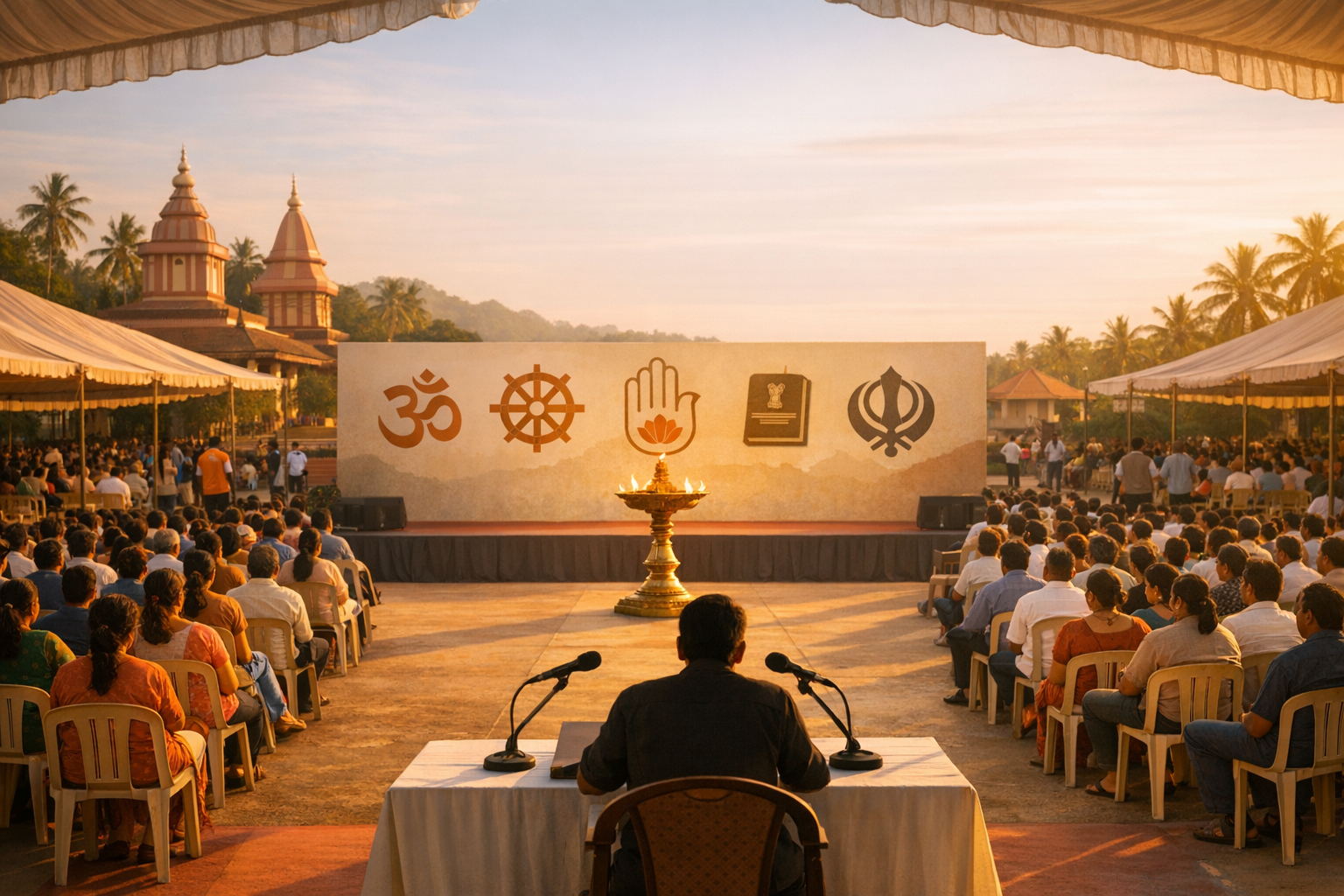
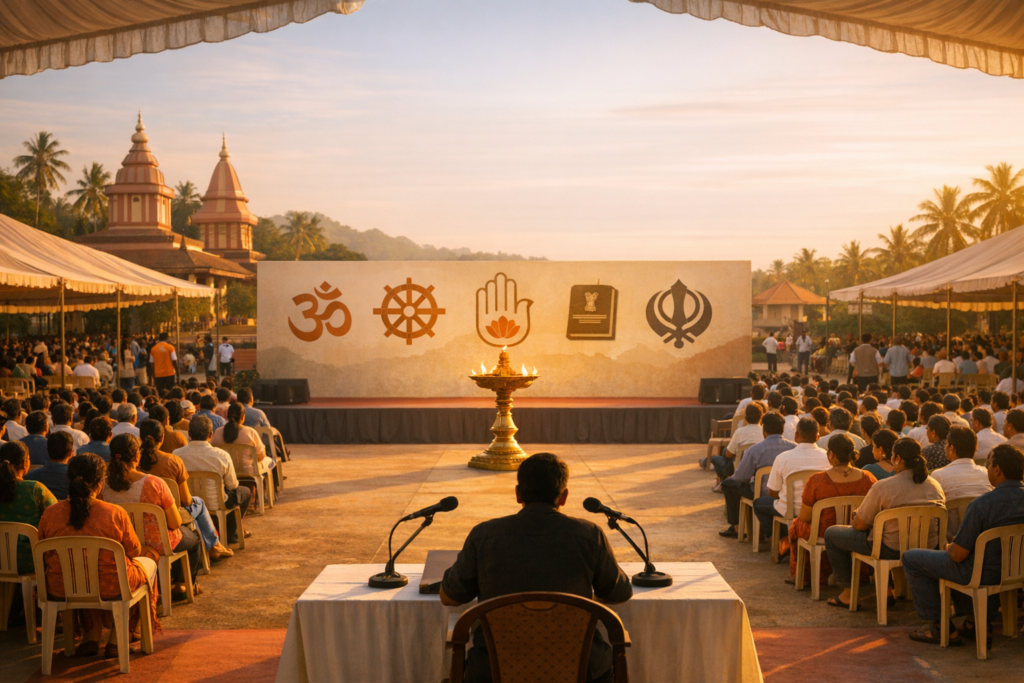
In Ponda, Goa, a Hindu Rashtra-Jagruti Sabha convened as a peaceful, community-focused assembly that drew over 300 participants. The program featured Bhagyanagar MLA T. Raja Singh and Hindu Janajagruti Samiti (HJS) National Spokesperson Ramesh Shinde as principal speakers, signaling strong public interest in community dialogue around cultural heritage, civic responsibility, and social cohesion.
The sabha, organized by Hindu Janajagruti Samiti (HJS), operated as an open forum for ideas—typical of such gatherings that aim to cultivate “jagruti” (awareness) about cultural continuity, public ethics, and constructive civic engagement. Within the broader Indian context, these assemblies have historically provided a structured space for citizens to reflect on duties, rights, and the shared values that sustain plural societies.
Set in Ponda—often described as part of Goa’s temple belt—the event’s location underscored a living link between sacred geography, everyday community life, and civil discourse. In regions where historic shrines, cultural festivals, and neighborhood associations naturally intersect, sabhas frequently become catalysts for intergenerational conversations about preserving tradition while navigating modern civic challenges.
While the speakers and format can vary, Hindu Rashtra-Jagruti Sabhas generally foreground questions of cultural literacy, local volunteerism (seva), and lawful advocacy within India’s constitutional framework. The emphasis commonly falls on non-violent, rights-respecting participation in public life—encouraging communities to deepen knowledge of history and institutions while strengthening mutual trust across social groups.
From a dharmic perspective, such gatherings are most impactful when they nurture unity across Hinduism, Buddhism, Jainism, and Sikhism. These traditions share abiding commitments—ahimsa (non-violence), satya (truth), karuna (compassion), and seva (service)—that can help communities meet contemporary challenges without sacrificing pluralism. For many families balancing work, study, and service, assemblies that uplift shared dharmic ethics also provide relatable, actionable pathways for daily living.
Constitutionally, the normative reference points are clear. Article 19(1)(a) and 19(1)(b) protect freedom of speech and the right to assemble peaceably and without arms, while Article 25 safeguards freedom of conscience and the right freely to profess, practice, and propagate religion—subject to public order, morality, and health. By aligning civic participation with these principles, sabhas strengthen a culture of lawful, respectful dialogue even when opinions differ.
The social dividends of such community events often accrue in practical ways: broader volunteer networks, improved cultural education initiatives, and an increased willingness among neighbors to collaborate on local concerns—from heritage documentation to youth mentorship. Many participants in similar gatherings describe a renewed sense of solidarity and purpose, rooted not in uniformity of belief but in the recognition of shared civic and ethical ground.
Coordination among civil society groups, local associations, and administrative stakeholders typically enhances these outcomes. Transparent communication, inclusive programming, and adherence to safety norms ensure that large assemblies remain accessible, welcoming, and constructive for elders, students, professionals, and families alike. This procedural diligence models the very civic responsibility that sabhas aim to cultivate.
Attendance estimates for the Ponda gathering indicate “over 300” participants, reflecting robust local engagement. The presence of Bhagyanagar MLA T. Raja Singh and HJS National Spokesperson Ramesh Shinde signaled a program anchored in public discourse. When such visibility is paired with messages of pluralism, non-violence, and constitutional fidelity, it can help communities navigate spirited debate without eroding social trust.
In practical terms, the most durable outcomes are those that invite continuing collaboration across dharmic lineages and community sectors. Panels that include Hindu, Buddhist, Jain, and Sikh scholars; youth-led service initiatives; and neighborhood dialogues on shared civic duties can translate the sabha’s momentum into year-round, solution-oriented engagement—demonstrating unity in diversity at the local scale.
As Goa continues to balance heritage preservation with the demands of a dynamic economy, sabhas like the one convened in Ponda can serve as steady anchors for civic literacy and ethical action. By channeling energy toward compassionate service, knowledge of constitutional protections, and inter-dharmic solidarity, communities reinforce the inclusive foundations that allow India’s many spiritual paths to flourish together.
In sum, the Hindu Rashtra-Jagruti Sabha in Ponda, Goa, showcased a familiar yet vital pattern in India’s civic life: informed participation, cultural confidence, and unity across dharmic traditions. The event’s scale and speaker lineup underscored public appetite for principled dialogue, while its ethos aligned with a broader vision of harmonious coexistence rooted in law, compassion, and shared responsibility.
Inspired by this post on Hindu Jagruti Samiti.









Leave a Reply
You must be logged in to post a comment.