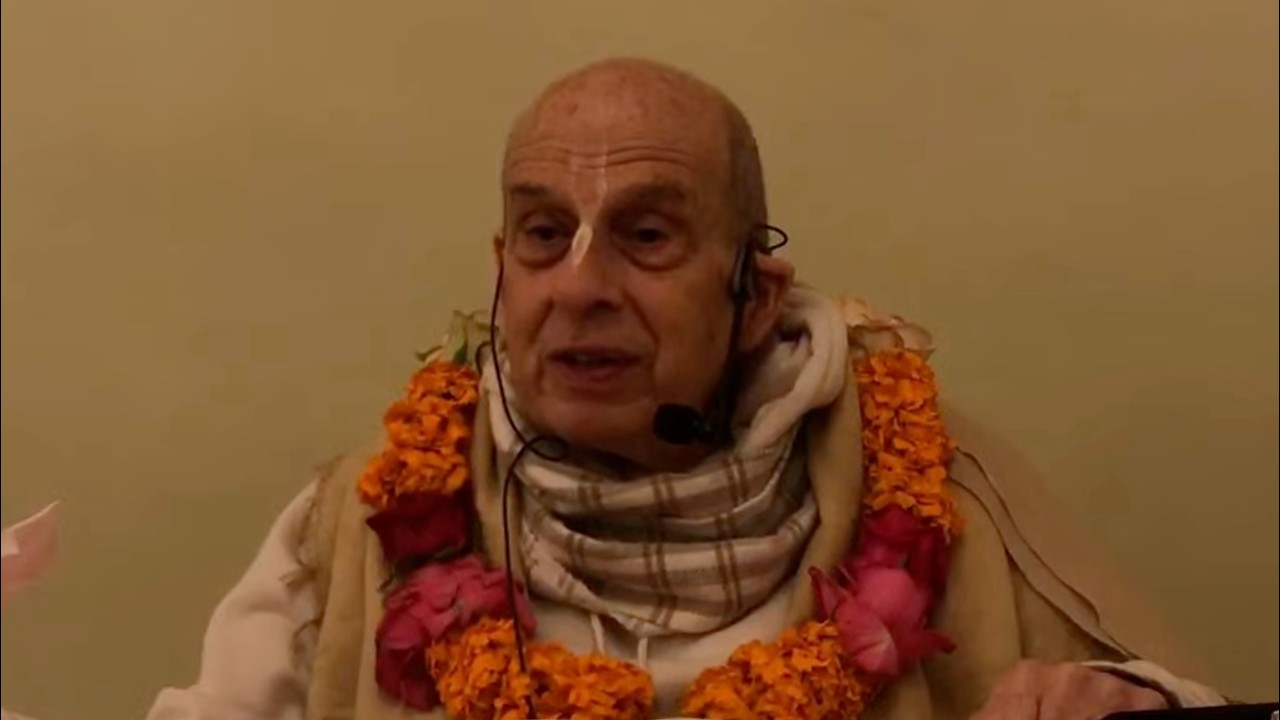
In a morning discourse on 17 April 2026, centered on Śrīmad-Bhāgavatam (SB) 10.4.20, HG Bhurijana Prabhu clarified a foundational principle of Vedic philosophy: conflating the body (deha) with the conscious self (ātmā) distorts identity and intensifies suffering. The verse under discussion emphasizes that attachment to the bodily concept of life generates acute vulnerability to the joys and sorrows of union and separation experienced within family, society, and nation. This insight is not a rejection of social bonds but a reorientation, inviting steadfast awareness of the self's transcendence over changing material configurations.
Seen through the lens of Hindu philosophy and the wider Dharmic traditions, the body–self distinction is a first principle. The ātmā is conscious, continuous, and irreducible; the body is composed of material elements, subject to origination and dissolution. As countless passages in the Bhagavad-Gita and the Bhagavata Purana attest, ignorance (avidyā) of this constitutional difference engenders an identity crisis that surfaces as fear, grief, possessiveness, and pride. SB 10.4.20 places this crisis in social context: familial and national identifications powerfully shape emotion, meaning that union (saṅga) and separation (viyoga) will alternately elevate or devastate the mind so long as embodiment is mistaken for the self.
Vedic philosophy offers a precise conceptual map of the person. The tri-śarīra doctrine distinguishes the gross body (sthūla-śarīra), the subtle body (sūkṣma-śarīra: manas, buddhi, ahaṅkāra), and the causal body (kāraṇa-śarīra). Complementing this is the pañca-kośa modelannamaya, prāṇamaya, manomaya, vijñānamaya, ānandamayadescribing nested sheaths of embodiment. Neither framework equates these layers with the ātmā; rather, they are vehicles for experience. Confusion of the vehicle with the voyager gives rise to samsāric entanglement and the felt volatility of worldly ties.
This philosophical anthropology underpins the Bhāgavata’s diagnosis of attachment (rāga) and aversion (dveṣa). When the mind’s routines orbit bodily preferences, social recognition, or national belonging, affection and alienation both become precariously externalized. The resulting oscillation is not merely emotional; it is existential, because the presumed ground of selfhood keeps shifting with circumstances. SB 10.4.20 addresses this fragility directly: without realizing ātmā, relationships are unconsciously leveraged to stabilize identityan impossible task that ensures recurrent anxiety.
The tradition does not dismiss family, society, and nation as illusory categories requiring abandonment. Rather, it advocates sobriety of identity and purity of motive. An instructive concept here is yukta-vairāgyaappropriate, skillful detachment. Duties are honored, love is deepened, and service (seva) is expanded, while the sense of “I” and “mine” is relocated from the perishable to the imperishable. In this mode, union is appreciated without clinging, and separation is grieved without despair.
Bhakti-yoga provides the most direct soteriological remedy in the Bhāgavata tradition. The ninefold practicesśravaṇaṁ (hearing), kīrtanaṁ (chanting), smaraṇaṁ (remembering), pāda-sevanaṁ (service), arcanaṁ (worship), vandanaṁ (prayer), dāsyaṁ (servitorship), sakhyam (friendship), and ātma-nivedanam (self-surrender)retrain attention and affection away from egoic investment and toward a relational identity with Bhagavān. This re-centering does not flatten personality; it harmonizes it, allowing natural affection for kin and community to be expressed without possessiveness.
Psychologically, the teaching anticipates insights recognized in contemporary studies of the mind–body connection. Identity entanglementover-identifying with roles and outcomesexacerbates stress responses and dysregulates attention. By contrast, a metaphysically grounded sense of self supports emotional regulation, prosocial behavior, and ethical clarity. In Vedic terms, sattva-guṇaclarity, equanimity, and insightarises as the heart engages in bhakti and the intellect discerns ātmā’s independence from bodily transformations.
Two frequent questions arise. First: does detachment weaken love? The Bhāgavata’s consistent answer is no. Love becomes safer and nobler when its root is spiritual rather than merely biological or social. Second: does spiritual focus justify neglect of responsibility? Again, no. Yogic detachment is inner freedom amidst dutiful excellence. As the Bhagavad-Gita affirms, yogaḥ karmasu kauśalamyoga is skill in actionindicating that spiritual insight should refine, not diminish, commitment to dharma.
SB 10.4.20 also illuminates grief. Separation in family lifebereavement, migration, or generational transitionsbecomes devastating when identity is anchored only in shared bodily proximity. By lifting identity to the ātmā, grief can be processed as an integral, teachable moment. Compassion flowers, remembrance deepens, and duties to the living remain steadfast. Rather than minimizing loss, the tradition contextualizes it, transmuting shock into a renewed vow of meaningful living.
Applied sādhanā emerges naturally from this teaching. A daily rhythm combining śravaṇaṁ and kīrtanaṁ with svādhyāya (scriptural study), contemplative japa, and seva produces cumulative clarity. Short, regular intervalstwo focused periods of mantra-japa, one period of study that includes the Bhagavata Purana or Bhagavad-Gita, and tangible service to family and communityshift the baseline of identity from bodily anxiety to spiritual resilience. Consistency, not intensity, is the force multiplier.
Relational practices complement personal sādhanā. Mindful speech, gratitude rituals, and the conscious release of grievance realign affections without denial. When parents face a child leaving home or an elder’s health declines, these practices help convert attachment from anxious grasping to protective, wise care. Union is then cherished as prasad (grace), and separation is honored as a teacher, not an enemy.
Professional life, too, benefits from this reframing. Karma-yoga encourages excellence without egoic overreach. Recognition and criticism lose their power to define the self. Ethical firmness strengthens, because decisions are no longer driven primarily by status or fear, but by dharma and compassion. Outcomes matter, but they no longer monopolize meaning.
Connections with Buddhism, Jainism, and Sikhism deepen the unity of this vision across Dharmic traditions. In Buddhism, the doctrine of anattā (anatman) denies a permanent, independent self, yet its therapeutic thrust converges with SB 10.4.20: clinging to changing aggregates (skandhas) breeds dukkha, and mindful compassion loosens fixation on identity narratives. The shared practical lesson is transparentnon-clinging restores clarity and kindness.
Jainism distinguishes jīva (sentient self) from ajīva (non-sentient substances) and explains bondage through karmic accretions that obscure the soul’s luminosity. Its path of ahiṁsā (non-violence), tapas (austerity), and samyag-darśana (right vision) weakens attachment and aversion, mirroring the Bhāgavata’s demand to relocate identity from perishable forms to the enduring self. The family is cared for, society is served, but neither becomes the yardstick of the self’s worth.
Sikhism addresses haumai (egoism) as the root disturbance by turning the heart toward nām-simran (remembrance of the Divine Name), kīrtan, and seva. Here, too, attachment to status and group superiority is seen as spiritually corrosive, while universal service heals divisions. The result is a practical spirituality where family and community ties are enriched by humility and remembrance, not ruled by possessiveness.
Across Hinduism, Buddhism, Jainism, and Sikhism, therefore, a unifying thread appears: misidentifying the locus of selfhood amplifies suffering; re-grounding identity in truthwhether expressed as ātmā’s transcendence, the cessation of clinging, the purification of jīva, or the surrender of haumailiberates love and service. SB 10.4.20 speaks for this shared inheritance: love each other well, but do not mistake the changing for the changeless.
Viewed sociologically, the verse’s mention of “family, society, and nation” acknowledges the gravitas of collective identities in modern life. National belonging can inspire sacrifice and solidarity, yet it can also breed antagonism and fear of loss. The text’s counsel is to engage these identities as instruments for dharmaprotecting the vulnerable, honoring elders, educating children, safeguarding cultural heritagewithout letting them imprison the heart or polarize the mind.
From the standpoint of mind–body science, practice-based spiritual identity shows measurable benefits. Breath-regulated mantra recitation can steady autonomic arousal; devotional singing coordinates breath, emotion, and communal synchrony; contemplative study sharpens metacognition; and service reduces self-preoccupation. Though the metaphysical conclusions of the Dharmic paths go beyond empirical measurement, their disciplines demonstrably cultivate resilience and prosocial conduct.
As a synthesis, consider three integrative commitments aligned with SB 10.4.20. First, daily contact with śāstra and nāma to stabilize identity in ātmā. Second, active, affectionate duty in family and society as an offering (yajña), without possessive pride. Third, inter-traditional respect and learning among Hinduism, Buddhism, Jainism, and Sikhism, recognizing a shared pledge to relieve suffering and awaken compassion.
When lived in this way, the teaching reframes the full spectrum of human experience. Births, weddings, departures, and bereavements are woven into a tapestry where love is fearless because it is not clinging; responsibility is joyful because it is not self-centric; and unity across Dharmic traditions is natural because it is grounded in truth rather than in uniformity. The result is not detachment from life but deeper participation in itclear-eyed, compassionate, and free.
SB 10.4.20 thus functions as both diagnosis and remedy. It names the root problembodily misidentificationand prescribes a pathbhakti-yoga supported by discernmentthat honors family, society, and nation without ceding the throne of identity to them. In doing so, it contributes to a broader civilizational vision articulated in Sanatan Dharma: Vasudhaiva Kutumbakamthe world is one familybest realized when the person knows who truly lives within the body and acts from that knowledge.
Inspired by this post on Dandavats.