
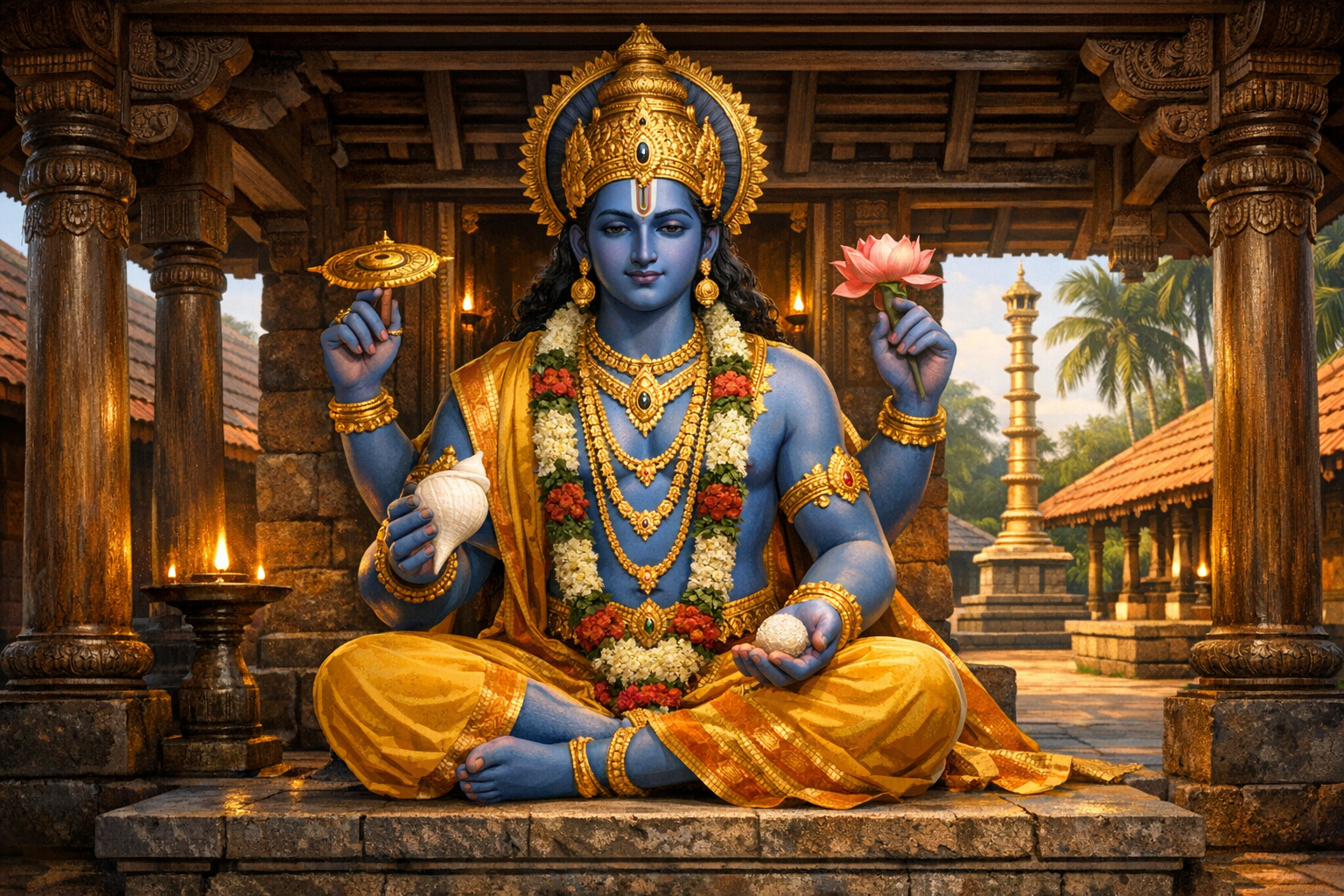
Sri Adi Janardhana Temple in Shimanthoor, Dakshina Kannada, Karnataka, preserves a singular and exceptionally rare Vaishnava iconography: Bhagavan Vishnu in the Janardhana form holding a pinda in the lower right hand. This distinctive feature, coupled with the temple’s location in the culturally rich Tulu Nadu region, makes it a significant site for understanding the breadth of Hindu ritual symbolism, regional temple architecture, and living devotional traditions.
Situated within the coastal belt historically known for vibrant trade routes and layered dynastic influences, Shimanthoor offers a tranquil rural setting where liturgical practice, oral memory, and local aesthetics converge. Mangaluru serves as the primary gateway for visitors, with the last stretch typically navigated by local roads and community guidancea reminder that many sacred sites in Dakshina Kannada remain intimately embedded within village life.
The epithet Janardhana bears layered meanings in Sanskrit usage, commonly understood as the protector and benefactor of people who also removes the distress of devotees by upholding dharma. The Shimanthoor manifestation intensifies this theological profile by including the pindaan object associated with śrāddha and pitṛ-kāryawithin the formal vocabulary of Vishnu’s murti. Such an inclusion is extremely unusual in mainstream Vishnu iconography, where the caturbhuja form normally bears śankha, chakra, gadā, and padma.
The presence of a pinda in the deity’s hand invites a careful hermeneutic reading grounded in dharmaśāstra and puranic guidance. Across Vaishnava practice, the sustenance and guidance Vishnu extends to all beings includes care for the journey of the departed. Texts such as portions of the Garuḍa Purāṇa emphasize śrāddha and pinda-pradāna as instruments of gratitude, remembrance, and duty to ancestors (pitṛs). In this light, the Shimanthoor icon visually encodes a theology of compassion that harmonizes bhakti to Vishnu with responsibility toward forebears.
From an iconographic perspective, the mūla-vigraha at Shimanthoor is notable for integrating a ritual object into the god’s hasta repertoire. While specific hand-attributes vary by local tradition, reports consistently highlight the lower right hand bearing the pinda, with remaining hands conforming to conventional Vaishnava attributes. The inclusion functions as a semiotic bridge between inner temple ritual and domestic life-cycle sacraments, thus lending the murti a powerful didactic presence for devotees.
Ritual life at the temple aligns with the Vaishnava calendar while giving unmistakable emphasis to observances that honor ancestors. Amāvasyā days, the fortnight of Pitru Paksha, and select Ekadashis tend to draw families who undertake sankalpa for parents and elders with priestly guidance. In this setting, the Janardhana who upholds dharma is also encountered as a reassuring presence in rites that weave remembrance, seva, and gratitude into the fabric of everyday worship.
Architecture in Dakshina Kannada often fuses a low stone plinth with robust timber superstructures and sloped, tiled roofs adapted to heavy monsoon. Within this regional typology, Sri Adi Janardhana Temple typically comprises a garbhagriha housing the presiding deity, a modest antarāla, and an ardha- or mukha-mandapa that facilitates circumambulation and darshan. The ritual axis usually includes a balipeetha and dhvaja-stambha aligned to the sanctum, while the surrounding prākāra preserves ancillary shrines and ritual pathways.
Stylistic detailswooden brackets, ceiling panels, and doorframe carvingsoften reflect the artisanal vocabulary of the coastal belt, where temple carpentry is a specialized craft. Ornament is purposeful, narrating puranic episodes, consecrating vegetal motifs, and elevating the mandapa’s acoustic qualities for Vedic chant and bhajana. In the coastal humidity, this organic palette also underscores the community’s ongoing role in maintenance, oiling, repainting, and seasonal repairsacts that are themselves seva.
Although a precise foundation date for the Shimanthoor shrine is difficult to establish given the limited availability of published inscriptions, the broader historical canvas is intelligible. Tulu Nadu’s sacred geography matured across Alupa, Hoysala, and Vijayanagara horizons, while later local rule and matha networks from the Sri Vaishnava and Madhva traditions amplified Vishnu-bhakti in the region. Where inscriptions are scarce, scholars typically triangulate chronology through masonry techniques, idol iconometry, prāsāda proportions, and archival references to temple lands and endowments.
Devotional culture surrounding the temple reflects the coastal synthesis of Sanskritic ritual, Kannada and Tulu liturgy, and performative arts. Yakshagana and harikathā traditions in the district continue to provide narrative frames for Vishnu’s avatāras, while Vaishnava bhajana mandalis anchor the rhythm of the lunar month. Visitors frequently describe an immediate sense of solace during the ārati as conch-blasts rise against lush areca grovesan experiential affirmation that ritual soundscapes and place-based ecology co-produce sacred presence.
The pinda-bearing Janardhana also resonates with values cherished across the wider dharmic family. While Hinduism, Buddhism, Jainism, and Sikhism articulate remembrance and ethical responsibility in distinct ways, all affirm gratitude toward elders, compassion for the departed, and seva within the living community. Whether expressed through charity in a grandparent’s name, prayers for the wider panth, or ethical conduct that honors lineage, these shared commitments foster unity without erasing differencean ethos visibly harmonized in Shimanthoor.
As a site of living heritage, the temple presents an instructive model for conservation. Timber and tile require cyclical care; the mūla-vigraha and utsava-murtis benefit from professional documentation; and ritual calendars need safeguarding through intergenerational transmission. Photogrammetric recording, epigraphic surveys in the precinct and nearby villages, and oral-history interviews with priests and senior devotees would substantially enrich the scholarly record while empowering the community’s stewardship.
For pilgrims and heritage enthusiasts, the journey to Shimanthoor is best planned via Mangaluru, with attention to local timings and seasonal conditions. Modest attire, observance of silence near the sanctum, and adherence to priestly guidance for offeringsespecially those linked to pitṛ-kāryahelp sustain the sanctity that the temple so carefully embodies. Families often return year after year, recalling childhood mornings of tulasi fragrance, prasada rice, and the steady reassurance of Janardhana’s gaze.
Interpreting Sri Adi Janardhana Temple as a regional archive in stone, wood, and ritual deepens appreciation of its rarity. The pinda in Vishnu’s hand is more than a curiosity; it is a theological statement carved into forma reminder that devotion in this part of Karnataka binds cosmic protection to domestic duty, transcendence to kinship, and liturgical finesse to everyday care. In Shimanthoor, Vishnu as Janardhana appears as the compassionate sustainer across realms, stretching a protective hand to both the living and the remembered.
In sum, Shimanthoor’s Sri Adi Janardhana Temple offers an invaluable lens on Dakshina Kannada’s sacred ecosystem. Its rare iconography, nuanced ritual calendar, and vernacular architecture together illuminate how Vaishnava devotion adapts to local climate, craft, and community memory. As scholarship and pilgrimage converge here with humility and rigor, the temple’s message remains steady and inclusive: uphold dharma, honor those who came before, and cultivate unity across the shared values of the dharmic traditions.
Inspired by this post on Hindu Blog.
