In Hindu cosmology, the words pralaya and kalpa do not merely signal the end of Earth or the fading of a familiar sky; they point to a scale of time and being that dwarfs planetary horizons. Within this vision, the observable world becomes a minute eddy in a vast ocean of recurring creation and dissolution, where universes arise, endure, and ultimately return to their source in rhythms both precise and profound.
Kalpa is commonly defined as a day of Brahmā, the cosmic architect, while pralaya denotes dissolution. Together, these terms map a cyclical universesṛṣṭi (emanation/creation), sthiti (sustenance), and saṁhāra or pralaya (reabsorption)that repeats without beginning or end. This cyclical time differs from a linear, one‑off apocalypse; it is patterned, periodic, and ontological, describing how forms emerge from and return to an underlying reality.
Across Purāṇic and Vedāntic literature, four principal kinds of pralaya are discussed. Nitya-pralaya (constant dissolution) refers to the unceasing flux in which forms perish moment to moment. Naimittika-pralaya (occasional dissolution) occurs at the close of a kalpathe end of Brahmā’s daywhen manifest worlds withdraw and re-emerge after Brahmā’s night. Prākṛtika-pralaya (material or elemental dissolution) is a grand reabsorption of the manifest cosmos into Prakṛti (primordial nature) at the end of Brahmā’s lifespan. Atyantika-pralaya (ultimate dissolution) is liberation (mokṣa), the dissolution of ignorance and ego wherein the jīva realizes non-separation from Brahman.
The temporal architecture supporting these dissolutions is remarkably detailed. A mahāyuga comprises four yugas in the ratio 4:3:2:1, totaling 4,320,000 human years. Seventy-one such mahāyugas, together with transitional intervals (yuga-sandhyā), constitute a manvantara, and fourteen manvantaras make one kalpaa day of Brahmāof 4.32 billion years. Brahmā’s night spans an equal duration, and a full year of Brahmā has 360 such day‑night cycles. One lifetime of Brahmā totals 100 such years, yielding 311.04 trillion human years.
These numbers are not astronomical predictions but metaphysical measures that orient consciousness toward immensity. Placing human events against kalpas invites a philosophical humility: what appears decisive at the scale of decades becomes a ripple across a cosmic day, affirming the dictum that this world is but a speck relative to the continuum of becoming and return.
Purāṇic cosmography complements these time measures with a multilevel ontology. The seven higher lokas (Bhur, Bhuvar, Svar, Mahar, Jana, Tapa, Satya) and seven lower realms (Atala to Pātāla) are not merely physical coordinates but tiers of experience and consciousness. They provide a map correlating ritual, yoga, and ethical cultivation with layered realities that arise, persist, and dissolve within the larger rhythm of sṛṣṭi and pralaya.
Creation itself is described in two modalities: sarga (primary emanation of elements, senses, and fundamental principles) and visarga or pratisarga (secondary creation, the proliferation of beings, species, and worlds). Texts such as the Viṣṇu Purāṇa and the Bhāgavata Purāṇa emphasize that dissolution does not erase the moral order; karmic saṁskāras persist as subtle seeds (bīja) carried into the next cycle, ensuring ethical continuity across cosmological epochs.
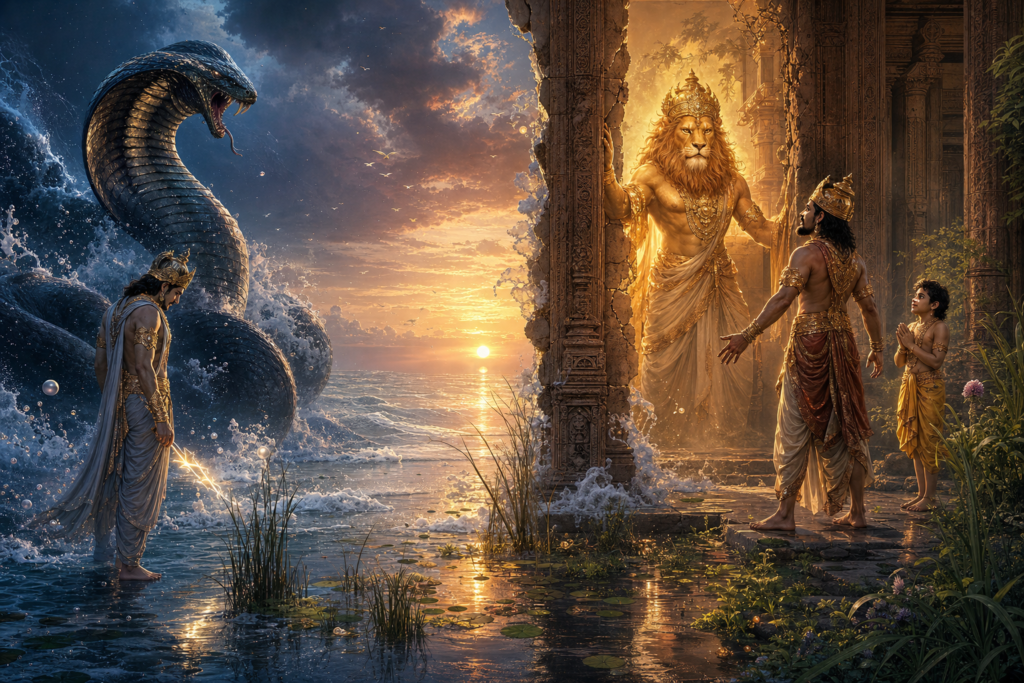
In the Vaiṣṇava lens, universes (brahmāṇḍas) arise like bubbles upon the causal ocean while Nārāyaṇa reclines in yoga‑nidrā upon Śeṣa. From the lotus sprung from Viṣṇu’s navel emerges Brahmā, who organizes creation; at pralaya, these universes withdraw into Viṣṇu, and potentiality rests in quiescence until the next emanation. Folding back into the divine is thus a rhythmic return of nāma‑rūpa (name‑and‑form) to their ground.
Śaiva traditions express the same law through the image of Śiva Naṭarāja. The pañcakṛtyasṛṣṭi (creation), sthiti (maintenance), saṁhāra (dissolution), tirobhāva (veiling), and anugraha (grace)portrays cosmic change as a dance. Laya, the “meltdown” of forms into source, is not annihilation but reintegration, much like musical resolution after a complex composition. The cosmic drumbeat signals emergence; the raised hand assures fearlessness through flux; the dance ends in poised silence, awaiting the next rhythm.
Śākta and Sāṁkhya frameworks speak of Prakṛti’s guṇassattva, rajas, tamasmoving from disequilibrium (manifestation) back to equilibrium (prākṛtika-pralaya). In Advaita Vedānta, the grandest pralaya is epistemic: names and forms are superimpositions (adhyāropa) upon nondual Brahman and are ultimately negated (apavāda). Atyantika-pralaya thus aligns with mokṣa, the dissolution of ignorance that reveals the ever-present fullness of Brahman.
Hindu cosmology integrates macrocosm and microcosm with unusual rigor. Daily sleep mirrors naimittika-pralaya in miniature; each exhalation carries a hint of release; pratyāhāra and dhyāna in yoga enact controlled inward folding. As the cosmos reabsorbs into its causal matrix, mind reabsorbs into clarity; both dramas illustrate a shared law of return and renewal.
Semantically, kalpa bears multiple valences: it names both a cosmological eon and, in Vedic ritual literature, a genre of procedural texts (Kalpa-sūtras). In Purāṇic chronology the use is primarily temporal, whereas in Śrauta and Smārta contexts it is liturgical. The shared term underlines a consistent concern: order (ṛta) in both ritual and cosmos.
This cyclical imagination is a shared heritage across dharmic traditions. Buddhism theorizes mahākalpas and asaṅkhyeya kalpas, describing vast cycles of arising and ceasing of world-systems without a fixed first cause. Jainism details alternating arcs of avasarpiṇī (descending) and utsarpiṇī (ascending) cycles, emphasizing the moral and spiritual consequences within time’s wheel. Sikh scripture praises the timeless One (Akal Purakh) beyond cycles, while acknowledging the incomprehensible multiplicity of worlds (koti brahmand). Even with doctrinal distinctiveness, these traditions converge in affirming impermanence, ethical causality, and a reality that transcends transient formsan ethos resonant with Vasudhaiva Kutumbakam.
Ethically, cyclical cosmology underwrites responsibility rather than fatalism. Actions do not evaporate at dissolution; they echo forward as dispositions in the next cycle. This understanding intensifies dharma: nonviolence (ahiṃsā), truthfulness (satya), stewardship, and compassion become rational choices within an interconnected, recurring universe.
Psychologically, contemplating pralaya fosters equanimity. Attachment loosens when even stars are seen as periodic actors on a larger stage. Yet this is not nihilism; it is orientation. A life anchored in service, learning, and inner discipline gains meaning precisely because it aligns with a cosmos patterned by law and renewal.
Dialogues with modern science are necessarily cautious yet suggestive. Contemporary cosmology entertains scenarios of expansion to heat death, cyclic “bounces,” and multiverse hypotheses. While Hindu cosmology is not a scientific model, its intuition of long timescales (a kalpa of 4.32 billion years) and iterative creation-dissolution offers a conceptual kinship: a universe intelligible as process rather than a singular, unidirectional event.
The arithmetic of yugas is internally consistent and pedagogical. Ratios (4:3:2:1), aggregations into mahāyugas, manvantaras, and kalpas, and the staggering figure of a Brahmā lifetime frame human time within a cosmic syllabus. Classical astronomers such as Āryabhaṭa worked with immense units of time, illustrating an intellectual culture unafraid of magnitude, even when purposesastronomical, liturgical, or metaphysicaldiverged.
Purāṇic imagery amplifies these abstractions. The brahmāṇḍa (cosmic egg), Śeṣa bearing worlds, and the ocean of causality are not crude physics but layered metaphors. They train imagination to hold multiple registers at once: narrative, symbol, ontology. Read this way, myth is a method; it domesticates the unimaginable without reducing it.
Rituals and festivals encode the same grammar. Mahā Śivarātri, the “great night of Śiva,” ritualizes stillness at the heart of cosmic motion; Kārttika Dīpam kindles primordial light; Vaikuntha Ekādaśī dramatizes passage through limiting conditions. Such observances align individual life with the larger cadence of emergence, maintenance, and return.
The phrase “the universe folding back into itself” names a general law in these traditions: effect resolves into cause, cause into subtler cause, and, finally, all nāma‑rūpa reabsorb into that which is beyond predication. In Vaiṣṇava idiom, the many return to Viṣṇu; in Śaiva language, the dance resolves into silence; in Advaita, appearances subside into Brahman, which alone is.
Far from diminishing human significance, this cosmology reframes it. Choice, character, and contemplation are not footnotes to an indifferent universe; they are the means by which consciousness aligns with reality’s deepest patterns. The recognition that worlds arise and pass away increasesnot decreasesthe urgency to live wisely now.
In sum, Hindu cosmology offers a disciplined, cyclic account of time and being: kalpas measure aeons, pralayas chart reabsorption, and dharma sustains meaning across cycles. Buddhist, Jain, and Sikh perspectives echo complementary insights about impermanence, karma, and the transcendent ground. Together, these dharmic traditions articulate a civilizational philosophy of unity-in-diversity that invites humility, ethical clarity, and a contemplative poise before the immeasurable.
To see this Earth as a speck is not to dismiss it; it is to place it in a luminous order where every act matters and every cycle teaches. In that recognition, awe turns into responsibility, and responsibility into quiet joy.
Inspired by this post on Hindu Blog.