
Why these ancient boons still matter
Absolute safety has a powerful emotional appeal. A ruler who has survived war, witnessed death, or feared the loss of authority may try to convert that fear into a perfect guarantee. The stories of Vritra and Hiranyakashipu examine precisely this impulse. Each figure attempts to surround death with carefully worded exclusions, as though reality could be converted into a complete checklist. Yet both narratives show that existence is larger than the categories used to describe it. Foam lies awkwardly between ordinary ideas of dry and wet; twilight interrupts the division between day and night; a threshold is neither fully indoors nor fully outdoors; and Narasimha cannot be reduced to either human or animal.
These episodes are often presented as tales of divine ingenuity defeating demonic cunning. That reading captures part of their dramatic structure, but it does not exhaust their philosophical depth. The narratives also investigate the limits of classification, the instability of power, the moral danger of fear-driven control, and the difference between legal compliance and ethical conduct. Most importantly, the Mahabharata refuses to portray every successful exploitation of a condition as morally innocent. Indra defeats Vritra, but the breach of trust continues to burden him after the battle has ended.
A careful comparison therefore reveals three distinct limits. The first is epistemic: no finite list can necessarily encompass every form that reality may take. The second is political: protection from known threats does not create unlimited sovereignty. The third is ethical: even a victorious act remains answerable to dharma, truthfulness, and the obligations created by a promise. Together, these limits transform the stories from entertaining accounts of loopholes into sustained reflections on humility, environmental ethics, resilient systems, and responsible power.
Textual setting and interpretive method
Within Hindu tradition, the Mahabharata is classified as itihasa, a term frequently translated as history but belonging to a literary and sacred category broader than modern critical historiography. The Vritra episode considered here appears in the Udyoga Parva, in the account narrated by Shalya to Yudhishthira. It is commonly printed as Chapter or Section 10, although numbering varies among Sanskrit editions and English translations. The account of Hiranyakashipu’s boon is stated most systematically in the Bhagavata Purana, especially Skandha 7, Chapter 3, while Narasimha’s manifestation and the death of Hiranyakashipu unfold in Chapters 8 and 9. The Vishnu Purana, Book 1, Chapters 17–20, preserves an important parallel Prahlada cycle.
These sources should be compared without being flattened into a single uniform version. Vritra appears in several layers of Hindu literature, and his characterization changes across those settings. Hiranyakashipu’s boon likewise acquires additional details in later retellings, performance traditions, and popular summaries. Academic precision requires distinguishing what a primary passage states from the explanatory correspondences developed by commentators and storytellers. Such precision does not diminish devotional meaning; it helps reveal how a narrative has continued to generate interpretation over time.
Vritra in the Mahabharata: protection negotiated through a truce
Vritra’s literary history begins earlier than the Mahabharata. Rigveda 1.32 celebrates Indra’s defeat of Vritra and the release of waters that had been obstructed. Later texts expand the conflict through new theological, ritual, and ethical frameworks. In the Udyoga Parva narrative, Vritra emerges from a chain of violence involving Indra, Tvashtri, and Tvashtri’s son. The conflict becomes so destructive that neither raw strength nor prolonged warfare offers a satisfactory resolution. Sages consequently intervene to establish peace between Indra and Vritra.
Shalya recounts the episode to Yudhishthira within a larger discussion of adversity, reversal, kingship, and the eventual restoration of order. This narrative frame matters. The story is not delivered as an isolated puzzle about defeating a powerful asura. It forms part of counsel given to a ruler facing uncertainty and injustice. Its political meaning therefore concerns more than military victory: it examines whether agreements can restrain violence, whether rulers remain bound by their word, and whether power can escape the consequences of its methods.
Vritra accepts friendship with Indra only after receiving a carefully constructed assurance. The exclusions cover death through anything dry or wet; through materials such as wood, stone, or metal in common retellings; through weapons or the thunderbolt in widely circulated translations; and during either day or night. Editions vary slightly in how these materials and instruments are grouped, but the semantic structure remains consistent. Vritra attempts to make the protection exhaustive by naming apparently opposite conditions and familiar classes of weapons.
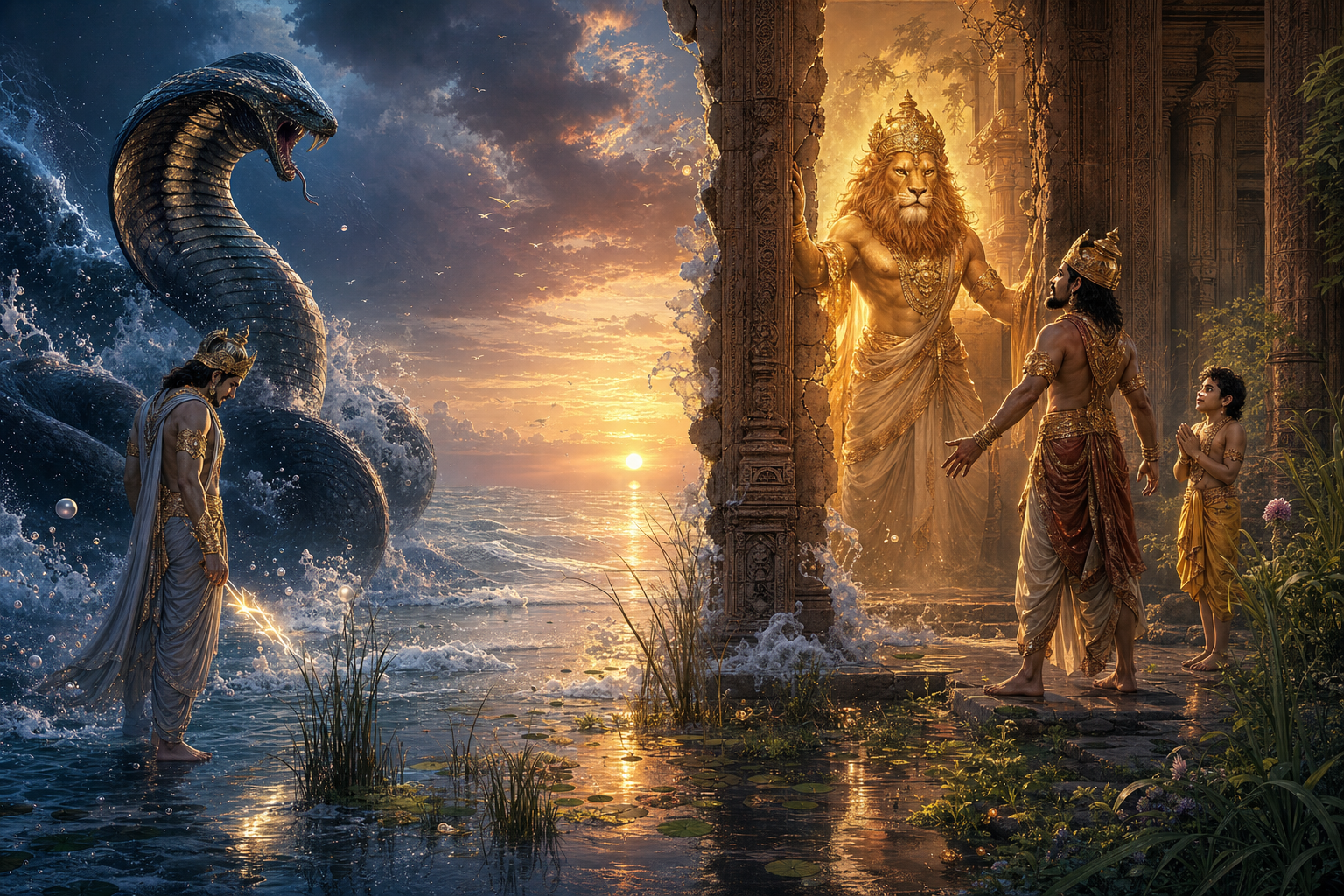
The opportunity appears at the seashore during evening twilight. The location and time are both transitional. Twilight is not ordinarily classified as full day or full night, while the shore marks the meeting of land and water. Indra notices a mass of sea foam and reasons that it is neither conventionally dry nor straightforwardly wet and is not an ordinary weapon. Vishnu enters or empowers the foam, according to the narrative, and Vritra is killed. The restrictions are navigated through their unclassified margins rather than openly contradicted.
The episode does not end with uncomplicated celebration. The Mahabharata associates Indra’s act with falsehood and the grave burden of brahmahatya. He becomes fearful, withdraws from view, and leaves cosmic and political order unsettled. The story therefore distinguishes technical success from moral legitimacy. Indra may have found a condition not explicitly prohibited by the agreement, but that ingenuity does not erase the friendship he pledged or the trust on which the truce depended. The narrative’s ethical force lies precisely in refusing to let a loophole cancel accountability.
The logic of Vritra’s conditions
Vritra’s protection illustrates a problem that contemporary logic and systems design would describe as the danger of a closed-world assumption. A closed-world model treats the known possibilities as though they were the only possibilities. If every threat appears to belong to category A or category B, excluding both may seem equivalent to excluding the entire domain. That inference is reliable only when the categories are genuinely exhaustive, mutually exclusive, and precisely defined. Ordinary words such as dry, wet, day, night, weapon, and material do not possess that degree of formal precision.
Dry and wet are gradable predicates rather than strict logical complements. An object can be damp, humid, porous, coated, suspended, or composed of several phases. Foam provides an especially vivid example. In modern physical chemistry, foam is a dispersion of gas bubbles within a continuous liquid phase, separated by thin liquid films. It is not scientifically outside matter or moisture. Nevertheless, ordinary language does not classify a handful of foam in the same way that it classifies a dry stone or a vessel of water. The epic exploits this semantic hesitation. It should not be misrepresented as a prediction of colloid science; the scientific analogy simply clarifies why everyday categories can have uncertain boundaries.
Day and night are similarly useful but simplified divisions. Illumination changes continuously as the Sun moves relative to the horizon. Modern astronomy operationalizes twilight through conventions: civil twilight extends until the Sun is 6 degrees below the horizon, nautical twilight from 6 to 12 degrees, and astronomical twilight from 12 to 18 degrees. Those measurements are modern standards, not hidden astronomical claims within the Mahabharata. Their relevance is epistemological. Even a familiar distinction such as day versus night depends on definitions selected for a particular purpose.
The category of weapon is even more dependent on context. An object manufactured for violence is clearly a weapon, but an ordinary object can become one through intention and use. Conversely, a bodily feature or natural substance may cause death without belonging to the conventional inventory of arms. Vritra’s request protects him against recognized instruments while assuming that lethal agency will arrive in a familiar form. The assumption proves more vulnerable than any individual omission in the list.
Hiranyakashipu: conditional immortality transformed into domination
Hiranyakashipu approaches the problem of mortality through tapas rather than diplomacy. After the death of his brother Hiranyaksha, who is slain by Vishnu in the form of Varaha, Hiranyakashipu undertakes formidable austerities. Brahma appears in response, and Hiranyakashipu requests a network of protections designed to approximate immortality without asking for immortality in a simple, unconditional form. The episode demonstrates that discipline can produce extraordinary capacity while remaining morally neutral about the purpose for which that capacity will be used. Tapas amplifies determination; it does not automatically purify intention.
Bhagavata Purana 7.3.35–38 records the principal conditions. Hiranyakashipu asks not to die through any being created by Brahma; not inside or outside a residence; not during day or night; not on the ground or in the sky; not through a weapon; not through a human being or an animal; and not through an entity possessing or lacking life. The verses also mention gods, asuras, and great serpents while extending the request beyond survival toward unrivalled power, lordship, and prestige. Translations distribute some clauses differently, but the larger design is unmistakable: every known source, location, time, and method of death is to be neutralized.
The moral problem is not that Hiranyakashipu desires safety after bereavement. Fear of death and grief over a family member are intelligible human responses. The danger appears when protection becomes a claim to absolute command. Hiranyakashipu uses his acquired power to subordinate cosmic authorities, suppress dissent, and persecute Prahlada for maintaining devotion to Vishnu. A private desire to escape vulnerability thus develops into a political demand that no independent center of loyalty be permitted to exist.
Prahlada’s refusal exposes the limit that no clause in the boon addresses: coercive power cannot secure complete ownership of another being’s consciousness. Hiranyakashipu can threaten the body, command institutions, and punish disobedience, but he cannot manufacture conviction. When he demands to know whether Vishnu is present in a pillar, Narasimha manifests from that apparently inert structure. The scene answers both a theological question and a political one. Divine presence cannot be confined to places recognized by an arrogant ruler, and reality does not become empty merely because authority declares it so.
Narasimha’s action corresponds to the conditions without directly violating them. The form is neither exclusively human nor exclusively animal. The manifestation occurs at twilight, neither full day nor full night. Hiranyakashipu is taken to a threshold, neither wholly inside nor wholly outside. He is held on Narasimha’s lap, neither on the ground nor suspended independently in the sky. He is killed with claws rather than a manufactured weapon. Within Vaishnava theology, Narasimha is Vishnu himself and therefore not one of the dependent beings created by Brahma.
Popular presentations often arrange these correspondences into a perfectly symmetrical table. That format is useful for teaching, but it should be treated as exegetical synthesis rather than a verbatim table embedded in a single verse. Puranic recensions, translations, and later retellings can emphasize different clauses. Claws, for example, are most securely connected with the prohibition against weapons; attempts to classify them biologically as neither living nor nonliving are interpretive elaborations rather than straightforward scientific descriptions. The central theological claim is broader: the divine manifestation exceeds the tyrant’s conceptual inventory while honoring the limits of the boon.
The narrative also places restraint after force. Narasimha’s protective fury terrifies the assembled divine beings, yet Prahlada approaches with prayer and devotion. The episode moves from oppression to intervention and then toward restored order. Prahlada does not inherit Hiranyakashipu’s model of domination. His authority is grounded in devotion, humility, and concern for others rather than in the fantasy of invulnerability. The story therefore offers more than the replacement of one powerful ruler by another; it contrasts two different understandings of power.
Similar structures, different ethical conclusions
Vritra and Hiranyakashipu share a recognizable strategy. Both attempt to achieve practical immortality by surrounding death with negative conditions. Both rely on pairs that appear exhaustive: dry and wet, day and night, inside and outside, earth and sky, human and animal. Both underestimate the reality of mixed states, relational locations, and agents that do not fit established classes. Their plans are sophisticated, but sophistication is not the same as completeness.
The ethical architectures of the two stories, however, are not identical. Vritra’s conditions belong to a peace agreement. Indra finds an unlisted means of killing him, but the Mahabharata still treats the breach as morally consequential. Hiranyakashipu’s conditions are part of a boon, and Narasimha’s intervention is presented as the protection of Prahlada and the restoration of dharma after sustained oppression. In one account, the successful agent remains stained by violated trust; in the other, the conditional promise is fulfilled while tyranny is ended. Any comparison that ignores this distinction loses one of the Mahabharata’s most challenging insights.
The narratives also prevent boons from being mistaken for certificates of virtue. A boon acknowledges effort, austerity, ritual force, or an agreed condition; it does not declare every future use of the resulting power morally legitimate. Hiranyakashipu treats capability as authorization. Indra treats a technical opening as permission to disregard the spirit of an accord. Both errors remain familiar in law, politics, technology, and institutional life. What can be done is not automatically what should be done.
Legitimate security differs from absolute control. Security creates enough stability for life, relationship, and responsibility to continue. Absolute control tries to eliminate uncertainty by eliminating autonomy, opposition, and difference. Hiranyakashipu crosses that boundary when his fear of death becomes a demand for universal submission. Indra crosses an ethical boundary when the purpose of language shifts from establishing trust to finding a concealed route around it. Power forgets its limits when protection becomes entitlement.
What the boundary imagery contributes to environmental ethics
Neither the Vritra episode nor the Narasimha narrative is a modern environmental policy document. An academic interpretation should not project contemporary ecology backward and claim that the texts secretly describe scientific disciplines developed much later. Their images nevertheless support a disciplined philosophical analogy. Nature is encountered through processes, gradients, cycles, mixtures, and relationships, while human institutions frequently manage it through fixed labels. The stories dramatize the risk of mistaking those labels for the whole of reality.
The Sanskrit term Prakriti carries different technical meanings across Hindu philosophical schools, so it should not be used as a vague synonym for every modern idea of the environment. Even with that caution, many Hindu traditions treat manifested existence as ordered, dynamic, and relational rather than as inert material awaiting unlimited possession. Vritra’s foam and twilight provide memorable symbols for this dynamism. They show that transition is not an empty gap between real categories; transition is itself a real condition.
Modern ecology confirms the practical importance of boundaries without requiring any claim of ancient scientific prediction. Wetlands, estuaries, riparian zones, forest edges, tidal flats, and seasonal floodplains are not failed examples of land or water. They are distinctive systems shaped by exchanges among soil, water, organisms, nutrients, temperature, and time. Ecologists often describe such transitional areas as ecotones. Their composition can change over short distances and across seasons, and they may support species and interactions not found in either neighboring system alone.
Environmental damage often begins when administrative convenience is confused with ecological truth. A seasonal wetland may appear dry during one inspection and still remain essential for flood storage, groundwater movement, breeding cycles, and migratory species. A river cannot be understood only through the water visible inside its channel on a particular day; its floodplain, sediment, vegetation, and seasonal pulses belong to the same living system. Treating every place as either usable land or permanent water repeats Vritra’s conceptual mistake in reverse: it assumes that a binary classification has captured all relevant states.
The stories also illuminate the difference between robustness and resilience. A robust design resists anticipated stresses. A resilient design additionally detects change, adapts, and recovers when an unanticipated stress occurs. Vritra and Hiranyakashipu construct protections against a long inventory of expected failure modes, but neither arrangement contains a mechanism for learning or adaptation. Their security models are broad yet brittle. A single boundary condition defeats the entire structure.
Contemporary safety engineering responds to this problem through hazard analysis, redundancy, defense in depth, monitoring, fail-safe behavior, and revision after new evidence. The epics do not teach these engineering methods directly, but their narrative logic makes the need for them intuitive. A system should never assume that enumerating known threats has abolished residual risk. The wiser position acknowledges uncertainty, preserves a margin of safety, and avoids concentrating so much power in one safeguard that its failure becomes catastrophic.
Adaptive environmental management follows a similar principle. Policies are treated as revisable hypotheses rather than permanent declarations of mastery. Conditions are monitored, local knowledge is incorporated, and intervention changes when the ecosystem responds unexpectedly. Such an approach is not indecision. It is disciplined humility before a complex system. Nature’s limits are discovered through attention and relationship, not merely imposed through definitions.
Dharma, power, and the danger of confusing a map with the territory
Every boon is a verbal map of possible danger. The map can be detailed and still remain incomplete. Power becomes reckless when it mistakes the map for the territory and assumes that unnamed possibilities do not exist. Hiranyakashipu’s error is not a lack of intelligence; his list demonstrates considerable intelligence. His deeper failure is epistemic arrogance—the conviction that reality must obey the architecture of his own concepts.
Indra’s conduct introduces a second warning. Even when a literal reading permits an action, dharma may require attention to purpose, trust, and consequence. A truce is not merely a bundle of prohibited instruments. It creates a relationship and an expectation that hostilities have ended. The Mahabharata’s treatment of Indra’s guilt suggests that the spirit of a promise cannot always be escaped through verbal ingenuity. Law without integrity becomes a technology for evasion.
Prahlada represents a contrasting form of strength. He possesses no comparable military apparatus, yet coercion fails to dislodge his devotion. His resilience comes from locating the center of identity beyond the approval of the ruler who threatens him. This does not romanticize suffering or imply that vulnerable people should endure oppression without protection. It shows why authoritarian power remains incomplete: it can compel performance more easily than conviction, and it can command fear more easily than reverence.
The emotional center of both stories is therefore vulnerability. The desire to remove every danger is understandable because uncertainty can be frightening. A family planning for illness, a community preparing for drought, or an institution defending against failure naturally seeks dependable safeguards. The texts do not mock preparation. They warn against the moment when preparation hardens into the belief that every contingency has been conquered and every remaining person or ecosystem may consequently be controlled.
A wider Dharmic conversation about humility
The lesson also resonates with other Dharmic traditions without making their doctrines interchangeable. Jain anekāntavāda disciplines claims by recognizing that complex realities can be approached from multiple standpoints; it does not reduce truth to the idea that every opinion is equally valid. Buddhist teachings on dependent arising and impermanence challenge the fantasy of a completely self-sufficient, unchanging power. Sikh teachings identify haumai, ego-centered self-assertion, as a source of separation and place human action within hukam, an order that cannot be possessed by an individual will.
These traditions differ in metaphysics, scripture, practice, and vocabulary. Their unity does not require homogenization. A constructive Dharmic dialogue instead recognizes a shared discipline of limiting the ego’s claim to total knowledge and total sovereignty. Vritra’s failed enumeration, Hiranyakashipu’s authoritarian certainty, Prahlada’s devotion, Jain many-sided analysis, Buddhist relationality, and Sikh resistance to haumai can be placed in conversation while their distinctive meanings remain intact.
Five practical lessons for living with nature and exercising power
First, classifications should remain provisional. Categories are indispensable for thought, law, and science, but each category should disclose its criteria, purpose, and uncertainty. When a situation falls near a boundary, it deserves closer investigation rather than forced placement into the most convenient box. This principle applies to wetlands, social identities, medical risk, technical failures, and legal interpretation alike.
Second, thresholds deserve protection. Shorelines, floodplains, migration corridors, forest margins, and transitional seasons are often treated as peripheral because they resist simple ownership and classification. Their ecological functions can make them central rather than marginal. The foam and twilight in Vritra’s story become reminders that boundaries are active zones where systems exchange energy, matter, information, and risk.
Third, resilience requires room for surprise. A plan built only around previously observed threats remains vulnerable to novel combinations. Responsible systems preserve redundancy, monitor weak signals, distribute authority, and allow correction before failure becomes irreversible. Humility is therefore not merely a private virtue. It is a design principle for institutions that must survive uncertainty.
Fourth, methods remain morally significant. Indra’s victory does not erase the broken trust surrounding it. Environmental and political goals likewise cannot be evaluated only by the result announced at the end. The treatment of communities, the honesty of consultation, the observance of agreements, and the distribution of costs all belong to the ethical assessment. A beneficial outcome claimed through deception may leave damage that technical success cannot measure.
Fifth, security should serve relationship rather than domination. Protection is healthy when it preserves the conditions under which beings can flourish together. It becomes destructive when fear is used to justify unlimited extraction, surveillance, suppression, or control. Hiranyakashipu’s downfall begins long before Narasimha appears; it begins when freedom from death is imagined as the right to rule without moral restraint.
When power remembers its limits
The deepest loophole in both boons is not merely foam, twilight, a threshold, a lap, or a set of claws. It is the assumption that reality can be made subordinate to a ruler’s vocabulary. Vritra’s conditions fail because transitional states remain outside an apparently comprehensive agreement. Hiranyakashipu’s conditions fail because the divine answer arrives in a form his conceptual system cannot contain. Indra’s subsequent suffering adds a necessary ethical correction: finding an unlisted possibility does not grant immunity from the consequences of betrayal.
Living with nature therefore requires more than admiration for forests, rivers, or sacred animals. It requires epistemic humility, respect for ecological relationships, adaptive institutions, and restraint in the use of power. The world is not an inert inventory of separate objects. It is filled with gradients, feedback loops, thresholds, and dependencies. A society that remembers those realities is better prepared to protect both human communities and the environments that sustain them.
The enduring lesson is neither that planning is futile nor that ambiguity should be celebrated for its own sake. Careful preparation remains necessary, and precise categories remain useful. Wisdom begins when their limits are acknowledged. Power becomes durable when it accepts accountability, security becomes humane when it does not demand submission, and knowledge becomes trustworthy when it remains open to what its first model failed to see.
Primary textual anchors for this interpretation include Rigveda 1.32; the Mahabharata’s Udyoga Parva, especially the Vritra truce in Chapter or Section 10 and its account of Indra’s subsequent guilt; Bhagavata Purana 7.3.35–38, 7.8, and 7.9; and the parallel Prahlada narrative in Vishnu Purana, Book 1, Chapters 17–20. Chapter numbering and individual wording can vary across recensions and translations, so claims about exact conditions should always be checked against the edition being used.
Inspired by this post on Hindu Blog.
