By Radha Mohan Das

Monday, 13 July 2026 marked the 60th anniversary of the legal incorporation of the International Society for Krishna Consciousness, widely known as ISKCON, in New York. At Bhaktivedanta Manor, the diamond jubilee became more than a ceremonial recognition of a date. It offered an opportunity to examine how Srila Prabhupada’s determined spiritual mission developed into an enduring international institution. Through theatre, photography, public history, devotional art and shared hospitality, the programme connected ISKCON’s formative years with the experiences of a contemporary community spread across generations and continents.
The anniversary carried both spiritual and institutional significance. A religious movement may begin with teachings, practices and relationships, but legal incorporation gives those elements a durable public structure. It enables a community to hold property, enter agreements, publish literature, organise programmes and define its purposes within a recognised legal framework. ISKCON’s incorporation on 13 July 1966 therefore did not create Krishna consciousness, whose theological and devotional roots extend through the Gaudiya Vaishnava tradition. It did, however, provide an organisational foundation through which those teachings could be presented systematically to a global audience.
From the Jaladuta to New York
The historical background makes the scale of the achievement especially striking. In 1965, one year before the incorporation of ISKCON, Srila Prabhupada travelled from India to the United States aboard the cargo ship Jaladuta. He was nearly seventy years old and carried limited financial resources, copies of his English translation and commentary on the Srimad Bhagavatam, and a firm commitment to communicate Krishna consciousness beyond India. He understood this work as the fulfilment of an instruction received from his spiritual master, Srila Bhaktisiddhanta Sarasvati Thakura, to present the teachings of Sri Caitanya in the English-speaking world.
The voyage and the months that followed involved serious physical and material hardship. Accounts of the journey describe severe illness, including cardiac episodes at sea. After reaching America, Srila Prabhupada lived with little money and without the security of an established institution, permanent residence or extensive network of supporters. He endured poverty, uncertain accommodation and periods without stable housing while continuing to translate, write, chant and teach. The historical importance of this period lies partly in the contrast between his limited external resources and the clarity of his purpose. The later global Hare Krishna movement emerged from disciplined daily work conducted under conditions that offered no guarantee of success.

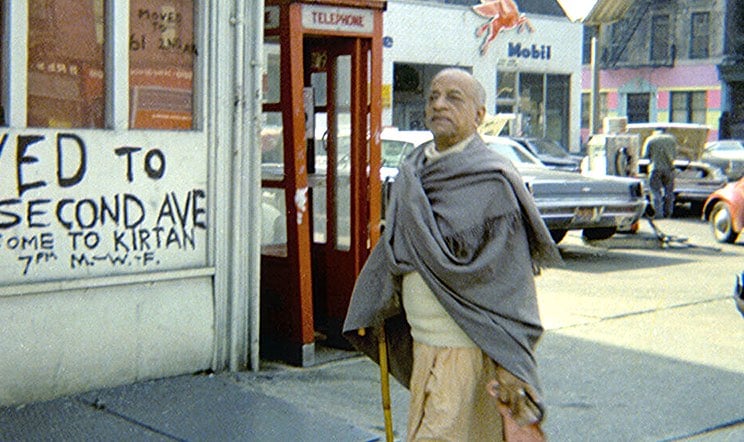
Srila Prabhupada initially stayed with the Gopal Agarwal family in Butler, Pennsylvania, before concentrating his efforts in New York. There, he moved through a succession of modest and sometimes difficult living arrangements. He taught in small rooms, met people through personal introductions and held discussions with individuals searching for alternatives to the dominant material and cultural assumptions of the period. His eventual base at 26 Second Avenue on Manhattan’s Lower East Side provided a storefront in which lectures, kirtan and discussions could take place regularly. The location was physically unremarkable, yet it became the first ISKCON temple and one of the most recognisable sites in the movement’s history.
The Lower East Side of the 1960s contained a complex mixture of artistic experimentation, social unrest, poverty and religious inquiry. Within that environment, Srila Prabhupada’s teachings attracted a small circle of sincere participants. Although some early followers emerged from the American counterculture, their contribution cannot be reduced to a cultural stereotype. They attended classes, learned devotional practices, assisted with cooking and administration, organised public chanting and helped establish a functioning community. Their cooperation with Srila Prabhupada transformed informal gatherings into a disciplined religious association.

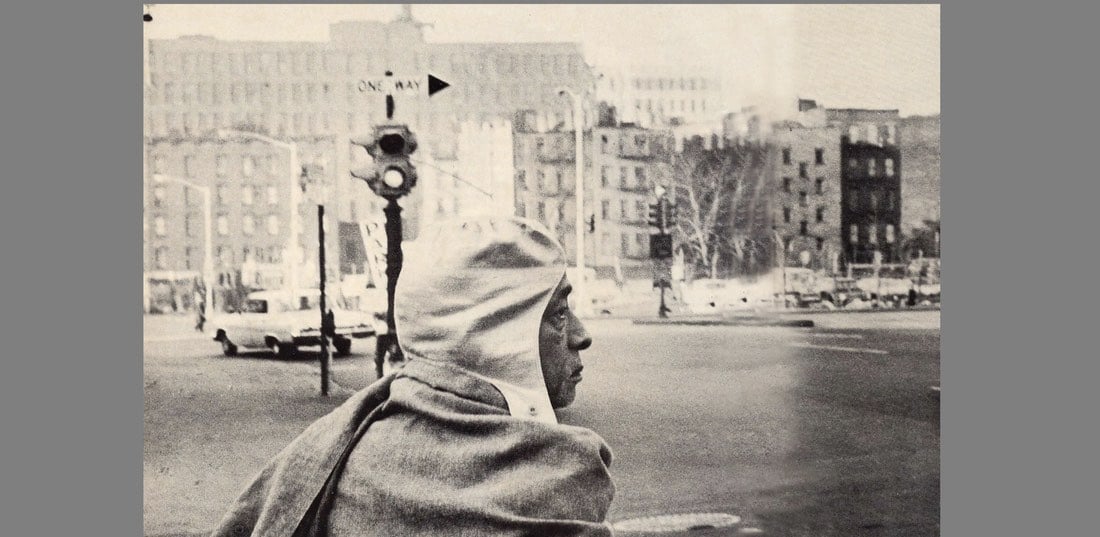
The incorporation of ISKCON in July 1966 represented the legal consolidation of this emerging community. It defined the society’s objectives and gave its activities an institutional identity capable of surviving beyond a single room or group of acquaintances. The administrative act was therefore inseparable from a larger spiritual ambition: to create a framework in which teachings, worship, education, publishing and communal life could reinforce one another. Later that year, public chanting in Tompkins Square Park—including the well-known kirtan beneath the tree subsequently remembered as the Hare Krishna Tree—made the movement increasingly visible within New York’s public culture.
The Seven Purposes as an institutional blueprint
The Seven Purposes of ISKCON are central to understanding why the 1966 incorporation mattered. They do not merely list devotional aspirations; taken together, they outline an integrated model of spiritual education, community formation, public engagement and cultural transmission. Their appearance on a new plaque at Bhaktivedanta Manor placed the anniversary within the purposes for which the society was established. The plaque also invited visitors to evaluate ISKCON’s history through its declared principles rather than through institutional size alone.
The first purpose: spiritual education and social balance. ISKCON seeks to disseminate spiritual knowledge systematically and to educate people in practices that can address an imbalance of values. This purpose connects individual discipline with social well-being. It assumes that peace and unity require more than administrative policy or material prosperity; they also depend on self-knowledge, ethical responsibility and a disciplined understanding of human purpose.
The second purpose: presenting Krishna consciousness through foundational texts. The society identifies the Bhagavad Gita and Srimad Bhagavatam as principal sources for understanding Krishna consciousness. Study is therefore not treated as separate from devotion. Translation, commentary, teaching and discussion form part of the same educational process as worship and meditation, allowing philosophical concepts to be examined alongside their practical application.
The third purpose: developing an understanding of the relationship between the individual and Krishna. Gaudiya Vaishnava theology describes living beings as eternally related to the Supreme. ISKCON’s community model is built around cultivating awareness of that relationship. The purpose has an interpersonal consequence as well: when life is understood as possessing spiritual dignity, community is ideally organised around service, responsibility and mutual respect rather than exploitation.
The fourth purpose: teaching and encouraging sankirtana. Sankirtana refers to the congregational chanting of the holy names, especially as taught within the tradition of Sri Caitanya Mahaprabhu. The practice is simultaneously personal, communal and public. It does not require elaborate equipment or restricted access, which helped make the Hare Krishna mantra portable across languages and national boundaries. Kirtan subsequently became one of ISKCON’s most recognisable forms of devotional expression.
The fifth purpose: establishing sacred places dedicated to Krishna. Temples and other devotional centres provide stable settings for worship, teaching, festivals and community relationships. Their significance is not confined to architecture. A sacred place becomes socially meaningful through repeated practice: daily worship, hospitality, study, music, festivals and service. Bhaktivedanta Manor itself illustrates how a physical site can develop into a centre of religious memory and public engagement.
The sixth purpose: encouraging a simpler and more natural way of life. This principle has influenced ISKCON’s interest in rural communities, eco-farms, agriculture and forms of living that place restraint and stewardship above unrestricted consumption. Its application has varied across locations, but the underlying concern remains relevant: spiritual values require expression in patterns of work, food, land use, community responsibility and care for the natural environment.

The seventh purpose: publishing and distributing literature. Books, periodicals and other writings have been essential to ISKCON’s international development. Publishing allows teaching to continue beyond a particular lecture, teacher or temple. It also creates a textual record through which claims can be studied, translated and debated. Srila Prabhupada’s sustained work as a translator and commentator gave this purpose a particularly strong foundation.
Viewed as a whole, the Seven Purposes form a connected institutional system. Education gives philosophical depth to practice; chanting creates participatory community; sacred places provide continuity; simple living connects belief with material conduct; and publishing carries ideas beyond local boundaries. This integration helps explain how a small New York association developed into a transnational religious network. The purposes also establish criteria for reflection: institutional growth has meaning when it remains connected to education, ethical practice, service and spiritual development.
From a storefront to a worldwide spiritual society
By the time of the 2026 diamond jubilee, ISKCON was described as a worldwide spiritual society comprising nearly 1,000 temples, more than 100 affiliated vegetarian restaurants and dozens of eco-farms across six continents. These institutions represent different ways of translating a common religious mission into local practice. Temples sustain worship and education; restaurants introduce vegetarian food culture to broad audiences; and rural projects explore relationships among spirituality, agriculture, community and ecological responsibility. Public festivals, study programmes, publications and congregational networks extend the movement’s presence beyond formal temple membership.
Such figures are best understood as a 2026 institutional snapshot rather than an immutable census. International religious organisations contain temples, affiliated centres and community initiatives with different administrative relationships, while new projects open and others change over time. Academic assessment therefore benefits from considering both quantitative reach and qualitative influence. Buildings and organisations demonstrate scale, but the continuity of a spiritual society also depends on teaching, practice, leadership, ethical accountability and the ability to transmit knowledge between generations.
Bhaktivedanta Manor occupies an important place within this history. The Hertfordshire estate was donated to ISKCON by George Harrison in 1973 and subsequently developed into one of the most prominent centres of the Hare Krishna movement in the United Kingdom. Its combination of temple worship, education, festivals, rural surroundings and community service gives physical expression to several of ISKCON’s stated purposes. Holding the 60th-anniversary commemoration there connected the movement’s early transatlantic history with a mature British Hindu institution shaped by decades of local participation.
Preparing a community celebration
The anniversary programme was organised through cooperation among Jaya Krishna das, Bhaktivedanta Manor’s Senior Management Team and many volunteers. This organisational detail is historically meaningful because large institutions are sustained through accumulated acts of coordination that are rarely visible in formal timelines. Scheduling performers, preparing spaces, creating displays, welcoming visitors and managing the practical requirements of a public event all demanded collective effort. The celebration consequently reflected not only ISKCON’s historical achievements but also the contemporary community’s capacity to work together.
The programme began with the unveiling of a plaque displaying the Seven Purposes of ISKCON. It was one of three identical plaques intended for permanent installation around Bhaktivedanta Manor. Distributing the plaques across the site turns the founding purposes into part of the Manor’s everyday interpretive environment. Visitors will encounter them not only during an anniversary but during future worship, festivals and educational visits. The installation therefore links institutional memory with continuing responsibility.

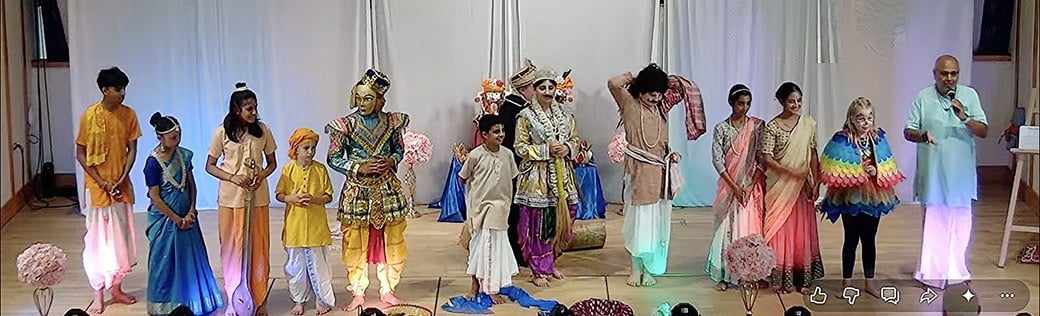
The Junior Bhaktivedanta Players then presented a drama depicting the historical appearance of Lord Jagannath. Lord Jagannath is central to a major Vaishnava tradition associated especially with Puri, while the Ratha-yatra chariot festival has become one of ISKCON’s most visible public celebrations around the world. By presenting this sacred history through young performers, the programme joined theological education with creative participation. Children were not positioned simply as spectators of an inherited tradition; they took an active role in communicating it.

The performance demonstrated the pedagogical value of drama within a religious community. Theatre requires participants to learn narrative sequence, character, symbolism, speech and movement. It can therefore convert information into embodied memory. For relatives and community members in the audience, the emotional significance also came from seeing a younger generation handle sacred material with confidence and care. That intergenerational exchange gave the diamond jubilee a forward-looking dimension: the history being remembered was also being entrusted to future custodians.
Praghosa das next presented Six Decades of ISKCON, a multimedia journey constructed from memorable photographs. The presentation traced the society’s development from its modest beginnings to its international presence. Photographs possess a distinctive evidentiary force because they preserve faces, places, clothing, architecture and public activity in a single frame. When arranged chronologically, they can reveal the movement from improvised early gatherings to established temples and large festivals. At the same time, their emotional power rests in their human scale: global history appears through individuals chanting, cooking, travelling, building and serving together.
Bringing Srila Prabhupada’s American journey to the stage
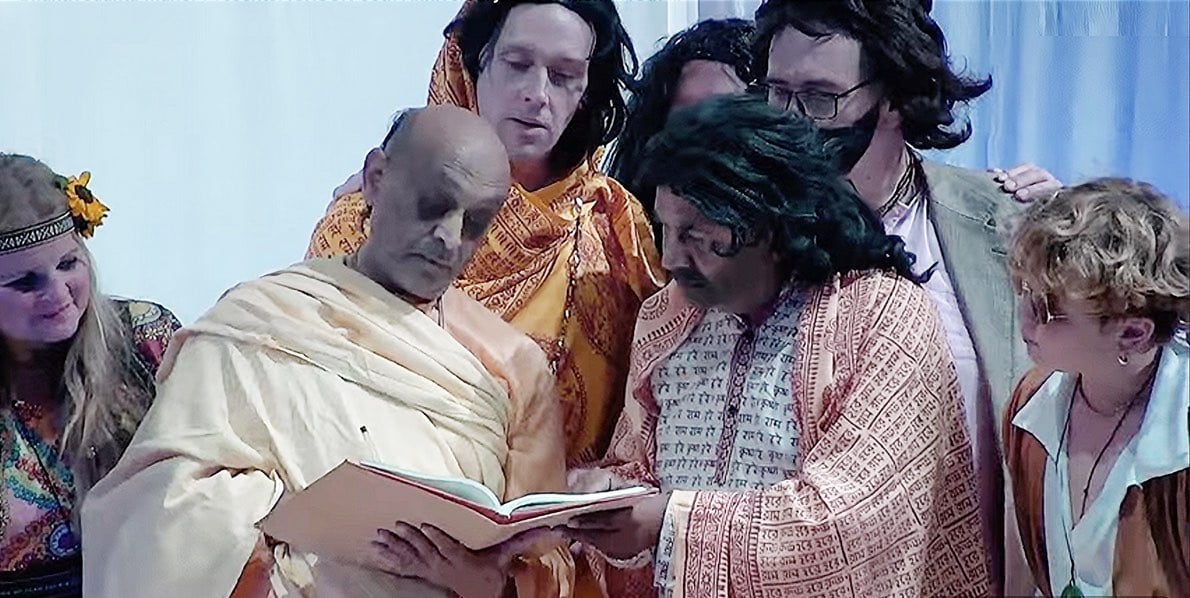
The afternoon’s principal theatrical presentation was a premiere performance by the Bhaktivedanta Players. It portrayed Srila Prabhupada’s arrival in America, his initial stay with the Gopal Agarwal family in Butler, Pennsylvania, and his eventual move to New York to fulfil the instruction of his spiritual master. The production concluded with the incorporation of ISKCON. In doing so, it transformed a sequence commonly encountered through dates, memoirs and institutional records into an embodied narrative of uncertainty, persistence and cooperation.
The dramatic structure highlighted a central historical paradox. The audience knew that the journey would eventually lead to a worldwide Hare Krishna movement, yet the character within the early scenes faced illness, financial insecurity, cultural distance and an uncertain reception. This difference between remembered outcome and lived uncertainty gave the performance much of its emotional force. Srila Prabhupada’s perseverance appeared not as an abstract virtue but as a repeated decision to continue teaching under conditions in which success remained invisible.
The portrayal of the Gopal Agarwal family also restored hospitality to its proper place in the history. International movements are often described through prominent leaders and institutions, but their beginnings frequently depend on households willing to receive an unfamiliar guest. Butler represented a transitional environment between the voyage from India and sustained work in New York. Recreating that episode acknowledged how private acts of welcome can acquire far-reaching historical consequences.


The final incorporation scene rendered an administrative event as human drama. Legal documents can appear distant from spiritual life, yet the production showed that signatures, agreed purposes and organised responsibilities helped protect the continuity of a fragile new community. The scene also brought Srila Prabhupada’s early followers into view as historical participants. Their willingness to learn, organise and accept responsibility enabled the movement to develop beyond the charisma of its founder into a society with a defined mission.
The combination of drama and photography created two complementary forms of public history. Photographs offered documentary traces of people and places, while theatre interpreted the motives, uncertainty and emotional stakes surrounding them. Neither medium replaced textual research, but together they made the institutional past accessible to visitors of different ages and levels of prior knowledge. The anniversary thereby demonstrated that historical literacy can be developed through archives, performance and shared discussion rather than through a single medium alone.
A commemorative cake as a visual history
To mark the diamond jubilee, Sundari Radha dasi and a dedicated team of volunteers created an elaborate commemorative cake. Its importance extended beyond size or decoration. The design assembled several key images from ISKCON’s history into a compact visual narrative: 26 Second Avenue, the Jaladuta, the Hare Krishna Tree in Tompkins Square Park, colourful Ratha-yatra carts and Srila Prabhupada seated on the front lawn of Bhaktivedanta Manor. Each image represented a distinct stage or method in the movement’s development.
The Jaladuta represented passage, vulnerability and determination. The model of 26 Second Avenue recalled the creation of a stable centre from a modest storefront. The Hare Krishna Tree represented the movement’s entry into public space through congregational chanting. The Ratha-yatra carts signified the adaptation of an ancient Jagannath festival to cities around the world, while the image of Srila Prabhupada at Bhaktivedanta Manor linked the New York beginnings with the establishment of a lasting British community. Arranged together, the motifs condensed six decades of institutional and devotional history into an immediately readable sequence.

The cake illustrates how material culture contributes to collective memory. Historical understanding is often associated with books, monuments and archives, but temporary objects can also communicate complex narratives. Because every guest received a slice, the display moved from observation to participation. The object was admired, interpreted and finally shared. This transition gave the commemoration warmth without diminishing its historical substance. It turned a global institutional story into a tangible community experience.
Volunteer service as institutional infrastructure

The celebration repeatedly revealed the importance of seva, or devotional service, as a form of institutional infrastructure. Plaques had to be designed and installed; children and adults rehearsed; photographs were selected and arranged; the cake required extensive artistic labour; and visitors needed to be accommodated. These contributions may not appear in conventional histories focused on leaders and buildings, yet they are essential to organisational continuity. Volunteer service converts shared conviction into practical capacity.
The programme also showed how a mature spiritual community can distribute historical interpretation across different participants. Senior managers provided coordination, speakers offered context, actors embodied the narrative, children transmitted sacred history, visual artists created symbols and volunteers sustained the event’s practical requirements. This division of labour did not fragment the celebration. It allowed a single anniversary to be experienced intellectually, artistically, spiritually and socially.
A Gaudiya Vaishnava celebration with a wider Dharmic significance
The event belonged specifically to the Gaudiya Vaishnava tradition within Hinduism, and academic accuracy requires that theological identity to be respected. Broader Dharmic unity does not require Hindu, Buddhist, Jain and Sikh traditions to be treated as interchangeable. They possess distinct teachings, histories and forms of practice. Meaningful unity instead develops through informed respect for those differences and recognition of shared commitments to disciplined practice, ethical cultivation, service, sacred memory and the transmission of wisdom across generations. ISKCON’s declared concern with spiritual education, unity and peace provides a constructive basis for such respectful engagement.
What the diamond jubilee ultimately commemorated
The 60th anniversary commemorated more than organisational longevity. It recalled the relationship between individual conviction and collective action. Srila Prabhupada’s mission required personal courage, but it also required hosts, students, editors, performers, managers, cooks, artists and volunteers. The movement’s development from a New York storefront to nearly 1,000 temples and a wide network of related institutions was possible because spiritual teaching became embedded in repeatable practices and durable communities.
A diamond jubilee is also an occasion for evaluation. Institutional scale alone cannot measure fidelity to a founding mission. The Seven Purposes direct attention toward the quality of education, integrity of spiritual practice, accessibility of sacred spaces, strength of community relationships, seriousness of publishing and responsible pursuit of a simpler way of life. Their permanent display at Bhaktivedanta Manor ensures that the anniversary looks forward as well as backward. The plaques will continue to ask how historical inheritance is being translated into present conduct.
The Bhaktivedanta Manor celebration succeeded because it made history both intelligible and emotionally immediate. The photographs provided continuity, the dramas supplied human perspective, the plaques restored attention to institutional purpose, and the cake translated chronology into shared visual culture. Together, these elements honoured Srila Prabhupada’s extraordinary journey while recognising the many communities that carried Krishna consciousness across six continents. Sixty years after the New York incorporation, the most enduring legacy remained the transformation of a determined spiritual mission into a living tradition of study, chanting, service and community.
A recording of Bhaktivedanta Manor’s ISKCON 60th Anniversary Celebration preserves the principal elements of the programme for historical and educational reference.
Inspired by this post on Dandavats.


Leave a Reply
You must be logged in to post a comment.