
From a sunlit home to a global institution
The story of Dileep Kumar Thangappan—widely known as Yogi Dileep or Guruji—opens far from the ceremonial atmosphere normally associated with international diplomacy. In the Indica Today conversation published on June 21, 2026, the setting is Yogabhavan, his residence in Kochi. Sunlight enters a spacious first-floor room; simple refreshments are served; nearby, a hall used for regular yoga classes carries the disciplined stillness of daily practice. The scene matters because it places a global story inside an ordinary human encounter.
That contrast is central to Yogi Dileep’s public identity. His influence is presented not as the product of spectacle, celebrity or institutional rank, but as the accumulated result of teaching, relationship-building and persistence. The path runs from Kerala’s community life to New York teaching spaces, from conversations with spiritual mentors to United Nations platforms, and from modest classes to the worldwide observance of the International Day of Yoga. The scale changed dramatically; the emphasis on simplicity did not.
This distinction also prevents a familiar error in biographical writing. No international observance is created by one individual alone. Ideas move through teachers, voluntary organizations, diplomats, elected governments and multilateral procedures before they acquire formal status. Yogi Dileep’s significance is therefore best understood as part of that wider ecology: a civil-society advocate who helped sustain the idea that yoga’s Indian heritage could be presented to the world as a practical, inclusive discipline.
The roots of a universal outlook
The 2026 interview traces his outlook to an interfaith household: a Christian father, a Hindu mother, a marriage that met communal opposition, and a childhood shared naturally between church, temple and neighbourhood care. It also recounts a serious childhood fire, his parents’ daily yoga practice, later study with several Indian institutions and teachers, grassroots classes in Kerala, and teaching in the United States. Together, these memories present interdependence—not solitary achievement—as the foundation of his spiritual life.
Several episodes—including a maternal health crisis, guidance said to have preceded his birth, accounts of Swami Bua’s longevity, and a 2008 sanyasa initiation—belong to personal and devotional testimony. Academic treatment keeps them attributed rather than recasting them as verified medical or historical facts. They remain biographically important because they show how Yogi Dileep understands survival, lineage and responsibility.
Viewed analytically, these memories produce three durable themes. The first is plurality without confusion: different sacred settings could be respected without requiring identical doctrines. The second is community as a form of formation: character emerged through a network of parents, siblings, neighbours and mentors rather than through solitary achievement. The third is the conversion of difficulty into service. Opposition, insecurity and trauma did not disappear from the story; they became reasons to ask how disciplined practice might reduce suffering and prevent human beings from becoming captive to greed, fear or status.
His refusal to confine learning to a single lineage follows from that formation. In a traditional context, respect for a guru need not imply hostility toward every other teacher. The more demanding principle is discernment: learning deeply, acknowledging sources, testing instruction through disciplined practice, and refusing the vanity of claiming exclusive possession of truth. This approach is especially relevant to the unity of Hindu, Buddhist, Jain and Sikh traditions, which retain distinct scriptures, institutions and philosophies while sharing a broad civilizational environment of ethical restraint, contemplation, self-cultivation and service.
From community teaching to international advocacy
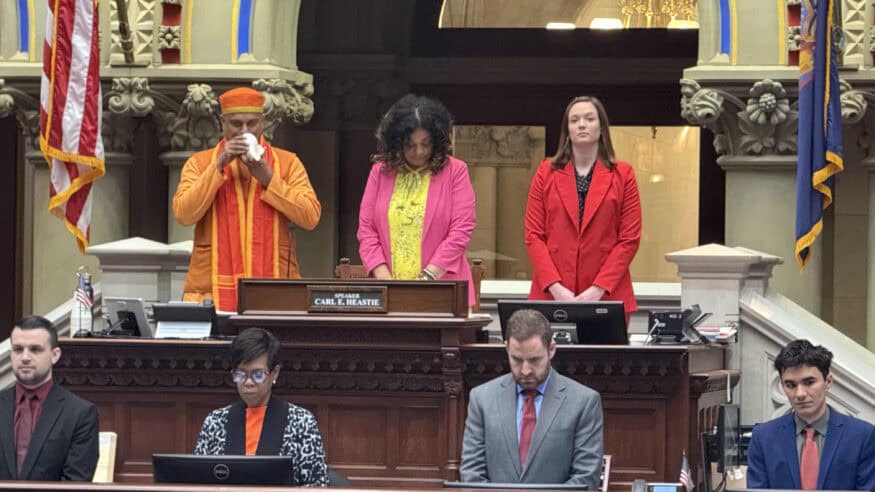
The interview presents a progression from modest notices and small classes in Tripunithura to teaching in New York and advocacy for global recognition. It names D.R. Karthikeyan, Dr. H.R. Nagendra and others as contacts in that effort, while its photographs show Yogi Dileep participating in UN-related settings, including an NGO session during the fifth International Day of Yoga in 2019. This record supports a role in coalition-building, not sole authorship of the international observance.
For yoga educators, the underlying challenge is universal: making an unfamiliar discipline accessible without reducing it to a commodity. Safe, observable practices can provide an effective entrance. A participant who notices steadier breathing, improved mobility or a quieter interval of attention gains direct information that no ideological sales pitch can provide. Philosophy can then be introduced as an explanation of practice rather than imposed as a condition of entry.
This form of experiential teaching does not reject yoga’s spiritual foundations. It creates a threshold that hesitant people can cross without pressure. It also helps yoga travel across religious and national boundaries as an invitation rather than a mechanism of conversion. The method is particularly valuable in interfaith settings, where respect depends on allowing participants to learn while preserving freedom of conscience.
The phrase “quiet force” is meaningful when it describes patient coalition-building; it becomes misleading if it erases the many people and institutions involved. Yogi Dileep’s contribution can be honoured without turning a multilateral achievement into a one-person origin story. The larger lesson is more powerful: durable cultural diplomacy emerges when grassroots practitioners, intellectual networks, public institutions and political leadership converge around a proposal that other societies can adopt on their own terms.
What the United Nations record establishes
The formal chronology is clear. On September 27, 2014, Prime Minister Narendra Modi used his address to the sixty-ninth session of the UN General Assembly to describe yoga as an inheritance of ancient Indian tradition and to call for an International Yoga Day. The official text of the address presented yoga as an integration of mind and body, thought and action, human wellbeing and harmony with nature rather than as exercise alone.
India then sponsored the draft that became UN General Assembly Resolution 69/131. On December 11, 2014, the General Assembly adopted it without a vote at its sixty-ninth plenary meeting. The resolution proclaimed June 21 as the International Day of Yoga, invited states, UN bodies, regional organizations, civil society and individuals to observe it according to national priorities, and emphasized public awareness of yoga’s potential contribution to health and wellbeing. It also specified that implementation costs should come from voluntary contributions.
The scale of support was exceptional. The UN’s current observance page states that the proposal was endorsed by a record 175 Member States, while Indian official accounts from the period commonly referred to 177 nations. The difference appears to reflect reporting at different stages or distinct counting conventions; the decisive institutional fact is that the resolution was adopted without a vote. The first International Day of Yoga was observed on June 21, 2015, transforming a diplomatic resolution into an annually recurring public practice.
International days have no power to compel private belief, nor do they certify every claim made in the name of a tradition. Their value lies elsewhere. They create a recurring platform for education, voluntary participation, public-health communication and cultural exchange. In yoga’s case, the platform also recognized India as the source civilization while allowing communities around the world to adapt instruction to local languages, ages, abilities and institutions.
The achievement was therefore both cultural and procedural. A civilizational practice entered the vocabulary of multilateral policy through a state proposal, broad sponsorship and consensus adoption. The process shows how soft power works at its most constructive: not by coercing agreement, but by offering an experience whose usefulness can be assessed through participation. The experiential logic of practice before persuasion closely mirrors that diplomatic approach.
Yoga is a system, not a single pose
Global popularity can obscure the technical breadth of yoga. In many commercial settings, yoga is presented primarily as a sequence of asana, or physical postures. Classical yoga is wider. Patanjali’s eight-limbed formulation includes yama, ethical restraints; niyama, personal observances; asana, stable posture; pranayama, regulation of breath; pratyahara, disciplined withdrawal of the senses; dharana, concentration; dhyana, meditation; and samadhi, profound integration. Different schools interpret and prioritize these elements differently, but the architecture makes one point unmistakable: physical practice belongs inside an ethical, attentional and contemplative system.
Asana trains more than flexibility. Depending on the sequence and the practitioner, it may involve isometric strength, controlled transitions, balance, joint range of motion, proprioception and tolerance for sustained attention under manageable physical demand. Good instruction does not reward maximum depth at any cost. It seeks stable alignment, unforced breathing, appropriate loading and the ability to distinguish productive effort from pain.
Pranayama is equally easy to oversimplify. Slow, comfortable breathing can change respiratory cadence, lengthen exhalation, sharpen interoceptive awareness and influence arousal. Forceful breathing, prolonged retention and rapid ventilatory techniques are physiologically different interventions, not advanced versions of the same beginner exercise. Their effects depend on rate, depth, duration, posture, health status and supervision. Technical seriousness therefore begins with matching the method to the person rather than treating intensity as spiritual progress.
Dharana and dhyana add the cognitive dimension. Concentration stabilizes attention on a chosen object; meditation develops continuity, observation and reduced reactivity. When posture, breath and attention are coordinated, each becomes feedback for the others. Muscular tension changes breathing, breathing changes arousal, arousal changes attention, and attention changes how sensation is interpreted. Yoga’s practical sophistication lies in working with that loop deliberately.
The ethical limbs prevent this skill from collapsing into self-optimization. Ahimsa, truthfulness, non-stealing, moderation and non-possessiveness direct practice toward conduct; observances such as discipline, contentment and self-study connect the mat to ordinary life. A technically accomplished posture combined with arrogance or exploitation would represent athletic ability, not necessarily yogic maturity. This explains why yoga philosophy associates disciplined practice with humility, service, ecological responsibility and human connection.
How experiential teaching builds durable practice
An instruction-first approach has a sound educational basis. Abstract claims are difficult to evaluate, whereas a carefully designed session produces observable information: whether the breath became smoother, whether balance improved with repetition, whether attention wandered less, and whether the body recovered comfortably afterward. This feedback encourages curiosity without demanding prior agreement about metaphysics.
Durable practice also depends on dosage. In research and teaching, dosage includes session length, weekly frequency, intensity, sequence, instructor competence, home practice, adherence and the number of weeks sustained. Two programmes both labelled “yoga” may therefore be materially different. One may emphasize gentle mobility and breath awareness; another may use vigorous flows, heat or long inversions. Any serious claim about benefit must specify what was practised, by whom, how often, under what supervision and against which comparison.
This is why modest beginnings can be more valuable than dramatic demonstrations. A short routine repeated consistently is easier to integrate into family and working life than an exhausting programme abandoned after a week. Yogi Dileep’s broader journey illustrates this principle: repeated contact and trust can build a community of practice long before there is a global banner under which to gather.
What contemporary health research can—and cannot—say
Modern research supports a measured account of yoga’s health value. The U.S. National Center for Complementary and Integrative Health summarizes evidence suggesting possible benefits for general wellbeing, stress management, balance, sleep, some pain conditions and symptoms of anxiety or depression. It also emphasizes that yoga styles and study designs vary widely. “Yoga works” is therefore too imprecise to function as a scientific conclusion; particular programmes may help particular populations achieve particular outcomes.
Low-back pain illustrates both promise and limitation. A 2022 systematic review and meta-analysis found evidence of benefit, but rated the certainty only low to moderate. Other reviews have found that yoga can outperform minimal intervention for some pain and disability outcomes while producing results broadly comparable to other appropriate exercise. That is clinically useful, but it does not make yoga a universal cure or prove that one traditional explanation accounts for every observed effect.
Mental-health findings require similar restraint. A 2023 meta-analysis of randomized trials found that yoga-based interventions may reduce anxiety symptoms in anxiety disorders and depression symptoms in depressive disorders, yet judged the certainty of evidence very low because of bias, inconsistency, imprecision and substantial variation among interventions. The responsible conclusion is neither dismissal nor miracle language. Yoga may be a useful adjunct for some people, while diagnosis and treatment decisions remain matters for qualified health professionals.
Several mechanisms are plausible and may operate together: physical activity can improve conditioning and function; repeated balance work can train neuromuscular control; controlled breathing can alter arousal; sustained attention can reduce automatic reactivity; group practice can reduce isolation; and successful adherence can strengthen self-efficacy. These pathways are not mutually exclusive, and no single biomarker captures the whole practice. Mechanistic language should therefore remain proportional to the evidence.
Safety is part of yoga, not an obstacle to it. For healthy people, appropriately taught yoga is generally considered a relatively safe physical activity, but strains, sprains and aggravation of existing conditions can occur. Beginners, older adults, pregnant practitioners and people with cardiovascular, neurological, musculoskeletal or eye conditions may require modifications or clinical advice. Extreme inversions, forceful breathing and prolonged breath retention should not be treated as entry-level techniques. Pain, dizziness, visual disturbance, numbness or breathlessness is information to stop and reassess, not a test of devotion.
The maternal health story in Yogi Dileep’s biography makes this distinction especially important. A family may experience yoga, dietary change and care as transformative, and that experience can motivate a lifetime of service. It still cannot establish which intervention caused a medical outcome, validate homeopathy, or replace diagnosis and evidence-based treatment. Science and spirituality can “walk together” only when neither is asked to impersonate the other.
International Yoga Day 2026 and healthy ageing
The twelfth International Day of Yoga carried the 2026 theme “Yoga for Healthy Ageing.” The United Nations observance page connects the theme with balance, flexibility, strength, mobility, mental wellbeing and the capacity to adapt practice to different abilities. The World Health Organization’s 2026 account places yoga within the broader goal of helping people live not merely longer, but with greater independence, dignity and participation.
For older adults, “adaptable” must be a concrete design principle. A chair, wall or stable support can reduce fall risk; range of motion can be shortened; transitions to and from the floor can be removed; balance work can begin with a wide base and external support; and breathing should remain comfortable. Programmes should combine mobility and balance with appropriate strength and aerobic activity rather than assume that one modality supplies every component of fitness.
Healthy ageing is also social. A recurring class creates routine, mutual recognition and a reason to leave isolation. Intergenerational practice can allow younger and older family members to share an activity without requiring identical performance. The relevant measure is not whether every participant reaches the same posture. It is whether each person can participate safely, preserve function, gain confidence and remain connected to community.
This perspective gives International Yoga Day a public-health function without reducing yoga to healthcare. The observance can introduce accessible movement and stress-management practices, but it can also direct attention toward ethics, purpose, responsibility and belonging. Healthy ageing, in this fuller sense, concerns the quality of relationships and meaning as much as the number of disease-free years.
Universal access without cultural amnesia
Yoga’s global accessibility does not require erasing its origins. The United Nations identifies it as an ancient physical, mental and spiritual practice originating in India, and UNESCO inscribed yoga in 2016 on the Representative List of the Intangible Cultural Heritage of Humanity. UNESCO’s description includes postures, meditation, controlled breathing, chanting, self-realization and traditional transmission through the Guru-Shishya relationship. This is a much richer inheritance than a branded fitness class.
Universalization and deracination are not the same process. A tradition becomes universal when people from many backgrounds can approach it respectfully, understand its provenance and adapt it without claiming to have invented it. It becomes deracinated when Sanskrit concepts, Indian teachers, ethical foundations and historical transmission are removed while only a marketable shell remains. Yogi Dileep’s model attempts to hold both truths together: yoga arises from India’s ancient traditions, and its disciplined benefits need not be restricted by nationality or religious identity.
Sanatana Dharma and Vasudhaiva Kutumbakam are central to that synthesis. In his interpretation, they express an order of life and a world-as-family ethic that exceed narrow sectarian ownership. Such language should not flatten genuine theological differences. Its constructive function is to create a hospitable frame in which difference need not become hostility and shared practice need not require conversion.
That frame is especially useful for dialogue among Dharmic traditions. Hinduism, Buddhism, Jainism and Sikhism are not interchangeable, yet each contains disciplined approaches to conduct, attention, compassion, self-restraint and liberation from destructive attachment. Ahimsa has distinctive formulations in Hindu, Buddhist and Jain thought; seva has especially visible institutional expression in Sikh life while also resonating across Indian traditions. Meditative disciplines appear across these traditions, while breath practices receive different forms and levels of emphasis. Unity becomes credible when common ground is acknowledged alongside difference, not when difference is denied.
Interfaith engagement can follow the same rule. Yogi Dileep’s childhood movement between church and temple and his later teaching among diverse participants suggest that hospitality works best when it is non-coercive. A Christian, Muslim, Buddhist, Jain, Sikh, Hindu or religiously unaffiliated participant can learn a safe breathing or mobility practice without being pressured to renounce an identity. At the same time, respect requires honesty that yoga’s language, history and philosophy are rooted in India’s civilizational and spiritual traditions.
Yoga as cultural diplomacy
International Yoga Day is a notable example of Indian soft power because participation is embodied rather than merely symbolic. A diplomatic audience does not only hear a speech about cultural heritage; participants stand, breathe, balance and observe the mind. The experience can be shared across languages with relatively little equipment, and programmes can be scaled from a neighbourhood hall to a public square or UN campus. These features make yoga unusually suited to international civic ritual.
Yet scale creates responsibilities. Mass events require trained instructors, screening, emergency planning, accessible alternatives and clear separation between public-health claims and political messaging. Global enthusiasm should not become a contest for difficult postures or attendance records. The observance succeeds when it leaves participants with a safer, more accurate understanding of practice and a path toward sustained learning after June 21.
Cultural diplomacy also depends on reciprocity. India can share yoga confidently while listening to how different communities adapt it, what barriers they face and what safety standards they need. International institutions can celebrate yoga’s universal relevance while naming its Indian provenance. Practitioners can welcome scientific study without demanding that laboratory language exhaust spiritual meaning. Each side preserves something the others cannot supply alone.
The deeper meaning of a quiet force
The hall at Yogabhavan offers a fitting final image. It is not important because it resembles a monument; it is important because people return there to practise. The same principle links the stages of Yogi Dileep’s journey. A family routine became a vocation. Small Kerala classes became communities. Diaspora teaching became advocacy. Advocacy joined a political proposal. The proposal passed through the United Nations and became an annual global observance. Every transition required institutions, but each began with human attention.
His story also makes humility operational rather than decorative. Humility means attributing a collective achievement accurately, distinguishing testimony from verified evidence, adapting instruction to the vulnerable, and remembering that cultural transmission creates obligations as well as recognition. It is compatible with confidence in yoga’s Hindu and Indian roots because confidence does not require exclusion.
The most enduring lesson is that yoga’s public future depends on integration. Asana without ethics can become display. Spiritual claims without evidence can become credulity. Science without cultural memory can become extraction. Diplomacy without grassroots practice can become ceremony. When ethics, embodiment, inquiry, heritage and service remain connected, yoga can contribute to holistic health while retaining its deeper purpose.
Yogi Dileep’s message is therefore less about personal prominence than about a way of working: live simply, teach patiently, let experience open the door to philosophy, connect science with disciplined spirituality, protect nature, and treat humanity as interdependent. That message explains why the distance from Kerala to the United Nations is not merely geographic. It is the distance an idea travels when quiet practice becomes shared culture—and shared culture becomes a global commitment.
Source and research note: The biographical narrative is based on the June 21, 2026 Indica Today interview with Yogi Dileep. Institutional dates and resolution language were checked against United Nations records; heritage context was checked against UNESCO; and health claims were framed using WHO, NCCIH and peer-reviewed research. Personal spiritual and medical recollections remain attributed where independent verification was not established.
Inspired by this post on Hindu Post.

Leave a Reply
You must be logged in to post a comment.