
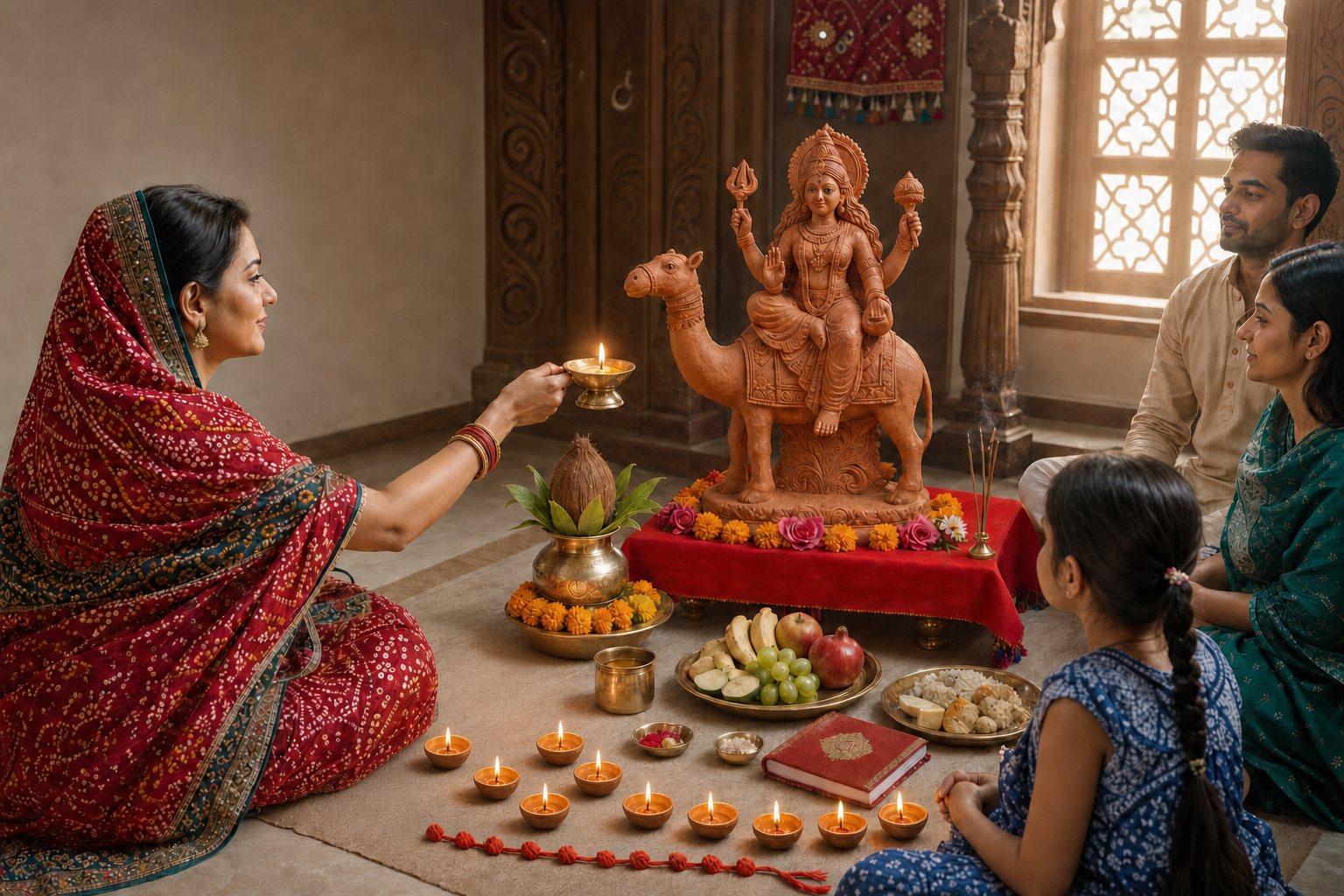
Dashama Vrat 2026 will be observed in many Gujarati households from Thursday, August 13, through Saturday, August 22. These ten dates correspond to the opening ten lunar days of Gujarati Shravan, from Shravan Sud Padvo or Shukla Pratipada through Shravan Sud Dasham or Shukla Dashami. The observance honours Dasha Maa, a regional manifestation of Goddess Shakti associated in devotional tradition with protection, household stability, health, prosperity and relief from adverse circumstances.
Dashama Vrat 2026 at a glance
The principal dates used in this guide are August 13–22, 2026, counted inclusively. Thursday, August 13, is Shravan Sud Padvo or Pratipada, the first day of the waxing fortnight. Saturday, August 22, is Shravan Sud Dasham or Dashami, the tenth lunar day and the customary concluding date for this form of the Gujarat observance.
Some families perform Dashama sthapana, or the preliminary installation of the sacred image, on Ashadha Amavasya, Wednesday, August 12. That Amavasya is also associated in Gujarat with Divaso, the day immediately preceding the new lunar month. In such households, August 12 functions as a preparatory or installation day, while the ten-day Shravan count begins on August 13. Other local traditions count the Amavasya rite within their ritual sequence and may conclude after the Navami-night jagaran. This explains why regional announcements sometimes differ by one civil date.
The date convention adopted here follows the first-day-to-tenth-day description in the source material and is corroborated by the 2026 Gujarati Shravan calendar, which places Shravan Sud Pratipada on August 13 and Shravan Sud Dashami on August 22. Exact puja times should still be checked against a trusted local panchang or temple calendar because tithi boundaries depend on location and do not necessarily coincide with midnight.
What Dashama Vrat represents
A vrata is more than a dietary fast. It is a deliberately undertaken religious discipline that may combine sankalpa, daily worship, ethical restraint, regulated food, recitation, storytelling, charity, remembrance and a concluding rite. Dashama Vrat therefore refers both to the promise made by a devotee and to the ten-day pattern through which that promise is embodied.
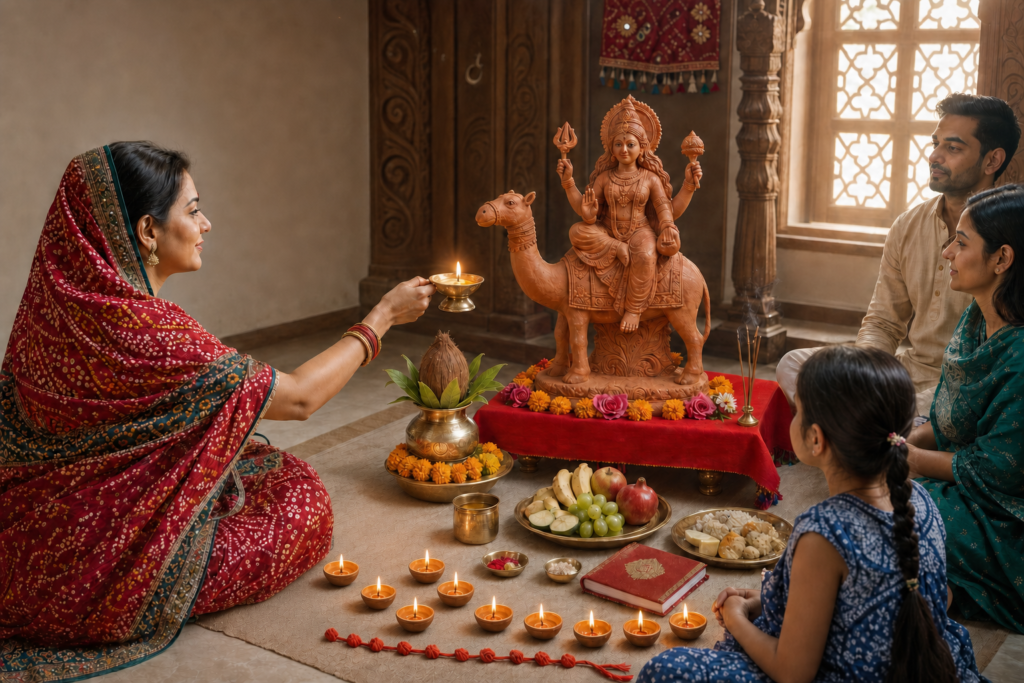
Within Gujarati popular Shakta devotion, Dasha Maa is understood as an expression of the Divine Feminine. Published accounts commonly portray her with four arms and a camel mount. Temporary clay representations brought into homes frequently emphasize this camel imagery and are sometimes described as a Sandhani. Iconographic details can vary among artisans, temples, districts and family traditions, so one commercial image should not be treated as the sole authoritative form.
The relationship among Dasha Maa, Momai Maa, Ashapura Maa and Nagbai Maa is described differently across communities. Some accounts closely identify or associate Dasha Maa with Momai Maa or Ashapura Maa, while others describe Momai Maa and Nagbai Maa as related deities worshipped alongside her. This diversity is characteristic of a living regional tradition. It is more accurate to preserve the names used by a household or temple than to force every local form into a single theological identity.
The name also carries a meaningful linguistic association. In several Indic languages, dasha can refer to a person’s condition, state or circumstance, while a similarly transliterated form can mean ten. Popular explanations consequently connect Dasha Maa both with the transformation of difficult circumstances and with the vow’s ten-day structure. These devotional interpretations are significant, although they should not be presented as a single uncontested etymology.
The vrat is traditionally undertaken with hopes for improved health, economic steadiness, family welfare, social dignity, children’s well-being and protection during unstable periods. These are religious aspirations rather than guaranteed material outcomes. The observance does not replace medical treatment, financial planning, employment, education or other practical responses to hardship. Its distinctive contribution lies in disciplined prayer, emotional resilience, household cooperation and the ethical reorientation encouraged by the katha.
Why the Gujarat observance falls in Shravan
Gujarat generally follows an amanta lunar calendar, in which a new month begins after Amavasya. The day after Ashadha Amavasya therefore opens Shravan Sud, the bright or waxing fortnight of Shravan. This calendar structure places the Gujarat Dashama Vrat at the threshold of a month already rich in worship, fasting, pilgrimage and household observances.
A tithi is an astronomical lunar-day unit rather than a fixed twenty-four-hour date. The synodic relationship between the Moon and Sun is divided into thirty segments of twelve degrees each. Because the relative motion is not uniform, a tithi can begin or end at almost any civil time. Festival calendars commonly assign a tithi to the date on which it prevails at local sunrise, although the precise rule can vary by observance.
This distinction is especially important for families outside Gujarat. A calendar prepared for Ahmedabad cannot automatically supply exact start and end times for London, Toronto, Nairobi, Sydney or New York. The civil-date sequence may remain similar, but local sunrise and tithi transitions can alter the applicable time. Diaspora households seeking strict observance should consult a panchang calculated for their city while retaining the ritual tradition transmitted by their family or temple.
Dashama Vrat should also be distinguished from the post-Holi Dasha Mata observance found in Rajasthan and parts of North and Central India. That regional vrata is associated with a different part of the lunar year, often Chaitra or the corresponding month under another calendar convention. Both observances honour the Divine Mother, but their dates, stories and ritual details should not be merged without local evidence.
The complete ten-day calendar for 2026
Preliminary day — Wednesday, August 12: Ashadha Amavasya may be used for cleaning the worship area, acquiring an unbaked clay image, preparing the bajot and performing sthapana where family custom prescribes it. Households that regard August 13 as the installation day may simply use August 12 for preparation. This preliminary day is not counted among the ten Shravan dates in the schedule used here.
Day 1 — Thursday, August 13: Shravan Sud Padvo or Shukla Pratipada begins the ten-day count. The household makes its sankalpa, installs Dasha Maa if this was not done on Amavasya, lights the lamp, presents the opening offerings and begins the selected fasting discipline. A red thread with ten knots may be tied on the right wrist where that custom is followed.
Day 2 — Friday, August 14: Shravan Sud Bij or Dwitiya establishes the daily rhythm of bathing, altar care, lamp-lighting, offerings, Dashama Katha, aarti and prasad. The simplicity and consistency of the routine are more important than adding unsupported ritual requirements.
Day 3 — Saturday, August 15: Shravan Sud Trij or Tritiya continues the vow. Devotees maintain the dietary rule selected at the beginning, keep the worship space orderly and preserve a calm domestic atmosphere. Family members who are not fasting can assist with flowers, food preparation, reading or cleanup.
Day 4 — Sunday, August 16: Shravan Sud Choth or Chaturthi offers an opportunity for collective worship when work schedules permit. Where Ganesha has been installed with Dasha Maa, respectful worship of Ganesha remains part of the family sequence rather than a separate improvised festival.
Day 5 — Monday, August 17: Shravan Sud Pancham or Panchami marks the midpoint of the practical discipline. The household may review whether food, work and worship arrangements remain safe and sustainable. An adjustment made for genuine health needs does not require abandoning prayer, katha or ethical restraint.
Day 6 — Tuesday, August 18: Shravan Sud Chhath or Shashti continues the regular puja. The repeated acts of cleaning, lighting, offering and listening gradually transform the vrata from a special event into a stable daily practice.
Day 7 — Wednesday, August 19: Shravan Sud Satam or Saptami is suitable for revisiting the katha’s ethical emphasis on humility and respect. Its message is not confined to ritual accuracy; it challenges contempt, social arrogance and the careless dismissal of another person’s devotion.
Day 8 — Thursday, August 20: Shravan Sud Atham or Ashtami is also identified as a monthly Durgashtami in several panchangs. Some Shakta households may acknowledge that wider calendar setting, but no additional Dashama rite should be declared compulsory unless supported by their lineage or temple.
Day 9 — Friday, August 21: Shravan Sud Nom or Navami is generally used to prepare for completion. The family can arrange the final naivedya, confirm the local immersion location, separate reusable decorations and ensure that children, elderly participants and the clay image can be transported safely.
Day 10 — Saturday, August 22: Shravan Sud Dasham or Dashami completes the stated ten-day sequence. A concluding puja, final katha or aarti, prasad and expressions of gratitude precede visarjan where a temporary clay image has been installed. Some communities hold jagaran on the preceding night or conclude the procession early in the morning; local practice remains decisive.
This date-by-date plan does not claim that Dasha Maa assumes a different prescribed form on each day. The widely documented structure emphasizes sustained worship of Dasha Maa throughout the period. Daily themes offered for reflection are practical aids, not substitutes for a family’s inherited vidhi.
Preparing the home and altar
Preparation should begin by consulting the most knowledgeable source available within the tradition: an elder who has actually observed the vrat, a local temple, a trusted priest or a regional vrata text. Internet summaries can identify broad patterns, but they cannot resolve every difference in food rules, installation, mantra, thread ritual or completion.
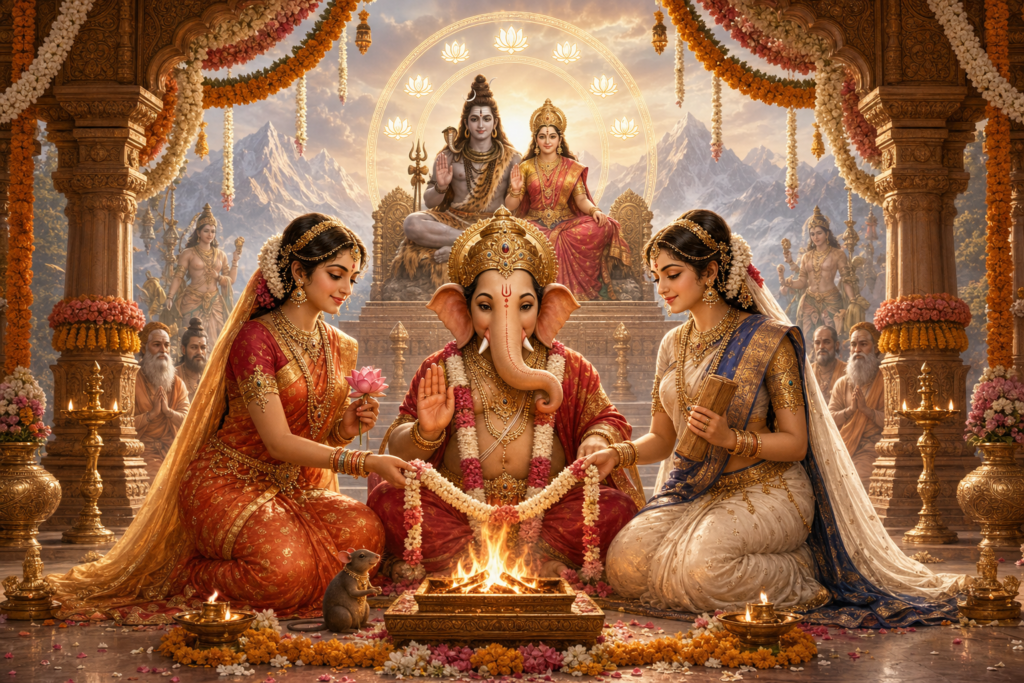
A clean, stable bajot or low worship platform is commonly covered with a fresh red cloth. The altar may hold an unbaked clay representation of Dasha Maa or Sandhani, an image of Ganesha where customary, a kalash and the usual lamp and offering vessels. Families using a framed image rather than a temporary clay murti should not assume that the permanent image must later be immersed.
Commonly reported materials include a natural-clay image or clean picture, red cloth, bajot, kalash, clean water, coconut and leaves where used, diya, cotton wick, oil or ghee, incense, kanku or kumkum, akshata, flowers, seasonal fruit, naivedya, a red sacred thread with ten knots, a Dashama Katha text, an aarti text and reusable utensils. Abhil, gulal and other traditional substances appear in some accounts but are not universal requirements.
The altar should express care rather than competitive expenditure. A small clay image, one lamp, locally available flowers and a sincere food offering are sufficient for a modest household observance. Borrowing money for elaborate decoration or treating commercial display as a measure of devotion contradicts the vrat’s concern with stability and responsible conduct.
A fasting plan should be chosen before the sankalpa. Work schedules, medication, pregnancy, age and existing medical conditions need to be considered honestly. Food ingredients and meal times can then be organized without daily uncertainty, and non-fasting relatives can help prevent waste or accidental mixing of foods that the devotee has chosen to avoid.
A careful household puja sequence
Purification and readiness: The worshipper bathes or washes appropriately, wears clean clothing, cleans the altar and approaches the rite in a composed state. Physical cleanliness supports concentration, but it should not become a basis for humiliating another person or enforcing discriminatory notions of human worth.
Lighting the sacred space: A diya is lit safely, followed by incense if household health and ventilation permit. Water, flowers and other materials are arranged before the puja begins so that the sequence can proceed attentively. An open flame should never be left unattended, especially near cloth, children or pets.
Sankalpa: On the opening day, the devotee states the intention to observe Dashama Vrat for the prescribed period according to capacity and family tradition. A sankalpa can name the place, date, deity and spiritual purpose. No improvised Sanskrit formula is necessary when its meaning is not understood; a clear and reverent statement in Gujarati or another familiar language can preserve the vow’s integrity.
Ganesha remembrance: Published descriptions of the Gujarat observance frequently place an image of Lord Ganesha with the Sandhani. Where this is the family practice, Ganesha is remembered at the beginning as the remover of obstacles. Households without this installation should follow their received procedure rather than adding an object merely because it appears in a general guide.
Invocation and offerings: Dasha Maa is respectfully invoked and offered water, kanku, akshata, flowers, fragrance, light and naivedya according to capacity. Some families use a simple panchopachara pattern, while others perform a more extensive sequence. The concluding day may include an expanded puja, but a formal shodashopachara should be undertaken with proper knowledge rather than reconstructed from unrelated festival instructions.
The ten-knotted thread: A documented custom uses a red kautuka or sacred thread bearing ten knots, commonly worn on the right wrist. The ten knots correspond symbolically to the vow’s ten days. Methods of preparing, sanctifying, wearing and later removing the thread vary, so an established family procedure should take precedence.
Katha, prayer and aarti: The Dashama Vrat Katha is read aloud or heard, followed by prayers, bhajans and aarti. Reading with attention is preferable to racing through an unfamiliar text. When children participate, a concise explanation of the katha’s ethical meaning can prevent the ritual from becoming a sequence of unexplained gestures.
Naivedya and prasad: Food is first offered in the manner accepted by the household and then distributed respectfully as prasad. Clean reusable plates and cups reduce waste. The person keeping a one-meal discipline may take the permitted food after puja at the customary time, while other family members may receive prasad without assuming the same fast.
Daily repetition: The altar is attended each day, the lamp is lit, fresh or properly preserved offerings are made, the katha or selected prayers are recited and aarti is performed. Wilted flowers and food should be removed hygienically rather than allowed to accumulate. Sacred care includes cleanliness and responsible disposal.
Completion: On Dashami, the devotee offers gratitude, seeks forgiveness for mistakes made unintentionally and formally completes the sankalpa. If a temporary natural-clay image was installed for visarjan, the final aarti is followed by an environmentally responsible immersion. A permanent photograph, stone icon or metal murti remains in the shrine and is not treated as disposable.
Fasting rules and legitimate variations
A frequently reported Gujarat practice is ek tanu, one meal a day. One published account describes a wheat-based meal, while other households take fruit, milk or foods permitted by their lineage. Some undertake a stricter fast, and a smaller number may practice nirjala, abstaining even from water for a defined period. These alternatives are variations, not cumulative obligations.
Generic rules copied from Ekadashi, Navratri or another vrata should not automatically be applied to Dashama Vrat. In particular, claims that every observer must avoid all grain, must eat wheat, must avoid salt or must follow one universal menu are too broad without local support. The rule included in the original sankalpa and transmitted within the family is the relevant discipline.
Fasting should be proportionate to health and responsibility. Children should not be pressured into severe restriction, and pregnant or nursing people, older adults, people with diabetes, kidney disease or a history of disordered eating, and anyone taking medication may require an adapted observance developed with appropriate clinical guidance. Prayer, one simplified meal, abstention from excess, service and katha recitation can retain the vrata’s spiritual purpose without preventable harm.
The wider discipline may include vegetarian food, avoidance of intoxicants, measured speech, restraint from anger, household cleanliness and compassionate conduct. These ethical practices translate devotion into daily life. A fast accompanied by contempt, exploitation or family conflict would preserve the outward form while weakening the moral substance emphasized by the katha.
The Dashama Vrat Katha and its ethical meaning
The katha belongs to devotional and oral literature rather than verified political history. Names, episodes and details can change between printed booklets, temple recitations and family retellings. One widely circulated version features King Vijay Singh and Queen Roopmati, who live in a palace called Jal Mahal in Gujarat.
In this version, Queen Roopmati sees women performing worship for Dasha Maa. Curious about their practice, she asks her attendants for an explanation and decides to undertake the vrata. Her response is marked by receptiveness: she learns from devotional knowledge circulating among ordinary women rather than dismissing it because it comes from outside the royal court.
King Vijay Singh reacts with anger and contempt. He orders the queen to stop and disparages the worship by associating it with people of lower economic or social standing. The narrative identifies this arrogance, not mere ignorance of a ritual detail, as the king’s central failure.
A sequence of reversals follows. The orchard loses its abundance, offered sweets become stones in some retellings, royal security collapses and the king is eventually imprisoned by another ruler. These episodes are symbolic expressions of a deteriorating dasha: privilege, wealth and authority prove unstable when accompanied by disrespect and moral blindness.
During adversity, the king recognizes his error, relinquishes his contempt and turns toward Dasha Maa with humility. He observes the vrata, and the narrative concludes with the restoration of well-being and fortune. The resolution should not be reduced to a mechanical bargain in which ritual performance purchases wealth. Its deeper structure links transformation with acknowledgement, discipline and corrected conduct.
The katha offers a strong lesson in social dignity. Devotion is not invalidated by the poverty, gender, occupation or social position of the person who carries it. Queen Roopmati’s willingness to learn contrasts with the king’s attempt to rank religious worth by status. The story therefore speaks to contemporary households whenever class prejudice or cultural arrogance is disguised as sophistication.
It also gives women’s domestic religious knowledge a central narrative role. The queen learns from women, chooses the vow and preserves a form of worship that the king initially rejects. Without imposing modern categories on an older story, the episode can still be read as recognition of women as transmitters, interpreters and organizers of living tradition.
The promised improvement in health, wealth and household circumstances remains a devotional belief. An academically responsible account distinguishes such belief from an empirically guaranteed result while still recognizing its emotional force. For a family facing uncertainty, ten days of ordered prayer, shared meals, storytelling and mutual support can create genuine structure even when external problems require longer practical solutions.
The five-year tradition
Some published descriptions state that Dashama Vrat is undertaken for five consecutive years. Certain lineages also prescribe a special completion rite after the fifth observance. This is not a universal rule for every devotee, and no one should make a multi-year sankalpa casually. The duration, interruption rules and completion procedure should be confirmed before the first vow with a knowledgeable family elder or temple authority.
Household, community and cultural experience
Married women are especially prominent in descriptions of Dashama Vrat, but the observance is rarely sustained by one person alone. Other family members prepare food, obtain flowers, read the katha, accompany the visarjan and care for children or elders. Recognizing that shared labour prevents the vrat from becoming an invisible domestic burden placed entirely on the principal observer.
Bhajans, aarti, jagaran and, in some communities, garba or collective singing give the observance a public dimension. These activities transmit melodies, stories, vocabulary and iconography across generations. Their value does not depend on excessive amplification or spectacle; smaller gatherings can preserve both devotion and consideration for neighbours.
Children often remember the visible rhythm most clearly: the red cloth, daily lamp, clay image, prasad and final procession. Adults can deepen that memory by explaining why the altar is cleaned, why food is offered, why the king’s contempt is criticized and why the image must be immersed without polluting water. Ritual literacy turns participation into cultural understanding.
Diaspora households may use a photograph, a small natural-clay image or a temple-based observance when a traditional Sandhani is unavailable. Adaptation is not the same as careless invention. The essential distinction is between preserving the vow’s recognizable structure and claiming that a new convenience is an ancient universal rule.
Dashama Vrat is specifically a Hindu regional Shakta and folk observance. Dharmic unity does not require its identity to be blurred or attributed to Buddhists, Jains or Sikhs. Unity is better served through accurate representation, mutual hospitality, ecological responsibility and respect for each tradition’s distinctive practices. The diversity found even within Hindu worship demonstrates that religious solidarity can coexist with theological and ritual difference.
Jagaran, visarjan and environmental responsibility
Jagaran is observed in some communities near the conclusion of the vrat through prayer, katha, aarti and devotional singing. It should not be confused with unsafe sleep deprivation or unrestricted noise. Elderly people, children and anyone whose work or health requires rest can participate for an appropriate period without being judged by the length of wakefulness.
Visarjan marks the ritual farewell to the divine presence invoked in a temporary clay form. The gesture expresses impermanence, gratitude and return rather than disposal. This meaning is preserved only when the image and its decorations are handled with dignity before, during and after immersion.
The Central Pollution Control Board’s Revised Guidelines for Idol Immersion encourage natural, biodegradable clay and non-toxic colours while rejecting Plaster of Paris, thermocol, single-use plastic and toxic paints. These general idol-immersion principles are directly relevant to a temporary Dashama murti.
Flowers, cloth, ornaments, plastic packaging, electrical lights and other removable materials should be separated before immersion. Reusable objects can return home, biodegradable flowers can enter the locally approved compost stream and other waste should be placed in designated bins. Throwing an entire decorated altar into a river is neither necessary nor environmentally responsible.
Where local rules permit household immersion, a small unbaked natural-clay image can be dissolved completely in a clean water container. The CPCB household guidance allows the settled clay to be dried and reused or placed with soil, while the clarified water may be used as directed by local authorities. If a municipality provides artificial ponds or mobile tanks, those designated facilities should take priority over an uncontrolled natural-water immersion.
Waterfront safety is part of religious responsibility. Participants should follow municipal and police instructions, use barricaded immersion points, avoid deep or fast-moving water, supervise children continuously and refrain from climbing unstable banks or overcrowded boats. A family member can record the rite without obstructing emergency access or pressuring anyone to enter the water.
Frequently asked questions
Are August 13 and August 22 both included? Yes. The sequence August 13–22 contains ten civil dates when counted inclusively, matching Shravan Sud Pratipada through Dashami in the calendar used for this guide.
Why do some notices say the vrat begins on August 12? August 12 is Ashadha Amavasya, when some households perform installation and begin associated discipline. Other accounts describe the vrat as beginning on the first day of Shravan, August 13. The apparent disagreement usually reflects whether the Amavasya sthapana is counted as Day 1 or treated as preliminary.
Does everyone have to follow the same fast? No. One meal a day, a wheat-based partial fast, fruit and milk, and stricter forms are all reported. The observer should follow a coherent family or temple rule suited to health rather than combining the strictest element from every online description.
Is Dasha Maa simply another name for Durga or Momai Maa? Dasha Maa is revered as a manifestation of Shakti, but regional explanations of her relationship to Durga, Momai Maa, Ashapura Maa and Nagbai Maa differ. The local name and theology should be preserved instead of asserting a universal identity that all communities may not recognize.
Can the vrat be observed with a photograph? Many households use a sacred image when a temporary clay form is unavailable, especially outside Gujarat. A photograph or permanent icon is worshipped respectfully but is not immersed. The concluding rite can consist of final aarti, gratitude and formal completion of the sankalpa.
Is there one mandatory mantra? The broadly documented core consists of worship, katha, bhajan and aarti, but mantra traditions vary. A mantra received through a family, temple or qualified guide should be retained accurately. Invented Sanskrit or a mantra borrowed from an unrelated vrata should not be presented as compulsory Dashama practice.
Must the vrat be continued for five years? A five-year cycle is reported in some traditions, but it is not established as a universal condition for every participant. The commitment should be made only after the household understands its own rule and completion rite.
Can men, unmarried people and children participate? Women, particularly married women, are central to many accounts, yet household members can assist in worship, listen to the katha, sing aarti and share prasad. Participation should respect the primary observer’s tradition without forcing severe fasting on children or medically vulnerable people.
Does the vrat guarantee wealth or cure illness? No material or medical outcome can be guaranteed. Devotional tradition seeks Dasha Maa’s blessings for improved circumstances, while responsible observance also requires medical care, sound decisions, work, financial prudence and supportive relationships.
A practical final checklist
Before the vrat, the household should verify local tithis, confirm whether sthapana occurs on August 12 or 13, choose a realistic fasting rule, obtain a natural-clay image if immersion is planned, prepare a clean altar and locate a reliable Gujarati or family-approved katha. It should also confirm the municipal immersion arrangement instead of waiting until Dashami.
During the ten days, the essential priorities are consistency, cleanliness, daily worship, attentive katha recitation, safe food practices, respectful speech and shared household support. Elaborate decoration, expensive purchases and increasingly severe fasting are not reliable measures of spiritual depth.
On the final day, the family should complete the puja, distribute prasad, remove reusable and non-biodegradable decorations, use an approved immersion method and leave the site clean. The thread and other ritual materials should be concluded according to the family’s instructions rather than discarded casually.
Closing reflection
Dashama Vrat endures because it joins regional identity, household memory and Shakti worship to a disciplined response to uncertainty. Its emotional power lies not only in asking for a better dasha, but also in examining the attitudes and habits that shape present circumstances. The ten-day rhythm invites humility where there was arrogance, order where there was confusion, cooperation where there was isolation and reverence where ordinary life had become mechanical.
For Gujarat in 2026, that sacred rhythm runs from August 13 through August 22, with Ashadha Amavasya on August 12 serving as the preliminary installation day in many traditions. When the dates are observed with local guidance, health-conscious fasting, accurate storytelling and responsible visarjan, Dashama Vrat becomes both a devotional vow and a thoughtful expression of living cultural heritage.
Research basis: The festival framework was developed from the HinduPad Dashama Vrat overview, its Gujarati Shravan 2026 calendar, a detailed DeshGujarat account of the rituals and katha, and the CPCB environmental guidance linked above. Local panchang and lineage-specific instructions remain authoritative for exact timing and family practice.
Inspired by this post on Hindu Pad.







Leave a Reply
You must be logged in to post a comment.