
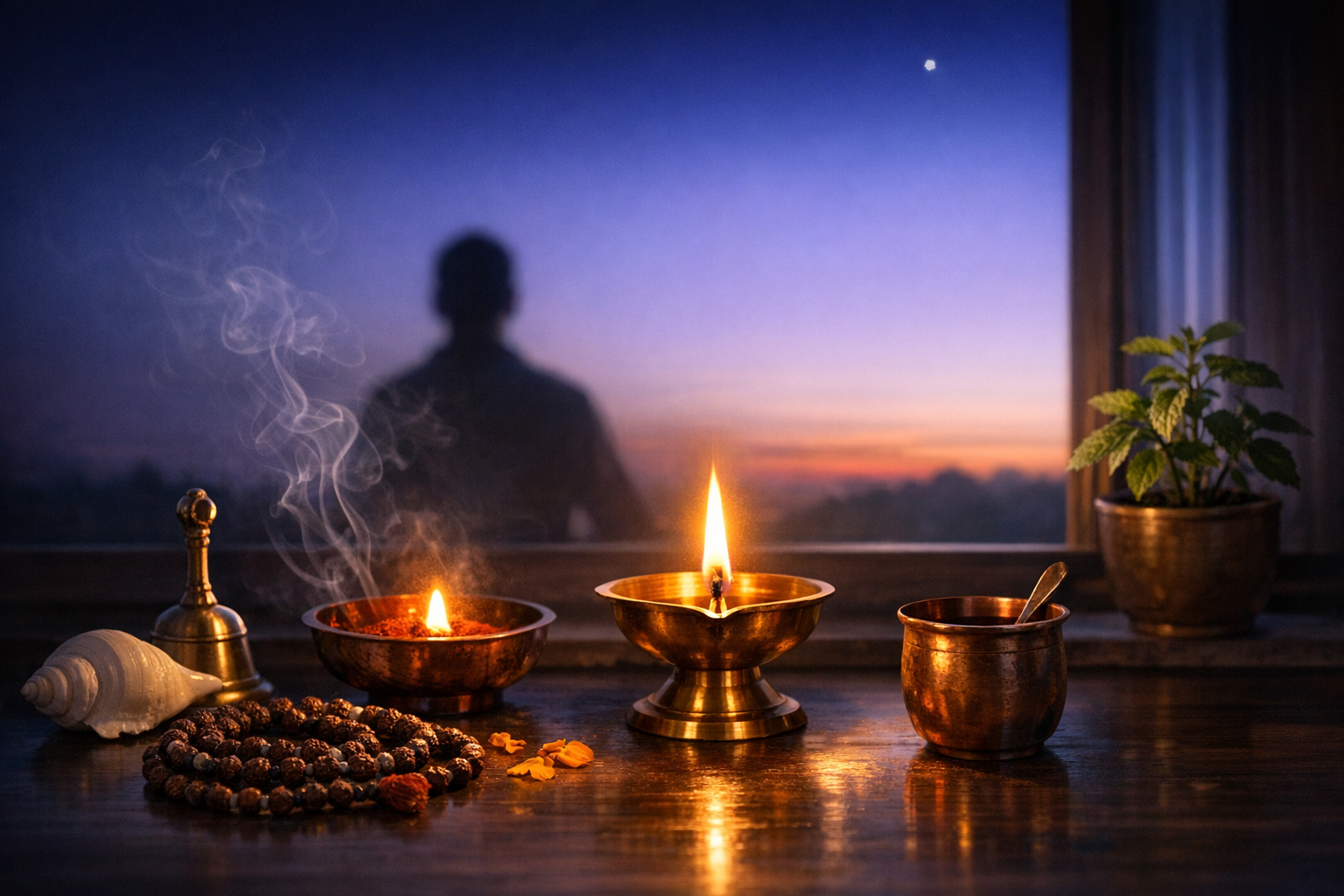
Across the dharmic world, dusk is more than a picturesque moment; it is a sacred transition. In Hindu tradition, this juncturesāyam-sandhyāis understood as a subtle rebalancing of forces that shape perception, mood, and attention. Far from mere superstition, it reflects a nuanced Vedic wisdom about cyclical energies and their effects on consciousness, ethics, and daily living within the Hindu way of life.
Classical philosophy describes reality through the interplay of three guṇassattva (clarity), rajas (activity), and tamas (inertia or obscuration). The Bhagavad Gita frames these modes not as moral absolutes but as tendencies that color awareness and behavior. At sunset, tamas rises. Properly oriented, this increase supports withdrawal from outward stimulus, quieting of the senses, and preparation for rest and contemplation. Left unguided, it may manifest as heaviness or distraction. Evening discipline, therefore, aims to harness tamas constructively.
Vedic and yogic traditions correlate the day’s arc with the guṇas: the pre-dawn Brahma-muhūrta inclines toward sattva, midday toward rajas, and post-sunset toward tamas. This cycle is mirrored in lived experiencesharpness and drive tend to crest with daylight, while twilight invites a softening of attention. The purpose of sāyam-sandhyā is not to resist that softening but to align with it, converting the descent of outward energy into an ascent of inward awareness.
Modern chronobiology adds a complementary lens. As solar irradiance fades, melanopsin-containing retinal cells signal circadian pathways; melatonin begins to rise; sensory processing shifts. The physiological environment at twilight is therefore unusually receptive to downregulation of stress arousal and to practices that favor focused calm. While scripture and science speak in different idioms, both converge on a pragmatic insight: evening is naturally suited to recalibration of mind and body.
Within this framework, sandhyā-vandanam serves as a canonical saṁskāra-like discipline at the day’s junctionsespecially at sunset. Rooted in the Gṛhya Sūtras and Dharmashastras, it typically includes ācamana (purificatory sips), mārjana (sprinkling), regulated prāṇāyāma, and Gāyatrī japa. The emphasis is technical: breath cadence steadies the autonomic system; mantra entrains attention; ritual gestures synchronize intention and posture. The goal is not mere observance but measurable composure and clarity.
Agnihotra, the compact Vedic fire-offering at sunrise and sunset, represents another precise response to dusk. In its śrauta-smārta form, small oblations of clarified butter and grains are offered into a carefully prepared flame at exact timings. Beyond theology, the ritual cultivates steadiness, gratitude, and temporal discipline. Traditional literature ascribes wide-ranging benefits; a measured view notes that the practice reliably anchors attention, regularizes breath, and strengthens the evening boundary between exertion and repose.
Śaiva traditions mark pradoṣa-kālathe approximately ninety-minute span flanking sunsetas especially potent for Śiva worship. The fortnightly Pradoṣa-vrata on Trayodaśī formalizes this emphasis, but daily twilight remains significant in itself. Narratives associate pradoṣa with the cosmic dance of Śiva and the easing of accumulated doṣas (impediments). In practical terms, a concise pradoṣa pūjā creates an intentional pause that reframes the remainder of the night.
Temple life encodes these insights through sandhyā-ārati: lamps are circled, bells and conchs resound, and the atmosphere perceptibly shifts. The sensory profilelight, sound, fragrancefunctions as embodied pedagogy. It orients attention from the dispersal of day toward gathered presence, exemplifying the philosophy that nāda (sound) and dīpa (light) can route awareness from the outer to the inner without repudiating either.
Domestic practice mirrors the temple. A lamp is lit before the household shrine or near a tulasī plant; family members often gather for a brief chant or silent reflection. Many householders describe the first minute after lighting the lamp as a qualitative resetconversations soften, tasks decelerate, and the home takes on a contemplative cadence. In this way, a simple ritual operationalizes a central tenet of Hindu tradition and culture: align the environment to support the mind.
Yoga philosophy prescribes specific evening sādhana. Gentle nāḍī-śodhana (alternate-nostril breathing) balances autonomic tone; bhrāmarī (humming exhalation) attenuates mental rumination; brief pratyāhāra transitions attention away from screens toward inward sensibility. Traditional physiology speaks of iḍā and piṅgalā nāḍīs alternating dominance through the day and of increased accessibility of suṣumnā during liminal periodsan interpretive map that, in practice, guides breath-led calming and focused awareness.
Contemplation (dhyāna) and japa consolidate this arc. Many practitioners find that one mālā of “Om”, Gāyatrī, “Om Namaḥ Śivāya”, or the Mahāmṛtyuñjaya at dusk yields disproportionate benefits relative to time invested. A lamp-based trāṭaka (soft, steady gazing) further stabilizes visual attention before the eyes are closed. The intent is not to perform more, but to do lessconsciously.
Ayurveda’s dinacaryā supports the same logic. Around sunset the day shifts from vāta toward kapha dominance (roughly 2–6 pm and 6–10 pm, respectively). Light, warm evening meals, reduced sensory load, and unhurried conversation leverage this transition into restorative tamaspreparing the ground for healthy nidrā (sleep). Stimulants, intense debate, and bright blue light tend to invert that curve, amplifying restlessness.
Ethical closure is integral. Many households include a brief kṣamā-prārthanā (prayer of forgiveness), express gratitude for the day’s learnings, and set gentle intentions for the morning. In experiential terms, this resolves residual agitation and prevents unprocessed rajas from hardening into restless tamas. The evening thereby becomes a hinge of learning, not a sink of fatigue.
These patterns are shared across dharmic traditions. In Buddhism, monasteries widely observe evening chanting and meditation, often emphasizing mettā (loving-kindness) or mindfulness of breathing. In Jainism, pratikraman at dusk facilitates introspection, repentance, and recommitment to ahiṁsā. In Sikhism, Rehras Sahib at twilight fortifies courage and gratitude as the day closes. Despite distinct theologies, the timing and intent converge: sunset is for inward recalibration and ethical clarity.
Seasonal and festival cycles heighten twilight’s resonance. During Kārttika, evening lamp-lighting becomes a sustained practice; Deepavali’s lamps dramatize the principle that inner light is not the negation of darkness but its orientation. Temple calendars, village customs, and household rhythms together inscribe dusk as a daily pedagogy in Vedic wisdom.
Misconceptions deserve gentle correction. Describing dusk as “inauspicious” flattens nuance. Shāstra frames it as powerful and therefore to be approached with clarity. The increased tamas is not a curse; it is the very condition that, when guided by sādhana, enables rest, repair, and assimilationphysically, mentally, and spiritually.
Practically, many find that a concise, repeatable sequence works best: a minute of silence to mark transition; lighting a lamp; a few cycles of nāḍī-śodhana to balance breath; one focused round of mantra; a short contemplation of the day’s main lesson; and a deliberate step-down from screens. The entire arc can take fifteen to twenty minutes yet reliably transforms the night that follows.
Adaptability is part of the tradition. Urban schedules, shifting latitudes, and seasonal curves may complicate exact timing. The principle remains: wherever possible, anchor practice near sunset; where not, approximate the energetic intentiona clear boundary that turns from outward tasks toward inward integration. Consistency matters more than perfection.
Seen through the lenses of the Upanishads, the Bhagavad Gita, Yoga philosophy, and Ayurveda, twilight is a living laboratory. It demonstrates how attention, breath, ethics, and environment can be coordinated to convert tamas from dullness into refuge; from weight into depth. And viewed across Hinduism, Buddhism, Jainism, and Sikhism, it also becomes a shared bridgea daily affirmation that diverse paths can meet in the same spacious pause at day’s end.
When darkness falls, the tradition does not ask for fear; it invites alignment. By tending the lamp, breath, word, and thought at dusk, householders and monastics alike translate ancient insight into present-centered wellbeing. The sacred transition becomes a practical artuniting body rhythms with contemplative intent, and individual practice with a wider dharmic kinship.
Inspired by this post on Hindu Blog.










