Kanya Pujaalso known as Kumari Pooja or Kanjak Pujais among the most cherished and widely observed rites during Navratri Durga Puja, honoring the living embodiment of Devi in young girls. It is both a devotional act and a social ethic: revering Shakti while affirming dignity, nourishment, and care for children. The ritual bridges home and temple, tradition and modernity, and it remains integral to how communities experience Navaratri across regions.
In 2026, Kanya Puja for Shardiya Navratri aligns with Durgashtami on October 18, with many households performing the rite on this day. In several traditions, Kanya Puja is conducted on Mahanavami, which falls on October 19 in 2026. During Chaitra Navaratri, Kanya Puja is observed on March 26, 2026 (Thursday). Community customs differ by region and lineage, yet the devotional intent remains consistent: to honor the Devi present in all beings, especially as Kumari.
These observance dates are determined by the lunar tithi and local sunrise. Durgashtami corresponds to Ashwin Shukla Ashtami and Mahanavami to Ashwin Shukla Navami in the Hindu lunisolar calendar. Because tithis may span across two civil dates and vary by geography, families often consult a regional panchang to decide whether Ashtami or Navami is best for Kanya Puja in their location.
The theological core of Kumari Pooja arises from the Shakta understanding that the Divine Mother pervades all of existence (Ya Devi Sarvabhuteshu), and that She is tangibly present as Kumarithe pure, auspicious, and compassionate force of renewal. The Devi Mahatmyam (Durga Saptashati) repeatedly affirms this presence of Shakti in every being. As a result, venerating young girls during Navratri becomes an act of worship directed to the Supreme Feminine, as well as a commitment to protect, nourish, and educate the next generation.
This practice also expresses a shared dharmic value across Hinduism, Buddhism, Jainism, and Sikhismnamely, reverence for compassion, non-violence, service (seva), and the inherent worth of every life. While liturgical forms differ among these traditions, the ethical through-line is unity in honoring dignity and nurturing the vulnerable, thereby strengthening social harmony and interfaith goodwill.
Traditionally, families invite nine pre-pubescent girls (and, in some lineages, an additional boy as Batuk/Bhairav) to represent the Nava Durga. Where nine girls are not available, one or more Kumaris may be respectfully welcomed; the essence of the rite is devotion (bhakti) and service (seva), not numerical perfection. In many households, relatives, neighbors, and friends assist to ensure the children feel safe, comfortable, and celebrated.
Classical sources and paddhatis describe nine manifestations symbolically present in the Kumaris: Shailaputri, Brahmacharini, Chandraghanta, Kushmanda, Skandamata, Katyayani, Kalaratri, Mahagauri, and Siddhidatri. A widespread convention associates ages two through ten with forms such as Kumari, Trimurti, Kalyani, Rohini, Kali, Chandika, Shambhavi, Durga, and Subhadra, though names, age mappings, and exact forms vary by region and family tradition. The focus remains on invoking Devi and offering respect, sustenance, and blessings to the children.
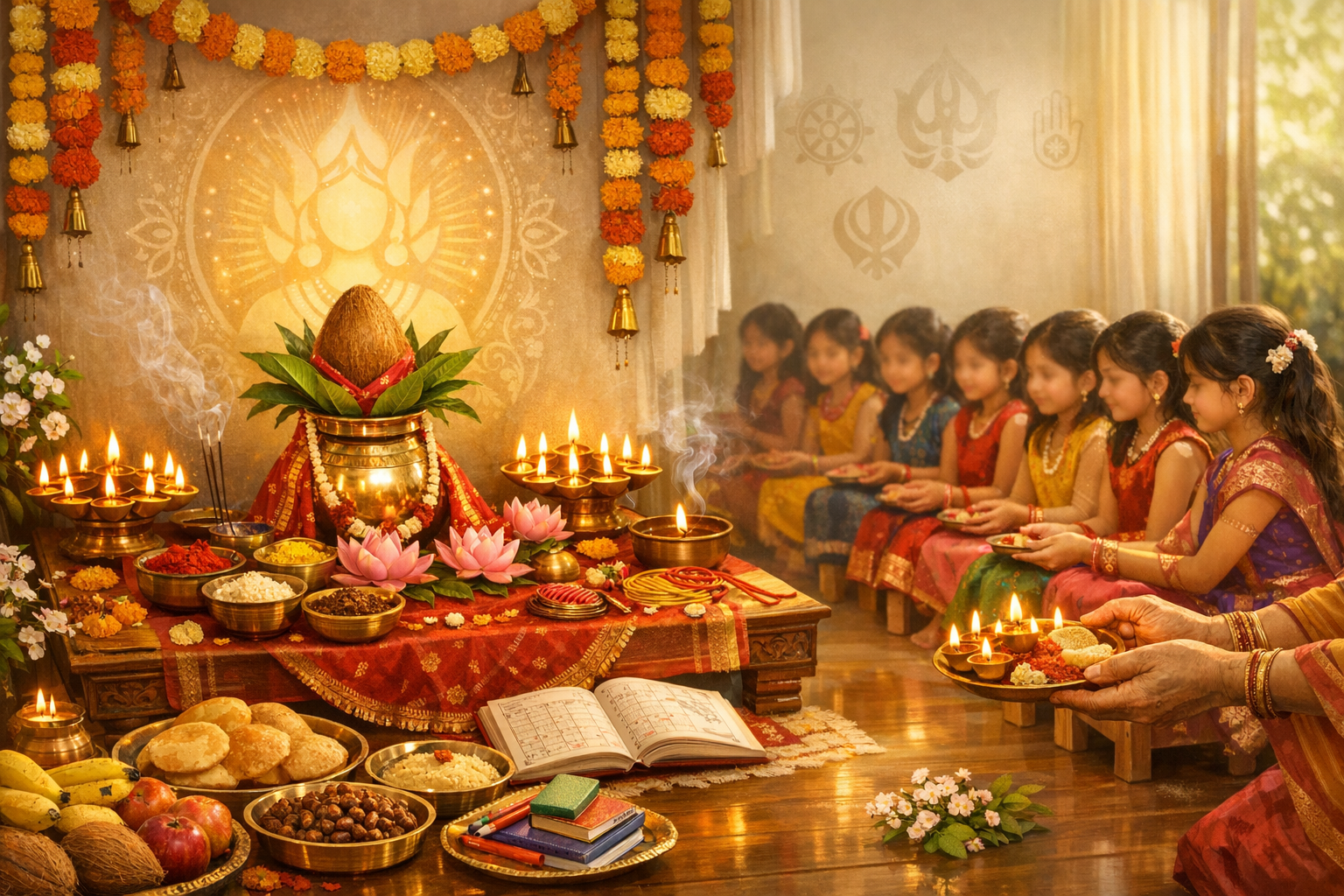
Essential items typically include a clean altar space or chowki, kalash, images or yantras of the Goddess, fresh flowers, incense, a ghee lamp, turmeric and vermilion (haldi-kumkum), akshata, sacred thread (kalava/mouli), new dupattas or chunris, bangles or small tokens, fruits, sweets, and a sattvic mealoften pooris, suji halwa, and kala chana (or other regional staples). Gifts may include notebooks, pencils, clothing, or any thoughtful, age-appropriate items.
Preparations begin with cleaning the space, lighting a lamp, and performing sankalparesolving to conduct Kanya Puja with purity of intention for the welfare of all. A brief dhyana on Devi as Shakti sets the contemplative tone. Invoking the Goddess into the Kumaris symbolically affirms that the worship offered to the children is worship offered to Mahadevi Herself.
The core vidhi commonly follows a sequence of welcoming the children, washing or ritually cleansing their feet (padya) with consent and care, applying tilak, adorning them with a light chunri or token, and tying kalava on the wrist. The priest or elder may chant from the Devi Mahatmyam or recite simple stotras that praise the Mother as present in all beings. The emphasis is on affection, dignity, and gentle hospitality.
Thereafter, the Kumaris are served a wholesome, freshly prepared, sattvic meal. Families often offer the canonical triopoori, suji halwa, and kala chanathough regional menus differ (e.g., rice-based offerings in the east and south). Following the meal, an arati is performed to the Kumaris, and blessings are sought for the home and community. Finally, respectful dakshina and small gifts are offered, and the rite concludes with gratitude and well-wishes.
Timing aligns with local custom. Many households perform Kanya Puja on Durgashtami between sunrise and noon, while others prefer Mahanavami. Some Shakta traditions mark the Sandhi Kaal (the junction of Ashtami and Navami) as exceptionally sacredespecially for arati and stotra recitationthough the children’s meal is typically scheduled more conveniently during the day. In all cases, the local panchang and family parampara take precedence.
Regional practice displays rich variety. In North India, the rite is widely known as Kanjak or Kanjakein and is often held on Ashtami or Navami. In Bengal and parts of the east, Kumari Puja on Maha Ashtami has a prominent place in Durga Puja observances. In the south and west, households and temples may adapt the puja to local paddhati while retaining the central ethic of honoring Shakti. Diaspora communities typically coordinate dates using the tithi-based calendar for their time zone.
Food and gifts reflect care and moderationfresh, clean, and sattvic preparations; simple, meaningful tokens rather than ostentation. The guiding principle is annadanam (nourishment) and saucha (purity). Families can also include fruits, coconuts, seasonal produce, or traditional sweets specific to their region to retain culinary heritage and nutritional balance.
Mantra recitation enhances the devotional atmosphere. Many households chant select adhyayas from the Devi Mahatmyam (Durga Saptashati), or stotras such as Argala Stotram and Keelakam. Simple refrains from the hymn beginning “Ya Devi Sarvabhuteshu” are also common and accessible. Where extensive chanting is not feasible, even a few minutes of concentrated prayer, meditation, or collective kirtan meaningfully sanctify the occasion.
Ethical and inclusive considerations are paramount. Consent and comfort for the children come first; no act of worship should cause embarrassment, fatigue, or distress. Hygienic arrangements, safe seating, and age-appropriate portions are essential. Photography, if any, should be respectful and optional. When circumstances make in-person hosting difficult, families may support girl-child nutrition, education, or health initiatives through trusted local channels, ensuring the spirit of Kanya Pujaseva to Deviremains intact.
Kanya Puja during Chaitra Navaratri carries a distinct seasonal resonance, occurring in spring and culminating with Rama Navami. The same devotional principles apply, and households may incorporate readings and kirtans related to both Devi and Sri Rama as expressions of dharmic harmony. The 2026 Chaitra Kanya Puja date is March 26 (Thursday), as per the regional panchang conventions followed by many communities.
A concise 2026 calendar snapshot: Shardiya Kanya Puja is widely kept on Durgashtami, October 18, with many also observing it on Mahanavami, October 19. For Chaitra Navaratri, Kanya Puja is on March 26, 2026 (Thursday). As always, local sunrise-based tithi calculations may shift observance to the prior or following civil date outside India; consulting a trusted panchang ensures accuracy.
Beyond ritual precision, Kanya Puja continually renews social commitments at home and in the communityrespect for girls, care for children, and a living culture of generosity. It also models dharmic unity: shared values of compassion, non-harm, and service resonate across Hinduism, Buddhism, Jainism, and Sikhism, strengthening mutual understanding and belonging.
Approached with devotion, clarity, and sensitivity, Kanya Puja in 2026 offers a powerful way to align Navratri practice with enduring dharmic principleshonoring Shakti, nourishing lives, and cultivating harmony within families and across traditions.
Inspired by this post on Hindu Pad.