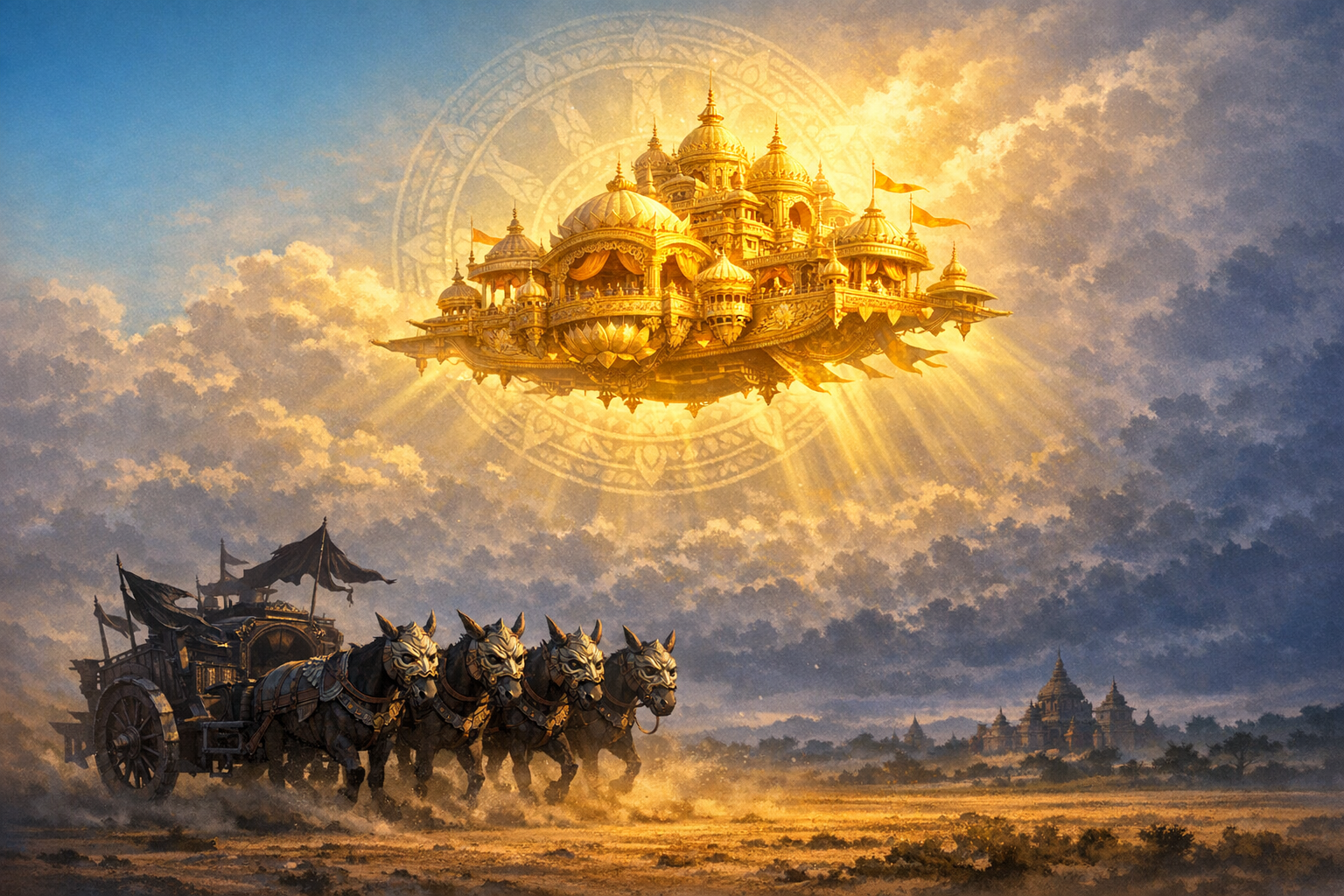
Few images in the Hindu epics evoke as much wonder and unease as the Pushpaka Vimana and the fearsome vehicles associated with Ravana in the Ramayana. The very juxtapositionan ethereal aerial chariot on one hand and a war-cart drawn by mules with faces of piśācas on the othercreates a powerful dialectic between splendor and terror. An academically careful reading across textual traditions shows how these motifs function both as narrative devices and as sophisticated symbols within Ancient Hindu Texts.
The central questions guiding a close study are straightforward: What does Valmiki’s Ramayana actually say about the Pushpaka Vimana? Where do references to mule-drawn, piśāca-faced teams appear? And how should these images be interpreted in light of dharma, aesthetics, and the wider family of dharmic traditions, including Buddhism, Jainism, and Sikhism?
Across the Sanskrit Ramayana attributed to Valmiki, the Pushpaka Vimana is introduced as a marvelous vimana originally crafted by Viśvakarma for Kubera and later seized by Ravana. It is consistently depicted as an aerial car or palace that moves without the need for animals, accommodates many passengers by expanding or contracting, and finally returns to Kubera after Ravana’s fall. The narrative peak of this motif appears when Rama, Sita, and Lakshmana return to Ayodhya aboard Pushpaka, underscoring royal restoration and cosmic order.
In contrast, the mule-drawn vehicle with ghastly, piśāca-like visages belongs to descriptions of Ravana’s war-chariot during the Yuddha Kāṇḍa battle sequences. Here the imagery is terrestrial, martial, and deliberately unsettling. Some southern recensions and regional retellings (for example, in Tamil and other South Indian literary and performative traditions) accentuate this grotesquerie by yoking Ravana’s battle-cart to mules or donkey-like beasts with demon-like faces. This accentuation serves an aesthetic and moral purpose: to render adharma viscerally visible.
The first technical clarity, therefore, is textual: the Pushpaka Vimana and the mule-drawn war-chariot are distinct vehicles serving different narrative functions. Pushpaka is an aerial conveyance symbolizing legitimacy, abundance, and cosmic sanctionespecially when it carries Rama. By contrast, Ravana’s grim battle-chariot is an instrument of coercive power in the mortal realm, marked by images designed to invoke raudra (fury) and bhayānaka (terror) rasa in classical aesthetics.
Why mules? In Sanskritic imagination, a mulebeing a hybridoften signifies force without fecundity: energy that moves but does not generate rightful continuities. Such a symbol maps onto Ravana’s projectimmense strength yoked to ends barren of dharma. The choice of a mule rather than a noble horse or auspicious animal communicates a quiet verdict on the quality of will propelling the chariot.
Why piśāca-like faces? In the epics and Puranic literature, piśācas evoke predatory appetites, liminal spaces, and unassimilated fear. Ghoulish visages on draft animals recast the very engine of motion as one driven by appetite, intimidation, and the consumption of life. The chariot thus becomes a mobile allegory of adharmaprogress powered by terror rather than by legitimate authority.
Together, mule bodies and piśāca faces frame a composite symbol: hybridized force animated by devouring desire. The image works as an ethical x-ray of Ravana’s kingship. It also spirals into the psychology of warfare in the Ramayana, where morale, spectacle, and fear are not peripheral details but essential features of political violence and statecraft within the epic’s moral universe.
This moral psychology is intelligible through the guṇa vocabulary familiar from Hindu philosophy. The mule suggests tamas and agitated rajasheavy, uncreative propulsion and restless ambitionwhile the piśāca visage signals unrefined craving. Set against Rama’s alignment with sattva and righteous order, the battlefield becomes a theater of inner energies externalized as vehicles. This neatly complements the classical chariot-of-the-mind metaphor known from the Upanishadic tradition, where the rider, charioteer, reins, and horses encode faculties of self, intellect, mind, and senses.
Placing these motifs within the wider dharmic family highlights shared ethical intuitions. In Buddhism, Mara’s army and the kilesas (defilements) dramatize how fear and craving mobilize suffering; in Jainism, the kashāyas (passions) and discussions of raudra dhyāna anatomize violence in thought and action; in Sikh thought, the five thieves and the pull of haumai map the same terrain of misdirected force. The Ramayana’s mule-and-piśāca imagery thus converses naturally with dharmic analyses of mind and morality, underscoring unity of insight across traditions even as idioms differ.
Textual pluralism also explains how modern retellings sometimes conflate Pushpaka with Ravana’s mule-drawn war-car. Southern vernacular Ramayanas and performative artsYakshagana, Kathakali, and regional koothu formsare adept at intensifying visual cues to communicate rasa to audiences. Where Valmiki emphasizes Pushpaka’s marvel and separate descriptions of battle-carts, later traditions may reweave motifs for dramatic coherence, never losing sight of the ethical contrast between Rama’s legitimacy and Ravana’s terror.
This brings the discussion to the modern fascination with “ancient aeronautics.” Philologically, vimāna in Sanskrit denotes a wide spectrumfrom palace and shrine to elevated carriage and aerial car. In the Ramayana, Pushpaka is an “aerial chariot” in narrative terms; the text is not a technical manual but a sacred epic (itihāsa) deploying wonder to mark dharmic reversal and royal restitution. A responsible reading honors the epic’s genre: symbolism and theology first, then technology as a secondary, speculative layer.
From a narrative-design viewpoint, Pushpaka functions as a litmus for legitimacy. In Ravana’s hands, it is a trophy of usurpation; in Rama’s hands, a vehicle of homecoming. That same binary animates the ground war: a grotesque cart fuels dread, whereas the chariot driven by Matali for Rama (borrowed from Indra) carries an aura of rightful sovereignty. Vehicles become mobile verdicts about their masters’ alignment with dharma or adharma.
Readers encountering these scenes for the first time often report a dual response: awe at the Pushpaka Vimana and disquiet at the piśāca imagery. That very affective split is purposeful. Wonder prepares the mind to recognize restoration and grace; disquiet sharpens ethical discrimination. In this way, Ramayana symbolism operates not only as literature but also as moral pedagogyengaging emotion to refine judgment.
The imagery’s durability is evident in South Asian visual culturetemple murals, illustrated palm-leaf manuscripts, and regional performance. Artists and poets repeatedly seize upon the contrast between luminous ascent and monstrous propulsion to teach the difference between power sanctified by dharma and power swollen by appetite. The lesson is pan-dharmic: strength is not intrinsically virtuous; the will that directs it determines its moral valence.
To summarize the scholarly takeaways for students of Hindu epics and comparative religion: Pushpaka Vimana and Ravana’s mule-drawn war-chariot are distinct textual entities; the former is a celestial, self-propelled vimana linked with rightful order, the latter a battlefield instrument deliberately marked with hybrid and ghoul-like signs of misdirected force. The mule and piśāca motifs are not gratuitous horror but tightly designed symbols that align with classical aesthetics (rasa) and ethics (dharma/adharma).
Viewed through a dharmic unity lens, these motifs invite a shared reflection across Hinduism, Buddhism, Jainism, and Sikhism: How are personal and political vehicles in one’s lifeinstitutions, technologies, ambitionsbeing “drawn”? By clarity, compassion, and restraint, or by hybridized cravings and intimidation? The Ramayana’s answer is perennial: align motion with meaning, means with ends, and force with dharma.
As a practical reading guide for contemporary audiences: when a tradition emphasizes mule-drawn, piśāca-faced steeds, it is heightening the sensory grammar of adharma. When it foregrounds Pushpaka in Rama’s return, it is celebrating the restoration of just order. Across versionsValmiki’s Ramayana, southern vernacular texts like Kambaramayanam, and regional performancesthe core ethical architecture remains stable even as imagery adapts to cultural and linguistic contexts.
In this way, the fearsome chariot and the miraculous vimana are not contradictory; they are complementary mirrors in which the epic shows how civilizations rise or fall with the quality of forces they harness. The lesson endures for readers of the Ramayana and for all who seek unity of insight across dharmic traditions: the true vehicle is the one guided by dharma.
Inspired by this post on Hindu Blog.