Sonthalso locally known as Chaitr Sankratmarks the beginning of the Chaitra month in the Kashmiri Hindu calendar (Saptarshi Panchang). In 2026, Sonth occurs on 14 March (India), aligning with the sensory and symbolic onset of spring across the Kashmir Valley. Beyond a calendrical transition, Sonth frames a contemplative reset: families revisit the almanac, refresh household rhythms, and reaffirm dharmic values that resonate across Hindu, Buddhist, Jain, and Sikh traditions.
In the Saptarshi Panchang (often called the Laukika or LK reckoning), months are solar and commence with a saṅkrāntiSurya’s sidereal ingress into a zodiacal sign. Chaitra thus begins when the Sun enters Meena (Pisces) in the nirayana (sidereal) framework. This typically falls in mid-March; for 2026, panchangam computations place the transition on 14 March in Indian Standard Time, with minor clock variations depending on the almanac used. The practice is astronomically grounded yet culturally experienced as the Valley’s blossoms, light, and lengthening day harmonize with the month’s first sunrise.
The term “Saptarshi” recalls the ancient civilizational memory of the Seven Sages; in Kashmir, this calendar has historically ordered social, ritual, and agrarian life. While many Indian regions follow lunisolar schemes keyed to the new moon or full moon, Kashmir’s Laukika system honors solar month starts at saṅkrāntis. Sonth, therefore, precedes the well-known Navreh (Kashmiri New Year), which falls on Chaitra Shukla Pratipada in the lunisolar count. Together, Sonth and Navreh create a season of renewal: first the solar cue to spring’s arrival, then the lunar-hinged inauguration of the new year.
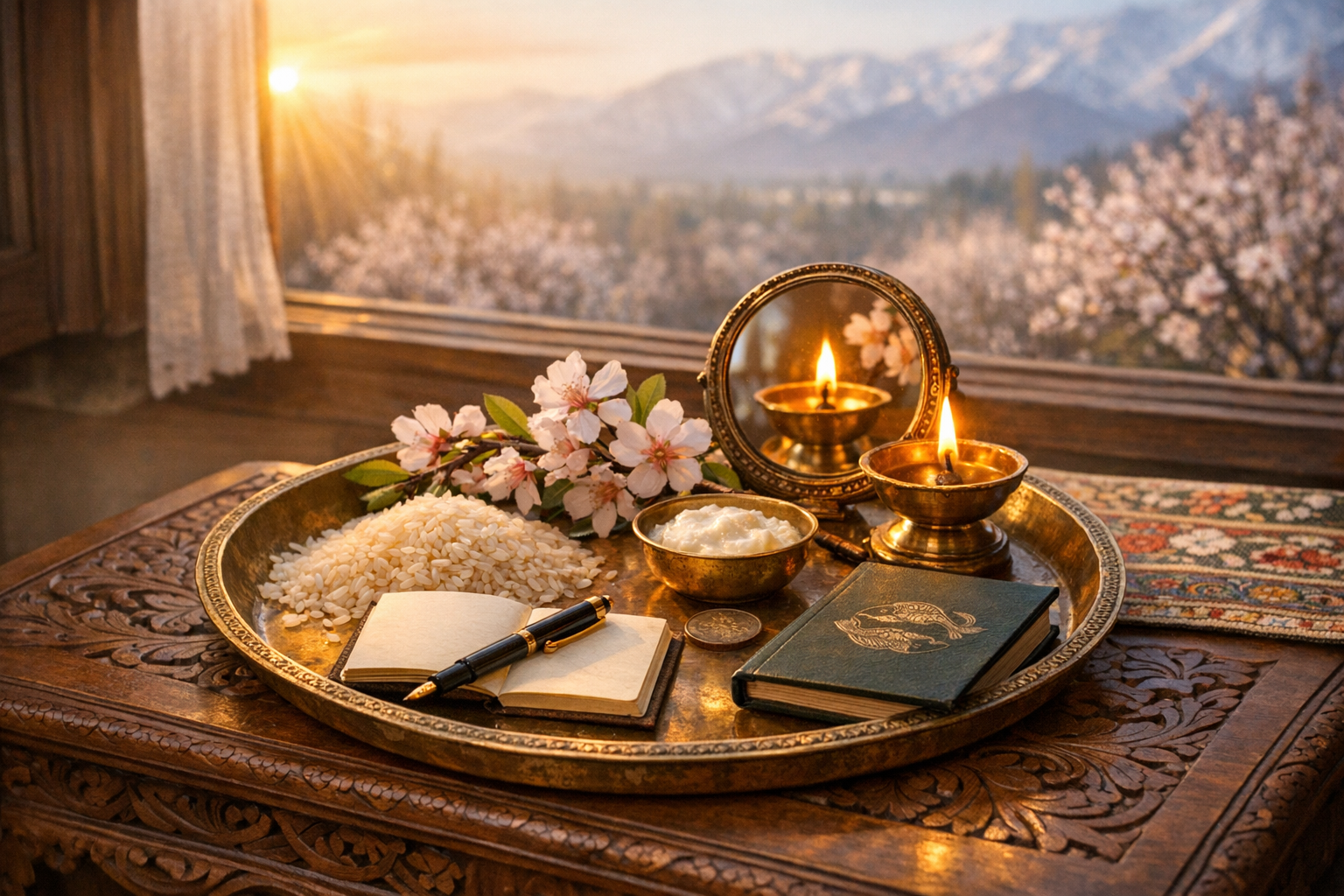
Ritual memory gives Sonth its intimacy. A distinctive custom is the preparation of a ritual thaal (ceremonial plate) curated the night before and seen at dawn. Families assemble auspicious elementsgrains (often rice) for sustenance, dairy (curd) for purity, a coin for prosperity, a pen or book for learning, a small mirror for self-reflection, fresh flowers or a sprig to signal new growth, a lamp for luminosity, and the new panchang (almanac) to align with cosmic time. Variations by household are common and respected; the core intent remains to “see” abundance, clarity, and right direction at first light.
The dawn sequence typically emphasizes cleanliness and clarity: homes are tidied, a lamp is kindled, and brief japa, stotra, or simple contemplation sanctifies the threshold of the month. Panchanga darshanaconsciously opening or viewing the almanachelps align daily choices with the cosmic clock. Offerings to the household deity (Kula Devata) and reverence to elders integrate personal sankalpa (resolution-setting) with intergenerational continuity.
Seasonal texture anchors the observance. In Kashmir, almond orchards famously signal spring; the Badamwari bloom in Srinagar has long been an emblem of Sonth’s mood of awakening. Diaspora families often bring this sensibility indoors with spring flowers, fresh greens, and sattvic foods prepared in gratitude for the new month. Community gatheringswhere possiblewelcome conversation, poetry, and music that braid cultural memory with present belonging.
Intertradition resonance is both historical and living. Across the broader Indic world, spring ushers in cognate milestones: Gudi Padwa and Ugadi mark the lunisolar year’s start in several regions; Mahavir Jayanti (in Chaitra) centers Jain contemplative ethics; the Theravada Buddhist New Year and Sikh Vaisakhi arrive in mid-April, uniting communities around renewal, seva, and gratitude. Sonth stands comfortably within this dharmic tapestry, inviting appreciation for diverse calendars that nevertheless speak a shared language of seasonal rebirth and ethical recommitment.
For household practice in 2026, a simple, tradition-aligned approach is effective. First, note the local saṅkrānti date from a reliable panchang (14 March 2026 in India; diaspora observance may adjust by time zone). Second, prepare the thaal on the eve of Sonth with items meaningful to the family’s lineagegrains, dairy, coin, book or pen, mirror, flowers or a sprig, lamp, and the year’s panchang. Third, at dawn, bathe, light a lamp, offer a brief prayer or reading, and consciously view the almanac. Finally, share a wholesome meal, extend greetings to relatives, and consider modest daan (charity) aligned with local needs.
Technical note for panchang readers: saṅkrānti is determined using the Sun’s nirayana (sidereal) longitude. Chaitra begins when Surya’s sidereal longitude enters Meena; exact timings vary with the ayanāṃśa adopted (e.g., Lahiri, Raman, or Krishnamurti) and with computational conventions. These differences may shift the saṅkrānti clock by minutes to (rarely) over an hour. For purposes of vrata and domestic observance, standard local panchang guidance is recommended; for temple rites, follow the temple’s official nigamana (calendar) to maintain sampradaya unity.
Common questions arise about Sonth’s relationship to Navreh. Sonth (Chaitr Sankrat) is the solar threshold of the Chaitra month in the Saptarshi Panchang. Navreh is the Kashmiri New Year tied to the lunisolar cycle and begins on Chaitra Shukla Pratipada. In many households, the same thaal tradition bridges both observances in close succession, expressing a unified intention across the solar and lunar markers of time.
Another recurring query concerns regional alignment. Sonth’s mid-March timing reflects Kashmir’s solar-month system, whereas other regions begin their year on different astronomical cues (e.g., lunisolar Pratipada near late March or April, or solar Mesha Sankranti in mid-April). Rather than contradiction, this diversity exemplifies a coherent civilizational design: multiple valid doorways into the same cycle of renewal.
In cultural terms, Sonth is as much about stewardship as celebration. Spring’s return highlights interdependence with land and water; many families incorporate mindful consumption, reduced waste, and support for local producers into their observance. Such practices extend dharma from altar to ecosystem, harmonizing ritual with responsibility.
In 2026, observing Sonth on 14 March with a thoughtfully prepared thaal, a brief dawn practice, and an informed reading of the panchang can cultivate inner clarity and communal connection. Rooted in Kashmiri heritage yet resonant across dharmic traditions, Sonth’s promise is perennial: to see the first light of the month with intentionand to carry that light into study, service, and shared wellbeing throughout Chaitra.
Inspired by this post on Hindu Pad.