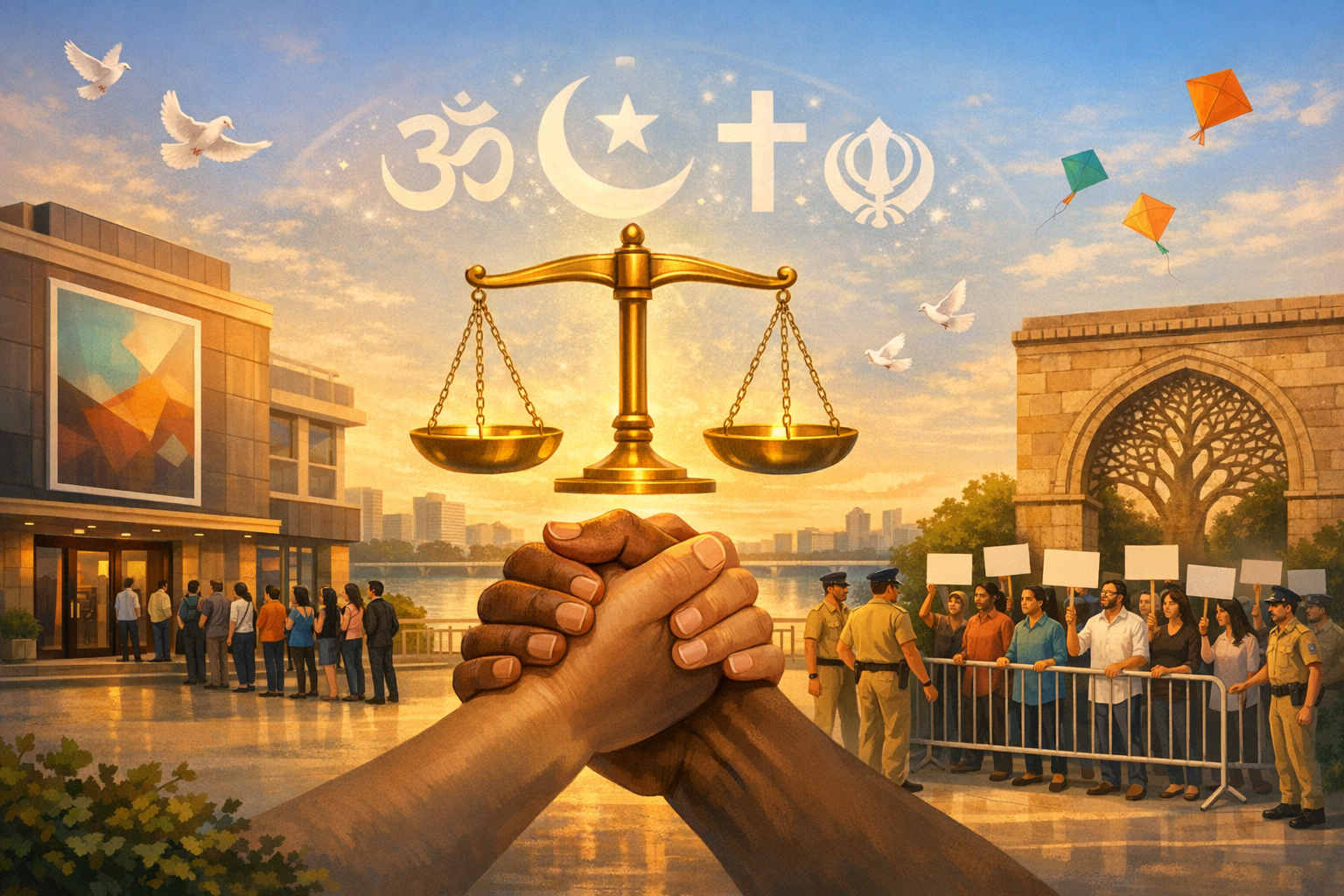
Protests in Ahmedabad over the screening of The Kerala Story 2 – Goes Beyond and concerns about an interfaith relationship have reignited a familiar yet deeply sensitive debate in Gujarat: how to uphold freedom of expression and personal liberty while nurturing communal harmony and public safety. Demonstrations associated with Vishwa Hindu Parishad (VHP) and Bajrang Dal echoed the sentiment, “We Don’t Want ‘Kerala Story’ in Gujarat,” framing the moment as a test of constitutional balance, ethical responsibility, and community trust.
The public discussion around The Kerala Story franchise has, since its inception, centered on contested depictions of religious conversion, women’s safety, and extremist recruitment. Across India, past litigation and administrative actions have underscored a core principle: once a film is certified by the Central Board of Film Certification (CBFC) under the Cinematograph Act, 1952, states are expected to maintain law and order rather than impose blanket prohibitions. The Supreme Court’s consistent jurisprudence, including S. Rangarajan v. P. Jagjivan Ram (1989), affirms that apprehension of disorder cannot be a ground to suppress certified expression; the state’s duty is to prevent disorder, not silence speech.
Recent controversies around screenings of politically sensitive films further clarified this principle. In 2023, when certain states explored restrictions on the earlier film, the Supreme Court emphasized that the appropriate response is robust policing and preventive measures, not prior restraint. This case law context is essential in Gujarat today: public order management must be precise and proportionate, ensuring both exhibition rights and audience safety.
At the same time, protests—peaceful, lawful, and non-intimidatory—are themselves protected under Article 19(1)(b) of the Constitution, subject to reasonable restrictions. The threshold that separates constitutionally protected dissent from unlawful coercion is defined not by the viewpoints expressed, but by conduct: obstruction, intimidation, incitement, or property damage invite penal consequences under the Indian Penal Code and allied statutes. This legal line is critical to sustain both civic participation and public tranquility.
The parallel concern raised in Ahmedabad over an interfaith relationship reflects a broader national discourse on autonomy, consent, and community anxieties. The Supreme Court in Shafin Jahan v. Asokan K.M. (2018) reiterated that adult individuals possess the constitutional right to choose a partner and faith, implicating Articles 21 and 25. India’s Special Marriage Act, 1954, explicitly provides a secular civil pathway for interfaith unions, while penal and anti-trafficking laws address any coercion, fraud, or exploitation regardless of religious identity.
Gujarat’s legal framework includes the Gujarat Freedom of Religion Act, 2003, amended in 2021, which addresses conversion by fraud, coercion, or allurement. Portions of the 2021 amendment—particularly those read as presuming conversion by marriage—have faced judicial scrutiny, including interim observations and stays by the Gujarat High Court. The evolving jurisprudence signals a calibrated approach: genuine coercion is punishable, but adult choice in marriage and belief remains protected. Notably, the phrase “love jihad” has no standing in Indian criminal law; crimes are investigated and prosecuted on the basis of evidence of illegality, not on communal attributions.
For many families, the images of police presence outside a cinema or the tumult of street slogans evoke anxieties that exceed the particulars of any single film or couple. Parents worry about the safety of young women and men navigating complex social spaces; interfaith couples fear stigma and harassment; community elders fear fractures in already fragile trust. These emotions are real and deserve a response that is principled, lawful, and compassionate.
Empirical research offers helpful orientation. The Pew Research Center’s 2021 study on religion in India indicates that interfaith marriages remain relatively uncommon nationwide, and community boundaries in everyday life are often carefully maintained. Where wrongdoing occurs—whether in the form of grooming, trafficking, intimidation, or familial violence—criminal law already provides remedies. A data-grounded approach cautions against generalizing isolated offences to entire communities and instead prioritizes targeted enforcement against specific illegal acts.
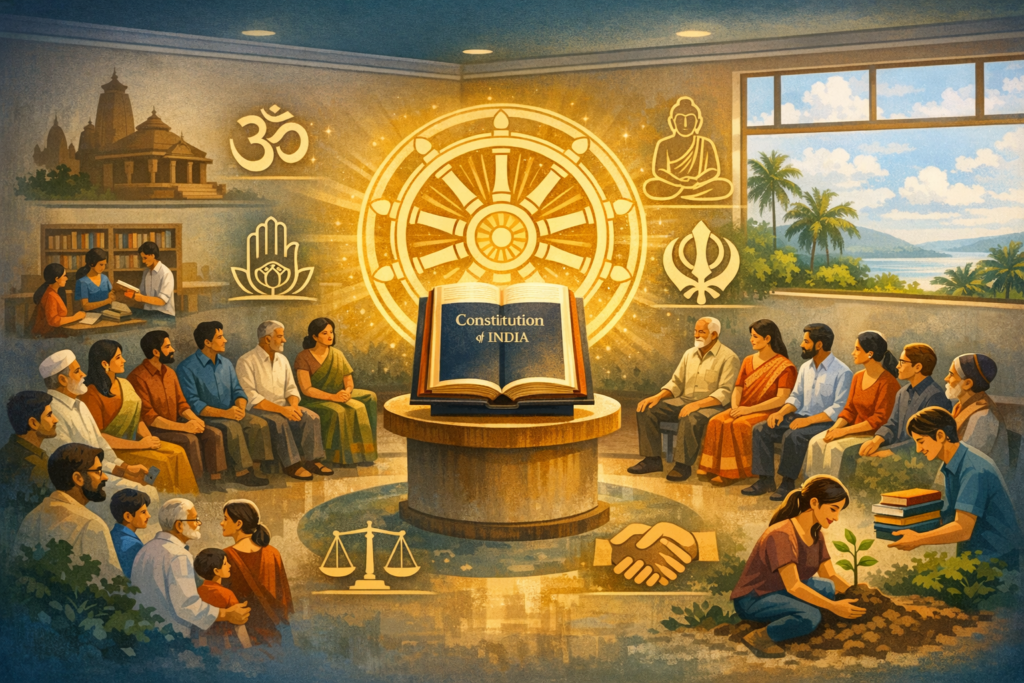
From a dharmic perspective, pluralism is not an abstract aspiration but a civilizational habitus. Hindu, Buddhist, Jain, and Sikh traditions share an ethical insistence on ahimsa, compassion, truthful speech, dignity, and the primacy of conscience. Sarva dharma sambhava—the respectful acknowledgment that different seekers may walk different paths—invites communities to express their convictions while refusing coercion. Within this shared ethos, concerns about exploitation or misinformation are best addressed through dialogue, education, and due process rather than through stigma or collective suspicion.
Institutionally, three pillars shape responsible outcomes in Gujarat. First, law enforcement must adopt a rights-respecting but firm posture: safeguarding certified screenings; intervening swiftly against intimidation; and facilitating peaceful, pre-notified assemblies. Second, civic forums—temples, gurdwaras, viharas, derasars, neighborhood associations, and educational institutions—can host structured interfaith dialogues, legal literacy sessions (on the Special Marriage Act and anti-coercion laws), and confidential counseling services for couples and families. Third, media literacy initiatives should equip citizens to evaluate claims, distinguish between evidence and rumor, and report malicious content.
Operationally, district administrations and Gujarat Police can rely on well-tested event protocols for potentially high-tension screenings: pre-screening coordination among exhibitors, law enforcement, and civil society; clear ingress and egress plans; rapid rumor-response cells; and a public communication strategy that reassures viewers and protestors alike that rights will be protected and violations prosecuted. These are practical, scalable measures that prevent small sparks from becoming conflagrations.
Protest organizers also carry a civic responsibility to translate conviction into civic virtue. Public charters of nonviolence, marshals trained to de-escalate, and zero tolerance for intimidation help keep demonstrations within constitutional bounds. This is not merely a matter of legal compliance; it is the ethical expression of dissent that strengthens, rather than frays, the social fabric.
Equally, exhibitors and producers can contribute to a responsible media ecosystem. Compliance with CBFC guidance, content advisories, age-gating, and voluntary post-screen discussions with subject-matter experts and community representatives demonstrate cultural sensitivity without capitulating to extra-legal censorship. When controversy is anticipated, advance engagement builds trust and reduces surprise.
For interfaith couples, practical support matters. Legal-aid hotlines, safe counseling spaces, discreet mediation with families, and liaison officers within police stations can lower the temperature around high-emotion disputes. Where credible threats arise, swift protective measures under the CrPC and allied statutes help preempt harm. Trust grows when the system is seen to work predictably for everyone.
In this moment, Gujarat has an opportunity to model a dharmic approach to pluralism that is both principled and pragmatic. The question is not whether citizens may disagree about a film or a relationship; they will. The question is whether disagreement can be channeled into lawful, dignified participation that strengthens collective security, respects personal freedom, and expands the space for truth-seeking without fear.
A path forward emerges from first principles: free expression protected by law; protests conducted with restraint; crimes punished based on evidence; and dialogue pursued in good faith across difference. The shared teachings of Hinduism, Buddhism, Jainism, and Sikhism point to the same horizon—compassion without naivety, courage without hostility, and vigilance without prejudice.
Ahmedabad’s protests will likely pass; what endures is the memory of how communities handled the heat of the moment. By foregrounding constitutional commitments and dharmic values, Gujarat can safeguard both interfaith harmony and individual rights—transforming a flashpoint into a living lesson in unity amidst diversity.
This approach does not endorse any specific filmic narrative or personal choice; it endorses the framework that allows many narratives and many choices to coexist under the rule of law. That, ultimately, is the surest path to security, dignity, and the flourishing of all.
Inspired by this post on Struggle for Hindu Existence.