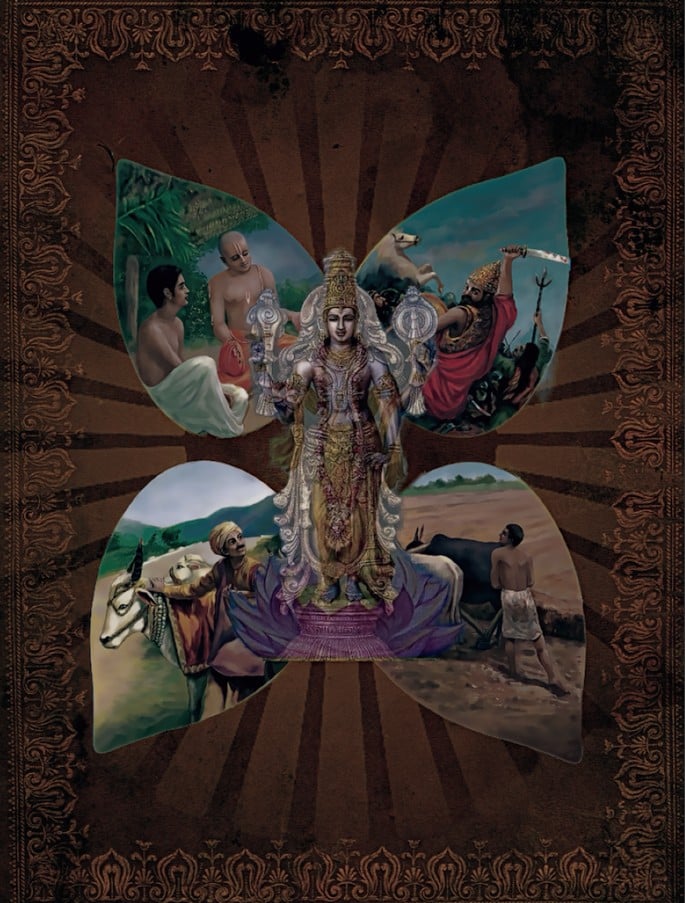
The Kathasaritsagara, the vast “ocean of stories” compiled in 11th-century Kashmir by the Sanskrit poet Somadeva, stands at the confluence of literary brilliance and spiritual instruction. Drawing on the lost Bṛhatkathā tradition, it interweaves entertainment with ethics, offering narrative frameworks through which readers encounter foundational tenets of Hindu philosophydharma, karma, and the quest for liberation (mokṣa). Within this corpus, the tale of Kadaligarbha, the “plantain-born maiden,” exemplifies how miraculous origins and mortal trials are harnessed to illuminate the inescapable workings of karma and the salvific power of detachment (vairāgya).
Kadaligarbha’s epithetliterally “one gestated in a kadalī (plantain) womb”signals a liminal birth outside ordinary lineage, a literary marker that her life will unfold at the threshold of the human and the divine. Across recensions and retellings, narrative specifics may vary, yet the structural constants endure: a wondrous appearance, the onset of worldly entanglements, the surfacing of karmic residue from prior existences, and the hard-won clarity that flows from ethical steadiness and non-attachment. Read in context, the tale functions as a didactic mirror, reflecting both the frailty of human clinging and the resilience born of discernment (viveka).
Textually, the Kathasaritsagara belongs to a pan-Indic narrative ecosystem that includes Kshemendra’s Bṛhatkathāmañjarī; both are heirs to the older Bṛhatkathā cycle. This shared lineage explains the recurrence of motifsmiraculous births, prophetic utterances, and reversals of fortunethat serve as vehicles for moral causality (karman). Somadeva’s craft is not merely to delight but to stage philosophical inquiry through character and plot, allowing readers to test the logic of dharma against the stubborn facts of saṃsāra.
Philologically, kadalī (plantain/banana) and garbha (womb) evoke a dense field of “Banana Symbolism” in South Asian thought. The plantain is auspicioustied to fertility, prosperity, and sacred hospitalityyet its trunk, lacking heartwood, often symbolizes insubstantiality. This dual valence is exploited across Hindu, Buddhist, and Jain literature to contrast the sheen of appearances with the hollowness of grasping. In Kadaligarbha’s case, the plantain-born origin casts her as both boon and warning: a bearer of grace whose life also cautions against mistaking transient forms for abiding essence.
In narrative outline, Kadaligarbha’s divine emergence precipitates human complications. Beauty attracts rivalry; vows collide with desire; chance encounters unveil unspent consequences. The tale underscores a classical insight: present virtue alone does not instantly erase past causality. Instead, prārabdha karmathe portion of accumulated action already ripened for fruitionmust be lived through. Counsel from sages and encounters with suffering gradually reorient her gaze from outcomes to conduct, from possession to presence. Whether the ending in a given retelling leans toward wise governance, domestic harmony, or renunciant peace, the through line remains the same: freedom grows as attachment loosens.
From a technical standpoint, the tale is an elegant primer on the classification of karma in Hinduism. Traditions commonly distinguish sañcita (the storehouse of past actions), prārabdha (that subset already bearing fruit in the present life), and āgāmi/kriyamāṇa (new actions generating future results). In this schema, wisdom (jñāna), devotion (bhakti), and right action (karma-yoga) purify intention and may “burn” unfructified sañcita, yet prārabdha ordinarily unfolds until exhausted. Kadaligarbha’s trials dramatize this inexorability: fate is not fatalism but the lawful maturation of seeds previously sown, countered not by denial but by disciplined response.
The doctrinal remedy is vairāgyadetachment that is neither indifference nor withdrawal but mastery over craving. Patañjali’s Yogasūtra (1.15) defines it as dispassion toward seen and heard objects (dṛṣṭānuśravika-viṣaya-vitṛṣṇasya), a stance that quiets compulsive grasping. The Bhagavad Gītā refines this into an ethic of engaged equanimity: act without fixation on results (niṣkāma-karma), thereby dissolving the inner economy of hope and fear. In Kadaligarbha’s world, detachment does not erase obligations; it clarifies them, allowing dharma to be performed without the haze of possessiveness.
This leitmotif resonates across dharmic traditions. Buddhism repeatedly invokes the plantain trunk to exemplify insubstantiality: like a kadalī without core, clung-to aggregates (skandhas) disappoint. Jain philosophy complements the lesson by identifying karmic “bondage” (bandha) with acts saturated in attachment and prescribing aparigraha (non-possession) as a practical antidote. Sikh teachings emphasize living in harmony with hukam (cosmic order) while cultivating vairāginner detachment amid worldly responsibilities. Read together, these perspectives converge on a common axiom: freedom is relational, not escapist; it flowers when grasping withers.
Gendered dimensions add further texture. The Kathasaritsagara often entrusts women protagonists with the narrative burden of discernment; they become mirrors for societal expectations and metaphors for self-knowledge. Kadaligarbha’s arc thus functions as more than ornament; it interrogates the economy of desire and fear that constrains agency. Her transitionsfrom wonder to ordeal, from confusion to claritychart an interior pilgrimage analogous to the yogic movement from the gross (sthūla) to the subtle (sūkṣma).
Ritual culture reinforces the symbolism. Across India, plantain stems mark auspicious thresholds at weddings and temple festivals, and in eastern regions the Navapatrikāpopularly manifested as the sari-draped Kola Bouincorporates the banana plant as a living emblem of fertility and abundance. Hospitality on banana leaves, temple adornment with kadalī stems, and agrarian proverbs about the banana’s bounty create a semantic field that the tale reconfigures: prosperity is real but provisional; without inner heartwoodethics, insight, compassionthe edifice remains hollow.
As a work of moral psychology, the story maps how raga–dveṣa (attraction–aversion) entangles attention and inflames misperception. Practical disciplines cut new grooves: svādhyāya (self-study) loosens rigid self-narratives, prāṇāyāma steadies affect, dāna (generosity) counters possessiveness, and mindful speech disrupts cycles of harm. Readers often recognize in Kadaligarbha’s reversals the contours of their own livestimes when control was illusory and only posture, not outcome, lay within reach. The narrative does not prescribe uniform renunciation; it recommends clarity that can inhabit any role.
Historically informed reading acknowledges variation among manuscripts and later retellings. Some versions emphasize the theophanic birth and eventual household harmony; others highlight renunciation and contemplative stillness. This plasticity is a hallmark of the Kathasaritsagara and its sister traditions: the frame holds steadydivine birth, karmic unfolding, ethical insightwhile cultural horizons and pedagogic needs shape the denouement. The result is not inconsistency but pedagogical range.
For contemporary seekers, the value proposition is precise. The tale explicates Hindu philosophy while remaining accessible as narrative; it offers a comparative bridge to Buddhist, Jain, and Sikh reflections on karma, aparigraha, anattā, and hukam; and it situates “detachment” as a disciplined reorientation rather than escape. In a plural spiritual landscape, Kadaligarbha’s lesson advances a unifying ethic: diverse paths converge when grasping relaxes and responsibility deepens.
Ultimately, Kadaligarbhaplantain-born yet wisdom-maturedstands as a luminous emblem in the Kathasaritsagara: appearances may dazzle, but only heartwood endures. The narrative invites a shift from fascination with origin stories to commitment to ethical practice. Karma is relentless, yet bondage is not inevitable; vairāgya and dharma together carve a way through the thicket of saṃsāra. In that passage from mirage to meaning lies the story’s enduring power.
Inspired by this post on Hindu Blog.