Kalabhairava, the fierce manifestation of Lord Shiva, is revered as the embodiment of time (Kala) and its dissolution. Across Hindu traditions and related dharmic frameworks, this form represents the uncompromising force of truth and justice that dispels ignorance and safeguards sacred order. The iconography of Kalabhairava—rich with layered symbolism—functions as a visual theology and a practical guide for seekers navigating impermanence, ethical action, and inner discipline.
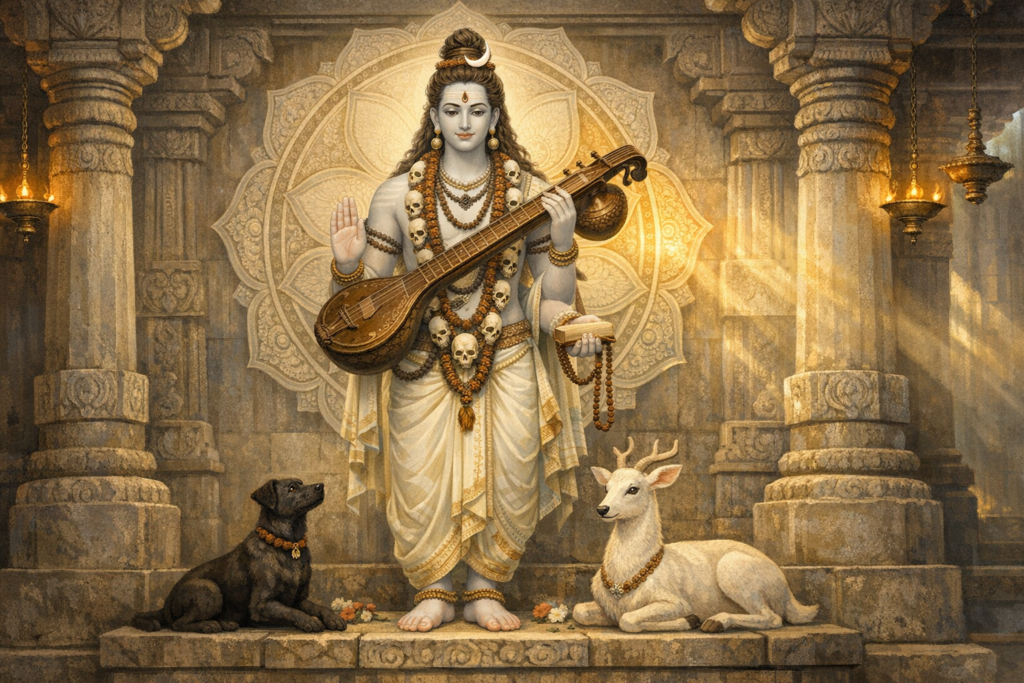
In iconographical and ritual manuals—such as select Agamas, Tantras, and Shilpa Shastra traditions—Kalabhairava is described with a powerful, awe-inspiring presence. He is often depicted with a dark or ash-smeared body, fiery hair, and three eyes signifying omniscience. The form may be nude or clad in a tiger skin, adorned with a garland of skulls (mundamala), serpentine ornaments, anklets, and a belt of bells. He appears with four or eight arms, carrying emblematic attributes: the trident (trishula), drum (damaru), sword (khadga), skull-bowl (kapala), noose (pasha), and goad (ankusha). His vahana is the dog (shvana), and as Kshetrapala (guardian of sacred space), he stands at the liminal edge between the sacred and the worldly.
Each attribute encodes a distinct spiritual insight. The trishula signifies mastery over time and the three gunas; the damaru expresses the rhythm of creation and dissolution; the kapala symbolizes the offering of ego and the transformation of fear; the sword cuts through delusion; the noose and goad indicate restraint and guidance. The dog, steadfast and alert, embodies loyalty and vigilance, reminding devotees to guard inner boundaries with integrity. Collectively, these symbols invite contemplation on impermanence, disciplined awareness, and fearless truthfulness.
As guardian of Kashi (Varanasi), Kalabhairava is honored as the protector of the city’s sacred time and space. Ritual traditions, including observances like Bhairava Ashtami, emphasize his role in guiding ethical conduct and protecting pilgrims. References in the Skanda Purana and the devotional hymn Kalabhairava Ashtakam attributed to Adi Shankaracharya underscore the theological depth of this form. Beyond India, resonances appear in broader dharmic cultures: related fierce-protector motifs in Buddhist and Jain contexts emphasize discipline, fearlessness, and moral clarity; Sikh teachings on courage and justice echo the same ethical core. These convergences highlight shared values across Hinduism, Buddhism, Jainism, and Sikhism, strengthening inter-dharmic understanding.
Devotees frequently describe encounters with Kalabhairava’s image as both humbling and empowering: humbling, because time is absolute; empowering, because moral courage becomes non-negotiable. In meditative practice, contemplation on his iconography encourages steadfastness under pressure, clarity in decision-making, and acceptance of change. The fierce aesthetic is not cruelty but compassionate ferocity—energy directed toward removing obstacles and safeguarding dharma.
The ethical dimension is central. Kalabhairava’s role as boundary-keeper affirms the sanctity of commitments, communities, and sacred spaces. By guarding thresholds—temple gates, city limits, and inner moral frontiers—this form of Shiva reminds society that justice is an expression of compassion when it protects the vulnerable and curbs harm. Such symbolism offers a shared ethical language across dharmic paths, reinforcing unity through common principles.
For contemporary seekers, the iconography offers practical relevance. It models disciplined use of time, resilience amid uncertainty, and unwavering adherence to truth. In daily life, the trident can be read as a guide to balance thought, word, and action; the drum as a call to align with natural rhythms; the skull-bowl as a reminder to release egoic rigidity. In this way, a temple image becomes a living curriculum for mindful conduct and communal harmony.
Classical sources anchor these understandings. Descriptions in the Skanda Purana, Agamic and Tantric traditions, and Shilpa texts shape the form’s canonical features, while regional practices—especially in Kashi—animate them in pilgrimage, worship, and arts. Read together, text and image communicate a single message: Kalabhairava’s fierceness is ultimately protective, calling all to ethical clarity and the courageous pursuit of wisdom.
Kalabhairava thus stands as a unifying symbol—an ever-relevant reminder that time is sacred, truth is non-negotiable, and justice is compassionate. Engaging this iconography invites seekers across Hindu, Buddhist, Jain, and Sikh traditions to recognize shared values and to cultivate vigilance, humility, and inner freedom in the service of the common good.
Inspired by this post on Hindu Blog.