Set amid the fertile Kaveri delta of Tamil Nadu, the Sri Akhilandeswari Samedha Sri Sundareswara Swamy Temple at Tiruloki (also referred to as Sundaresvarar Temple, Tiruloki) embodies the living continuity of Sanatana Dharma. The shrine venerates Shiva as Sundareswara (the Beautiful One) together with Akhilandeswari (She who rules the entire cosmos), inviting devotees to seek inner purification, clarity of purpose, and holistic well-being through darshan, ritual, and contemplative silence.
Within the broader dharmic ethos, temples function as crucibles of learning, ethics, and service. They integrate sacred geometry, liturgy, music, sculpture, and community life into a single, life-affirming practice. In this spirit, the Tiruloki temple welcomes pilgrims, students of art and architecture, and spiritual seekers alike, emphasizing values shared across Hinduism, Buddhism, Jainism, and Sikhismreverence for truth, compassion, self-discipline, and service (seva).
The paired deities articulate a profound theological synthesis. Etymologically, “Akhilandeswari” (Akhila + anda + ishwari) evokes the universal Mother who protects and nurtures all beings, while “Sundareswara” (from sundara, beautiful) signifies Shiva’s benevolent, auspicious presence that beautifies life through wisdom and grace. Together, they affirm the inseparability of consciousness (Shiva) and energy (Shakti) at the heart of Sanatana Dharma.
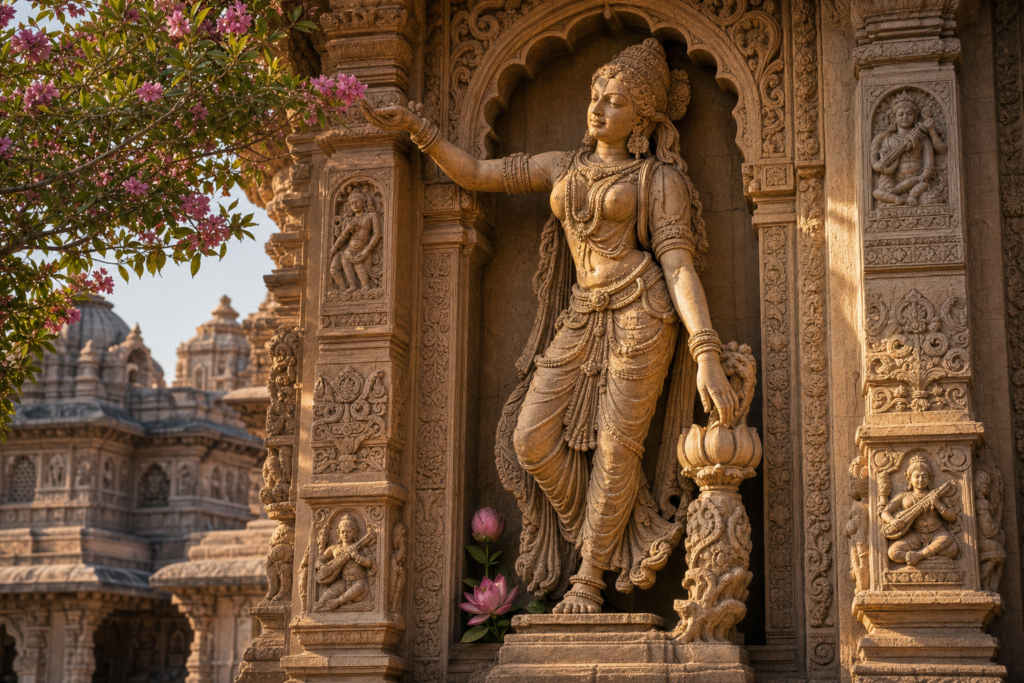
As in many Kaveri-delta shrines, architectural features at Tiruloki follow classical Dravidian canons: a sanctum (garbhagriha) typically aligned on an east–west axis, an antarala (vestibule), and mandapas for congregational worship, with Nandi seated on the main axis facing the linga. The temple’s base (adhisthana) and walls are commonly executed in granite in this region, with superstructures (vimana) often rendered in brick and lime-stucco; a metal kalasha crowns the vimana. A dvajasthambha (flagstaff) and bali-pitha (offering pedestal) complete the axial sequence inside the prakara (circumambulatory enclosure).
Shaiva iconographic grammar is usually present on the sanctum walls: Dakshinamurti on the southern niche (embodying Shiva as the silent teacher), Lingodbhava at the west (affirming Shiva’s aniconic infinitude), and Durga on the north (as protective Shakti). A Chandikeswara shrine near the northern corridor underscores ritual guardianship. Secondary shrines commonly include Ganesha, Subrahmanya with Valli and Devasena, Bhairava, Nataraja, and the Navagrahas.
In the Akhilandeswari shrine, devotees often encounter the compassionate iconography of the Goddess in abhaya–varada mudras (boon-bestowing assurance), richly adorned with flowers and kumkuma. The Devi’s sanctum complements the linga’s austere symbolism, reminding worshippers that insight (jnana) and compassion (karuna) must advance together for spiritual maturity.
Ritual life follows Shaiva Siddhanta Agamastexts such as the Kamikagama, Karana, and Suprabhedawhich prescribe daily and festival liturgies. Typical nitya-puja includes abhishekam (sacred bathing with water, milk, curd, honey, and sandal), alankaram (vesture and ornamentation), archana (recitation of divine names with flowers, often bilva leaves for Shiva), and deepa-aradhana (lamp offering). The sonic landscapemantra, bell, conch, and nagasvaramharmonizes with incense and lamp-light to cultivate attentiveness and inner stillness.
The festival calendar orbits around three focal arcs: Shiva, Shakti, and community. For Shiva, Maha Shivaratri is observed with night-long vigil, mantra-japa, and special abhishekams; monthly Pradosham on Trayodashi draws devotees seeking inner cleansing and renewed resolve; Arudra Darshan in the Tamil month of Margazhi venerates Nataraja’s cosmic dance; and Karthigai Deepam celebrates light’s triumph. Aippasi Annabhishekam (grain ablution) symbolically weaves agrarian gratitude into worship.
For the Goddess, Navaratri is marked by daily alankarams and recitations venerating Shakti’s many forms; Fridays in the month of Aadi hold special resonance for prosperity, protection, and spiritual resilience. These observances reinforce the temple’s role as a cultural and ethical anchor for surrounding communities.
Devotees frequently describe a palpable stillness during the evening deepa-aradhana as camphor flames rise before the linga and the Goddess. The experience is not merely aesthetic; it functions as contemplative training. People report leaving the sanctum with steadier breath, clearer priorities, and a renewed willingness to practice ahimsa, generosity, and self-restraint in daily life.
While detailed epigraphic records for Tiruloki are yet to be systematically published, the Kaveri delta is rich in Chola, Pandya, and Nayaka-era inscriptions documenting agrarian endowments, water management, and ritual patronage. Stylistic features observable across the regiongranite construction, sculpted devakoṣṭhas, and axial planningsuggest that the temple at Tiruloki stands within this larger architectural and historical continuum. Periodic kumbhabhishekam (consecration) at intervalstraditionally around twelve yearsmaintains the sanctity and structural integrity in line with Agamic canons.
Visitor flow typically aligns with trikaala (thrice-daily) puja rhythms: early-morning suprabhatam and abhishekam, midday offerings, and evening deepa-aradhana. Exact timings vary by season and administration; pilgrims are advised to confirm locally and arrive early for unhurried darshan. Simple, modest attire, silence within sanctums, and clockwise circumambulation (pradakshina) are observed as basic etiquette.
Tiruloki lies within the Thanjavur region’s well-connected temple circuit. The nearest major railheads are Thanjavur and Kumbakonam, with Tiruchirappalli (Trichy) serving as the closest major airport for domestic and international access. State highways and local roads provide reliable connectivity; autos and taxis are readily available from nearby towns. Pilgrims often combine a visit here with major Chola landmarks and Paadal Petra Sthalams across the delta.
For those new to Shaiva worship, a simple, meaningful sequence can include silent sitting before the linga, offering of bilva leaves with a sankalpa for inner clarity, recitation of the Mahamrityunjaya mantra, and a concluding pranam at Akhilandeswari’s sanctum seeking compassion and steadiness of mind. Prasadam typically includes vibhuti (sacred ash) and kumkuma, signifying purification and auspiciousness.
From a technical standpoint, the temple’s spatial grammar functions as embodied pedagogy. The garbhagriha symbolizes the heart-cave (dahara-vidya) where awareness abides; the mandapas host community learningmusic, discourse, and vratas; the prakara invites mindful walking meditation; and the alignment of shrines maps theological relationshipsShiva as guru (Dakshinamurti), Shiva as infinite (Lingodbhava), and Shakti as protective wisdom (Durga).
The temple’s sanctity also depends on environmental stewardship. Many Kaveri-delta shrines address water drainage, vegetation near foundations, lime-stucco conservation, and careful electrical retrofits to protect masonry. Visitors can support preservation by observing no-plastic protocols, handling lamps and incense safely, and respecting zones where photography is restricted to protect icons and murals.
The dharmic vision here is innately inclusive. Devotees from Hindu, Buddhist, Jain, and Sikh lineages will recognize shared disciplinesattention to breath, ethical vows, quiet contemplation, selfless service, and a pedagogy grounded in compassion. The temple thus stands not only as a Shaiva kshetra but also as a beacon for inter-dharmic understanding grounded in practice rather than polemic.
For scholars and students, Tiruloki offers a compact case study in Dravidian temple architecture, Shaiva Siddhanta ritualism, and the social history of the Kaveri delta. Future epigraphic surveys and conservation documentation would further clarify chronology, patronage, and craft lineages, enriching public knowledge while honoring local custodianship.
In sum, the Sri Akhilandeswari Samedha Sri Sundareswara Swamy Temple at Tiruloki unites metaphysics, ritual, architecture, and community into a luminous whole. Those who come in humilityseeking purification from inner afflictions and the strength to live ethicallyfind in its sanctum a steadying presence, in its Devi a compassionate guide, and in its rituals a time-tested method for personal and collective renewal.
Inspired by this post on Hindu Pad.