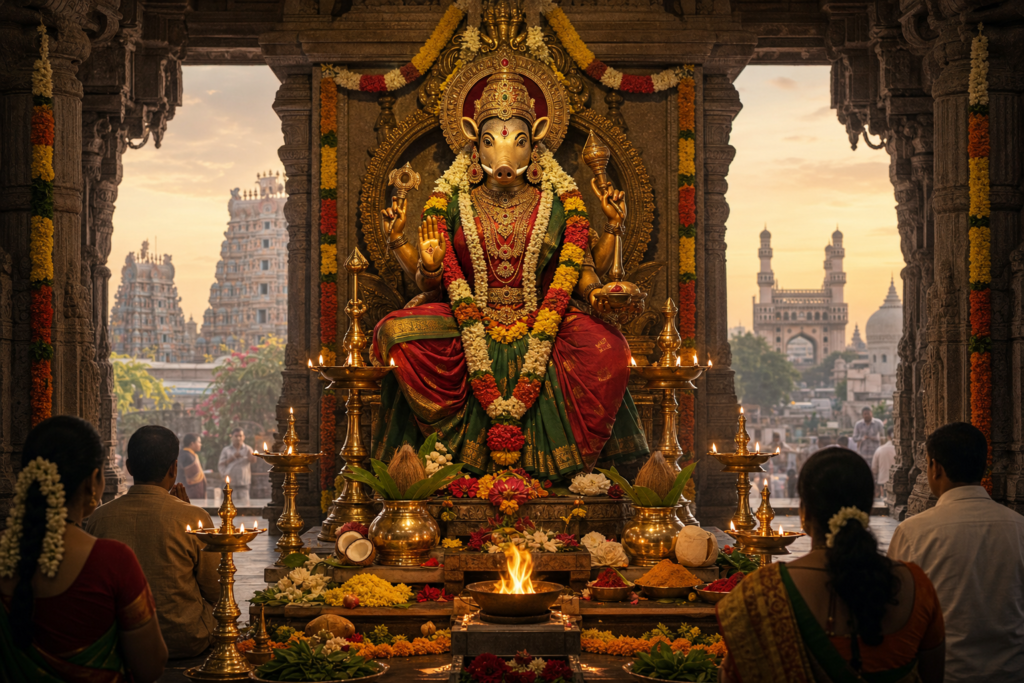
In Gujarat’s coastal imagination, Sikotar Maarevered also as Vahanvati Matastands as a luminous embodiment of sacred guardianship. As a Hindu Goddess closely linked with maritime protection, she is invoked by sailors, fishermen, and harbor-side communities who seek safe passage across the unpredictable sea. The reverence offered to this protective form of the Divine Mother reflects an enduring relationship between people and ocean, where devotion, duty, and daily coastal life converge.
Across Saurashtra and Kutch, communities historically engaged in maritime trade and fishingespecially Kharwa and Koli groupshave turned to Sikotar Maa for generations. Gujarat’s ports once anchored extensive Indian Ocean shipping, connecting local livelihoods to far-reaching trade networks. Within this broader maritime history, shrines dedicated to the goddess affirm a lived understanding that faith, skill, and sea knowledge work together to safeguard voyages.
Theologically, Sikotar Maa is venerated as a manifestation of Shakti, aligned with the protective and compassionate dimensions often associated with Durga and Devi. Her sphere of grace is the liminal zone where land yields to the sea, a threshold that demands humility and courage. In the wider dharmic ethos shared across Hinduism, Buddhism, Jainism, and Sikhism, there is a common recognition of nature’s sanctity and the moral responsibility to seek harmony with the environmentan ethic that contextualizes maritime devotion without presuming a single path.
Ritual life around Sikotar Maa emphasizes prudence before departure and gratitude upon return. Families prepare offerings such as coconuts, incense, and red cloth, and many tie protective threads before a voyage, treating the ship and its mast as bearers of collective trust. On successful homecoming, devotees often fulfill vows and offer thanks at local temples. During Navratri, Garba and community gatherings near coastal shrines underscore that maritime faith is both personal and communal.
Local iconography frequently links the goddess with seafaring motifsa boat, an unfurled banner, and blessing gestures that signify favorable winds and steady waters. Within the broader Shakti tradition, symbols of courage and maternal care converge, presenting an image of the Divine Mother who protects travelers, steadies their resolve, and honors the ethic of responsibility at sea. These emblems neither promise immunity from risk nor negate seamanship; rather, they sacralize preparedness and mutual care.
Coastal folklore preserves accounts of storms weathered and rescues remembered, transmitted as family histories rather than formal chronicles. Such narratives reside in prayer rooms, harbor tea-stalls, and seasonal fishing camps, where lived testimony and devotion strengthen social bonds. The oral tradition thereby complements the practical wisdom of navigation, net-mending, and seasonal timing, integrating spiritual assurance into the rhythms of coastal life.
Historically, inclusive harbor-side observances have drawn participation from diverse dharmic households. While ritual forms differHindu worship may center on Sikotar Maa or Vahanvati Mata, and Jain and Sikh families may express gratitude through their own prayersthe shared intention is unmistakable: to uphold safety, compassion, and responsibility in a high-risk environment. This unity in diversity exemplifies a distinctly Indian approach to religious coexistence in which many paths honor the same ocean’s sovereignty.
Temples and wayside shrines dedicated to the goddess are commonly found near fishing jetties and harbor roads along Gujarat’s coastline, from Veraval and Porbandar to Mandvi and Okha. Their locations align with everyday movementboats set out at dawn, nets return at dusk, and devotees pause to light lamps or offer brief prayers. By integrating worship into work rhythms, these sanctuaries transform maritime routes into sacred geography, where each pier and quay acquires a protective aura.
In the present day, the goddess’s maritime guardianship resonates with conversations on coastal resilience and ecological responsibility. The dharmic emphasis on reverence for nature supports sustainable practices that protect shorelines, fish stocks, and marine biodiversity. In this way, faith in Sikotar Maa complements scientific stewardship, encouraging communities to balance livelihood needs with the long-term health of the sea.
Viewed through the lenses of history, theology, and lived practice, Sikotar Maa embodies a protective ideal that is spiritually compelling and socially cohesive. Her worship acknowledges human vulnerability, honors the discipline of sailors and fishermen, and promotes solidarity across dharmic traditions. In Gujarat, where the ocean shapes memory and aspiration alike, the goddess endures as a guiding presencean emblem of courage, care, and cultural unity across the waters.
Inspired by this post on Hindu Blog.