
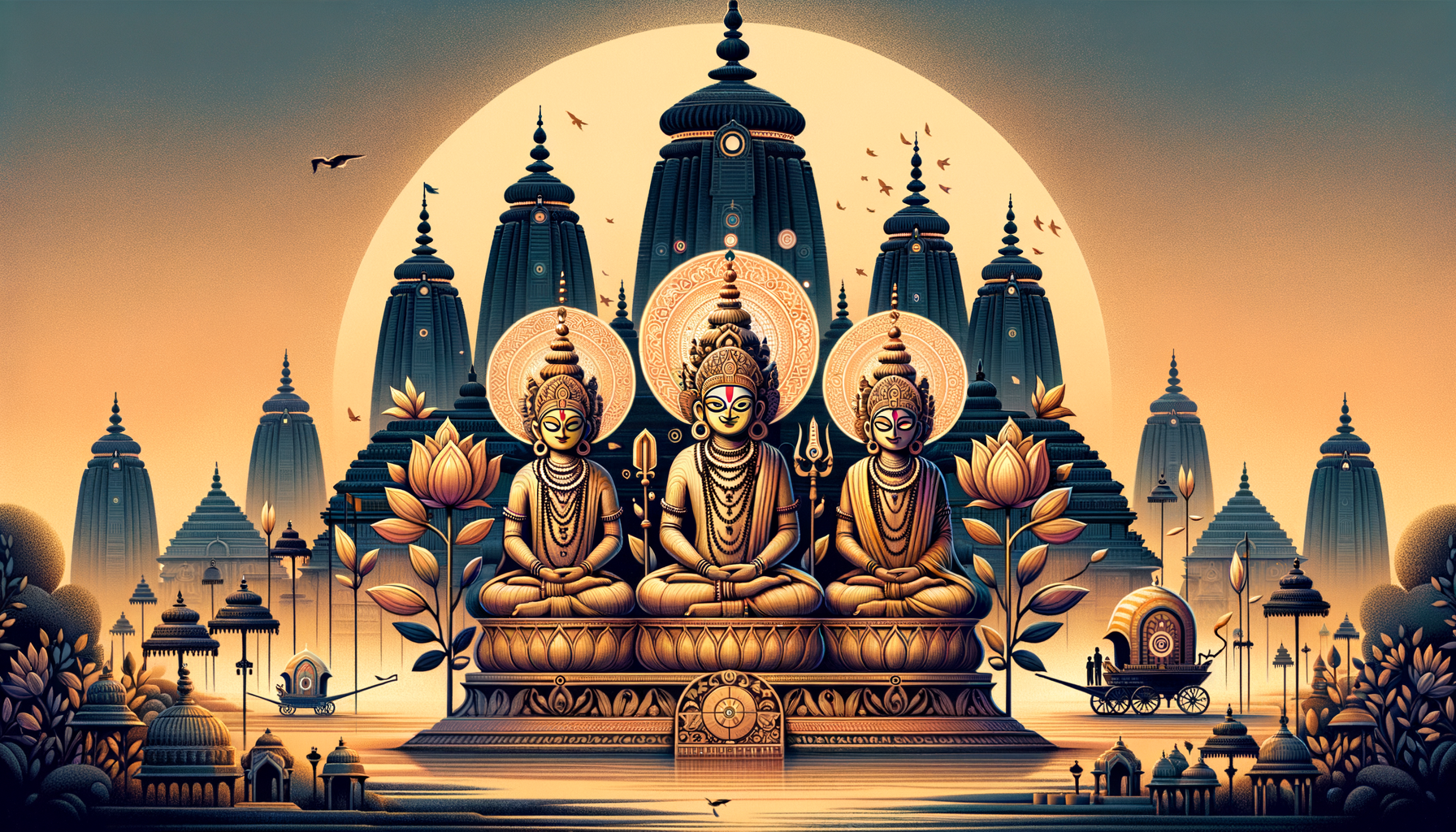
The Jagannath Temple at Puri, one of the four sacred dhams of India, is renowned for Vaishnav worship and, at the same time, revered for profound Tantric significance. Within the devotional experience of darshan lies an esoteric vision in which the triad of Jagannath, Balabhadra, and Subhadra encodes the dynamism of Adi Shakti and the eternal circulation of cosmic energy.
In Tantric philosophy, the Jagannath trinity is often interpreted as a living synthesis of consciousness, force, and support. Jagannath represents expansive consciousness and compassionate presence; Subhadra is read as Adi Shakti, the catalytic power that moves and transforms; and Balabhadra symbolizes stabilizing strength and protective prana. This triune arrangement reflects the Sanatana Dharma insight that the cosmos is sustained through the interplay of Purusha and Shakti in every moment.
Multiple interpretive lenses, preserved in sacred traditions, deepen this reading. One Tantric lens aligns the triad with the yogic nadis: ida, pingala, and sushumna, the subtle channels of pranic flow. Another associates the deities with the three gunassattva, rajas, and tamassuggesting that Subhadra’s radiance embodies activating rajas, Balabhadra’s luminosity embodies clarifying sattva, and Jagannath’s depth absorbs and transforms tamas. Such perspectives do not compete; rather, they illuminate complementary dimensions of a single spiritual reality.
Cosmologically, the triad can be viewed as Purusha, Prakriti, and the infinite support (Ananta) that holds the universe in balance. In this vantage, Jagannath aligns with Purusha, Subhadra with the transformative Prakriti as Adi Shakti, and Balabhadra with the foundational, protective principle that steadies the world. The result is a holistic vision in which devotion (bhakti) and inner realization (jnana) converge through Tantric symbolism.
The temple’s ritual ecology underscores this integrative vision. Within the complex stands the shrine of Bimala Devi, and Mahaprasad attains its sacred completion through offering to Bimala Devi before distribution. This choreographyVaishnav devotion honoring Shakta sanctityembodies the inclusive genius of Hindu traditions, where Shakta, Shaiva, and Vaishnava streams converge without contradiction.
Pilgrims frequently describe a felt unity during Ratha Yatra, when Jagannath, Balabhadra, and Subhadra journey among the people. The movement of the chariots itself resonates with Tantric imagery: the outward procession mirrors the inner movement of prana, and the collective darshan evokes a shared field of spiritual aspiration. Many visitors speak of quiet clarity, emotional warmth, and a subtle re-centeringexperiences that align with contemplative practices such as japa, pranayama, and meditative focus on the heart’s stillness.
This integrative spirit naturally extends to the broader dharmic family. The Jagannath tradition’s emphasis on compassion, service (seva), and reverence for inner awakening resonates with the ethical heart of Buddhism (karuna), Jainism (ahimsa and self-discipline), and Sikhism (seva and oneness). Rather than insisting on a singular path, the tradition exemplifies Religious Pluralism and Unity in Diversity, affirming that seekers may follow their Ishta while recognizing the same underlying truth.
As a cultural heritage center of India, the Jagannath Temple at Puri thus serves as a living classroom in Hindu philosophy. It demonstrates how Tantra is not separate from devotion but deepens ithow Shakti is not an abstract doctrine but the palpable vitality animating ritual, community, and personal transformation. In this sense, Jagannath consciousness is both devotional and esoteric, inviting study and experience in equal measure.
Those who reflect on the trinity through a Tantric lens often find it a practical contemplative map: Jagannath as spacious awareness, Subhadra as the awakening pulse of Adi Shakti within, and Balabhadra as the strength to hold one’s vows and values steady amid change. Such reflection can enrich everyday practicecultivating balance, clarity, and compassionwhile honoring the inclusive ethos of Sanatana Dharma.
Ultimately, Jagannath, Balabhadra, and Subhadra present a luminous symbol of harmony: the unity of bhakti and Tantra, the interdependence of consciousness and energy, and the shared values that bind Hinduism, Buddhism, Jainism, and Sikhism. In unveiling the hidden Shakti principle of the trinity, the tradition at Puri offers a timeless invitationto see the world as sacred, to live with reverence, and to recognize the one light shining through many paths.
Inspired by this post on Hindu Blog.










