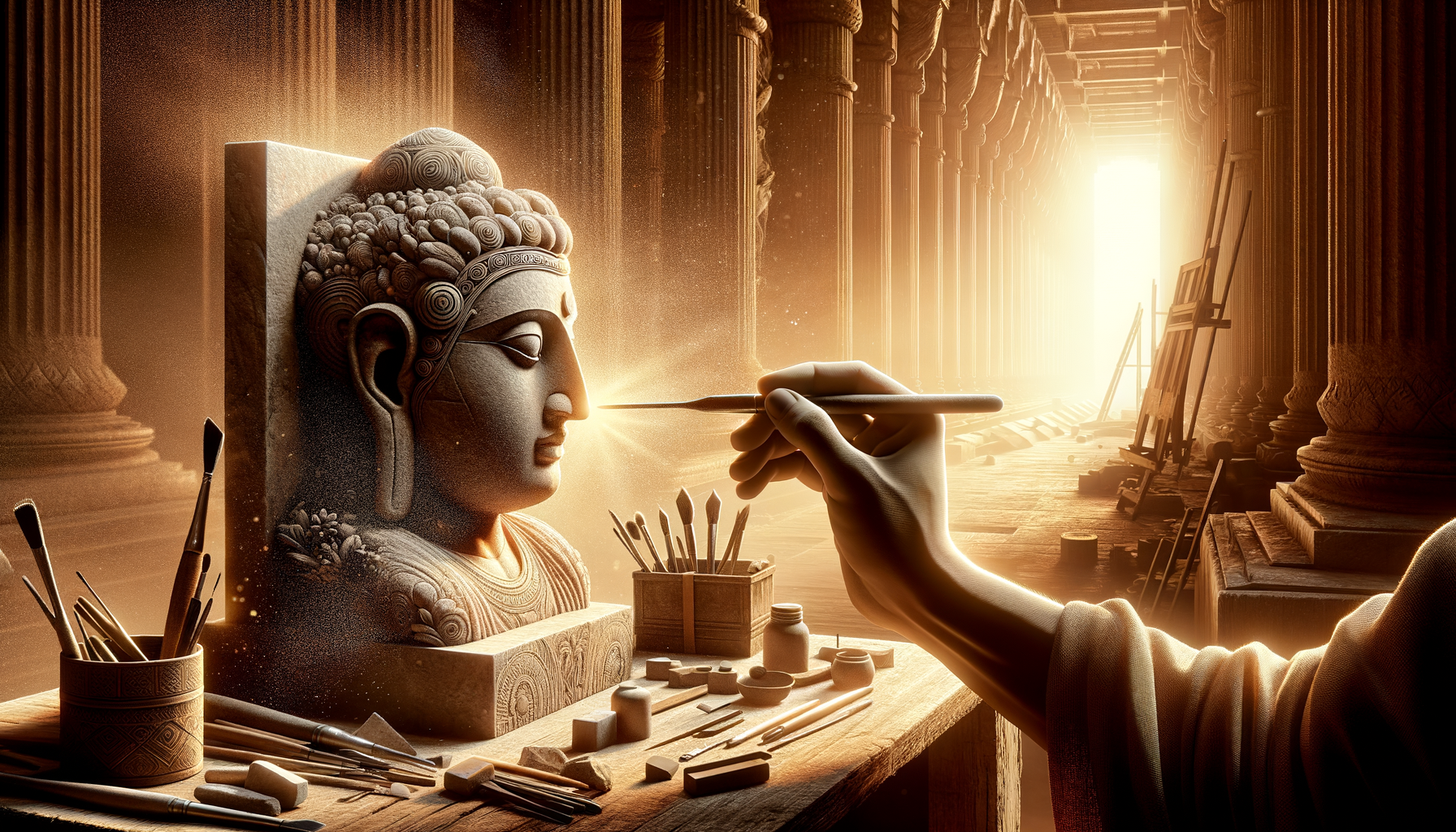
Within the Hare Krishna Movement (ISKCON), a frequently retold teaching story illuminates the ethic of sacred workmanship in Hindu temple building. It recounts a visitor from Germany observing a sculptor in a Hindu temple under construction, patiently shaping a murti (idol) while an almost identical image lay nearby. The scene, simple yet evocative, frames a profound reflection on devotion, accountability, and excellence.
Noticing the second image, the visitor asked, “Do you need two statues of the same idol?” Without pausing, the sculptor replied that only one was required; the other bore a minute flaw on the nose. When the visitor learned the completed idol would be installed atop a high pillar, he wondered who could possibly see such a tiny defect. The sculptor’s answer was concise: “God will.”
This narrativeoften circulated in Hare Krishna circlescaptures a core principle of bhakti: work offered as worship. Excellence in craftsmanship here is not a pursuit of external validation but a form of inner accountability aligned with dharma. Framed through karma-yoga and bhakti, the sculptor’s standard exists even when no human eye will inspect the result, because the work itself is an offering to Bhagavān.
The lesson resonates across dharmic traditions. Buddhism’s Right Effort (sammā-vāyāma) emphasizes disciplined, ethical action; Jain practice embodies meticulous care (ahimsa and samiti) in every deed; Sikh teaching upholds seva and kirat karo as honest, conscientious work. In each path, excellence arises from devotion, moral clarity, and the understanding that integrity persists beyond public recognition. Unity in spiritual diversity is thus affirmed by a shared ethic of sacred workmanship.
Applied to contemporary lifewhether in temple construction, kīrtan, prasāda distribution, education, or community servicethe parable argues for standards that endure out of sight. Such integrity strengthens cultural heritage, sustains trust in religious institutions, and deepens personal devotion. In this sense, a Hindu temple’s carefully carved idol becomes a living reminder that every detail can be an expression of love and reverence.
As a practical reflection, one may ask: Does this action honor the Divine? Would this work retain dignity if placed metaphorically “on a high pillar”? By aligning intention and execution with bhakti and dharma, the ethic of unseen excellence becomes a daily disciplinequiet, steady, and transformativeacross Hinduism, Buddhism, Jainism, and Sikhism alike.
Inspired by this post on Hindu Pad.