Shiva, in the Shaiva vision, is the god of all possibilitiesboth the still point at the heart of existence and the ceaseless dynamism of the cosmos. Among the innumerable manifestations that articulate this paradox, Kirata Murti and Kalyanasundara Murti stand out as a profound dialectic: the untamed hunter who tests and transforms, and the refined bridegroom who unites and blesses. Read together, they reveal how Shaiva philosophy, Tamil temple culture, and pan-Indic mythic memory converge to affirm a civilizational truthultimate reality embraces diversity, integrates opposites, and invites seekers into a path that is at once rigorous and tender.
Positioned within the continuum “from hunter to bridegroom,” these murtis map the journey from ordeal to grace, from tapas to ananda, and from solitary striving to relational fullness. Kiratamurti presents Shiva as a forest-dwelling archer who confronts and purifies; Kalyanasundaramurti presents Shiva as the bridegroom, the embodiment of auspicious union. Each image is a theological statement, an ethical compass, and an aesthetic tradition honed through centuries of devotion, sculpture, and festival performance in South India.
Textual foundations anchor these forms. Kiratamurti is grounded in the Mahabharata (Vana Parva), where Arjuna’s severe austerities culminate in a duel with a mysterious Kirata (hunter). Only after Arjuna’s courage, humility, and discernment are tested does the hunter reveal himself as Shiva and confer the Pashupatastra, the peerless weapon of consciousness and responsibility. The Sanskrit mahakavya Kiratarjuniya by Bharavi (c. 6th century) elaborates this episode into a study of heroism, inner conquest, and divine trial. Later vernacular retellings and temple liturgies in South India preserve and reinterpret this motif for local publics and ritual calendars.
Kalyanasundaramurti draws from a broad Puranic and classical substrate. Shiva’s marriage to Pārvatī is narrated in the Shiva Purana and Skanda Purana and reaches literary refinement in Kalidasa’s Kumarasambhava. Tamil Shaiva canon and narrative cyclesTevaram, Periya Puranam, and Tiruvilayadal traditionsincorporate the divine wedding into sacred geography and communal memory, culminating in celebrated utsavams such as Meenakshi Thirukalyanam in Madurai during Panguni Uttiram. In these enactments, theology becomes theatre: society participates in the cosmic wedding to renew the bonds of place, kinship, and dharma.
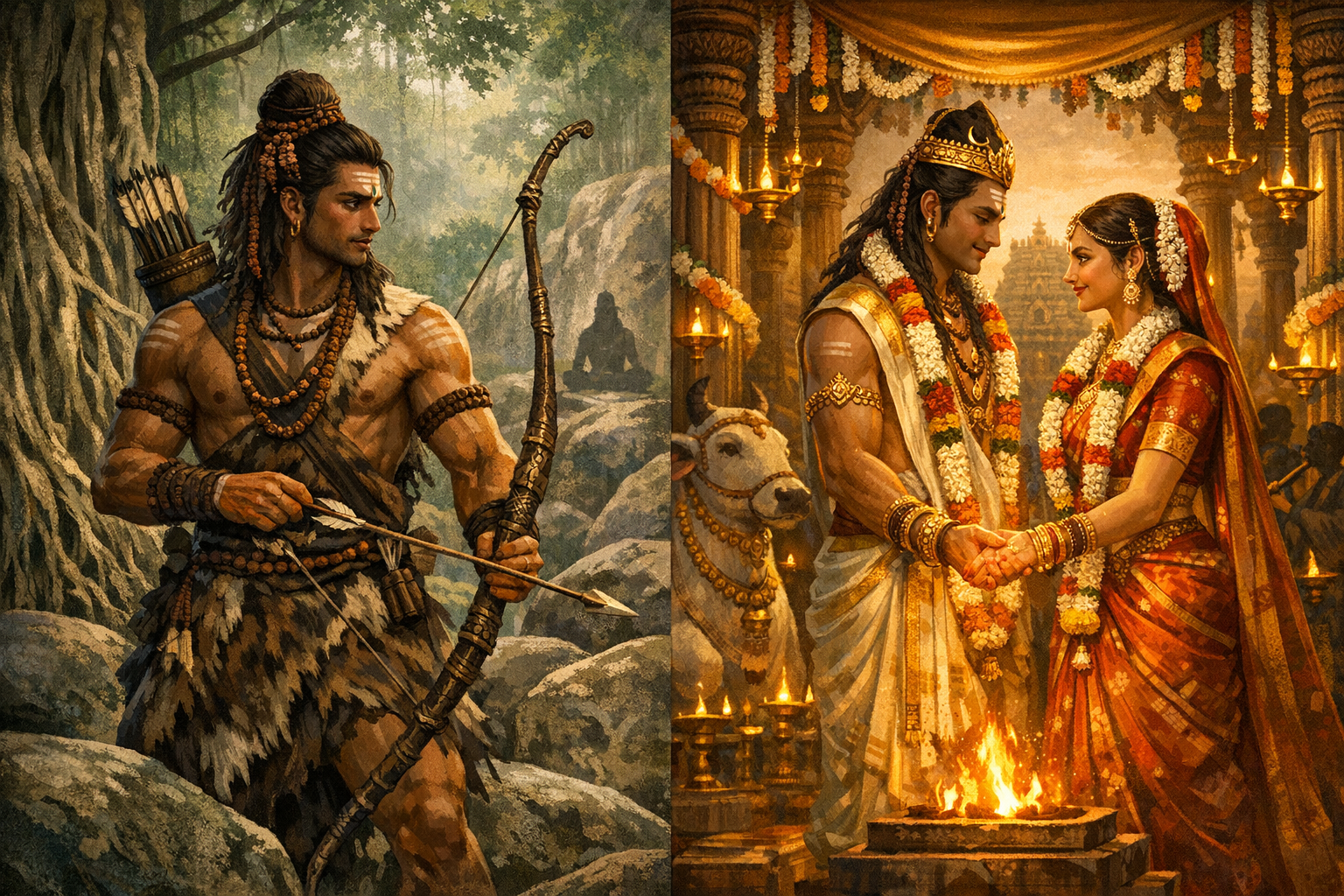
Iconographically, Kiratamurti discloses Shiva in a form unmistakably wild yet sovereign. Sculptures and paintings typically render a muscular hunter with bow, arrows, and a quiver, draped in animal hide or coarse garments, adorned with tribal ornaments that signal liminality rather than courtliness. The stance is alert, often dynamic, as if frozen in the instant before or after the fateful duel. Some traditions accompany the Kirata with a huntress aspect of Parvati and attendants, evoking a complete hunting party from forest margins. Although Arjuna may appear in some compositions, many Tamil works imply his presence through ascetic cuesmatted locks, one-legged penance, or hands raised in tapasas seen in Pallava-era reliefs where “Arjuna’s Penance” is one major interpretation.
Kalyanasundaramurti is the art of auspiciousness distilled. The essential gesture is pāṇigraha (panigraha)Shiva’s right hand clasping Pārvatī’s leftan iconographic condensation of vows, protection, and mutual entrustment. Vishnu commonly appears as the bride’s guardian and giver, while Brahma officiates as priest; Agni stands as witness to the rite; ganas and devas frame the scene as a celestial sabha. South Indian bronzes from the Chola period exhibit an extraordinary refinement of this themeelegant silhouettes, sensuous yet disciplined line, and a ritual poise that translates metaphysical union into tactile form.
The two forms stage a movement between raudra (fierce) and saumya (gentle) modes without privileging either. Kiratamurti foregrounds the pedagogy of ordeal: the ego must be tested; resolve must be tempered; dharma must be internalized as capacity to act without arrogance. Kalyanasundaramurti foregrounds the pedagogy of relation: the cosmos is a web of connections; the householder path is not second-best but a sacral vocation; grace culminates not in isolation but in union. In Shaiva Siddhanta terms, Kirata reveals Pati (the Lord) breaking the fetters of pāśa (bond) for the paśu (soul) through trial; Kalyanasundara reveals the same Pati uniting with Shakti, the ground of manifestation, to nurture, sustain, and sanctify the world.
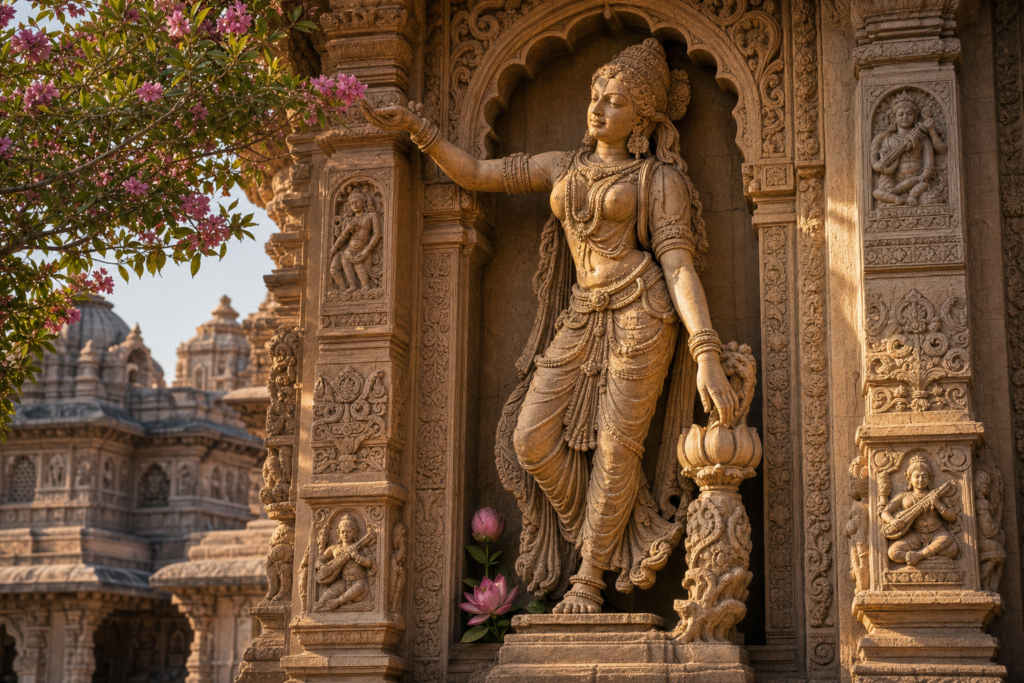
Tamil temple culture situates these insights in tangible spaces and cyclical time. Kanchipuram, Chidambaram, Thanjavur, Kumbakonam, and Madurai preserve visual and performative lineages that make the abstractions of Shaiva philosophy accessible. Chola bronzes of Kalyanasundaraonce processed through streets to the rhythms of nagasvaram and tavilwere not museum objects but living presences whose darshan integrated aesthetics, ethics, and civic belonging. Pallava and Chola sculptural programs frequently juxtapose ascetic and householder motifs, reminding devotees that liberation and life in the world are not antagonists but partners.
Ritually, Kalyana Utsavams translate cosmic union into everyday benediction. The wedding of Sundareshvara and Meenakshi rehearses themes of sovereignty, complementarity, and communal flourishing; farmers, artisans, scholars, and householders discover their vocations mirrored in the marriage vows. Kirata-related liturgies, though more episodic, infuse narrations, homilies, and artistic programs that valorize sadhana, courage, and the moral grammar of power, especially through the Mahabharata’s Arjuna who channels martial excellence into self-mastery under divine guidance.
Philosophically, these forms articulate a complete pedagogy of the self. Kiratamurti affirms that knowledge without trial remains fragile; one must walk through ambiguityface a disguised deity, contend with inner resistancebefore receiving Pashupatastra, which, beyond a weapon, symbolizes awakened agency. Kalyanasundaramurti affirms that knowledge without love remains incomplete; vows, trust, and reciprocity are not merely social niceties but ontological truths woven into reality by Shiva-Shakti themselves.
Socially and historically, Kirata imagery encodes the civilizational genius for inclusivity. The hunter’s attire acknowledges forest and tribal ecologies as part of dharma’s ambit, not as spaces outside the sacred. The divine wedding encodes kinship norms, gender complementarity, and inter-community reciprocity under a sacral canopy, offering a grammar for society that is neither homogenizing nor exclusionary. Together they resist the flattening of tradition into a single register, affirming plural embodiments of the good.
Art-historically, Pallava reliefs at Mamallapuram, including the celebrated “Descent of the Ganges/Arjuna’s Penance,” contribute a visual lexicon for ascetic striving and divine response in the Tamil region. Chola bronzes transform Kalyanasundaramurti into idealized formsupple, measured, and luminouswhere pāṇigraha becomes the still axis around which ritual movement turns. Subsequent Nayaka and later schools replicate and localize these idioms, sustaining continuity while allowing innovation.
Lived experience in temples confirms the interpretive arc. During Meenakshi Thirukalyanam, the atmosphere thickens with fragrance and song as thousands receive darshan of the joined hands. Anxiety softens; estrangements mend; vows are quietly renewed. By contrast, when narratives of the Kirata episode are chanted or dramatized, listeners lean forward into the tension of the duel; the heart recognizes the truth that strength must pass through humility to become worthy.
Comparatively, the dual vision resonates across dharmic traditions. Buddhism balances the renunciant path with the Bodhisattva’s compassionate return; Jainism honors both the muni and the śrāvaka as mutually sustaining ideals; Sikhism synthesizes saint and soldier (sant–sipahi), celebrating miri and piri as complementary sovereignties. Such convergences underscore a civilizational ethic: diversity of spiritual dispositions is not a problem to be solved but a treasury to be tended. In this light, Kiratamurti and Kalyanasundaramurti become not only Shaiva symbols but also shared mirrors for the broader dharmic family.
Ethically, Kirata warns against triumphalism and moral complacency. The duel with Arjuna dramatizes a subtle point: even just power must be surrendered back to the source; only then can it be exercised without residual violence. Kalyanasundara instructs that communal bonds and household dharma are not lesser callings; they are laboratories of compassion, fidelity, and responsibilitythe everyday crucibles where the cosmic wedding is rehearsed in miniature.
Semiotically, Kirata marks thresholdsforest margins, unbuilt terrain, liminal identities. The hunter’s skin garments, muscular frame, and nomadic accoutrements denote a world before walls, where skill and alertness ensure life. Kalyanasundara marks centressanctum and sabha, curated attire and measured gesturedenoting a world of settled relations, oaths, and ritual time. The tradition brings margins and centres into a single map of meaning, allowing devotees to move between them with dignity.
In Shaiva Siddhanta theology, the five cosmic acts (pañcakṛtya)creation, maintenance, dissolution, concealment, and graceframe both murtis. Kirata enacts tirodhana (concealment) in the guise that tests and anugraha (grace) in the revelation that blesses; Kalyanasundara enacts sṛṣṭi (creation) and sthiti (maintenance) as the world is birthed and sustained through auspicious union. Both thus remain pedagogies of the same compassionate Absolute.
Aesthetically, the contrast is deliberate. Kirata compositions privilege diagonals, tensioned musculature, and open spatial fields, evoking the unpredictability of wild space. Kalyanasundara compositions privilege verticals and gentle curves, closed and centered spatialities, and the focal clasp of hands, evoking repose, trust, and the fecundity of culture. This contrast is not a dualism but a choreography within the one dance of Shiva.
Pedagogically, temples leverage both forms to educate across ages. Children grasp the wedding’s warmth and the simple truth of keeping promises; adolescents resonate with Arjuna’s striving and learn that excellence is earned; adults read in both images the steady invitation to integrate strength and tenderness in work, family, and service. In this way, iconography becomes civic pedagogy and spiritual formation.
Geographically, the Tamil region contributes distinctive inflections. Madurai centres the divine wedding as the polity’s sacred charter, with Meenakshi–Sundareshvara embodying sovereignty and mutuality. Kanchipuram and Chidambaram, layered with Pallava and Chola legacies, display narrative panels and processional bronzes that keep Kirata and Kalyanasundara within living ritual circuits. Such localization ensures that universal myths breathe through local textures.
Hermeneutically, the Kirata narrative may also be read as a critique of appearances. The divine refuses to flatter; grace often arrives in forms the ego resists. The hunter’s roughness provokes honesty; only after surrender does recognition dawn. In the wedding narrative, the divine refuses to isolate; love is elevated to a sacrament that binds heaven and earth. Together, these readings protect spiritual life from both harshness without heart and sweetness without spine.
Historically, these forms adapted through changing dynasties without loss of core meaning. Pallava innovations in narrative relief, Chola mastery in bronze, and Nayaka elaborations in festival dramaturgy demonstrate a continuity that is creative rather than static. The images endured because they remained true to lived experiencestruggle and celebration, effort and embrace.
For contemporary seekers, the practical counsel is clear. Embrace a Kirata season: train, fast from distractions, welcome exacting mentors, and learn to discern between pride and strength. Embrace a Kalyanasundara season: invest in relationships, honour vows, reconcile differences, and let tenderness mature into courage. Spiritual maturity requires both seasons in rhythm, not one against the other.
In educational settings, these murtis offer integrative curricula. Courses in mythology and art history can correlate Mahabharata’s Kirata episode and Kalidasa’s Kumarasambhava with Chola bronzes and Pallava reliefs; classes in ethics can explore the moral conditions under which power becomes legitimate; programs in cultural heritage can study how Tamil festivals transmit values across generations without coercion or uniformity.
Comparative religion can fruitfully set these images alongside Buddhist, Jain, and Sikh paradigms of renunciation and service, demonstrating a shared dharmic insight: paths vary by temperament (adhikara-bheda), yet all aim at liberation seasoned by compassion. This unity-in-diversity remains a hallmark of the subcontinent’s civilizational strength.
In summary, Kiratamurti and Kalyanasundaramurti are not merely two episodes in Shiva’s vast iconography; they are bookends of a single wisdom. The hunter teaches integrity under fire; the bridegroom teaches fidelity under favour. Between them, a human life can be shapedalert in the forest, serene in the sanctum; disciplined in striving, generous in love.
The cosmic vision of Shiva thereby resists reduction into a singular way or a single temperament. It affirms many dispositions and honours multiple gates to the same sanctum. In the Tamil temple world, this affirmation is not abstract; it is seen, sung, carried in procession, and embraced in households. The result is a spiritual culture resilient enough to welcome difference and strong enough to hold it together.
To stand before Kiratamurti is to remember that truth sometimes wears a disguise and carries a bow. To stand before Kalyanasundaramurti is to remember that truth also takes a hand and gives a home. Held together, they invite a decisive, compassionate lifeone worthy of Shiva’s blessing and aligned with the dharmic unity that binds Hinduism, Buddhism, Jainism, and Sikhism in a shared quest for wisdom and liberation.
Inspired by this post on Hindu Blog.