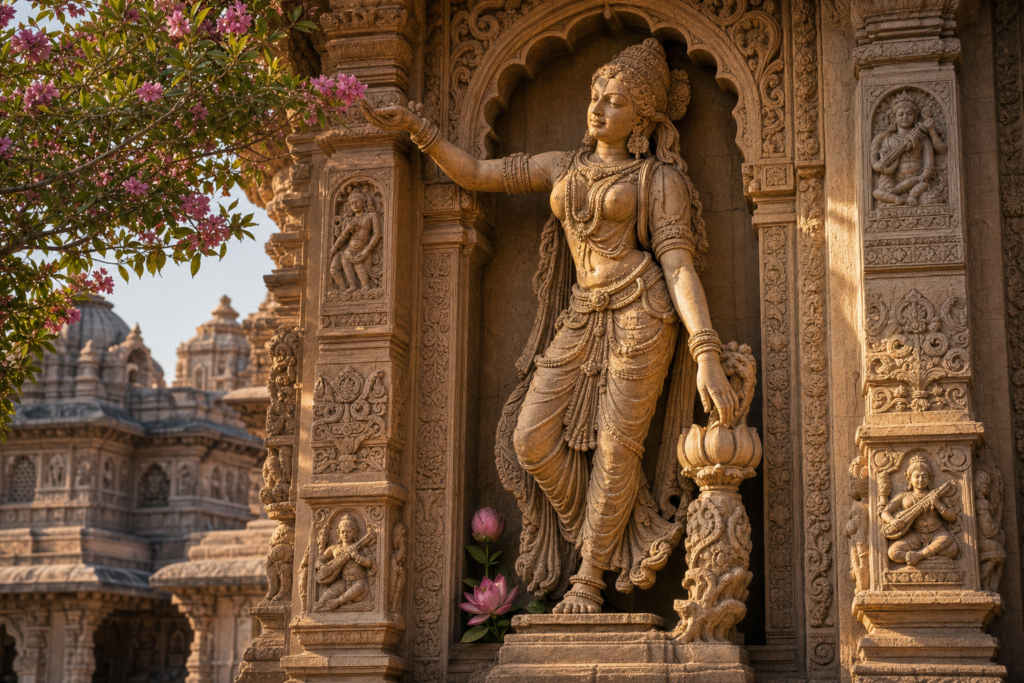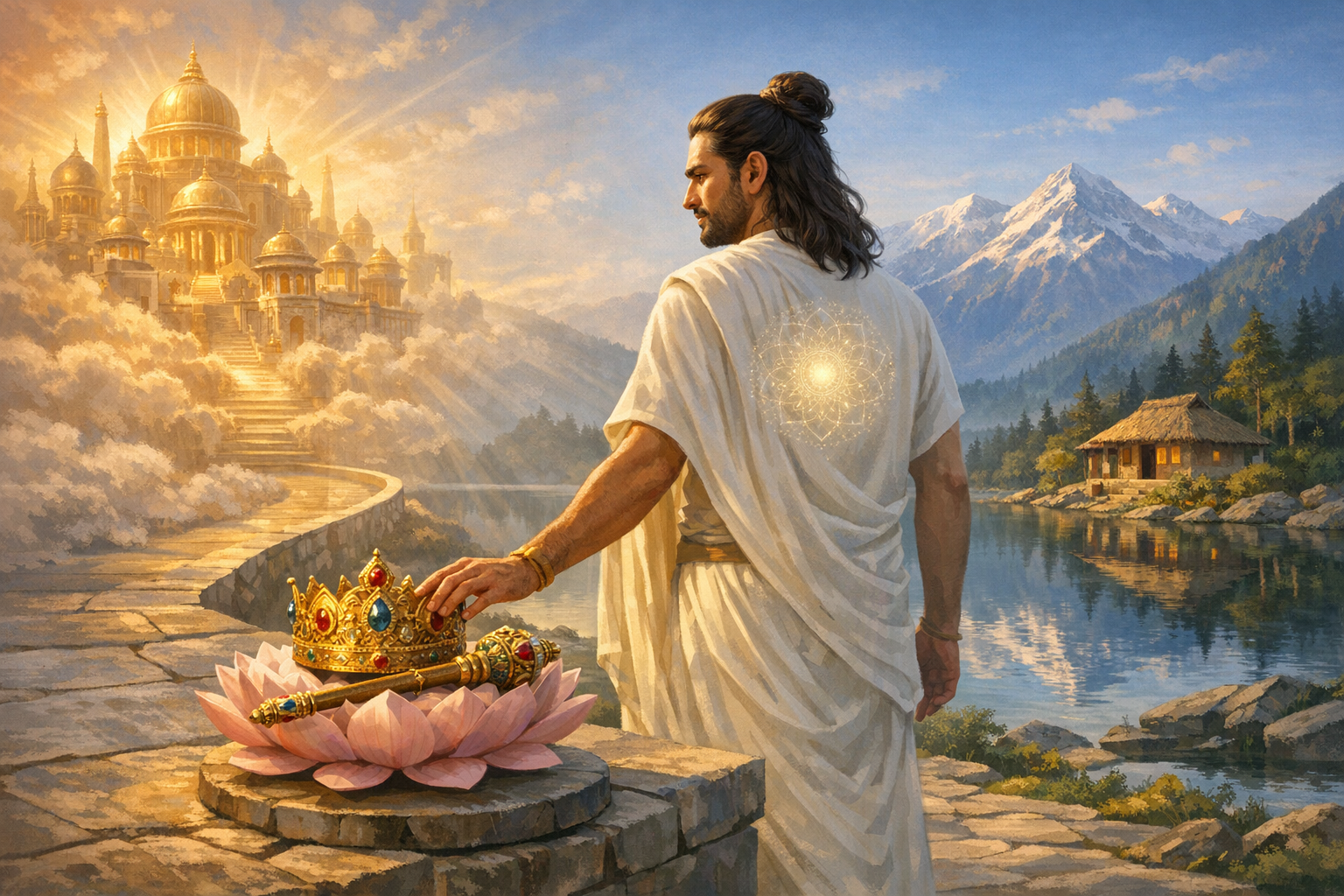
Among the opening narratives of the Yoga Vasishta, the account of King Arishtanemi turning away from Indra’s heaven distills the scripture’s uncompromising vision: true freedom lies not in exalted experiences but in the quiet extinction of craving and the steady illumination of wisdom. This narrative, positioned early in the Vairagya section, is more than an uplifting parable; it is a methodological preface to the text’s philosophy of liberation, where the mind’s projections are examined, unseated, and dissolved. The story provides an elegant and searching lens to study renunciation (vairagya) in relation to karma, desire, and the mind’s subtle compulsions.
The Yoga Vasishtaattributed in tradition to a dialogue between Sage Vasistha and Prince Rama and compiled in its extant form across medieval centuriesstands at the confluence of Yoga, Vedanta, and contemplative inquiry. It is a scripture of philosophical narratives that treat the world as mind-shaped and mind-sustained, drawing repeated attention to the contingency of experiences across all planes, from earthly life to svarga. Within this framework, the renunciation enacted by King Arishtanemi is neither escapism nor disdain; it is precise discrimination (viveka) applied to the full spectrum of pleasure, status, and hope.
The narrative unfolds with King Arishtanemi’s conspicuous virtue and merit inviting an offer from Indra himself: entry into heaven, the summit of reward promised by ritual and righteousness. Led through the celestial precincts, the king beholds resplendence beyond human reachfragrant groves, luminous beings, refined enjoyments, and the arresting ease of a realm seemingly untroubled by decay. Yet what the vision bestows in wonder it also reveals in limitation: heaven is a high terrace within samsara, not a breach beyond it.
Seeing that even celestial attainments are measured by time, exhausted by karma, and ringed by return, Arishtanemi’s insight matures into a question deeper than privilege can answer: What remains when the cycle of acquisition ceases? The realization is archetypal in dharmic literaturesustained pleasure cannot sidestep impermanence; at most, it can postpone the reckoning. In this moment of clarity, the king does not lament heaven; he outgrows its promise.
Indra’s heaven functions here as a pedagogic mirror that magnifies the logic of desire: whenever contentment depends on changing conditions, contentment is hostage to change. The king’s renunciation is therefore not a flight from joy but a refusal to tether peace to objects, locales, or auspicious births. Vairagya in the Yoga Vasishta is portrayed as luminous sobriety, not rejection; as inner spaciousness, not austerity for its own sake.
Technically, vairagya is the stabilization of the mind upon recognizing the structural insufficiency of object-seeking. This is not indifference; it is lucid valuation. When the mind ceases to grant ultimacy to the fleeting, it becomes available to unconditioned awareness (cit), the ground that the text repeatedly identifies as the one reality in which all experiences appear and pass.
The narrative thus introduces a method: discrimination (viveka) precedes renunciation (vairagya), and both prepare the terrain for inquiry (vichara). Arishtanemi’s turning away from svarga is not a denial of ethical cause and effect; it is an accurate mapping of karma’s jurisdiction and a decision to step beyond it. The story signals to seekers that higher states are not the telos, and that the mind’s quietingupashamais the soteriological pivot of the text.
From a doctrinal standpoint, svarga belongs to the domain of punya (merit) and is subject to the calculus of karma-phala. Yoga Vasishta reframes this: whatever is produced by causes (hetu) remains provisional and time-bound (kala-paricchinna). Therefore, the ultimate aimmokshais not heightened experience but unconditioned freedom from the push-pull of raga-dvesha (attraction and aversion).
In this perspective, Arishtanemi’s decision illuminates a core thesis of Indian philosophy shared across Dharmic Traditions: rewards, whether earthly or heavenly, are still within samsara. The Bhagavad-Gita echoes this when it notes that even those who attain bright realms “return,” having expended their merit. Yoga Vasishta radicalizes the insight through a mind-centric analysis: if cognition constructs and colors experience, the cure must address the mind’s own projections (chitta-vrittis).
Yoga Vasishta’s distinctive contribution is its rigorous phenomenology of mind. The text repeatedly shows that experiences, from the gross to the subtle, are mind-shaped and mind-sustained; when grasping rests, so do entire experiential worlds. In that light, renunciation is a refinement of attention: turning from object-fixation toward the witnessing awareness (sakshi-bhava) in which all experiences rise and set.
Importantly, the scripture treats renunciation as inward first. Outer withdrawal may be skillful for some temperaments, but the decisive shift is the de-energizing of craving. Arishtanemi’s stance symbolizes this interior revolution: having seen the arc of pleasure end in return, he commits to knowledge that does not return to lack.
Such knowledge is not acquired like an object. It is recognized as one’s own luminous ground when the mind, satisfied by discernment, stops racing. In Yoga Vasishta’s idiom, the cessation of the mind’s turbulence reveals what was never absentawareness unbound by becoming.
Seen against the broader canvas of Indian thought, the king’s choice parallels the Katha Upanishad’s distinction between shreyas (the good) and preyas (the merely pleasant). Both texts warn that choosing the pleasant without insight binds one to further seeking. Arishtanemi’s insight is exemplary shreyas: the courage to prefer truth over thrill.
This renunciant wisdom harmonizes with Buddhism, where deva-lokas are refined yet impermanent, and where nirvana is freedom from the fire of craving. It accords with Jain emphasis on aparigraha (non-possessiveness), where even heavenly births are still within the orbit of karma and rebirth. It resonates with Sikh teachings that durably anchor fulfillment not in “swarg” and “narak” as destinations but in the living remembrance of the Naam and detachment from maya while honoring life’s duties.
In each of these Dharmic Traditions, renunciation is not world-negating; it is compulsion-negating. The aim is clarity that empowers compassionate action, not withdrawal that abandons responsibility. Yoga Vasishta underscores this by addressing Prince Ramadestined to governindicating that inner freedom is compatible with righteous engagement.
Ethically, Arishtanemi’s renunciation is the quiet end of the pleasure principle’s sovereignty over choice. When pleasure no longer dictates, ethics can be grounded in wisdom rather than fear or appetite. This reframing supports virtues like non-violence, truthfulness, and restraintnot as rules, but as natural consequences of seeing clearly.
From a practical standpoint, the narrative invites a reorientation of sadhana. First, cultivate viveka through regular contemplation on impermanence (anitya-bhavana), causality, and the structural instability of desire-based fulfillment. Second, deepen vairagya by practicing aparigraha in everyday choices, reducing dependence on stimuli for mood regulation.
Complementary methods across traditions can fortify this turn. Buddhist shamatha and vipashyana stabilize and clarify the mind; Jain samayik cultivates equanimity; Sikh simran centers awareness in the remembrance of the One; and Yoga’s pratyahara, dhyana, and self-inquiry (atma-vichara) converge on the same destinationsteadiness in awareness. The cross-traditional convergence affirms unity in spiritual diversity while honoring distinct methods.
For contemporary seekers, Indra’s heaven can be read as a metaphor for today’s elevated but conditional gratificationsstatus, optimized experiences, carefully engineered comfort, and digital abundance. These are not condemned; they are contextualized. The question Arishtanemi raises remains surgical: does any of it conclude seeking?
When the mind is trained to prize intensity over insight, it risks cycling endlessly through refined dissatisfaction. Vairagya introduces a different metric of success: the capacity to remain clear, steady, and kind, regardless of circumstance. In that register, renunciation feels less like losing and more like relief.
A structured way to apply this teaching can be staged over weeks. Begin with daily intervals of inward quietten to twenty minutes of breath awareness and gentle witnessing of thoughts. Add weekly reflections on cause and effect in personal choices, noting how certain pursuits amplify agitation while others foster balance.
Introduce an aparigraha practice by simplifying one domain of lifemedia consumption, purchases, or food impulsesand observe the mind’s reactions with curiosity rather than judgment. This is not austerity theatre; it is data gathering for wisdom. Over time, the mind learns that peace is not the prize at the end of acquisition but the baseline that acquisition often obscures.
Support inquiry with study (svadhyaya) of Ancient Texts, especially sections of Yoga philosophy, Upanishads, and allied teachings in Buddhist and Jain canons that illuminate impermanence and non-attachment. Integrating Sikh insights on living remembrance prevents renunciation from curdling into passivity and keeps the insight anchored in service (seva) and love. Such study, when paired with living practice, gradually matures into insight that does not vacillate.
Two misunderstandings are worth avoiding. First, vairagya is not aversion; aversion still grants reality to what it resists. Second, renunciation is not a rejection of relationship or responsibility; it is a refusal to be driven by compulsion in their midst. Properly understood, vairagya intensifies care by removing self-centered urgency.
Arishtanemi’s decision also speaks to collective life. Societies thrive when aspiration is balanced by wisdomwhen progress is pursued without mistaking it for ultimacy. The Yoga Vasishta offers a civilizational ethic in which inner freedom coexists with outer excellence, ensuring that gains do not become new prisons.
Scholarly context enriches appreciation for the narrative’s reach. The Yoga Vasishta exists in multiple recensions, including abridged forms like the Laghu Yoga Vasishta and anthologies such as Yoga Vasishta Sara, with dates ranging roughly from the 10th to the 14th centuries CE for the stabilized Sanskrit forms. Across versions, the throughline is consistent: mind’s quieting is liberation; the rest, however exalted, is preface.
In pedagogical terms, Arishtanemi’s renunciation is a “threshold demonstration.” Before approaching the text’s more subtle non-dual analyses, the seeker must first be convinced that the summit of becoming is still becoming. Only then does inquiry meaningfully reveal what is not born, not acquired, and not lost.
When read as guidance rather than legend alone, the narrative encourages an intimate audit of motivation. What is pursued for its own sake, and what is pursued as a hedge against fear? This question, examined gently and persistently, is itself a form of renunciation that loosens the knot of compulsion.
Ultimately, the refusal of heaven is a declaration of freedom from bargaining with life. It is the alignment with moksha as present-moment clarity, not as a distant acquisition. In this sense, Arishtanemi’s turning is profoundly affirmative: it affirms that what is truly valuable is already nearer than the nearest attainment.
By harmonizing insights from Hindu philosophy with resonant strands in Buddhism, Jainism, and Sikhism, the narrative offers a shared civilizational inheritance: renunciation as the intelligent end of captivity to the pleasant, and liberation as the flowering of wisdom and compassion. The message is enduringly contemporarychoose clarity over escalation, presence over promise, and unity in spiritual diversity over narrow triumphs. Heaven remains honored as a high station; liberation remains honored as home.
Inspired by this post on Hindu Blog.