
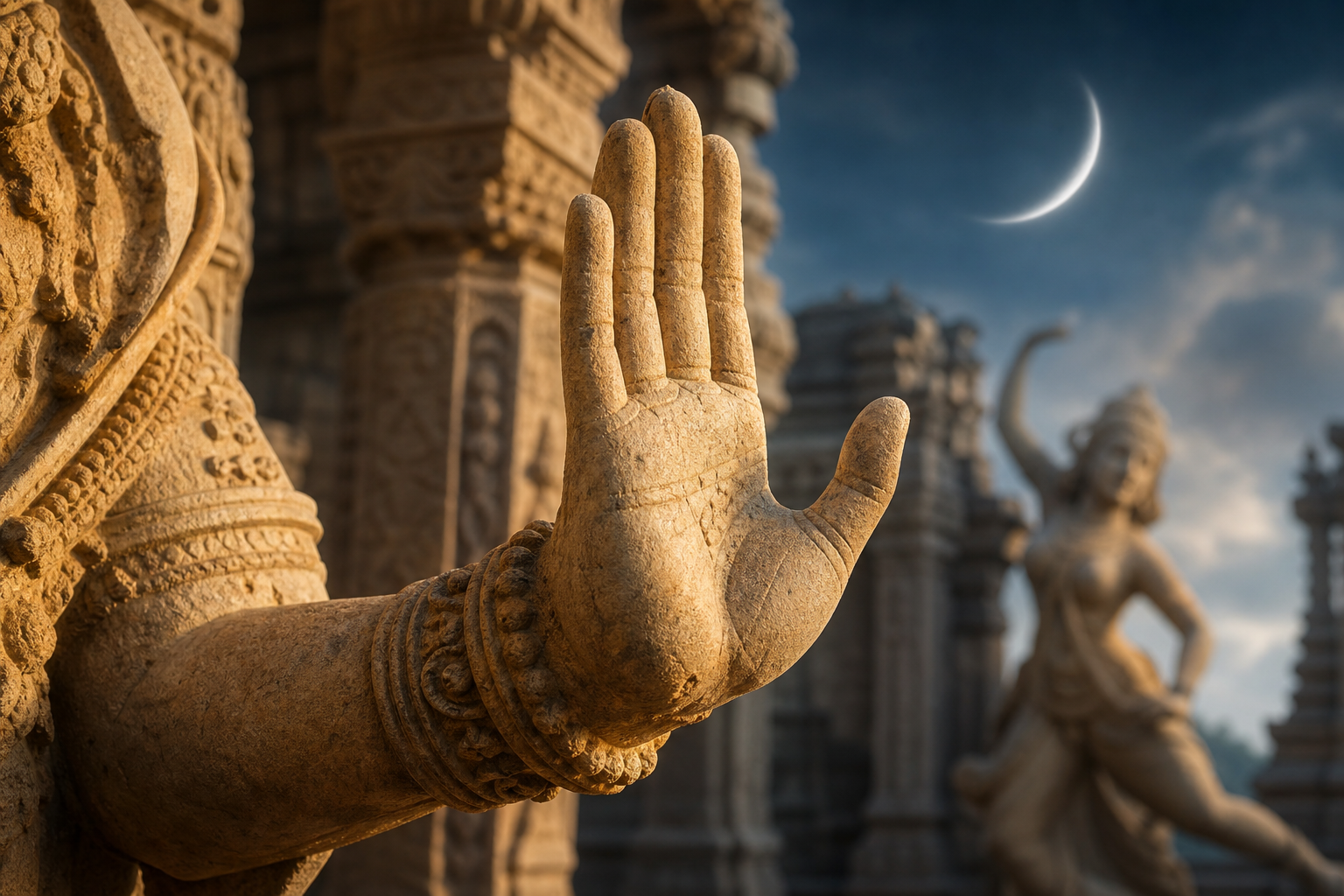
Ardha Chandra Mudra, often translated as the Half-Moon Gesture, occupies an elegant place in the visual language of Hindu sculpture, temple art, classical dance, and sacred symbolism. The term comes from Sanskrit: ardha means half, and chandra means moon. Together, they evoke the luminous crescent that has long carried associations of rhythm, time, beauty, coolness, fertility, renewal, and divine presence in the Indic imagination.
In Hindu sculptures, a hand is rarely merely anatomical. It communicates blessing, assurance, protection, teaching, invitation, warning, devotion, or cosmic truth. Mudras make stone appear alive because they allow a deity, sage, dancer, or celestial being to speak without words. Ardha Chandra Mudra belongs to this refined grammar of sacred gesture, where the body becomes a vehicle of philosophy and the hand becomes a condensed symbol of spiritual meaning.
Technically, Ardha Chandra Mudra is understood as a hand position in which the fingers are generally extended together while the thumb is opened outward, creating a form that suggests the curve or openness of a crescent. In classical Indian dance traditions, especially within the codified vocabulary of hasta mudras, Ardhachandra is recognized as one of the single-hand gestures. Its sculptural form can vary by region, period, artistic school, and the specific iconographic program of a temple, but the defining impression remains one of graceful extension and measured openness.
The significance of the half moon in Hindu thought is especially rich. The moon is connected with soma, with the cool and nourishing principle of life, with cyclical time, with the mind, with vegetation, and with the changing rhythms of nature. Unlike the full moon, which suggests completion and fullness, the half moon or crescent suggests becoming, transition, restraint, and subtle luminosity. This makes Ardha Chandra Mudra visually powerful: it does not shout a doctrine, but quietly suggests balance, emergence, and sacred measure.
The gesture is particularly resonant when considered beside the iconography of Shiva. Shiva is famously Chandrashekhara, the bearer of the crescent moon upon the matted locks. The crescent on Shiva’s head represents mastery over time, the cooling of ascetic fire, the containment of cosmic rhythm, and the integration of stillness with movement. When a sculptural hand evokes the half moon, it naturally enters this wider field of Shaiva symbolism, even when the hand itself is not the crescent ornament worn on the head.
In temple sculpture, Ardha Chandra Mudra may appear in contexts where the figure is not simply standing, but communicating a refined emotional or theological state. A deity’s hand may suggest cosmic order; a dancer’s hand may suggest lyric expression; a devotee’s hand may suggest reverence; a celestial attendant’s hand may contribute to the rhythm of the sculptural panel. The meaning depends on posture, facial expression, surrounding figures, attributes, narrative context, and the architectural placement of the image.
This contextual reading is important because Hindu iconography is not a dictionary in which one sign always has only one meaning. A mudra may carry a core visual identity, yet its function changes when placed in a narrative scene from the Ramayana, a Shaiva shrine, a Vaishnava temple, a Shakta panel, or a sculptural representation of dance. The same hand that evokes the crescent may also support the mood of devotion, beauty, offering, instruction, or divine play.
The academic study of mudras therefore requires close attention to form. The position of the thumb, the alignment of the fingers, the direction of the palm, the bend of the wrist, and the relation of the arm to the torso all matter. In weathered sculptures, especially those exposed to centuries of ritual use, climate, repainting, breakage, or restoration, identification must remain careful. A partially damaged hand may resemble Ardha Chandra Mudra without originally being intended as such, and responsible interpretation avoids certainty where the evidence is incomplete.
At the same time, the presence of mudras across Hindu art reveals a remarkable continuity between sculpture, ritual, yoga, mantra practice, and classical performance. The temple dancer, the sculpted apsara, the yogic practitioner, and the devotee before the murti all participate in a shared understanding that the body can become sacred language. Ardha Chandra Mudra is one expression of this wider civilizational insight: form, gesture, rhythm, and consciousness are not separate domains but interconnected modes of meaning.
In Bharatanatyam and other classical traditions, the Ardhachandra hand is used within a sophisticated language of abhinaya, or expressive communication. Dance manuals and performance lineages preserve many uses for such gestures, including references to the moon, beauty, direction, worship, and narrative action. Sculptors who carved temple figures were often working in a cultural environment where performance, ritual, and visual art informed one another. A carved gesture may therefore preserve not only theology but also the memory of movement.
This relationship between dance and sculpture is visible in many Indian temples where figures are carved with a striking sense of kinetic intelligence. The body may be stone, yet the pose suggests transition from one movement to the next. Hands become especially important in such compositions because they complete the rhythm of the torso, hips, shoulders, and gaze. Ardha Chandra Mudra, with its gentle outward opening, can soften the geometry of a figure and draw the viewer into a mood of contemplation.
The gesture also invites reflection on the Hindu understanding of beauty as disciplined symbolism. Sacred art is not decorative in a shallow sense. Its beauty is structured by proportion, iconographic convention, metaphysical association, and ritual purpose. A crescent-like hand may appear delicate, but it belongs to an ordered visual system in which even delicacy is meaningful. The viewer is not only meant to admire the sculpture but to perceive the subtle intelligence through which beauty becomes a path toward insight.
Ardha Chandra Mudra may also be interpreted through the symbolism of balance. A half moon is neither absence nor completion. It is a phase, a measured portion of light, a reminder that sacred time moves through cycles. Hindu traditions often present reality not as a rigid line but as recurring rhythm: day and night, waxing and waning, creation and dissolution, concealment and revelation. The half-moon gesture quietly participates in this worldview.
For many viewers standing before an ancient sculpture, this is the emotional force of the mudra. It can make a distant deity feel intimate and approachable. The hand appears calm, intentional, and humane. It suggests that divinity is not always expressed through dramatic power; sometimes it is expressed through restraint, clarity, and luminous composure. This is one reason Hindu sculptures continue to communicate across centuries, even to those who may not know every technical term of iconography.
From a theological perspective, Ardha Chandra Mudra can be placed within the broader Hindu reverence for symbolic embodiment. The divine is not limited to abstract doctrine; it is made visible through murti, mantra, mandala, mudra, temple architecture, pilgrimage, music, and ritual action. A hand gesture can therefore serve as a bridge between the seen and the unseen. It gives form to an idea that might otherwise remain too subtle for ordinary perception.
The moon’s association with the mind also gives the gesture contemplative depth. In many Indic frameworks, the mind is changeable, reflective, and cyclical, much like the moon. A crescent form may therefore suggest the disciplined mind: not extinguished, not restless, but held in a state of luminous balance. When seen in sacred sculpture, the gesture can become a visual reminder of inner refinement, emotional regulation, and the quiet work of spiritual practice.
In the context of Hindu temple architecture, mudras are not isolated ornaments. They participate in the temple as a total sacred environment. The devotee moves from the outer space toward the sanctum, encountering sculpted deities, guardians, dancers, sages, narrative panels, and symbolic motifs. Each figure contributes to the gradual transformation of attention. Ardha Chandra Mudra, when present, helps tune the eye toward subtlety rather than spectacle.
Regional artistic traditions give the gesture different visual textures. South Indian bronze and stone traditions may emphasize refined line, rhythmic balance, and liturgical presence. Medieval temple sculpture from central and western India may integrate such gestures into complex architectural surfaces filled with movement and ornament. Eastern Indian and Himalayan traditions may present related hand forms within distinct ritual and iconographic systems. These variations show that Hindu art is unified by shared principles while remaining regionally alive and diverse.
The study of Ardha Chandra Mudra also benefits from comparison with other mudras. Abhaya Mudra communicates fearlessness and protection. Varada Mudra suggests giving and grace. Anjali Mudra expresses reverence and union. Jnana Mudra and Chin Mudra are associated with knowledge and contemplative realization. Ardha Chandra Mudra is subtler than many of these because its force lies not primarily in command or blessing but in form, suggestion, and symbolic association.
This subtlety makes it especially valuable for understanding Hindu sculpture. Some sacred images communicate through obvious attributes: a trident, conch, discus, lotus, mace, bow, drum, or flame. Others communicate through bodily nuance. The slight opening of a thumb, the gentle curve of a palm, or the stillness of a wrist can change the entire emotional register of a sculpture. Ardha Chandra Mudra belongs to this refined layer of iconographic reading.
There is also a broader dharmic dimension to the study of mudras. Hinduism, Buddhism, Jainism, and Sikh traditions have each preserved profound ways of understanding the body, discipline, devotion, contemplation, and sacred memory. While their doctrines and practices are distinct, their shared civilizational environment has often valued gesture, reverence, self-mastery, and symbolic communication. Studying Ardha Chandra Mudra with this awareness encourages unity without flattening difference.
In Buddhist art, mudras such as Bhumisparsha, Dhyana, Dharmachakra, and Abhaya became central to visual theology. In Jain imagery, meditative stillness, posture, and symbolic restraint convey liberation and spiritual discipline. In Sikh practice, the emphasis is different, yet the embodied dignity of devotion, seva, and remembrance remains central to lived spirituality. Against this wider dharmic background, the Hindu Ardha Chandra Mudra can be appreciated as part of a larger Indic confidence that the body can express truth when disciplined by sacred intention.
The gesture also resists reduction to a purely aesthetic motif. It is beautiful, but beauty is only the surface. It points toward cosmology, ritual practice, disciplined embodiment, artistic transmission, and the symbolic relationship between human form and divine presence. To read it only as a graceful hand shape would be to miss the intellectual and devotional architecture behind it.
For students of Hindu iconography, Ardha Chandra Mudra offers a useful lesson in method. First, the visible form must be identified. Second, the sculptural context must be studied. Third, textual and performative traditions may be consulted. Fourth, interpretation must remain sensitive to regional variation. Finally, the spiritual meaning should be approached with respect, because temple art was not created merely for museums; it was created within living worlds of worship, memory, and sacred presence.
The mudra’s crescent symbolism also makes it relevant to the experience of time. The moon is a calendar in the sky. Hindu festivals, vratas, tithis, and ritual observances are deeply connected with lunar phases. The half moon therefore evokes not only visual beauty but the ordering of sacred life. It reminds the devotee that worship unfolds through time and that time itself can be sanctified through awareness.
In this sense, Ardha Chandra Mudra is not a small detail but a compact theological statement. It binds the human hand to the celestial moon, the sculpted body to cosmic rhythm, and temple art to lived ritual time. Such symbolic compression is one of the great strengths of Hindu sculpture. A single gesture can hold together art history, philosophy, devotion, astronomy, performance, and spiritual psychology.
The half-moon form may also be read as a sign of humility. It is not the full radiance of the complete moon, yet it is not darkness. It is partial light, enough to guide the eye and awaken memory. In spiritual life, this is a deeply relatable image. Human understanding often grows gradually, through phases, corrections, disciplines, and glimpses. The gesture can therefore speak to the lived experience of seekers who move toward clarity without claiming instant completion.
Hindu sculpture frequently uses such layered symbolism to train perception. The casual viewer may first see ornament. The attentive viewer begins to see pattern. The informed viewer recognizes iconographic grammar. The contemplative viewer senses the inner stillness that the form is designed to awaken. Ardha Chandra Mudra rewards this gradual deepening of attention.
Its relevance today is not limited to historians or temple specialists. In an age of visual speed and distraction, studying a mudra requires patience. It asks the viewer to slow down and observe how meaning can be carried by small things. A hand carved in stone can teach that sacred communication does not always depend on excess. Precision, restraint, and reverence can carry extraordinary force.
Ardha Chandra Mudra also enriches the understanding of Hindu art as a living tradition rather than a closed archive. The same symbolic vocabulary continues in dance classrooms, yoga spaces, temple rituals, devotional art, and scholarly study. When a practitioner forms the gesture today, or when a viewer recognizes it on a temple wall, a link is formed with centuries of embodied knowledge. This continuity is one of the reasons mudras remain culturally and spiritually powerful.
The gesture’s enduring appeal lies in its union of clarity and mystery. It is clear enough to be recognized as a half-moon form, yet deep enough to invite multiple levels of interpretation. It belongs to the hand, but it points to the sky. It is carved in matter, yet it speaks of rhythm, mind, time, beauty, and transcendence. Such is the genius of Hindu sacred sculpture: it allows the finite to suggest the infinite without dissolving the dignity of form.
Ultimately, Ardha Chandra Mudra should be understood as more than an elegant gesture in Hindu sculptures. It is a refined symbol of cosmic rhythm, contemplative balance, sacred beauty, and embodied wisdom. Its crescent shape carries the memory of the moon, the discipline of artistic tradition, and the quiet emotional power of dharmic spirituality. To study it carefully is to see how Hindu art transforms the smallest movement of the hand into a luminous statement about the universe and the inner life of the seeker.
Inspired by this post on Hindu Blog.


Leave a Reply
You must be logged in to post a comment.