
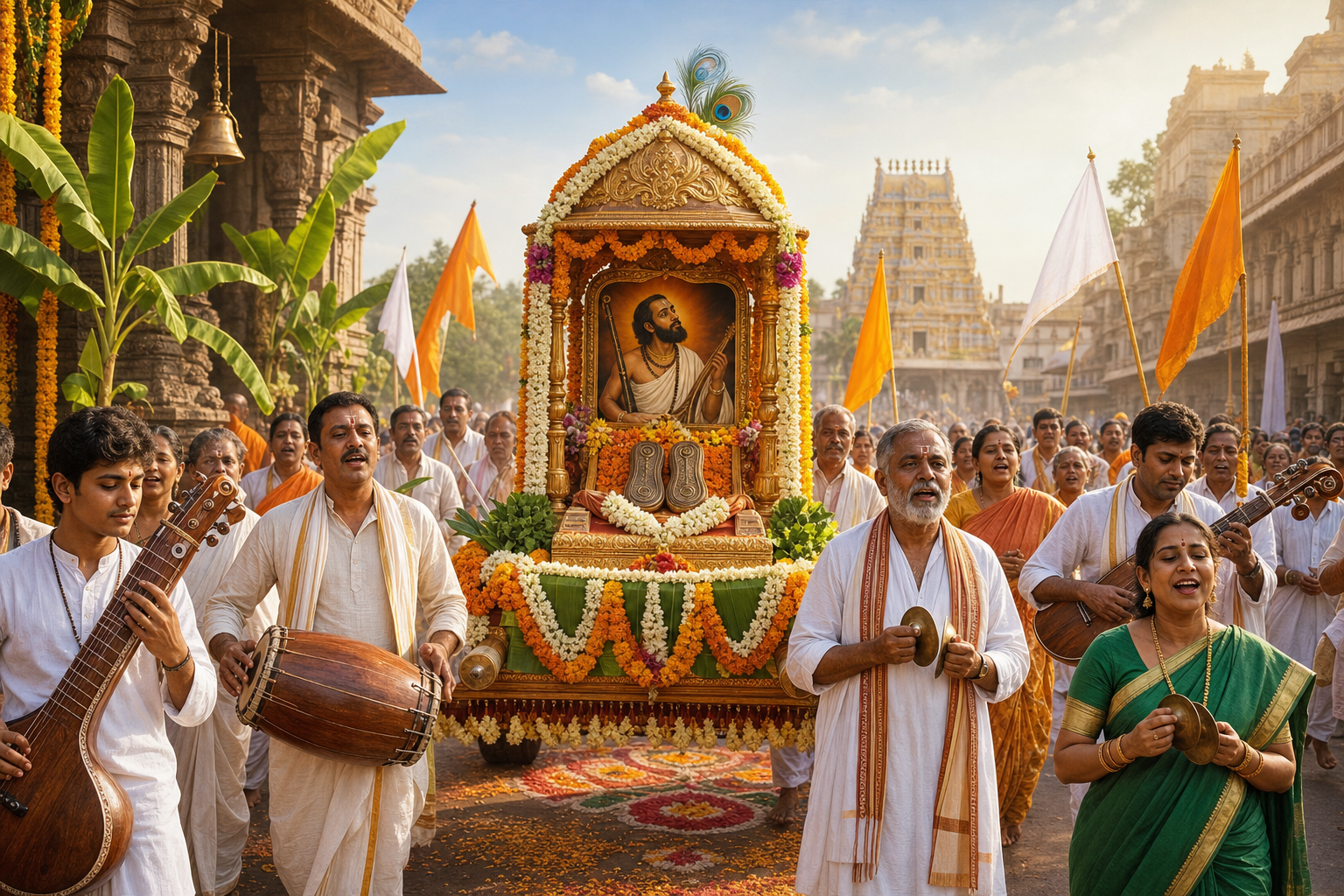
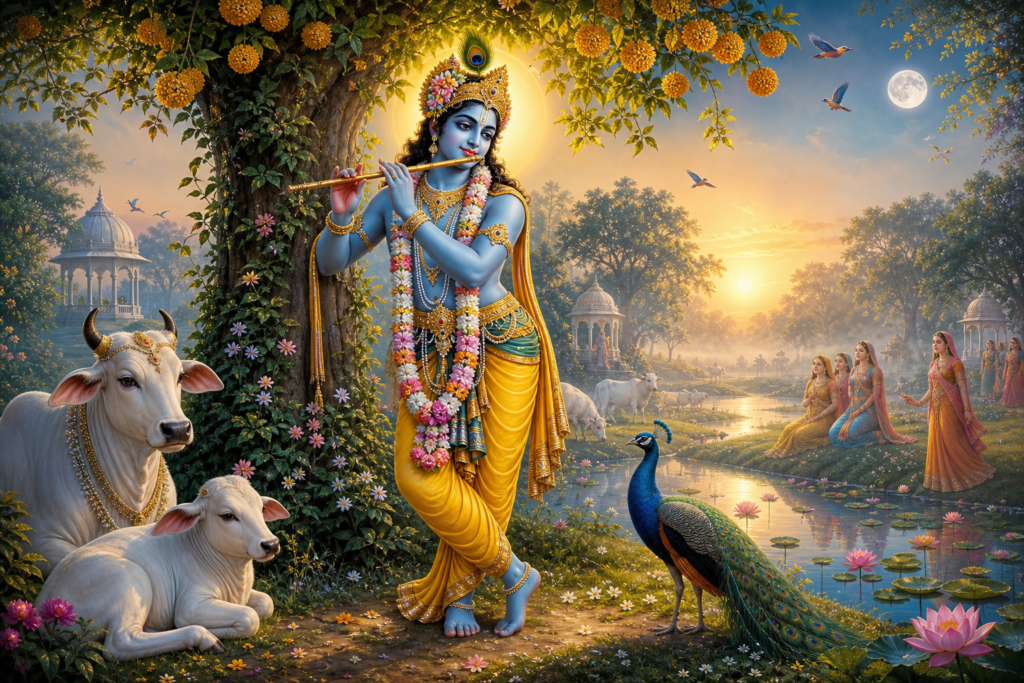
Sant Kanakadasa Palkhi Sohala 2026 is best understood as a devotional procession rooted in the memory of Shri Sant Kanakadasa, the celebrated Haridasa saint-poet of Karnataka whose life continues to speak to bhakti, social harmony, Kannada literature, and the wider unity of Sanatana Dharma. The invocation “Jai Gopal!” captures the emotional center of the observance: devotion to Lord Krishna expressed not merely as private worship, but as shared movement, music, remembrance, and community participation.
In the religious culture of India, a palkhi is more than a ceremonial palanquin. It is a mobile sacred presence, carrying the memory of a saint into the streets, villages, temples, and public spaces where ordinary people live. When devotees gather around a palkhi, they are not simply watching a procession; they are entering a disciplined public form of remembrance. The route, the singing, the rhythmic walking, the offering of flowers, and the collective chanting create a temporary sacred geography in which the saint’s teachings are made visible.
The phrase Sant Kanakadasa Palkhi naturally invites comparison with the Warkari Palkhi traditions of Maharashtra, especially the revered processions associated with Sant Dnyaneshwar, Sant Tukaram, Sant Nivruttinath, and other Varkari saints who journey toward Pandharpur. Yet the Haridasa setting of Karnataka gives the Kanakadasa observance its own texture. The Warkari tradition is closely associated with Vithoba of Pandharpur, abhangs, dindis, and long walking pilgrimages, while the Haridasa tradition is deeply associated with Hari bhakti, Kannada devaranamas, Dvaita Vedanta, Carnatic musical idioms, and the devotional worlds of Kaginele, Udupi, Hampi, and the broader Kannada-speaking region.
This difference should not be treated as separation. It is better understood as diversity within a shared dharmic civilizational grammar. The Varkari and Haridasa traditions both center devotion, humility, congregational singing, remembrance of the divine name, reverence for saints, and the spiritual dignity of common people. One tradition may move through Maharashtra with the cry of Vithoba-Rakhumai, while another may sing the Kannada compositions of Haridasas in praise of Hari, Krishna, and Adikeshava. The devotional language changes, but the inner movement is strikingly similar.
Shri Sant Kanakadasa, traditionally dated to the sixteenth century and often placed around 1508/1509 to 1606, is remembered as a poet, composer, philosopher, social reformer, and saint of the Haridasa movement. Born as Thimmappa Nayaka in the region of present-day Haveri district in Karnataka, he is associated with Baada, Bankapura, Kaginele, and Udupi in different strands of memory and tradition. His devotional identity was shaped through the worship of Lord Krishna and Adikeshava, and his compositions are remembered through the ankita nama “Kaginele Adikeshava.”
Kanakadasa belonged to the Haridasa stream that helped bring philosophical and devotional teachings into the language of the people. Rather than restricting sacred reflection to elite circles, the Haridasas used accessible Kannada, music, metaphor, moral instruction, and everyday imagery. This method was technically sophisticated but socially generous. It translated high theological reflection into songs that could be sung in homes, temples, processions, and public gatherings. In that sense, a palkhi in his honor is not merely a symbolic tribute; it is a continuation of the very public pedagogy that defined the Haridasa movement.
The Haridasa tradition is closely associated with Dvaita Vedanta, especially the intellectual and devotional influence of Madhvacharya and later teachers such as Vyasatirtha. Kanakadasa is generally remembered as a disciple within this devotional-intellectual world. However, his importance cannot be reduced only to doctrinal classification. His enduring place in Hindu spirituality comes from the way he joined philosophy with song, devotion with ethical reflection, and Krishna bhakti with concern for social unity.
One reason Sant Kanakadasa remains deeply loved is his refusal to separate devotion from moral seriousness. His compositions criticized arrogance, empty ritualism, caste pride, and superficial claims of superiority. The famous tradition surrounding Kanakana Kindi at Udupi, where devotion is remembered as transcending social exclusion, continues to communicate a powerful spiritual idea: divine grace is not the private possession of any group. In devotional memory, Lord Krishna turns toward the sincere bhakta, and that image remains one of the most moving symbols in Karnataka’s sacred culture.
The emotional power of Sant Kanakadasa Palkhi Sohala lies in this combination of devotion and dignity. Participants are drawn not only to the external beauty of the procession, but also to the saint’s message that bhakti should soften pride and widen human sympathy. A devotee watching the palkhi pass through a town may experience the event as music and movement, but the deeper experience is often one of moral remembrance: the saint’s life asks whether religious practice is producing humility, compassion, discipline, and unity.
For 2026, public planning should distinguish between Kanakadasa Jayanthi and any specific local Sant Kanakadasa Palkhi route or schedule. Karnataka’s 2026 public holiday calendar lists Kanakadasa Jayanthi on Friday, 27 November 2026. A local palkhi, procession, temple celebration, or community program may be organized around that period, but exact timings, routes, halts, and ritual details should be verified with the relevant temple, local organizing committee, Kaginele institutions, municipal notices, or community announcements. This distinction is important because the term “Palkhi Sohala” can refer to a local devotional procession rather than a single statewide route comparable to the major Warkari wari processions.
A typical Sant Kanakadasa Palkhi celebration may include the ceremonial placement of a portrait, paduka, or symbolic representation of the saint in a decorated palanquin or vehicle, followed by collective chanting, bhajans, kirtanas, floral offerings, and public homage. In many places, such events also include speeches on Kanakadasa’s life, community meals, cultural programs, Kannada devotional music, and educational activities for children. These elements reflect the broad Indian pattern in which saint remembrance is both religious and pedagogical.
Music is central to understanding the observance. Kanakadasa’s legacy cannot be separated from devaranamas, ugabhogas, and the wider corpus of Dasa Sahitya. The Haridasa movement contributed significantly to Kannada literature and Carnatic music, and Kanakadasa stands alongside figures such as Purandaradasa in the devotional imagination of Karnataka. His songs are valued not only for melody but for their ethical and philosophical density. They make metaphysics singable, and they make social reform emotionally intelligible.
From a literary perspective, Kanakadasa’s contribution is especially significant because he used familiar social images to communicate profound truths. Works such as Ramadhanya Charitre are often discussed for their symbolic treatment of ragi and rice, a poetic device that opens reflection on hierarchy, nourishment, class, and dignity. This literary method is technically important: it shows how bhakti literature can preserve philosophical depth while using everyday objects as vehicles of insight. Such writing belongs to the larger Indian tradition in which spiritual poetry becomes a form of social thought.
The procession also has a community function. A palkhi brings together people across age, region, language, and social background. Children see elders bowing before a saint whose songs shaped Kannada culture. Musicians keep living compositions in circulation. Families participate in a public act of reverence. Local volunteers manage movement, food, order, and hospitality. In these details, the observance becomes a practical exercise in seva, not simply a ritual spectacle.
The dharmic value of such a celebration is strengthened when it avoids narrow social ownership. Kanakadasa may be especially cherished by particular communities in Karnataka, but his teaching is not confined to one caste, region, or identity. His critique of pride and his devotion to Lord Krishna belong to a broader Hindu and dharmic inheritance. A mature observance of Sant Kanakadasa Palkhi therefore honors community memory while also emphasizing shared spiritual dignity, inter-community respect, and unity among diverse Hindu traditions.
This wider unity can also be extended to the broader dharmic family of Hinduism, Buddhism, Jainism, and Sikhism. Each tradition has cultivated processions, saint remembrance, pilgrimage, music, ethical discipline, and public forms of devotion or reverence. The details differ, but the civilizational pattern is familiar: sacred memory is carried through embodied practice. When Sant Kanakadasa is remembered in this spirit, the palkhi becomes an occasion for mutual respect rather than sectarian narrowing.
The comparison with Maharashtra’s Varkari movement is especially useful for understanding this shared grammar. The Warkari processions toward Pandharpur are famous for disciplined walking, abhang singing, communal equality, and devotion to Vithoba. The Haridasa mode, by contrast, often centers Kannada songs, Krishna devotion, philosophical instruction, and regional devotional centers such as Kaginele and Udupi. Both traditions show how bhakti moves through sound, body, memory, and public ethics. Both preserve the insight that spiritual life becomes stronger when it is shared without arrogance.
For devotees planning to attend Sant Kanakadasa Palkhi Sohala 2026, practical preparation should include confirming the local schedule, understanding the expected route, wearing modest and comfortable clothing, carrying water where permitted, respecting traffic and security instructions, and participating with patience. Processions can be crowded, and their success depends on mutual consideration. The spiritual discipline of the event is not limited to singing or bowing; it also includes orderly conduct, respect for elders, care for children, and cleanliness after public gatherings.
Those who cannot attend physically can still observe the occasion meaningfully. Reading about Kanakadasa’s life, listening to his devaranamas, teaching children about the Haridasa movement, supporting local cultural programs, or reflecting on the message of Kanakana Kindi can all become forms of remembrance. The point is not merely to mark a date, but to carry forward a discipline of humility, devotion, and social responsibility.
Academically, Sant Kanakadasa Palkhi 2026 should be read through several connected lenses: the history of the Haridasa movement, the development of Kannada devotional literature, the devotional culture of Krishna bhakti, the public role of saint processions, and the social ethics embedded in bhakti poetry. This multi-layered approach prevents the event from being reduced either to folklore or to a simple festival listing. It reveals the palkhi as a living ritual form that carries theology, music, history, and social memory together.
The most enduring lesson of Sant Kanakadasa’s memory is that devotion must become humane. A song to Krishna, a decorated palkhi, a public procession, or a festival speech becomes meaningful only when it turns the mind toward humility and the heart toward unity. Sant Kanakadasa Palkhi Sohala 2026 can therefore be approached as a celebration of Karnataka’s cultural heritage, a tribute to Kannada literature, a living expression of Haridasa bhakti, and a timely reminder that dharma is strengthened when communities walk together with dignity.
For date verification and civic planning, readers may compare local announcements with the publicly reported Karnataka 2026 holiday calendar, which lists Kanakadasa Jayanthi on 27 November 2026. For background on the source topic, readers may also consult the original HinduPad reference page on Sant Kanakadasa Palkhi. Local temple and community notices remain the most reliable source for the exact Sant Kanakadasa Palkhi Sohala 2026 route, timing, and ritual sequence.
Inspired by this post on Hindu Pad.





Leave a Reply
You must be logged in to post a comment.