
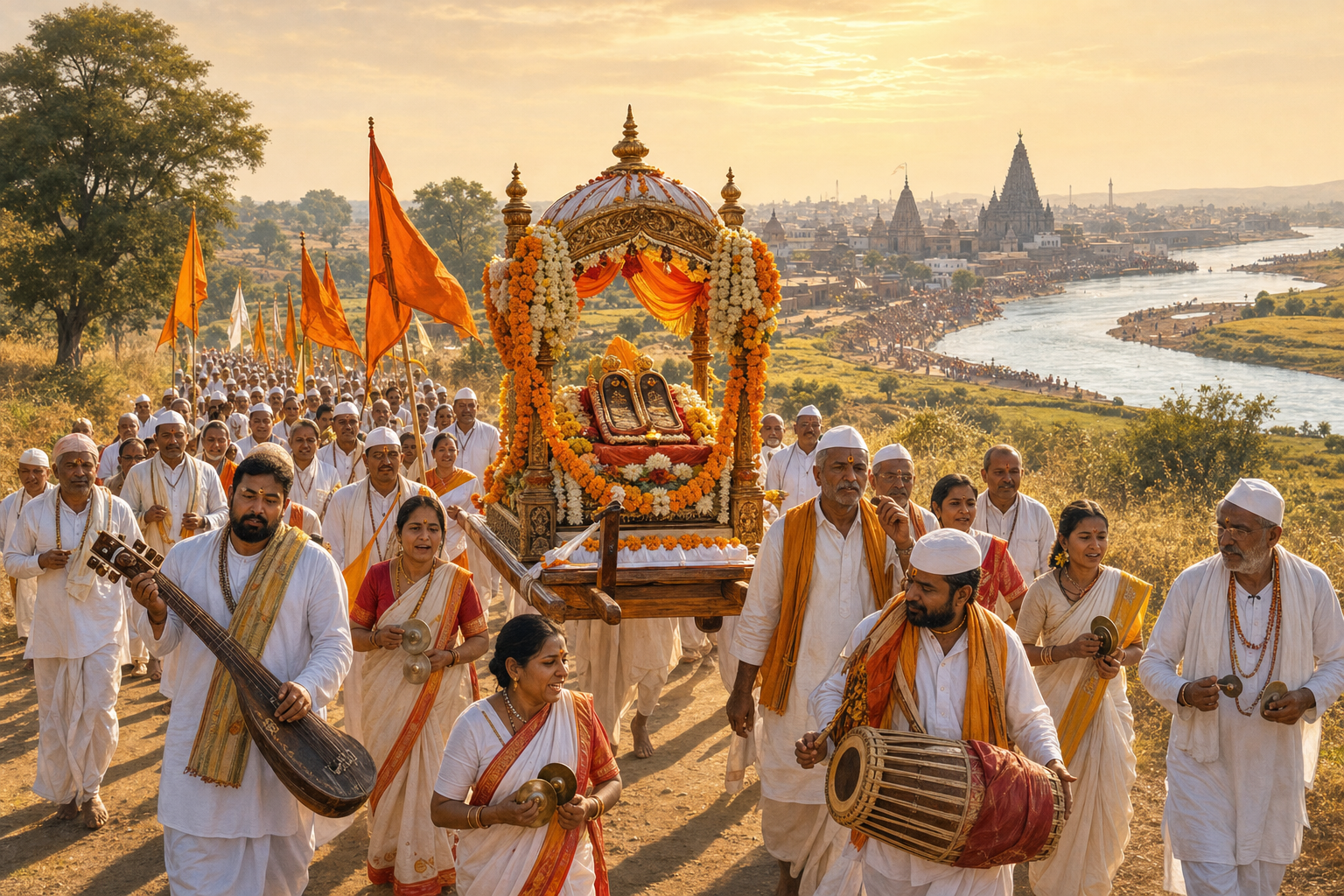
Sant Purandara Dasa Palkhi Sohala 2026 stands at the meeting point of two major devotional currents in India: the Haridasa tradition of Karnataka and the Warkari sampradaya of Maharashtra. The procession is not merely an event connected with a saint, a palanquin, or a calendar date. It is a living expression of bhakti, music, pilgrimage, public discipline, and regional cultural unity around Lord Vitthala, also revered as Vithoba or Panduranga at Pandharpur.
Purandara Dasa is remembered as one of the great saint-composers of the Haridasa movement and as a foundational figure in Carnatic music. His devotional songs, usually associated with the ankitanama “Purandara Vittala,” made philosophical ideas accessible through Kannada, melody, rhythm, and moral reflection. When his memory is carried into the Pandharpur Ashadhi Ekadashi Wari, the result is a powerful cultural bridge between Karnataka’s Haridasa heritage and Maharashtra’s Varkari pilgrimage tradition.
In 2026, Ashadhi Ekadashi, also known as Devshayani Ekadashi or Shayani Ekadashi, falls in late July according to widely used Hindu calendar listings, with July 25, 2026 noted in several panchang references. Local temple committees, Wari organizers, and regional panchangs should still be consulted for the final Palkhi Sohala schedule, route, halts, darshan arrangements, and seva timings. This is especially important because tithi observance can vary by location, sunrise calculation, and institutional custom.
The spiritual geography of this event begins with Pandharpur, the sacred town on the banks of the Bhima River, also called Chandrabhaga because of its crescent-like curve near the pilgrimage centre. Pandharpur’s Lord Vithoba temple is central to the Warkari sampradaya, whose devotees walk in disciplined groups called dindis while singing abhangas, carrying flags, performing kirtan, and approaching the deity through humility, equality, and collective remembrance. The Palkhi tradition, in which sacred padukas or symbols of saints are carried in procession, turns movement itself into worship.
Purandara Dasa’s presence in this devotional landscape is historically and theologically meaningful. Though he is most strongly associated with Karnataka, Kannada devotional literature, Dvaita Vedanta, and Carnatic music pedagogy, his chosen form of devotion was directed toward Vittala. The name “Purandara Vittala” itself places his poetry in intimate relation with the same divine form that draws Warkaris to Pandharpur. Thus, the Purandara Dasa Palkhi does not appear as an external addition to the Wari. It appears as a recognition of an already shared devotional centre.
The Haridasa tradition emphasized devotion expressed through song, ethical reform, and accessible teaching. Purandara Dasa is traditionally described as Srinivasa Nayaka before his transformation into a saintly composer. His life story, especially the movement from wealth and attachment toward devotion and service, has remained an instructive narrative across generations. The deeper message is not anti-worldly withdrawal for its own sake, but a reordering of life around dharma, compassion, humility, and remembrance of the divine.
His contribution to Indian music is equally significant. Purandara Dasa is widely honoured as Karnataka Sangeeta Pitamaha, the father or grandsire of Carnatic music, because tradition credits him with organizing graded lessons such as sarali varisai, jantai varisai, alankara, and geetham for beginners. He is also associated with the pedagogical use of Mayamalavagowla as an early scale for training. This makes the Palkhi not only a religious procession but also a moving memorial to the union of music and sadhana.
The Warkari tradition, meanwhile, brings its own devotional grammar. Its great saints include Dnyaneshwar, Tukaram, Namdev, Chokhamela, Janabai, Eknath, and others whose compositions shaped Marathi bhakti. Warkari spirituality gives primacy to remembrance of Vithoba, moral conduct, community participation, simple living, pilgrimage, and the repeated chanting of divine names. The sight of thousands of devotees walking together toward Pandharpur has long represented a social ethic as much as a ritual act: the road becomes a temporary fellowship of shared food, shared song, and shared discipline.
The Purandara Dasa Palkhi Sohala therefore carries a layered significance. It honours a Kannada saint in a Marathi pilgrimage space. It connects Carnatic music with abhang and kirtan. It places Haridasa compositions beside Warkari chanting. It shows how dharmic traditions often travel across linguistic and regional boundaries without losing their distinctiveness. The event demonstrates unity without uniformity, a principle deeply suited to the wider Hindu civilizational experience and to the broader harmony among dharmic paths.
For devotees, the emotional force of a Palkhi is difficult to reduce to logistics. The palanquin is a symbol of saintly presence. The walking body becomes an instrument of prayer. The repeated name of Vithoba slowly changes the rhythm of the mind. The dust of the road, the sound of cymbals, the discipline of the dindi, and the hospitality of villages along the route together create an experience in which scholarship, memory, and devotion become visible in public life.
From an academic perspective, the Palkhi tradition is also a study in community organization. A Wari is not an unstructured gathering. Dindis often maintain internal discipline, assigned positions, flags, musical groups, food arrangements, rest halts, and collective codes of conduct. Pilgrims may come from different castes, occupations, regions, and economic backgrounds, yet the shared identity of being a devotee of Vithoba temporarily becomes the central social marker. This is one of the reasons the Wari has attracted attention from scholars of religion, anthropology, music, and public culture.
Purandara Dasa’s teachings fit naturally into this ethos. His songs frequently used everyday examples to teach moral clarity, detachment, devotion, and social reflection. He did not reserve spiritual insight for scholastic elites. He used accessible language and memorable melodies to carry bhakti into ordinary households. In that sense, his work resembles the Warkari emphasis on making divine remembrance available to farmers, traders, artisans, women, mendicants, scholars, and householders alike.
The 2026 Purandara Dasa Palkhi can be understood as a continuation of this public pedagogy. A procession teaches by participation. It does not depend only on lectures or texts. Children learn by watching elders walk barefoot or with restraint. Musicians learn by singing in groups rather than in isolation. Householders learn seva by offering water, food, shelter, medical help, or simple respectful attention. The pilgrimage becomes a social classroom where dharma is enacted rather than merely defined.
The relationship between Karnataka and Pandharpur is not incidental. Devotion to Vittala has circulated across the Deccan through language, trade, music, saint poetry, and pilgrimage. Kannada and Marathi traditions have both shaped the memory of Panduranga. The very devotional name “Vittala” travels comfortably through bhajans, abhangas, devaranamas, temple liturgy, and classical performance. The Purandara Dasa Palkhi highlights this shared sacred vocabulary and reminds devotees that regional identity can strengthen, rather than weaken, dharmic unity.
There is also an important musical dimension. Purandara Dasa’s compositions are not museum objects. They continue to be sung in Carnatic concerts, temple gatherings, bhajan mandalis, homes, and educational settings. When his memory enters the Wari, the saint is not remembered only as a historical composer but as a living voice in the devotional soundscape. His songs make technical music devotional, and the Wari makes devotional sound collective.
For those preparing to observe or participate in the 2026 Sohala, the first practical step is to confirm the official route and schedule from the relevant Palkhi organizers or local temple authorities. Devotees should verify dates, reporting points, expected halts, accommodation availability, medical support, food arrangements, and any local government advisories. Since Ashadhi Ekadashi attracts large numbers of pilgrims to Pandharpur, careful preparation is an act of respect for both personal safety and collective order.
Participation also requires an ethical orientation. The Wari is traditionally associated with simplicity, restraint, devotion, and seva. Pilgrims are expected to respect fellow devotees, avoid waste, maintain cleanliness, cooperate with dindi leaders, and preserve the sanctity of public spaces. The best preparation is not only physical stamina but also mental steadiness: the ability to walk with patience, accept inconvenience, and treat the journey itself as worship.
Those who cannot physically join the procession can still observe the occasion meaningfully. They may study the life of Purandara Dasa, sing devaranamas, listen to Warkari abhangas, perform nama japa, read about the Haridasa and Warkari traditions, support pilgrims through seva, or visit a local Vithoba, Krishna, Vishnu, or Rama temple. The deeper principle is not distance covered by the feet alone, but the movement of the mind toward humility, devotion, and unity.
The Palkhi also has contemporary relevance. In a time when communities often experience cultural fragmentation, the Purandara Dasa Palkhi offers a model of rooted pluralism. It does not erase difference between Kannada and Marathi, Haridasa and Warkari, classical and folk, temple and road, scholarship and emotion. Instead, it places these forms in a shared devotional orbit around Vithoba. This is precisely the kind of cultural synthesis that keeps dharmic traditions resilient.
The unity expressed here can also be extended to the wider family of dharmic traditions, including Hinduism, Buddhism, Jainism, and Sikhism. Each has its own doctrines, disciplines, scriptures, and historical experiences, yet all have contributed to the civilizational value of sadhana, ethical self-cultivation, compassion, restraint, service, and liberation-oriented life. A pilgrimage such as the Purandara Dasa Palkhi is specifically Vaishnava and Hindu in form, but its public message of humility, disciplined community, and reverence for saints resonates across the dharmic world.
As Sant Purandara Dasa Palkhi Sohala 2026 approaches, its importance lies not only in the date of Ashadhi Ekadashi or the physical arrival at Pandharpur. Its lasting value lies in what it reveals: that music can become theology, walking can become meditation, regional devotion can become national cultural heritage, and the memory of a saint can continue to guide living communities. The procession is best understood as a moving archive of bhakti, carrying Purandara Dasa’s devotion to Vittala into the shared heart of the Wari.
Inspired by this post on Hindu Pad.





Leave a Reply
You must be logged in to post a comment.