
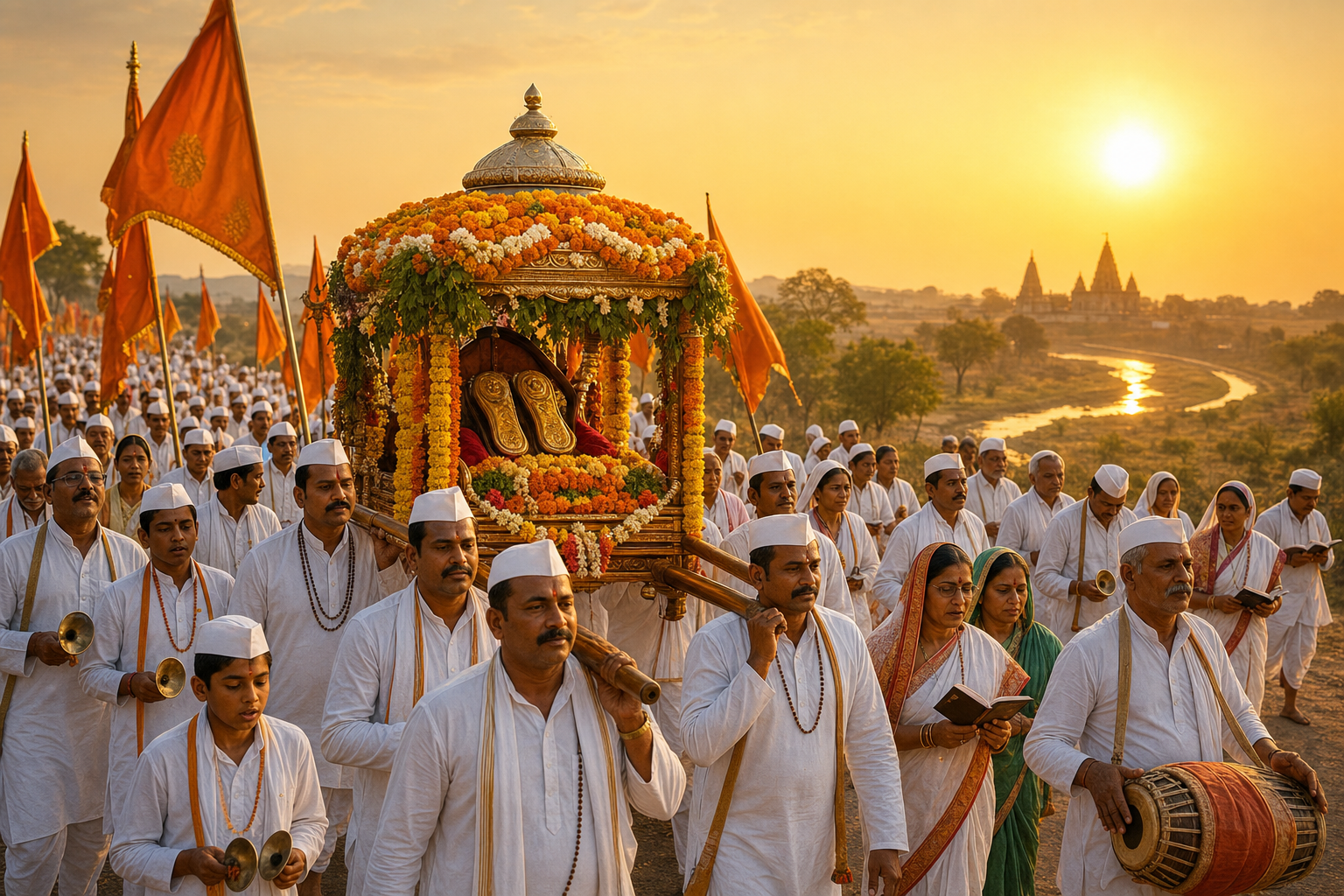
The Sant Jaganade Maharaj Palkhi Sohala 2026 belongs to the living devotional geography of Maharashtra, where memory, movement, music, and collective discipline come together in the Warkari tradition. Centered on the revered Sant Santaji Jagnade Maharaj, also written as Sant Jaganade Maharaj in popular usage, this pilgrimage is not merely a procession; it is a public expression of bhakti, community ethics, and the enduring relationship between a saint, his guru-parampara, and Vitthal of Pandharpur.
In the language of devotees, the emotion of the Palkhi is often captured through the salutation Jai Hari Mauli. That expression is simple, but its devotional reach is deep. It reflects the Warkari habit of seeing the divine, the saint, and the fellow pilgrim through the affectionate idea of Mauli, the compassionate motherly presence. The Sant Jaganade Maharaj Palkhi 2026 therefore needs to be understood as both a sacred journey and a social tradition that trains participants in humility, seva, restraint, equality, and remembrance.
Santaji Jagnade Maharaj occupies a significant place in the bhakti heritage of Maharashtra because of his association with Sant Tukaram Maharaj and the preservation of devotional literature. He is remembered in Warkari memory as a close companion and devoted follower of Sant Tukaram, and tradition credits him with helping preserve the abhangas that became central to Marathi devotional culture. This association gives the Palkhi its special character: it is a journey that honors not only a saint, but also the sacred act of safeguarding wisdom for future generations.
The Palkhi Sohala follows the wider pattern of the Pandharpur Wari, the foot-pilgrimage in which Warkaris travel toward Pandharpur to seek the darshan of Lord Vithoba and Rakhumai. In this tradition, the palanquin represents the presence and blessings of the saint whose padukas or symbolic memory are carried with reverence. The path becomes a moving temple, and the road itself becomes a classroom of dharma, where devotion is learned through walking, singing, serving, and sharing.
The 2026 observance is connected with the sacred rhythm of Ashadhi Wari and Ashadhi Ekadashi, also known as Devshayani Ekadashi or Shayani Ekadashi. In Maharashtra, this period draws countless devotees toward Pandharpur, the principal center of Vithoba worship on the banks of the Chandrabhaga River. The Sant Jaganade Maharaj Palkhi participates in this broader sacred movement by carrying forward a lineage of devotion that is rooted in remembrance, discipline, and collective spiritual aspiration.
From an academic perspective, the strength of the Warkari movement lies in its ability to combine personal devotion with public ethics. The Warkari does not approach bhakti as an isolated interior emotion alone. Devotion is expressed through conduct: walking with others, keeping vows, respecting food, maintaining simplicity, singing abhangas, avoiding arrogance, and recognizing the dignity of every participant. The Sant Jaganade Maharaj Palkhi 2026 continues this civilizational pattern in a form that is visible, disciplined, and emotionally compelling.
Santaji Jagnade Maharaj is especially important because his life points to the relationship between devotion and documentation. In many spiritual traditions, saints are remembered for miracles, teachings, renunciation, or poetic genius. Santaji’s memory is distinctive because it also emphasizes preservation. The act of writing, remembering, and transmitting abhangas is itself a form of seva. In this sense, his legacy reminds devotees that dharma survives not only through temples and festivals, but also through careful memory, oral tradition, manuscripts, song, and disciplined community transmission.
The Palkhi also highlights the sacred relationship between Sant Tukaram Maharaj and Santaji Jagnade Maharaj. Tukaram’s abhangas reshaped Marathi religious consciousness by bringing direct devotion to Vithoba into the language of ordinary people. Santaji’s remembered role in preserving that devotional wealth shows how bhakti traditions depend on both inspired expression and faithful service. The Sant Jaganade Maharaj Palkhi therefore becomes a journey through the emotional history of guru-bhakti, literary preservation, and community remembrance.
For devotees, the experience of walking in a Palkhi is often transformative because it removes many layers of social distance. People who may otherwise live separate lives walk on the same road, chant the same names, eat simple food, rest in shared spaces, and orient their minds toward the same destination. This is one reason the Warkari tradition has long been admired as a devotional movement with a strong social dimension. The Palkhi does not erase identity; it disciplines identity through humility and shared reverence.
The phrase Payi Wari, or pilgrimage on foot, is central to understanding this practice. Walking is not incidental. It is part of the sadhana. The body bears the rhythm of devotion; the feet measure the distance between ordinary life and sacred intention. In a time when religious observance is often reduced to quick visits, digital images, or festival consumption, the Palkhi preserves a demanding form of embodied spirituality. It asks participants to give time, effort, attention, and patience.
The devotional soundscape of the Palkhi is equally important. Abhangas, tal, mridang, namasmaran, and the repeated invocation of Vithoba create a shared spiritual atmosphere. These are not performances in the modern entertainment sense. They are vehicles of remembrance. Through the sung word, the teachings of saints enter the mind of the community again and again. In the Sant Jaganade Maharaj Palkhi 2026, this musical and poetic inheritance remains one of the most powerful ways in which the saint’s memory is kept alive.
Pandharpur itself gives the journey its theological center. Vithoba, standing on the brick with hands on hips, has become one of the most beloved forms of Vishnu-Krishna in western India. The deity’s form is approachable, intimate, and connected with the stories of Pundalik, Rakhumai, and the saint-poets of Maharashtra. The Palkhi’s movement toward Pandharpur is therefore not only geographic; it is devotional movement toward a form of the divine associated with patience, accessibility, and loving presence.
The Sant Jaganade Maharaj Palkhi 2026 also deserves attention as part of Maharashtra’s wider saint tradition, which includes Sant Dnyaneshwar, Sant Tukaram, Sant Namdev, Sant Chokhamela, Sant Savata Mali, Sant Kanhopatra, Sant Eknath, and many others. These saints came from different social locations, yet their teachings converged around devotion, ethical conduct, remembrance of God, and the dignity of the bhakta. This makes the Warkari tradition a vital example of unity within Sanatana Dharma and a bridge across diverse communities.
Such unity has wider relevance for dharmic traditions as a whole. Hinduism, Buddhism, Jainism, and Sikhism all preserve distinct spiritual paths, yet they also share respect for discipline, ethical self-cultivation, compassion, pilgrimage, memory, and the transformative power of community practice. The Sant Jaganade Maharaj Palkhi stands within a Hindu Vaishnava-bhakti framework, but its values of humility, seva, truthfulness, non-arrogance, and collective spiritual effort resonate across the broader dharmic landscape.
In the modern context, the Palkhi is also a study in community organization. Large pilgrimages require coordination, route discipline, food distribution, sanitation, medical support, crowd management, and cooperation between devotees, local communities, and public authorities. The fact that such traditions continue year after year shows the depth of voluntary participation and inherited social knowledge. The Sant Jaganade Maharaj Palkhi 2026 will likely continue this model of devotional organization, where faith is supported by careful collective responsibility.
For those who cannot physically join the Palkhi, the event still offers meaningful lessons. It invites reflection on how sacred memory is preserved, how communities remain connected to saints, and how discipline can be practiced in daily life. One may not walk all the way to Pandharpur, yet the inner principles of Wari can still be practiced through namasmaran, reading abhangas, serving others, honoring food, avoiding harsh speech, and remembering that spiritual life matures through consistency rather than display.
A careful understanding of the Sant Jaganade Maharaj Palkhi 2026 should also avoid reducing it to a cultural spectacle. The colors, music, flags, and crowds are visually striking, but the deeper significance lies in the spiritual discipline that supports them. The Warkari tradition is not merely a festival crowd moving across Maharashtra. It is a sustained devotional institution formed by vows, songs, saintly memory, and a shared moral vocabulary centered on Vitthal bhakti.
The academic importance of this tradition is equally notable. The Palkhi preserves oral literature, regional identity, pilgrimage networks, collective ritual, and vernacular theology. It demonstrates how a religious movement can carry philosophical ideas through simple but powerful practices. Concepts such as surrender, equality before God, guru-bhakti, seva, and remembrance do not remain abstract doctrines; they are enacted in the dust of the road, in the discipline of walking, and in the shared voice of abhangas.
The emotional appeal of the Sant Jaganade Maharaj Palkhi comes from its ability to connect the individual to a much larger history. A devotee walking in 2026 does not walk alone. The journey is accompanied by memories of saints, earlier generations of Warkaris, family vows, village participation, and the continuing call of Pandharpur. This layered memory gives the pilgrimage its depth. It is at once personal, communal, historical, and theological.
The Palkhi also offers a corrective to fragmented modern living. Contemporary life often encourages speed, individual preference, and constant distraction. The Wari moves in the opposite direction: it values rhythm, repetition, shared discipline, and surrender to a sacred timetable. In that sense, the Sant Jaganade Maharaj Palkhi 2026 is not only a continuation of the past; it is also a meaningful response to modern restlessness.
Devotees planning to participate in the Sant Jaganade Maharaj Palkhi Sohala 2026 should follow official local announcements for exact dates, halts, route details, and practical instructions. Since Palkhi schedules are tied to the lunar calendar, Ashadhi Wari arrangements, local administration, and community-level coordination, day-by-day information should be verified close to the event through trusted organizers and local notices. This approach respects both devotional enthusiasm and practical responsibility.
Ultimately, the Sant Jaganade Maharaj Palkhi 2026 is a powerful reminder that a saint’s legacy is not confined to biography. It lives when people walk, sing, remember, serve, and transmit wisdom with care. Santaji Jagnade Maharaj’s association with Sant Tukaram Maharaj and the preservation of abhangas gives this Palkhi a special intellectual and devotional dignity. The journey to Pandharpur becomes a journey into memory, humility, and the living unity of dharmic tradition.
Inspired by this post on Hindu Pad.




Leave a Reply
You must be logged in to post a comment.