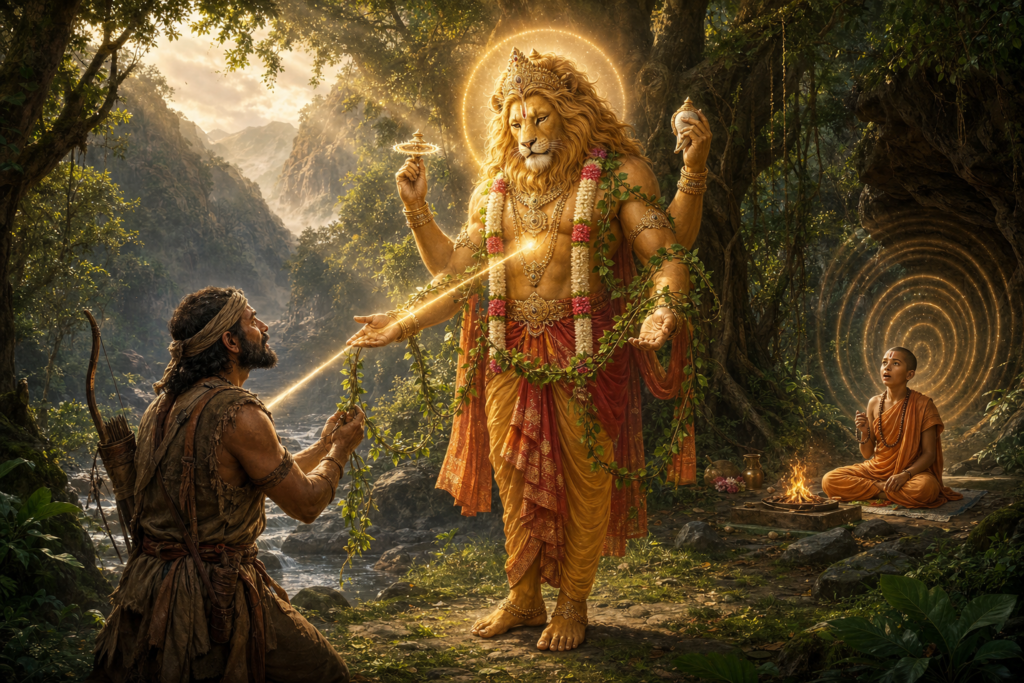
The legend of Mani and Malla endures in Hindu folklore as a profound meditation on pride, surrender, and grace. Often linked with the Maharashtra tradition of Khandobaan aspect of Lord Shiva revered at Jejurithis narrative situates the struggle between asuras and divinity within the broader theme of dharma prevailing over adharma.
Mani and Malla were brothers who attained formidable power through intense penance. Their spiritual attainment, however, soon turned to arrogance. Empowered but unanchored, they gathered armies of asuras and disturbed sages, communities, and the natural order. The episode frames a classic ethical conflict: when strength loses humility, it ceases to serve dharma and begins to erode it.
In response to the growing imbalance, Lord Shiva is described as manifesting in a fierce, protective form (venerated regionally as Khandoba or Martanda Bhairava). The ensuing battle is depicted as both cosmic and intimate: cosmic in its moral stakes, intimate in its consequences for everyday life. In most retellings, Malla is vanquished in combat, symbolizing the fall of unrepentant hubris. The event is commemorated in Maharashtra during Champa Shashthi, when devotees recall the victory of righteousness with devotion and communal solidarity.
The narrative’s most striking turn comes with Mani. Confronted by the undeniable force of dharma, he surrenders, acknowledges his errors, and seeks refuge. Lord Shiva’s response foregrounds a spiritual principle shared across dharmic traditions: the possibility of inner transformation through humility. Granted grace, Mani is remembered not only for his past defiance but for his repentancea reminder that surrender to truth restores balance more lastingly than force alone.
Ethically, the story illustrates that penance without humility culminates in pride, while surrender to dharma opens the path to renewal. Power aligned with compassion protects; power aligned with ego destroys. The legend thus becomes a living teaching on how discernment, courage, and mercy together safeguard the moral fabric of society.
Viewed through a dharmic unity lens, the Mani–Malla episode resonates beyond sectarian boundaries. Hindu tellings emphasize Shiva’s protective compassion; Buddhist reflections might underscore the transformative power of insight over aggression; Jain perspectives echo the primacy of self-restraint; Sikh teachings highlight righteous strength guided by humility. Across these traditions, a shared ethic emerges: confront injustice firmly, yet cultivate the compassion that makes reconciliation possible.
Culturally, the story continues to shape practice and memory. At Jejuri, the vibrant bhandara of turmeric during Champa Shashthi visually evokes divine protection and auspicious renewal. Families narrate the tale to younger generations, embedding ethical reflection within celebration. In this way, ritual, place, and story interweave to anchor communal resilience.
Today, the Mani and Malla legend invites reflection on leadership, responsibility, and the wise use of strength. It urges communities to stand against disorder with clarity, and to receive sincere repentance with generosity. In affirming the triumph of dharmaand the redemptive power of compassionthe tale offers a unifying message that harmonizes with the deepest values of Hinduism, Buddhism, Jainism, and Sikhism.
Inspired by this post on Hindu Pad.