
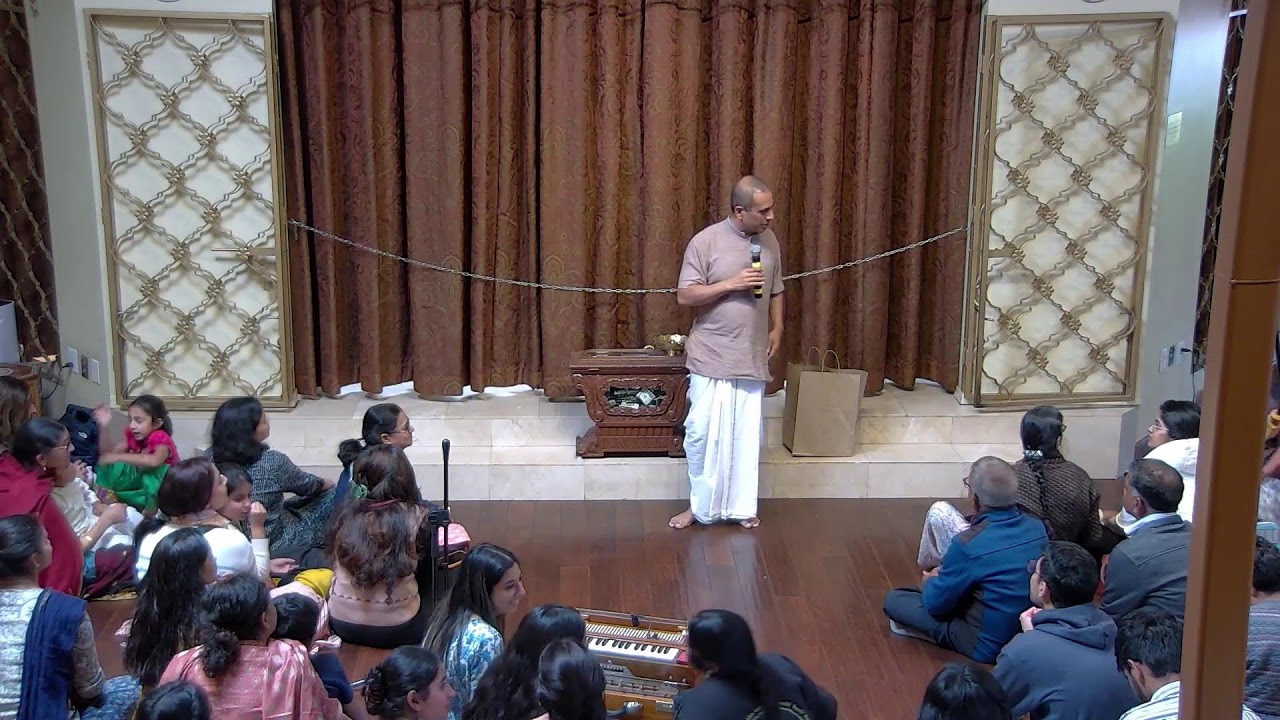
On 26 April 2026, ISKCON of Silicon Valley (ISV) hosted Krishna Katha with H.G. Vaisesika Dasa, focusing on the time-honored Vaishnava disciplines of hearing (sravana) and chanting (kirtana) about Sri Krishna’s name, instruction, and pastimes. Within the Bhakti Tradition, these sonic practices are regarded as the principal means of devotional service and inner renewal, uniting rigorous scriptural understanding with lived, meditative experience.
Krishna Katha denotes a structured exposition of sacred narrative and doctrine, often centered on the Bhagavad Gita and Srimad Bhagavatham (Bhagavata Purana). Historically cultivated in Gaudiya Vaishnavism and invigorated by the sankirtana movement, such discourse integrates theology, aesthetics, and ethics, translating timeless principles into contemporary life.
The scriptural locus classicus for devotional methodology enumerates nine interlinked practices, beginning with hearing and chanting. By foregrounding these two, practitioners internalize meaning through attentive listening and reinforce it through rhythmic vocalization, allowing affective states such as gratitude, humility, and compassion to stabilize as enduring traits rather than transient moods.
In practical terms, chanting may take the form of kirtan (collective singing) or japa (individual, bead-counted mantra recitation). Japa commonly employs a mala of 108 beads to support steady cadence and concentration, while kirtan’s call-and-response structure cultivates synchrony, shared intention, and a palpable sense of community. Clear articulation, paced breathing, and mindful posture enhance both audibility and absorption.
Contemporary research on contemplative sound practices aligns with these traditional insights. Mantra repetition lengthens exhalation and can improve vagal tone; group singing has been associated with enhanced social bonding; and sustained, meaningful vocalization correlates with decreased stress markers and more coherent heart-rate variability. Neuroimaging studies further suggest reduced default-mode network activity and improved attentional control during disciplined recitation, outcomes consistent with long-term cognitive resilience.
H.G. Vaisesika Dasa is widely recognized within ISKCON (International Society For Krishna Consciousness) for presenting accessible, stepwise frameworks that link daily sadhana with careful study and service-oriented action. His Krishna Katha typically weaves close readings from the Bhagavad Gita and Srimad Bhagavatham with practical guidance, enabling participants to translate philosophical clarity into repeatable habits that support steady progress.
From a philosophical perspective, Gaudiya Vaishnavism’s achintya-bhedabheda articulates a nuanced relationship between the Divine and the individual self, a stance that imbues sound with sacred significance. In this view, devotionally invoked names of Krishna are not merely referential signs but spiritually potent, making attentive hearing and chanting both epistemic disciplines and transformative practices.
While Krishna Katha is grounded in Hindu dharma, its core modalities resonate across kindred dharmic traditions. Sikh kirtan and Naam Simran, Buddhist mantra recitation in schools ranging from Tibetan to Far Eastern lineages, and the Jain Namokar Mantra with its emphasis on ethical purification all employ focused sound, ethical intent, and mindful attention. These convergences illuminate a shared civilizational ethos of inner cultivation, non-harm, discipline, and compassion, affirming unity in spiritual diversity without erasing distinctive theologies.
In diaspora contexts such as Silicon Valley, these practices offer stabilizing routines amidst high cognitive demands. Regular hearing and chanting can anchor attention, soften reactivity, and renew purpose, while collective singing fosters belonging and intercultural understanding. The result is a form of spiritual resilience that benefits both individual well-being and community cohesion.
Methodologically, effective engagement with Krishna Katha balances three pillars: study, practice, and reflection. Study provides conceptual scaffolding through texts like the Bhagavad Gita and Srimad Bhagavatham; practice consolidates understanding via kirtan and japa; and reflection translates insights into daily conduct through gratitude, seva, and conscientious speech. Even modest, consistent investment in these pillars can yield disproportionate gains in clarity and equanimity.
Ethically, devotional sound is framed by virtues such as ahimsa, truthfulness, humility, and service. This ethical container is not ancillary; it conditions the psychological effects of chanting by aligning intention, behavior, and attention. Over time, such alignment strengthens character, making spiritual progress measurable not only by interior states but also by reliable, compassionate action.
Viewed through this lens, the 26 April 2026 Krishna Katha at ISV exemplifies a living tradition that is intellectually rigorous, emotionally intelligent, and communally unifying. By prioritizing hearing and chanting about Krishna within a broad dharmic horizon, the discourse demonstrates how ancient practices can meet contemporary needs while honoring the plural pathways of Hinduism, Buddhism, Jainism, and Sikhism.
Inspired by this post on Dandavats.
