
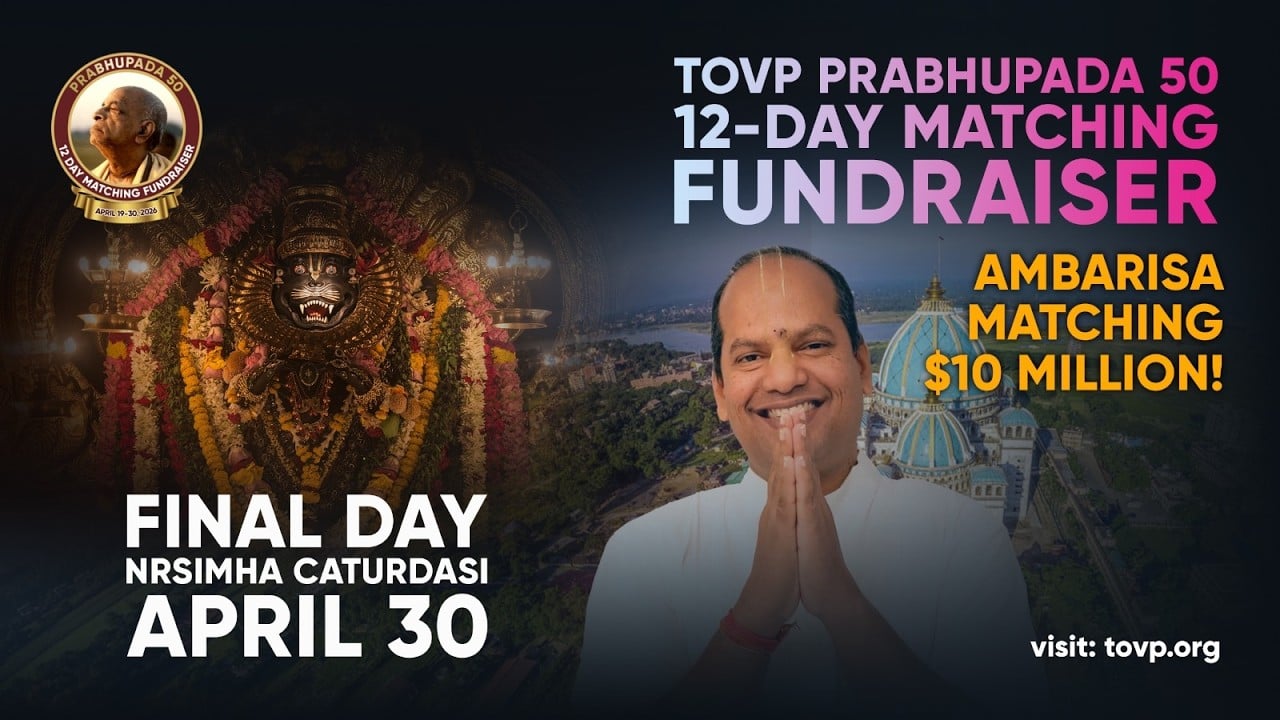
The Temple of the Vedic Planetarium in Mayapur has marked a reflective 12-day observance concluding on Nrsimha Caturdasi, April 30, to align community focus on the forthcoming Prabhupada 50 milestone. The initiative orients attention toward the planned opening on November 1, 2027, the 50th Disappearance Anniversary of Srila Prabhupada, followed by a three-month sequence of ceremonial transitions as the beloved Mayapur Deities are relocated into their new palace home.
Framing the opening around Srila Prabhupada’s Disappearance Anniversary establishes a historically and spiritually coherent arc for the global Gaudiya Vaishnava community. It underscores a continuity of purpose: to present Vedic wisdom with intellectual clarity, aesthetic excellence, and devotional depth. In this way, the observance serves as both remembrance and resolve, situating the project within a living bhakti tradition that is at once rigorous, inclusive, and future-facing.
The Temple of the Vedic Planetarium integrates a grand temple complex with a world-class planetarium, conceived to present Vedic cosmology as described in classical texts such as the Srimad-Bhagavatam. A signature feature, often termed the cosmic chandelier, is planned to render a multidimensional representation of the Vedic universe, inviting visitors to contemplate the relationship between metaphysical maps and lived spiritual practice. Surrounding interpretive galleries, immersive theaters, and educational installations are designed to support sustained learning rather than momentary spectacle.
In the Vedic cosmographic conception, Bhu-mandala, Mount Meru, and the gradation of lokas form a symbolic architecture of reality that is simultaneously cosmological and ethical. Presented responsibly, this framework can foster dialogue with contemporary astronomy and the philosophy of science, prompting questions about models, meaning, and the diverse ways civilizations encode knowledge. The planetarium’s curatorial ethos, by articulating correspondences and distinctions without conflation, promises an intellectually honest exchange between traditional insights and modern inquiry.
Architecturally, the complex synthesizes devotional functionality with durable, large-span construction suited to a significant congregational space and an advanced exhibition program. The spatial planning prioritizes ritual circulation, sightlines to the Deity forms, and acoustics that support kirtan and scriptural recitation, while also accommodating education, research, and cultural programming. Craft traditions from across India find expression in stone, metal, and woodwork, preserving artisanal lineages and showcasing the living continuum of temple workmanship.
The forthcoming three-month ceremonial period after November 1, 2027 is expected to proceed through carefully sequenced rites of relocation and installation. In Mayapur, the Deities traditionally revered as Sri Sri Radha Madhava, Sri Pancha Tattva, and Lord Narasimha will be transferred following established protocols of worship continuity, including daily seva-puja, mantra-samskara, and community participation. Such transitions are planned to sustain unbroken worship while educating visitors about the theological and ritual grammar that governs temple life.
Nrsimha Caturdasi, widely observed as Narasimha Jayanti on the Vaishakha Shukla Chaturdashi, commemorates the avatara of Lord Narasimha and is honored for its resonance with protection, courage, and dharmic restoration. Concluding the 12-day observance on this date conveys a deliberate symbolism: the project advances under the auspices of divine guardianship, while devotees reflect on the ethical imperative that devotion and duty travel together. In the Mayapur context, the day carries added intimacy due to longstanding worship of Lord Narasimha.
Beyond sectarian boundaries, the TOVP’s interpretive approach speaks to a broader dharmic family. Buddhist cosmologies discuss Mount Sumeru and layered realms that invite meaningful comparison with Vedic mappings; Jain cosmography describes Jambudvipa and cosmic structures that parallel thematic concerns; Sikh heritage centers community around sacred sound and service, resonating with the devotional culture of kirtan and seva. By foregrounding shared civilizational motifs while respecting doctrinal distinctions, the project nurtures unity among Hindu, Buddhist, Jain, and Sikh traditions.
From a cultural heritage perspective, the TOVP promises tangible and intangible benefits. It strengthens a pilgrimage corridor, creates livelihoods through arts and services, and motivates preservation of classical music, dance, ritual, and craftsmanship. Educationally, it invites students, researchers, and families to engage primary sources, curated exhibits, and guided learning in an environment that normalizes serious study alongside lived devotion. Diaspora communities, connected through digital broadcasts and periodic travel, gain an anchor for transmission of values across generations.
For many visitors, the temple’s emerging silhouette over Mayapur’s horizon evokes a felt continuity between ancient sacred geography and contemporary engineering. Accounts often note a quiet turning of attention upon entering the kirtan-filled halls, where scholarship and spirituality find a working harmony. The experience illustrates an important social fact: when people encounter their heritage in a setting that respects both intellect and emotion, identity becomes less about opposition and more about contribution.
As the November 1, 2027 opening approaches, the project’s next phases include interior fit-outs, fine-tuning of the cosmic display, exhibit commissioning, and rehearsal of ritual and educational programs to ensure smooth, safe, and meaningful visitor flow. The timeline remains anchored in prudent sequencing of construction, curatorial testing, and regulatory clearances. This methodical approach aims to deliver not only a landmark temple but also a research-informed museum and planetarium capable of standing in dialogue with the world’s great cultural and scientific institutions.
Viewed in total, the Temple of the Vedic Planetarium is less a single structure than a civilizational classroom. By dedicating the project’s momentum to Srila Prabhupada’s legacy and aligning key milestones with sacred observances such as Nrsimha Caturdasi, the undertaking models how devotion, learning, and service can move together. In that spirit, the TOVP invites all who value the dharmic traditions to engage in a shared journey of understanding, unity, and uplift.
Inspired by this post on Dandavats.
