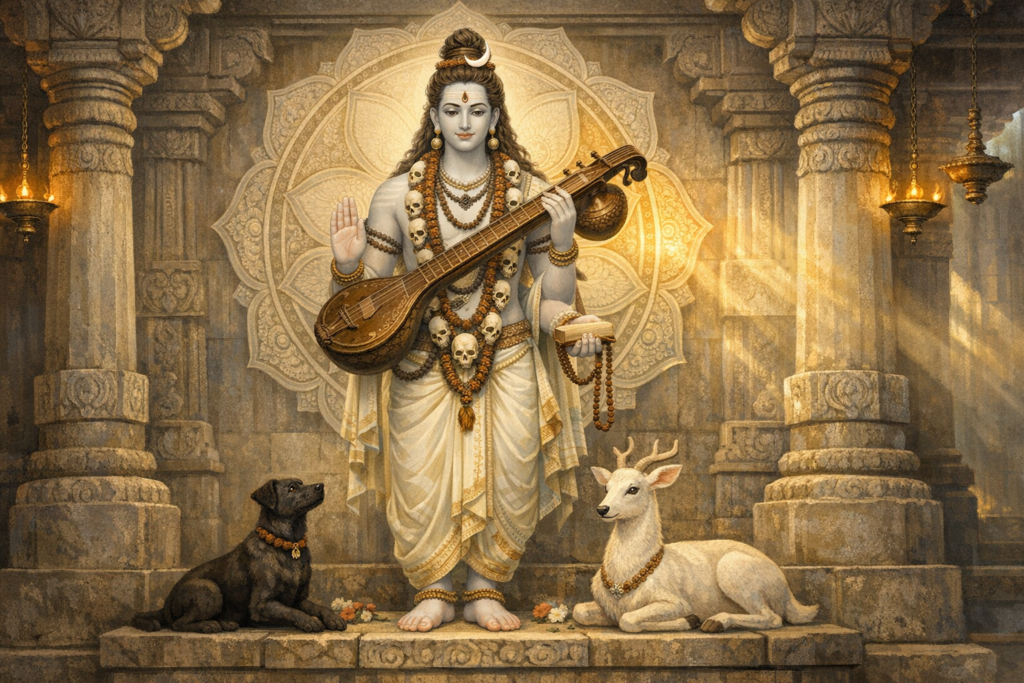
Goddess Kali, a luminous form of the Divine Mother in the Hindu tradition, is often portrayed as fierce yet immeasurably compassionate. In her upper left hand rests the sword (kripana), and in her lower left hand she holds a freshly severed head (chinnamunda). Her right hands commonly display abhaya and varada mudras, signaling protection and the bestowal of grace. Read as a whole, this iconography conveys a powerful teaching: the Divine ends delusion and fear while revealing wisdom, dignity, and inner freedom.
The sword symbolizes the decisive power of discernment (viveka). In the language of spiritual philosophy, it cuts through avidya—ignorance, misperception, and the narratives that bind consciousness. The blade’s edge signifies clarity, precision, and luminous awareness (jnana). Rather than a weapon for harm, it is a tool for insight, severing confusion and setting seekers on a path of truth aligned with dharma.
The severed head (chinnamunda) communicates not cruelty, but transformation. It embodies the surrender of egoic pride, constricting thought-patterns, and the anxieties that obscure the Self. In this reading, Kali does not destroy life; she liberates it from the tyranny of false identifications. Devotees often find that this imagery reframes fear as a passage to freedom—what appears fearsome is in fact merciful and healing.
Her right hands, displaying abhaya (fearlessness) and varada (boon-bestowing), complete the teaching. The gesture of fearlessness fortifies inner courage; the gesture of giving assures compassionate support. Together, these mudras affirm that the removal of ignorance is inseparable from divine care. Many seekers resonate with this balance in daily life: clarity without compassion can be harsh, while kindness without clarity can be enabling. Kali holds both.
In practical terms, the kripana points to the need for disciplined discernment. Cutting through distraction, harmful habits, or unexamined assumptions mirrors the sword’s work in the psyche. Whether examining media, confronting self-doubt, or choosing ethical action, the symbolism invites steady, courageous inquiry. The severed head then represents the release of what no longer serves: fixed roles, rigid self-concepts, and fear-driven reactions.
Read within the broader family of Dharmic traditions, Kali’s sword aligns with a shared ethos of awakening. In Buddhist Vajrayana, comparable imagery of chinnamunda conveys the severing of ignorance; in Jain thought, the overcoming of avidya through jnana and ahiṁsā underscores ethical clarity; in Sikh tradition, the Khanda symbolizes truth cutting through falsehood. These parallels highlight a unifying insight across Hinduism, Buddhism, Jainism, and Sikhism: authentic wisdom liberates, protects, and fosters compassion.
The image of Kali also honors Shakti—the dynamic, protective, and nourishing power of the Sacred Feminine. Her fierce countenance can be understood as a shield for the vulnerable and a mirror of the courage required on the path of realization. Many find emotional solace in this vision: the same power that dismantles falsehood also upholds dignity, community, and shared well-being.
Ritually and contemplatively, the symbolism invites practice. Chanting, contemplative reading of texts such as the Devi Mahatmyam, or quietly meditating on abhaya and varada can orient the mind toward steadiness, clarity, and compassion. Even simple, mindful breathing paired with an intention to “cut through” unhelpful thoughts echoes the kripana’s function, making the symbolism immediately relevant to daily living.
Historically and artistically, representations of Kali across temples, manuscripts, and sculpture preserve these teachings in visual form. The sword, the severed head, and the hand-gestures are not random attributes; they are a coherent theology rendered as sacred art. Studied with care, they illuminate philosophical themes—avidya and jnana, fear and fearlessness, form and transcendence—central to Hindu symbols and to Dharmic heritage more broadly.
Ultimately, Kali’s sword reassures that inner clarity is possible, courage is teachable, and compassion is non-negotiable. By confronting illusion and anchoring in wisdom, individuals and communities alike can embody fearless presence. In this way, a seemingly fierce image becomes a beacon: it severs ignorance, affirms dignity, and awakens the shared dharmic wisdom that unites diverse spiritual paths.
Inspired by this post on Hindu Blog.