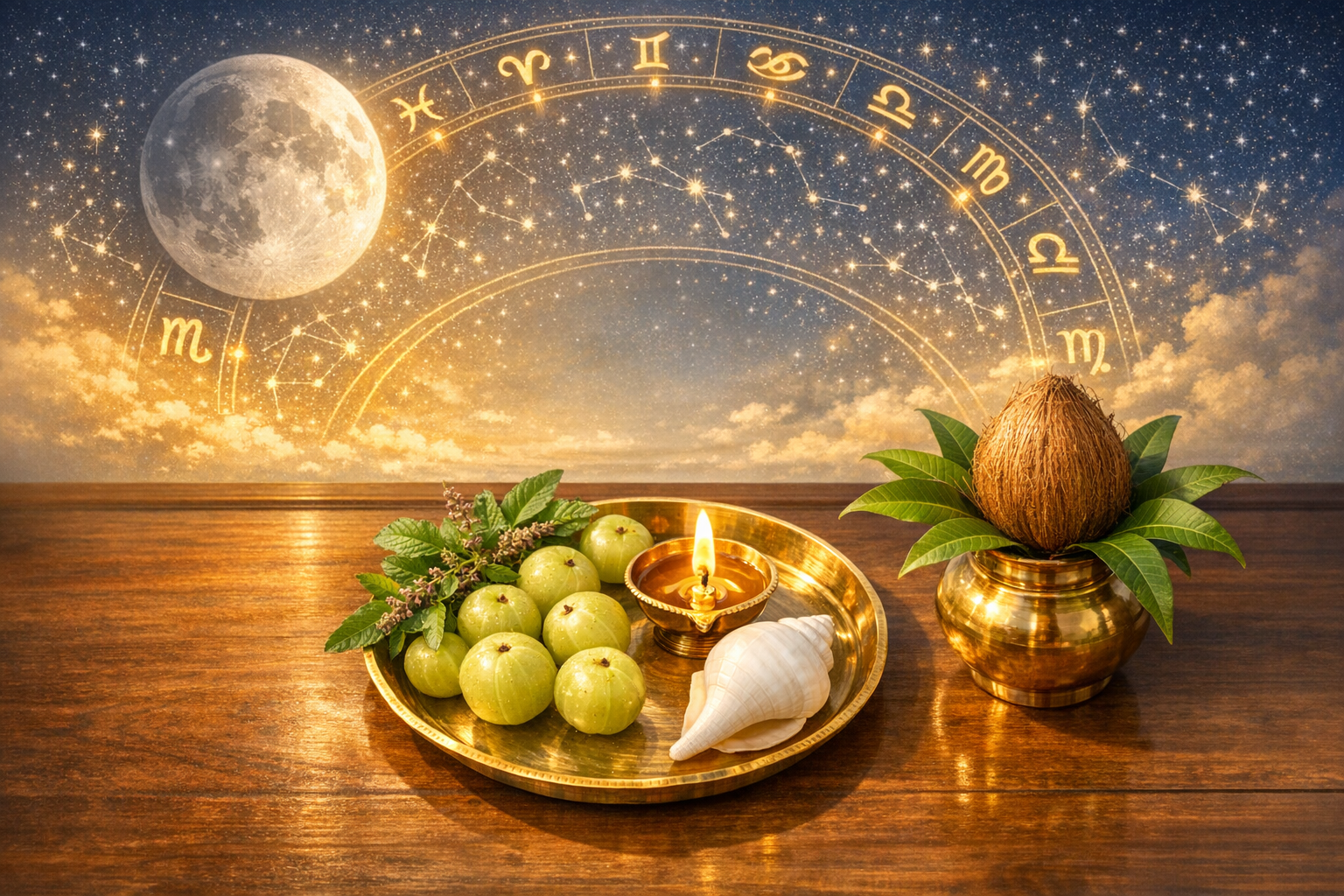
On Friday, February 27, 2026, the Panchang (Hindu calendar) records a transition from Shukla Paksha Dashami tithi to Shukla Paksha Ekadashi tithi at 12:06 AM IST. From this moment onward, most regions in India observe the civil day as Ekadashi, the eleventh lunar day of the waxing phase (Shukla Paksha). This alignment makes the date especially significant for vrata (vow) and worship, with the Ekadashi tithi in effect at sunrisean important criterion for observance across traditions.
This Shukla Paksha Ekadashi coincides, in many regional reckonings, with Phalguna Shukla Ekadashi and is widely known as Amalaki Ekadashi. While month nomenclature may vary between Amanta and Purnimanta systems, the tithi-based observance remains consistent. The day is traditionally dedicated to Sri Vishnu, with āmalakī (Indian gooseberry) and Tulasi offerings symbolizing clarity, vitality, and sattvic restraint.
Within the Hindu calendar, a tithi is a precise astronomical interval defined by the longitudinal separation between the Moon and the Sun. Each tithi spans 12 degrees of this separation, producing 30 tithis in a synodic lunar month. Because the Moon’s apparent motion is variable and the Sun’s is comparatively uniform, tithi changeovers rarely align exactly with civil midnights or sunrises, which is why Panchang entries provide start and end times accurate to the minute.
Panchang compilers determine the tithi using geocentric longitudes (true positions) of the Sun and Moon. The day-of-observance rule then layers a cultural convention over the astronomical computation: the tithi prevailing at local sunrise governs the day’s religious designation. Thus, although Shukla Paksha Dashami ends at 12:06 AM IST on February 27, 2026, the tithi at sunrise is Ekadashi, making the entire civil day the proper time to keep the Ekadashi vrata in most Indian locations.
Time-zone differences and local sunrise variations mean that diaspora communities outside India should verify city-specific Panchang data. While the astronomical tithi boundaries are global, the day of observance aligns with local sunrise. For practitioners across geographies, reliable Panchang calculations (drik/visual astronomy-based) or local temple almanacs are the best guides to confirm Ekadashi and the following day’s Parana window.
Regarding observance traditions, both Smarta and Vaishnava communities emphasize the sunrise criterion. If Ekadashi prevails at sunrise, fasting is observed that day. If Ekadashi begins after sunrise and continues to the next sunrise, Vaishnava practice may observe on the second day (the “Vaishnava Ekadashi”). In 2026, because Shukla Paksha Ekadashi prevails at sunrise on February 27 in most of India, both Smarta and Vaishnava communities generally observe the fast on this date.
Parana, the ritual conclusion of the fast, is performed on Shukla Paksha Dwadashi (the twelfth tithi). Standard guidance recommends breaking the fast after sunrise and after the Hari Vasara period on Dwadashi has elapsed. Given the Ekadashi alignment on February 27, 2026 (IST), Parana will typically fall on the following civil day when Dwadashi is in effect at the practitioner’s location; exact timing should be taken from the local Panchang.
Amalaki Ekadashi symbolism highlights renewal, steadiness, and sattva. The āmalakīrevered in Ayurvedic literature for its rasayana qualitiesembodies purity and resilience. Devotees often offer Tulasi, recite Vishnu Sahasranama or select chapters of the Bhagavad-Gita, and practice dana (charity) with a focus on humility and compassion. These shared actions harmonize internal discipline with outward service, reinforcing the vrata’s integrative aim.
Auspicious periods (good time) on any Ekadashi can be understood through daily muhurta frameworks. Brahma Muhurtaapproximately one hour and thirty-six minutes before local sunriseis valued for meditation, japa, and sankalpa. Abhijit Muhurta, centered on local solar noon (roughly a 48-minute span around midday), is traditionally favorable for commencing sattvic undertakings. The early Pradosh Kaal, around twilight after sunset, nurtures contemplative worship. Practitioners who favor Choghadiya may select Shubh, Labh, or Amrit segments during the day or evening; these windows should be computed for the relevant city.
Nakshatra and Rashi contextualize the Moon’s stellar backdrop and sign placement, offering additional interpretive texture to the day. Panchang listings provide the operative Nakshatra and the Moon’s Rashi for a given date and location. Because these can shift across the day and differ with longitude and latitude, it is prudent to confirm the Moon’s Nakshatra and Rashi for February 27, 2026, using a trusted regional or drik Panchang for precise, city-specific insights into devotional emphasis and mind-body disposition.
Complementary Panchang elementsYoga and Karanaalso enrich the day’s qualitative reading. Yoga (distinct from asana practice) results from specific Sun–Moon relationships and describes the day’s underlying energetic “tone,” while Karana (half-tithi segments) refines the selection of micro-muhurta for rituals. Although Ekadashi itself anchors the day’s dharmic focus, practitioners seeking technical completeness may consult local listings to align puja or sankalpa with favorable Yoga and Karana in their locale.
Home observance on this Ekadashi typically emphasizes simplicity and intentionality. Many households begin the day with snana (purification), light a lamp, offer Tulasi and seasonal fruits, and meditate on Sri Vishnu’s names. Reading or listening to a vrata-katha associated with Amalaki Ekadashi, keeping mindful silence during meals, and dedicating time to seva (service) cultivate steadiness and empathyqualities the lunar rhythm seeks to awaken.
Dietary guidelines during Ekadashi vrata often include phalahara (fruit-based nourishment), milk, nuts, and satvik preparations made without grains and certain legumes. Some practitioners undertake nirjala (water-only) or upavasa with minimal intake, while others adopt a moderated fast aligned with health needs. The dharmic principle of ahimsa and personal well-being remain paramount; those with medical conditions, expectant mothers, and the elderly may adapt the fast in consultation with healthcare professionals and spiritual counsel.
Across dharmic traditions, lunar observances cultivate attentiveness and interiority. While Ekadashi is a hallmark of Hindu vrata, Buddhism’s Uposatha and Jain posadha similarly attune practice to lunar rhythms, emphasizing ethical reflection, restraint, and compassion. Sikh teachings on constant remembrance (nam simran) and seva resonate deeply with the Ekadashi ethos of mindful living and selfless action. Framed together, these pathways reveal a shared civilizational commitment to inner clarity and collective harmony.
For many families, Ekadashi mornings evoke familiar textures of reverence: the fragrance of Tulasi, the cadence of Sanskrit recitation, and the quiet resolve that accompanies a day of measured intake. These impressions become cultural memory, binding generations through the Panchang’s subtle cadence and renewing a sense of belonging that extends beyond geography and lineage.
Practically, those living outside India should confirm February 27, 2026 Ekadashi and the subsequent Dwadashi Parana based on local sunrise and tithi boundaries. Mobile apps and temple calendars that employ accurate astronomical algorithms help synchronize household observance with the sky’s actual motions, honoring both tradition and precision.
In summary, Friday, February 27, 2026 is observed as Shukla Paksha Ekadashi in most regions of India from 12:06 AM IST onward. The day’s vrata, commonly identified as Amalaki Ekadashi in many traditions, encourages sattva, devotion to Sri Vishnu, and compassion through disciplined practice and charity. By aligning intention with tithi, Nakshatra, Rashi, and daily muhurta windows, practitioners integrate technical Panchang knowledge with living spiritualitysustaining the unity and wisdom that dharmic lineages have cultivated for millennia.
Inspired by this post on Hindu Blog.